👨🔬 Rheumatologist in Hospital Nacional Guillermo Almenara Irigoyen - Peru
📌 Interested in Vasculitis, IgG4-RD, SLE
🩻 Head of the Almenara Vasculitis Cohort
#EULAR2026 Recommendations: Vasculitis
-Confirm diagnosis with imaging and biopsy
- Start GC early but with taper plan
- For major flare again confirm dx and restart GC
- Consider IL-6 or UPA
- MTX may be option if biologics not available
@RheumNow
Abstr LB0009
Baricitinib vs TNFi in RA patients enriched for VTE risk. 3,640 patients. 3.7 years median follow-up.
VTE: HR 1.61 (95% CI 0.97–2.66)
non-inferiority not demonstrated
MACE: HR 1.06 no cardiovascular excess
Serious infections: HR 1.32 (p<0.05)
@RheumNow #EULAR2026
POS0990: What drives mortality in AAV today? In this nationwide cohort, excess mortality was mainly driven by infections, kidney disease and vasculitis itself. Infection-related mortality was particularly pronounced during the first year after diagnosis. #EULAR2026
SELECT-GCA extension focused on UPA 15 mg in GCA through 2 years ➡️ From weeks 52–104, continuous UPA benefited both new-onset and relapsing GCA, while switch to placebo was associated with more flares, lower remission and higher cumulative GC exposure. #EULAR2026#vasculitis
Presented at #EULAR2026:
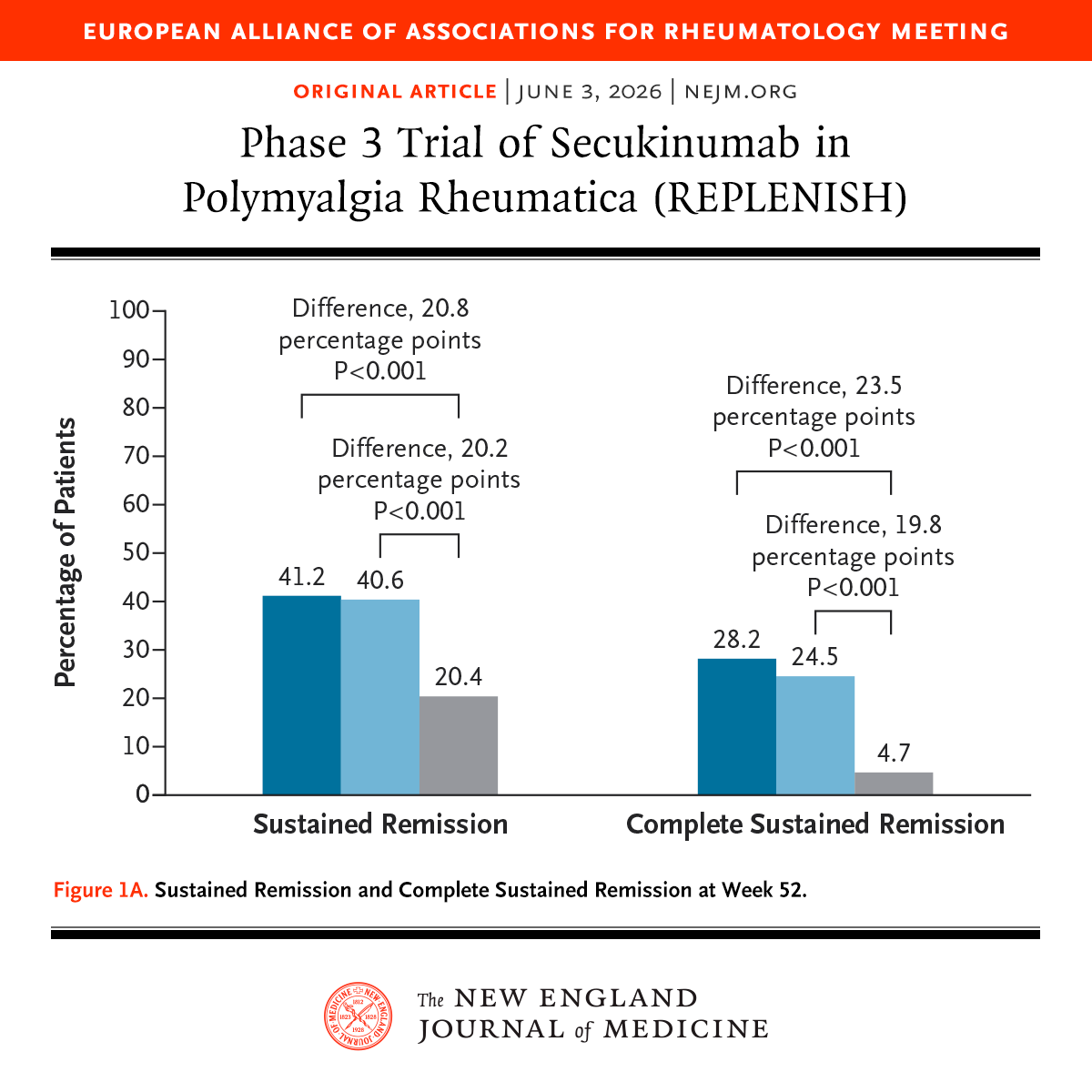
Among patients with relapsed polymyalgia rheumatica, treatment with secukinumab plus a 24-week glucocorticoid taper resulted in a higher percentage of patients with remission than a glucocorticoid taper alone. Full phase 3 REPLENISH trial results: https://t.co/w1oD5ug1kJ
Editorial: Emerging Era for Polymyalgia Rheumatica and GCA — Interleukin-17A Targeting https://t.co/I13JtK01EA
Original Article in @NEJMEvidence: Secukinumab for Giant Cell Arteritis (phase 3 GCAptAIN trial) https://t.co/0dWjwDaEHs
@eular_org
Presented at #EULAR2026:
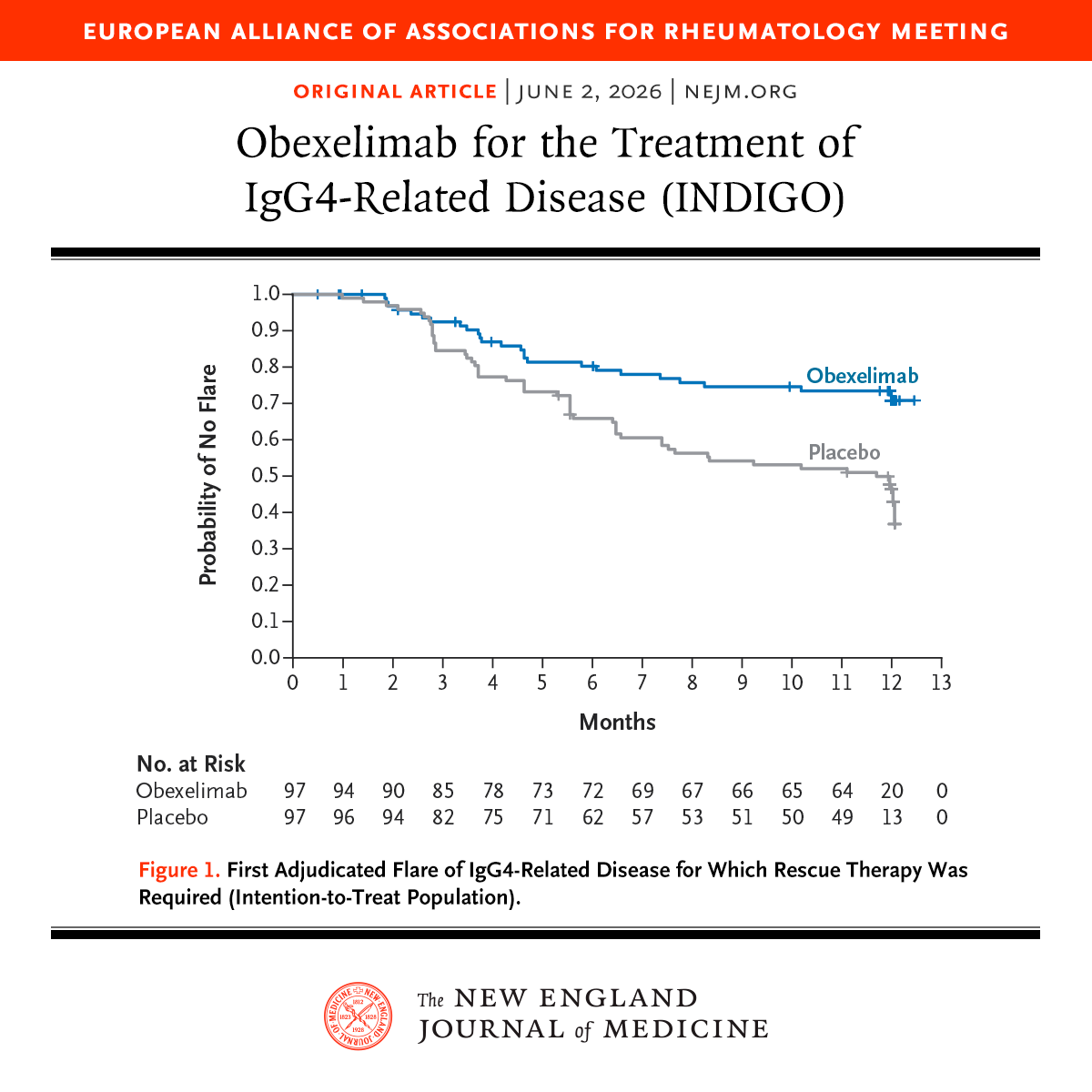
In a phase 3 trial, obexelimab led to a lower risk of disease flares than placebo among patients with IgG4-related disease. Glucocorticoid use was lower and the incidence of remission was higher with obexelimab than with placebo. Full INDIGO trial results: https://t.co/Lynf6nmA9N
Editorial: Obexelimab and the Promise of Nondepleting B-Cell Therapy in IgG4-Related Disease https://t.co/BUQ7r8jVWz
@eular_org
🧬 HA20 is not a single phenotype.
In 17 patients from 6 families with TNFAIP3 variants:
✅ Oral aphthosis: 88%
✅ Recurrent fever: 53%
✅ GI inflammation: 53%
✅ Autoimmunity: 47%
✅ Neuropsychiatric symptoms: 41%
Early onset before age 5 was linked to more neuropsychiatric involvement, while arthritis appeared more often with later onset.
Type 1 IFN signature may help monitor disease activity.
🔓 https://t.co/GSJeBBwGpo
Hispanic children with AAV are more likely to have severe disease and to develop kidney failure than white children, according to a study. https://t.co/br5Jk7rw7Y
A 19-year-old man presented with persistent anterior chest pain. Lab tests showed elevated ESR of 30 mm/h & high-sensitivity CRP level of 11.2 mg/L. HLA-B51, HLA-B27, ANA, ANCA, RF, and anti–CCP antibody tests were all negative. PET-CT scan demonstrated increased FDG uptake at the bilateral costochondral junctions (A)
Clinical images in ACR Open Rheumatology
https://t.co/8DkPCmGUFN
NEW RESEARCH—Prevalence and determinants of sacroiliac joint bone marrow oedema in the general population in Germany: a population-based cross-sectional study https://t.co/4oMMNcaPEw
VEDOSS vs pre-#SystemicSclerosis: boundaries remain blurred.
This scoping review found major variability in how very early diagnosis of systemic sclerosis and pre-SSc are defined.
✅ 40 original articles included
✅ 3 definitions of pre-SSc identified
✅ 13 different applications of VEDOSS criteria
✅ Only 31.3% applied the complete VEDOSS definition
✅ Some studies included patients with visceral or fibrotic complications, challenging the “very early” concept
A consensus definition of pre-SSc is needed to support risk stratification and future preventive trials.
🔓 https://t.co/uhQofaGNv9