4/13
To fix this, we abandon physical weights entirely. Instead, we look at the actual continuous function a neuron computes mapping inputs to outputs.
Think of a function over an entire continuous domain as an infinite-dimensional column vector!
Genuinely what are these terms
> This creates non-convergent, rotational training dynamics ... higher-order optimization techniques like Extra-Gradient methods or Optimistic Mirror Descent ... force local Nash equilibrium convergence ... Sion's theorem ... Dirac saddle point often possesses strictly imaginary eigenvalues
I need to learn sm more math, fun times.
This is so cool (and also daunting).
I was so excited for the next few years, but I suppose I should be expecting breakthroughs at least a couple of times every month :D
hello there the jacobian conjecture is false thanx to my close friend akhil for asking about it and my other close friend fable for working during the world cup final
((1+xy)^3 z + y^2 (1+xy) (4+3xy), y + 3 x (1+xy)^2 z + 3 x y^2 (4+3xy), 2 x - 3 x^2 y - x^3 z): \C^3\to \C^3, has jacobian determinant -2, and sends (0, 0, -1/4), (1, -3/2, 13/2), and (-1, 3/2, 13/2) to (-1/4, 0, 0)
@stripe@mldcmu@CarnegieMellon Broadly interested in robot learning & foundation models (policy arch & training recipes), with the hope of making a small dent towards generalist robots.
Super happy to chat / trade notes if anyone's working on something similar!
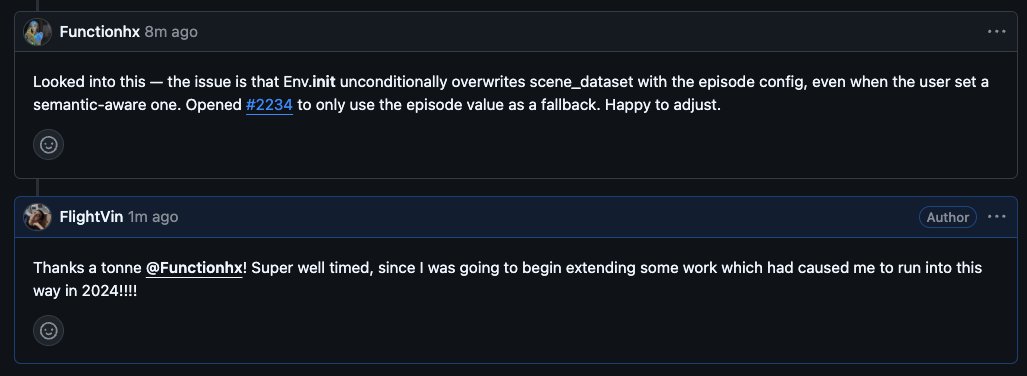
Some people are out there doing god's work. This was an issue that I'd found with Meta's habitat-lab way, way back in October 2024.
So cool to see someone picking it up, I'd totally forgotten about it :D
I'm kinda speechless, not sure what I could write. This was the most unexpected and important launch of the year, and that includes Fable. If this is real it will save countless lives
I want to offer some unsolicited advice to computer vision researchers jumping into robotics. Don't focus too much on VLMs, VLAs etc. That's fine, but the real action is at the sensorimotor level. Most of the open problems in robotics are in manipulation, which is about hand-object interaction, and contacts and forces are central. Proprioception and tactile sensing are as important as vision. Don't get seduced by cherry-picked demos. You can't do robotics without doing robotics.
I promise this will be the best 20 min you spend today! Robotics: Endgame, the sequel to my last year's Sequoia AI Ascent talk, "Physical Turing Test". I laid out the roadmap for solving Physical AGI as a simple parallel to the LLM success story. Be a good scientist, copy homework ;)
And stay till the end, more easter eggs and predictions for your polymarket!
00:30 DGX-1 origin story at OpenAI, I was there in 2016 signing with Jensen and Elon. Heading to the Computer History Museum!
01:42 The Great Parallel
03:31 Robotics, the Endgame
03:39 Why VLAs fall short
04:32 Video world models as the 2nd pretraining paradigm
06:09 World Action Models (WAM)
07:46 Strategies for robot data collection and the FSD equivalent to physical data flywheel for robot manipulation
11:06 EgoScale and the Dexterity Scaling Law we discovered recently
14:00 Physical RL: bridging the last mile
15:39 DreamDojo: an end-to-end neural physics engine for scaling RL in silico
17:00 Civilizational Technology Tree and my predictions for the near future. Spoiler: it's closer than you think.
Thanks to my friends at Sequoia for inviting me back to AI Ascent this year! I had a blast! Last year's talk is attached in the thread if you missed it.
Was giving VAEs & ELBO a read, and Gemini about change in variables as a tangential question... and it hit me with
> Where This Shines: Normalizing Flows
Gosh
I love how this aligns with S1's intuition that post-training unlocks capabilities that the model already had through perturbation.
A really cheap alternative to RL, if you will.
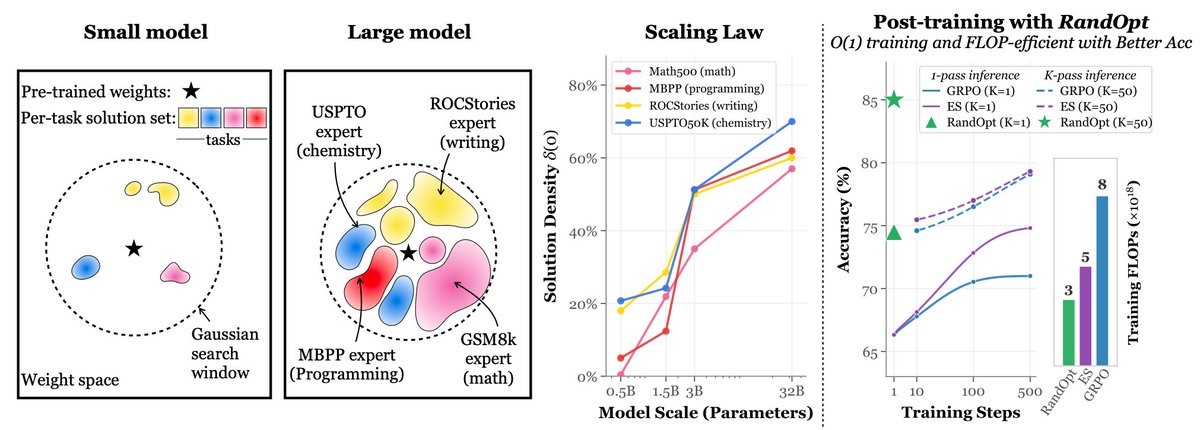
Simply adding Gaussian noise to LLMs (one step—no iterations, no learning rate, no gradients) and ensembling them can achieve performance comparable to or even better than standard GRPO/PPO on math reasoning, coding, writing, and chemistry tasks. We call this algorithm RandOpt.
To verify that this is not limited to specific models, we tested it on Qwen, Llama, OLMo3, and VLMs.
What's behind this? We find that in the Gaussian search neighborhood around pretrained LLMs, diverse task experts are densely distributed — a regime we term Neural Thickets.
Paper: https://t.co/rFJz2kVEOA
Code: https://t.co/HAmonfpXIA
Website: https://t.co/QZ6AMIsKCw