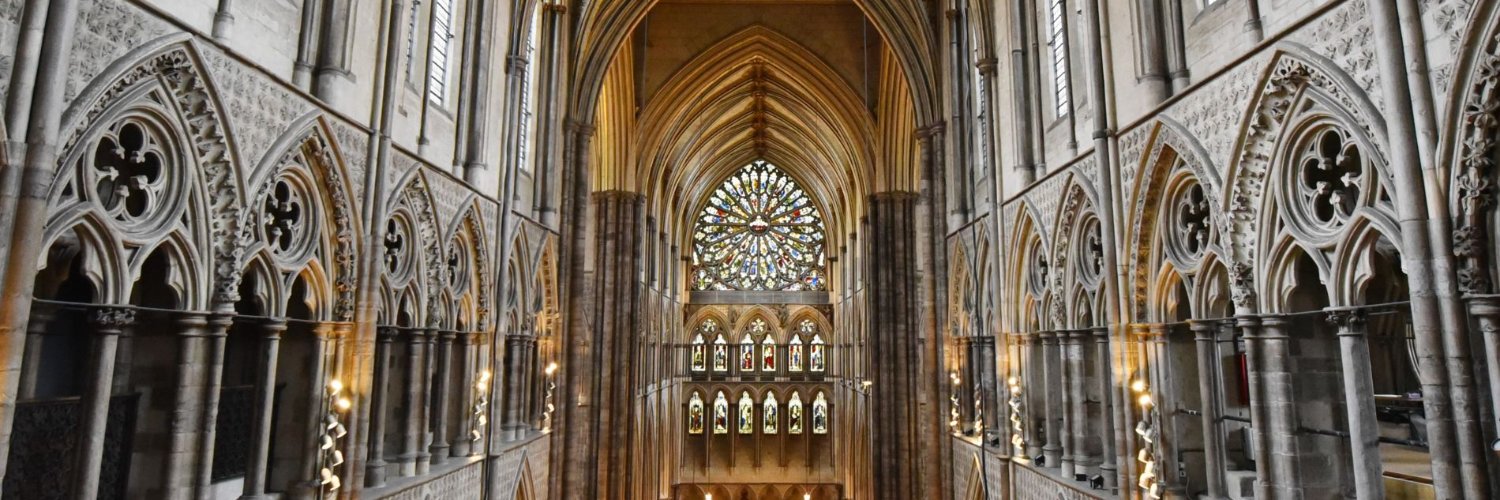
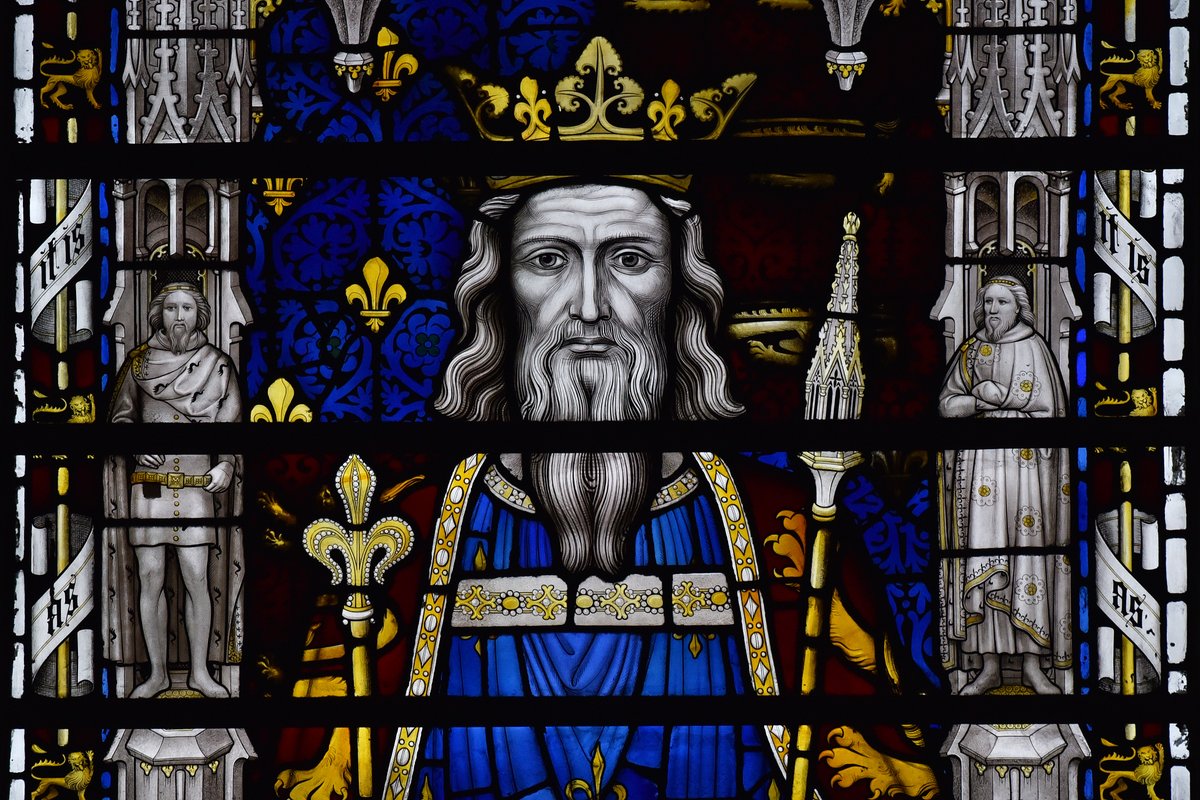
It had been prophesised that Henry IV would die in Jerusalem. But on a visit to the Abbey in 1413, he was taken ill and died in a room in the Abbot's house known as the Jerusalem Chamber.
Our memorial to poet Percy Shelley was dedicated #onthisday in 1954. One of the most renowned poets of the Romantic period, he is remembered for his works such as Ode to the West Wind and Ozymandias. His memorial adjoins that to his fellow poet John Keats in Poets’ Corner.
Architect and stained glass designer Sir John Ninian Comper was born #onthisday in 1864.
Among the works he designed for the Abbey is a series of eight windows in the nave, each depicting an English king with an abbot of Westminster of the same era. They are:
King Edgar and St Dunstan
Edward the Confessor and Edwin
Henry III and Richard de Ware
Edward I and Walter de Wenlock
Edward III and Simon Langham
Richard II and Nicholas Litlyngton
Henry V and William Colchester
Henry VI and Richard Harweden
Comper was died in 1960 and his ashes are buried in the Abbey, close to the windows which bring so much light and colour into the nave.
Charles Dickens, author of some of the greatest novels in the English language, died #onthisday in 1870.
Dickens is buried among other literary powerhouses in the Abbey's Poets' Corner. Only twelve mourners attended the funeral, but the grave was left open as thousands of people paid their respects by throwing roses on his coffin.
Dickens’ grave remains one of the most popular among visitors to the Abbey, and you discover more about the fascinating story of how he came to be buried here at: https://t.co/lqRSzNPnVj
'For it is the God who said, 'Light will shine out of darkness,' who has shone in our hearts to give the light of the knowledge of the glory of God in the face of Christ'
2 Corinthians 4: 6
June's Memorial of the Month talks highlight the life of Aphra Behn. Buried in the Cloisters, she was one of the first English women to earn a living through her writing. Her plays, poetry and prose engage with politics, gender, power and social expectation in ways that still resonate today.
You can find out more at 10-minute talks running in Poets' Corner at 10:30am on Tuesdays and Thursdays throughout June. These drop-in sessions are free with entry to the Abbey, and there's no need to book.
Find out more and plan your visit: https://t.co/MUGGrUEkuz
The Abbey has been a place of worship since the tenth century. Our doors are open every day for services and everyone is welcome to join us.
You can find more information about worshipping here, and full service times, at: https://t.co/mnaG3NEfpy
This is the tomb of Ludovic Stuart, Duke of Richmond and Lennox, and his wife Frances, who are buried in the Abbey's Lady Chapel.
The tomb's domed canopy is supported by grand life-size figures of Hope (pictured below), Truth, Charity and Faith, and is topped with the figure of Fame.
#MuseumWeek #HopeMW
Our memorial to actress Dame Peggy Ashcroft was dedicated #onthisday in 2005. Her career spanned more than six decades, and she was well-known for her Shakespearean and classical roles, as well as her Oscar-winning screen performance in A Passage to India. Her memorial can be found in Poets’ Corner, close to the grave of Sir Laurence Olivier with whom she often worked.
'The courage of a woman'
- Antony and Cleopatra (IV, 14)
Dame Millicent Fawcett, leader of the constitutional women's suffrage movement, is remembered with this memorial in the Abbey's St George's Chapel. She is also honoured with a statue just across the road from us in Parliament Square.
#ShakespeareSunday #FormidableAndFantasticWomen
‘She shall be, to the happiness of England, an aged princess; many days shall see her, and yet no day without a deed to crown it’
- Henry VIII (V, 5)
Elizabeth I was crowned here in the Abbey in 1559. She had succeeded her half-sister, Mary I, as queen and reigned for 45 years until her death in 1603. They are buried together in this magnificent tomb in the Abbey's Lady Chapel.
#ShakespeareSunday #FormidableAndFantasticWomen
Our memorial to writer Edward Lear was dedicated #onthisday in 1988. Lear is well-known for his collection of nonsense poems and limericks such as The Owl and the Pussy-cat as well as his illustrations, some of which feature in books of Alfred Lord Tennyson’s poems. You can find his memorial in Poets’ Corner.
This book, the Gigantick History of Westminster Abbey, is one of a series describing the sights of London for children. Published in 1742, it's just 10cm x 12cm and includes this charming drawing of our North Front. It's on display in our museum, The Queen's Diamond Jubilee Galleries.
#Museum Week #FunInTheMuseumMW
'Ask, and it will be given you; search, and you will find; knock, and the door will be opened for you. For everyone who asks receives, and everyone who searches finds, and for everyone who knocks, the door will be opened.'
Luke 11: 9-10
Everyone's welcome in the Abbey at 5pm on Sunday for a recital by organist Iain Quinn, who'll be playing music by Bridge, Rachmaninoff and Franck.
Places are free and there's no need to book: https://t.co/TZHpzdfnoB
Westminster Abbey is home to the 13th-century Westminster Retable, England's oldest altarpiece. Designed for Henry III's Abbey, the retable is made of painted and gilded wood, and decorated with metalwork, enamel and glass.
This detail shows Christ holding a globe of the world decorated with minute images of the sun and moon, a boat on water, trees, sheep and birds.
The retable is on permanent display in our museum, The Queen's Diamond Jubilee Galleries.
#MuseumWeek #MuseumsForThePlanetMW