Bridges were never the endgame for multi-chain.
Wire Network is building the Universal Transaction Layer.
Now your assets stay native, execution stays coordinated, and fragmented systems operate like one.
Every major system eventually develops a control layer.
Air traffic has one.
Global logistics has one.
Financial networks have one.
As digital assets expanded across dozens of ecosystems, transactions became increasingly interconnected, but coordination remained fragmented.
Messages move.
Assets move.
Value moves.
Yet the systems responsible for coordinating those interactions often remain disconnected from one another.
The idea behind Wire Network is crucial:
Multi-chain finance eventually needs a financial control plane.
Wire Network is that control plane.
@jbrukh Can’t be more trustless than Wire’s Universal Transaction Layer nor meet more requirements that the AI’s are going to choose to execute their transactions on.
One of the biggest hidden costs in crypto isn't visible on a transaction receipt.
It's everything happening behind the scenes.
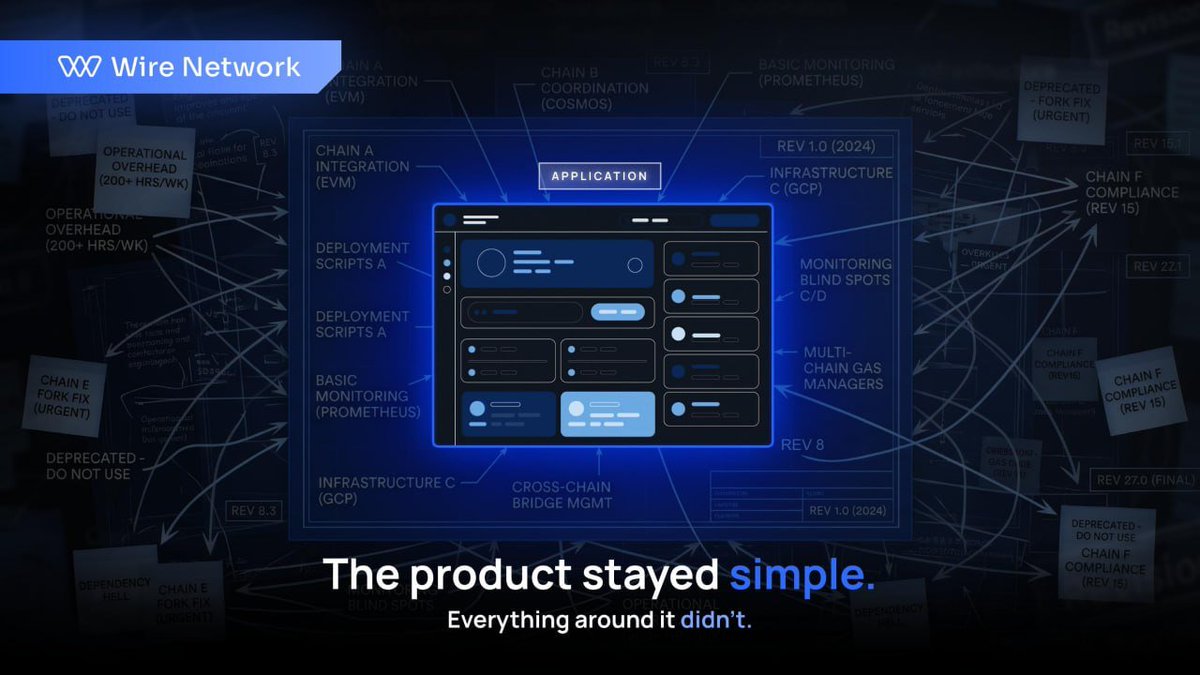
The same applications are repeatedly deployed, integrated, monitored, and coordinated across separate blockchain environments.
The application often stays the same.
The coordination requirements don't.
Shared interoperability layers exist because rebuilding the same coordination logic across every environment becomes increasingly difficult as ecosystems grow.
Applications integrate once with Wire's UTL rather than rebuilding that coordination layer chain by chain.
Complexity compounds quietly.
Crypto became remarkably good at proving ownership.
It became possible to verify where an asset lives, which address controls it, and its complete transaction history.
What's becoming increasingly important now is coordination.
Assets, applications, and users no longer exist in one environment, which means ownership increasingly needs to be coordinated across connected systems.
That's the idea behind Wire's Universal Transaction Layer: ownership settles on Wire while assets remain native, creating a shared coordination layer across connected ecosystems.
Ownership laid the foundation.
Coordination is what allows digital economies to scale.
The most valuable infrastructure doesn't give users more decisions.
It removes unnecessary ones.
Most people don't want to think about which chain they should use, how value moves between environments, or what route a transaction should take.
They care about outcomes.
The same way nobody thinks about which server delivers an email, most users eventually won't care where an asset originated or how a transaction was coordinated behind the scenes.
That's part of what makes shared interoperability layers interesting.
Applications integrate once with Wire's Universal Transaction Layer and can transact against assets across connected chains without rebuilding coordination logic for every environment.
Infrastructure tends to become invisible when it works.
At some point, crypto stopped solving certain problems and started adapting to them.
Bridges.
Network switching.
Multiple wallets.
Wrapped assets.
Manual routing.
The industry became so familiar with these workflows that they started feeling normal.
Most of them exist because independent systems still struggle to coordinate ownership and transactions across environments.
The idea behind Wire's Universal Transaction Layer is that coordination should be shared rather than rebuilt over and over again, creating a common layer where transactions and state are standardized across connected chains while assets remain native.
The best workaround is usually the one you no longer need.
At some point, “just bridge it” became normal advice in crypto.
That should probably concern more people.
No other financial system treats intermediary custody layers, wrapped representations, and fragmented transaction coordination as standard UX.
The industry spent years asking:
“How do we connect more chains?”
A better question might have been:
“Why do they behave like disconnected systems in the first place?”
There’s a reason “multi-chain UX” still feels unfinished.
Most systems were never designed to coordinate state natively across environments.
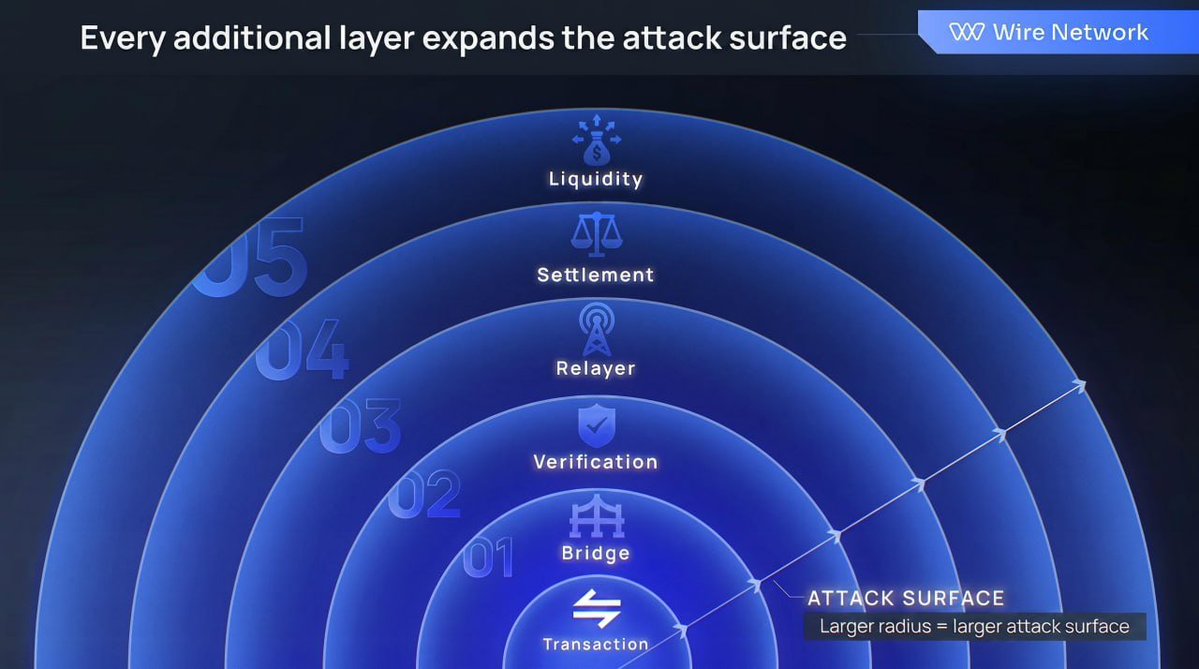
So the industry built layers around the problem:
Bridges, wrappers, relayers, verification systems.
Wire Network approaches interoperability at the coordination layer instead of layering more infrastructure on top of fragmentation.
AI agents won't care about narratives.
They'll care about transaction certainty, cost, reliability, and outcomes.
Tune in now as our CEO @KenDicross joins @BawsaXBT to discuss the infrastructure being built for that future.
The Wire Network team was proud to attend the TechDollar Dinner during NY Tech Week hosted by @introductioncom.
The private event brought together leaders from frontier AI, enterprise technology, fintech, institutional finance, and global banking, including representatives from Anthropic, NVIDIA, Stripe, Palantir, Google, Amazon, JPMorgan, Robinhood, Grayscale, and more.
One theme was impossible to ignore: the lines between AI, finance, and infrastructure are disappearing.
As these industries converge, the need for systems that can coordinate value, ownership, and transactions across fragmented environments only becomes more important.
Great conversations. Great people. Excited for what's ahead.
One of the least discussed problems in crypto is transaction ambiguity.
Users often don't know:
→ whether a transaction finalized
→ where state actually settled
→ which system is accountable when something fails
Wire is built as a control plane for multi-chain transactions. Ownership settles on Wire; the assets never leave their native chains.
So every transaction has a confirmed final state, a single place where ownership settles, and a defined party accountable for recovery when a step fails.
Deterministic and verifiable, by design.
Ownership and interoperability are becoming increasingly important as digital assets expand across ecosystems.
Excited to discuss the future of connected chains and what comes next.
Reality Check: Founder Series goes live tomorrow with @WireNetwork
We’re talking Web3 infrastructure, the vision behind https://t.co/qFcGxPlEaj, and what they’re building next.
🗓 Tomorrow
⏰ 1 PM EST
📍 @RealityCheck_RR
Question. Think. Verify.
One of the highest hidden costs in crypto is duplicated infrastructure.
The same applications are repeatedly redeployed, re-integrated, and re-coordinated across separate blockchain environments.
That increases operational complexity, fragments liquidity, and expands trust assumptions across every additional integration.
Wire Network reduces that complexity through a shared interoperability layer where applications integrate once with the UTL instead of rebuilding coordination logic chain-by-chain.
Crypto users were told a multi-chain future would create more freedom.
In many ways, it created more fragmentation.
Every additional chain introduced more coordination overhead between systems that were never designed to share state natively.
Instead of connecting fragmented systems externally, the UTL standardizes transactions and state through a shared coordination layer where assets remain native and ownership transacts on Wire.
For years, crypto scaled by adding more chains.
But every new chain also introduced:
new liquidity silos, new integration work, new trust assumptions, and new coordination problems.
The industry kept solving fragmentation with more infrastructure layered on top of fragmentation itself.
Instead of relying on bridges and external coordination layers, Wire introduces a Universal Transaction Layer where transactions and state are standardized across connected chains while assets remain native.
Bridges became one of the most important parts of crypto infrastructure.
They also became one of the largest sources of risk.
That’s because every time value moves between chains, additional infrastructure is needed to coordinate ownership, verify transactions, and keep systems in sync.
The more layers involved, the larger the attack surface becomes.
Wire approaches this differently.
Ownership transacts on Wire while assets stay put on their native chains, removing the need for intermediary custody layers entirely.