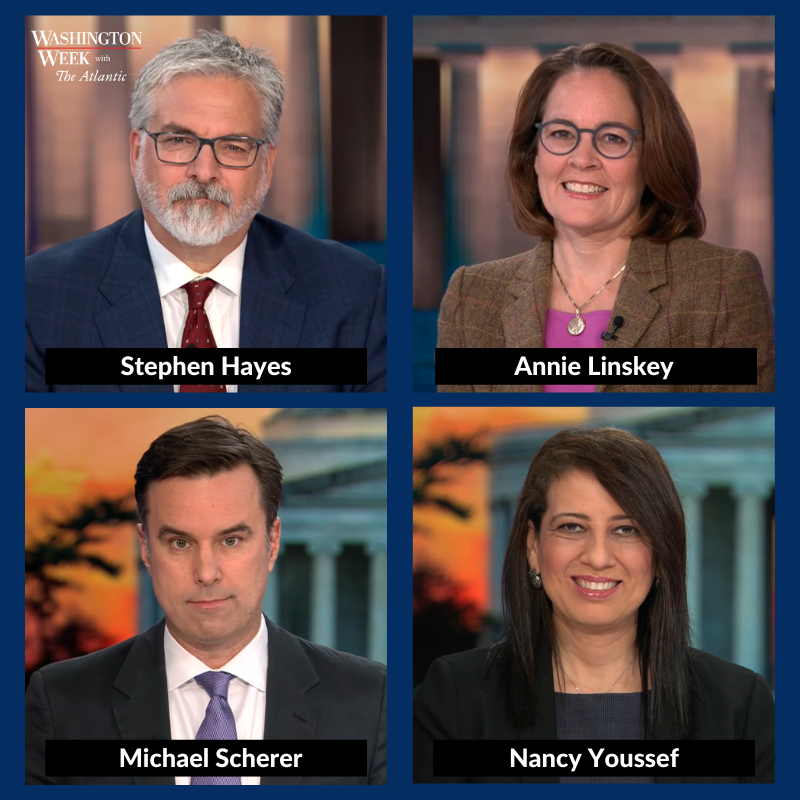
The Atlantic’s Nancy Youssef told moderator Jeffrey Goldberg that the president's comments actually “hurt” the U.S. in their negotiations. “What it's signaling [is] that the U.S. really wants a deal," Youssef said.
President Donald Trump told reporters last week he doesn’t want to meet Iranian Supreme Leader Ayatollah Mojtaba Khamenei, but that if they did meet, he would be “honored” and that he would “like to see if we make a deal.”
"If you've got the leader of Israel and the leader of the United States fighting with each other over what's going on every day in Lebanon, like, why make a deal? There's a perfect situation for [Iran] to draw out," said @michaelscherer.
"I actually think that these kinds of comments hurt the U.S. in their negotiating because, again, what it's signaling [is] that the U.S. really wants a deal," said @nancyayoussef about President Trump's recent comments on Ayatollah Mojtaba Khamenei.
"Three of those Republicans who have suddenly become quite eager to voice publicly, and vote against, the president in some cases have been pushed out by the president, and that's a group that some people in D.C. call the YOLO caucus," said @AnnieLinskey.
.@stephenfhayes: This is not new frustration with Donald Trump. It's emerging frustration with Donald Trump. ... A lot of these Republicans who are now voicing their frustration and willing to speak out have been frustrated with him behind the scenes, in some cases, for a decade.
They compared President Donald Trump's current approach to Iran with the approach employed by President Barack Obama in the mid-2010s, when the U.S. and Iran enacted the Joint Comprehensive Plan of Action, commonly known as the Iran nuclear deal.
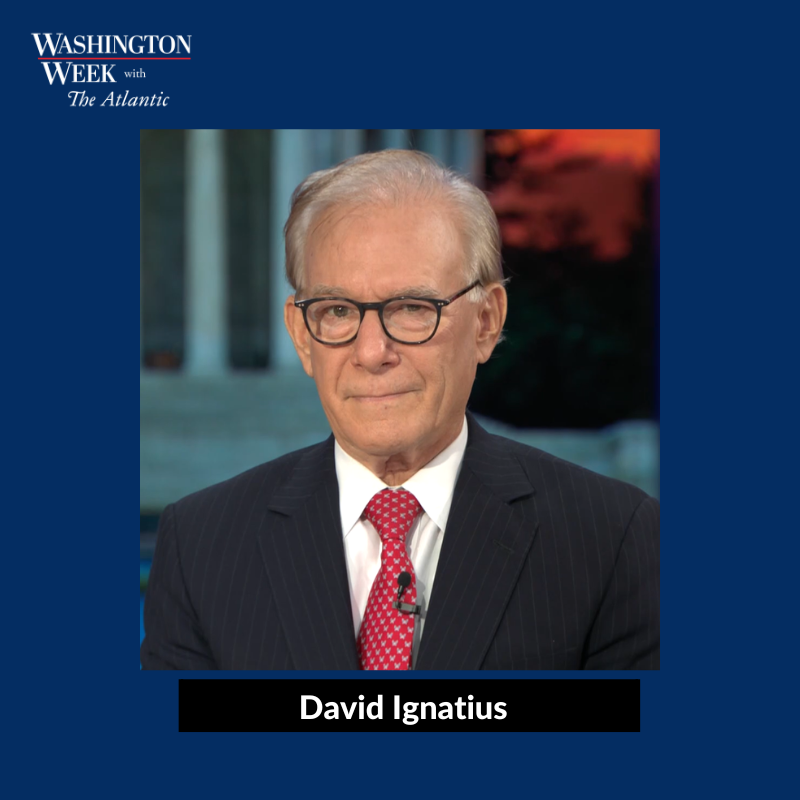
David Ignatius, foreign affairs columnist for The Washington Post, joined moderator Jeffrey Goldberg to discuss the global consequences of America’s unpredictability, including the current state of negotiations with Iran.
"I think there is a growing fear in the world that America's promises that it will sacrifice its own cities to save those of its allies, ... people just don't believe it," said @IgnatiusPost.
Would President Trump try to take Greenland in some way?
"I think he's going to get something that he can call taking Greenland. He'll get bases," said @IgnatiusPost.
"I think Europe has really now dropped any willingness to accommodate Trump's bullying on Greenland."
"The Trump doctrine, in part, is just do it. Just go for it," said @IgnatiusPost.
"When you look back to President Obama, ... he did plan carefully. ... The opposite of what you see with Trump."
What is your analysis of the Iran deal that's taking shape?
"That this was a war of choice and it's a peace of necessity," said @IgnatiusPost.
"Both sides are exhausted. ... It's been time to make peace, but it's been difficult to get there."
TONIGHT: Longtime foreign affairs columnist @IgnatiusPost joins moderator @JeffreyGoldberg to discuss the global consequences of America’s unpredictability.
Watch at 8/7c on @PBS
.@helenecooper:"When we're talking about DEI, we're talking about [Pete Hegseth's] anti-woke war. I just would like to put some of this into a little bit of perspective. ... If you looked at the people who were in the leadership roles of the military. All of them were white men."
"The fact that [Pete Hegseth] has this ability, as a former television reporter, to kind of deliver the message to the president in a way the president not only understands, but that resonates with him, that has kept him in his job," said @vmsalama.
"You've had the purging of the press. ... I think it's a notable thing. I'm a former Pentagon correspondent," said @jonkarl.
"It's like [Pete Hegseth] doesn't want to face — not any dissent, because it's not a matter of dissent, but even questions that veer from the orthodoxy."
"There is also a tradition where Defense secretaries attempt to minimize their overtly partisan behavior," said @missy_ryan.
"They try to, in the name of national security, act more as a nonpartisan actor, and Pete Hegseth has totally discarded that tradition."