How to lose $50M in under an hour. This is one of the largest on-chain scam losses we’ve seen recently.
A single victim lost $50M in $USDT to an address poisoning scam. The funds had arrived less than 1h earlier.
The user first sent a small test tx to the correct address. Mins later, $50M was sent to a poisoned address copied from transaction history.
Saturday 26 Sep, Toranomon Hills Forum. A day of talks with @ethglobal, Aya Miyaguchi (Ethereum Foundation), Yuzo Kano (bitFlyer) and more.
We are there with @intercepta_. DM
Stablecoins are becoming one of the main rails for crypto crime.
FATF says most identified onchain criminal activity now involves dollar-pegged tokens, while criminal networks are also exploring proprietary tokens designed to resist freezes and seizures.
Stablecoins are fast, liquid, global and easy to move across wallets, exchanges, bridges and DeFi routes. The same features that make them useful for real users also make them attractive for laundering, sanctions evasion, scams and off-ramp abuse.
Address history, counterparties, sanctions exposure, fund flow and repeated routes matter before a transaction is treated as clean.
After the $131M $USDT freeze we covered earlier, here’s a wider look at the $USDT blocklist.
Our current monitor shows:
$1.54B in blocked $USDT
2,903 blocked addresses
$151K blocked in the last 24h
Blocklists are another reason address history matters.
A wallet can look active, funded and liquid until issuer-level controls kick in. The reason may be scams, hacks, sanctions exposure, law enforcement requests or other high-risk activity.
Tether reportedly froze around $131M in $USDT across 4 Tron wallets linked to Iran.
The wallets were tied by analysts to recent U.S. sanctions connected to Iran’s central bank, with funds moving through payment and exchange infrastructure before the freeze.
The official reason for the freeze was not publicly stated, but the timing followed new OFAC designations.
Remember that address history, sanctions exposure and counterparties matter.
For users, wallets, exchanges and crypto products, transaction context isn't optional.
OkoBot’s SeedHunter module was built for this. It watches for wallet software, waits for a device connection in some cases and tries to turn user trust into seed phrase theft.
Don't enter a seed into a random window, pop-up, website, support chat or unexpected desktop prompt.
If a wallet app suddenly asks for your seed phrase, stop and verify the recovery flow through official docs and the device screen.
OkoBot shows why hardware wallet security still depends on the computer around it.
The malware reportedly runs on infected Windows machines and waits for Ledger or Trezor desktop apps. Once it detects the right moment, it injects a fake recovery phrase screen inside the real wallet software.
The hardware wallet isn't giving up the key. The attacker is trying to make the user type the recovery phrase into a malicious page that appears in a trusted app environment.
Fresh weekly leaderboard of tokens scammers are impersonating.
$USDT moved back to the top with 264 detections, up from 249 last week.
$ETH followed closely at 258, down from 276, while $USDC dropped to 185 after holding at 200 last week.
ERC20 tokens and $DAI both landed at 155, with both categories slightly up from 147.
Scammers keep copying the assets users recognize, trust and interact with most often. Before swapping, approving, or accepting any token, verify the contract address.
A wallet address is public. Tie it to a name, email, browsing history or app profile and pseudonymous stops meaning much.
Users can reduce some risk by clearing old connected sites and separating activity across wallets or browser profiles.
Disconnect should actually disconnect. Wallet presence shouldn't be an easy fingerprint. A wallet address shouldn't leak across unrelated websites.
Your wallet address can follow you around the web even when you think you disconnected.
A new study tested 85 crypto wallet browser extensions and found privacy leaks that can link separate addresses, fingerprint installed wallets and expose wallet addresses across sites.
The wallets often work as designed, but the way they talk to websites and RPC servers can reveal more than users expect.
17 wallets could expose links between separate addresses that likely belong to the same user. 36 wallets could be fingerprinted by websites, even without a wallet connection. In 22 wallets, access could persist after logout, cookie clearing and browser restart. 23 wallets could expose an address through cross-site iframe behavior, letting a tracker connect a wallet identity to activity on another site.
Tether reportedly froze around $131M in $USDT across 4 Tron wallets linked to Iran.
The wallets were tied by analysts to recent U.S. sanctions connected to Iran’s central bank, with funds moving through payment and exchange infrastructure before the freeze.
The official reason for the freeze was not publicly stated, but the timing followed new OFAC designations.
Remember that address history, sanctions exposure and counterparties matter.
For users, wallets, exchanges and crypto products, transaction context isn't optional.
Impersonation scams keep showing up right under real project posts.
In this case, a fake Backpaek Ecosystem acc replied under @Backpack with a Q3 $BP distribution claim and a link to check an estimated allocation.
The link was flagged by @web3_antivirus as phishing.
Always check the exact handle and the domain before clicking. A reward link in the replies is not an announcement.
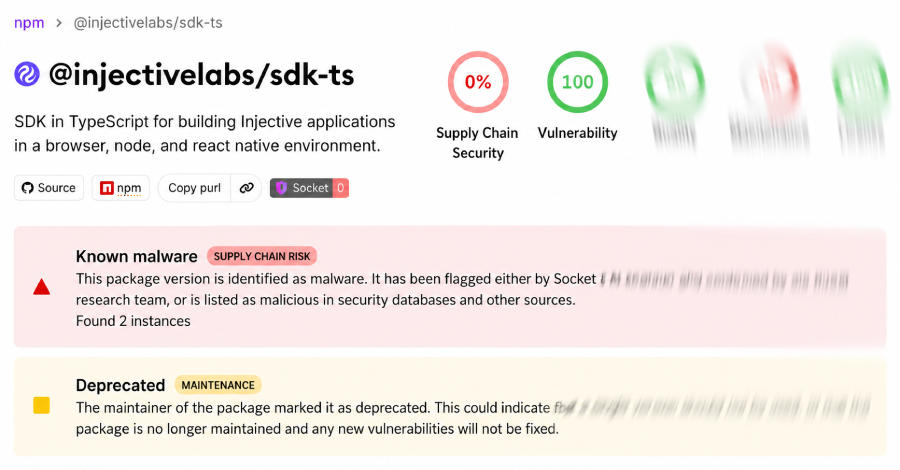
Injective Labs’ GitHub repo was compromised, leading to a malicious npm release of @injectivelabs/[email protected].
The package added fake telemetry logic that could exfiltrate wallet private keys and mnemonic seed phrases to an external server when key derivation functions were used.
The risk also extended beyond one direct install, since the same version was pinned across multiple Injective Labs scoped packages.
If you used the affected version, update to 1.20.23, check transitive dependencies and treat any private key or seed phrase that passed through the package as compromised.
One suspect’s crypto wallet processed more than $122.5M in 10 months as part of a wider crackdown on social engineering scams and fraud infrastructure.
The Thai investigation reportedly uncovered a laundering network that moved proceeds from romance scams into crypto, then used cross-chain swaps to make the trail harder to follow.
Scammers may build trust through chats, dating apps, fake investment platforms or social media, but the back end often depends on wallets, swaps, bank accs, mule networks and off-ramp routes.
Interpol’s broader operation involved 97 countries, 5,811 arrests and $293M in seized illicit assets.
If someone you met online starts guiding you into crypto investments, transfers or safe wallets, step back.
A newly disclosed flaw called Ill Bloom has been linked to more than $5M drained from crypto wallets.
The issue is not a phishing link or a malicious approval. It comes from how some older or lesser-known wallet software generated recovery phrases. Weak randomness made certain seed phrases predictable enough for attackers to work through and find wallets holding funds.
One coordinated sweep on May 27 drained about $3.1M from 431 wallets. Another $2.1M in USDT was later stolen from an exposed wallet, pushing confirmed losses past $5M.
The affected apps haven't been publicly named. Hardware wallets are reportedly not affected and most mainstream software wallets are believed to be safe.
SpaceXAI and Starlink accs were compromised and used to promote the solana:Cit4M38LLvYFX2EGFFyit83WEZ1GFN8PA3nF57mu4mgA memecoin by reposting contract details from another acc.
Within the first 20 mins, the token price jumped 575%, and its market cap briefly passed $800K. The posts were later deleted and the project acc was suspended.
Almost 90% of the SCATMAN supply was reportedly controlled by one address.
UPD: An entity initially funded by the LAB team deposited 18.4M LAB, worth around $18.3M, to Aster and began selling LAB spot on the DEX.
LAB has since dropped another 54%, from around $1.20 to $0.55.
The same entity reportedly received 196M+ LAB from the LAB team in April 2026 and previously moved LAB through four Bitget deposit addresses. Around 100M LAB was later withdrawn from Bitget to 10 addresses, sat dormant and started moving again this week.
The entity still appears to hold another 81.5M LAB.
Now LAB has collapsed shortly before rumored unlocks, while the team blamed large market participants.
When token supply, exchange flows, vesting and market-making activity are opaque, users are the ones left absorbing the damage.
One entity reportedly received ESPORTS, RIVER and LIGHT via Sablier vesting, while also being tied to a signer on three LAB multisigs.
All 4 BSC tokens have seen market manipulation incidents on CEXs. LAB and RIVER were already flagged earlier, and today ESPORTS crashed 93% in a single red candle.
Connected addresses:
Bitget deposit
0x5f04a53bff7ae409140f35cf1804892aac295be5
Kraken deposit
0xba898b422932783c7a3cb57b641922b84daa24f2
LAB signer
0xcea722a1a812ebdfa5bbd8130531cf1d1956ebc9
In June, we tracked $173.1M in outbound funds and $11.1B in inbound funds moved via @MetaMask across the monitored addresses.
Scam activity increased compared with May, reaching $906.8K outbound and $917.1K inbound across 398 outgoing and 398 incoming scam transactions.
Sanctions exposure dropped sharply to $651 outbound and $664 inbound, with 12 txs on each side.
Bot activity kept rising too, with $227.4K outbound and $230.6K inbound across 119 outgoing and 121 incoming bot txs.
Before signing, swapping or sending funds, check what's really happening behind the transaction.
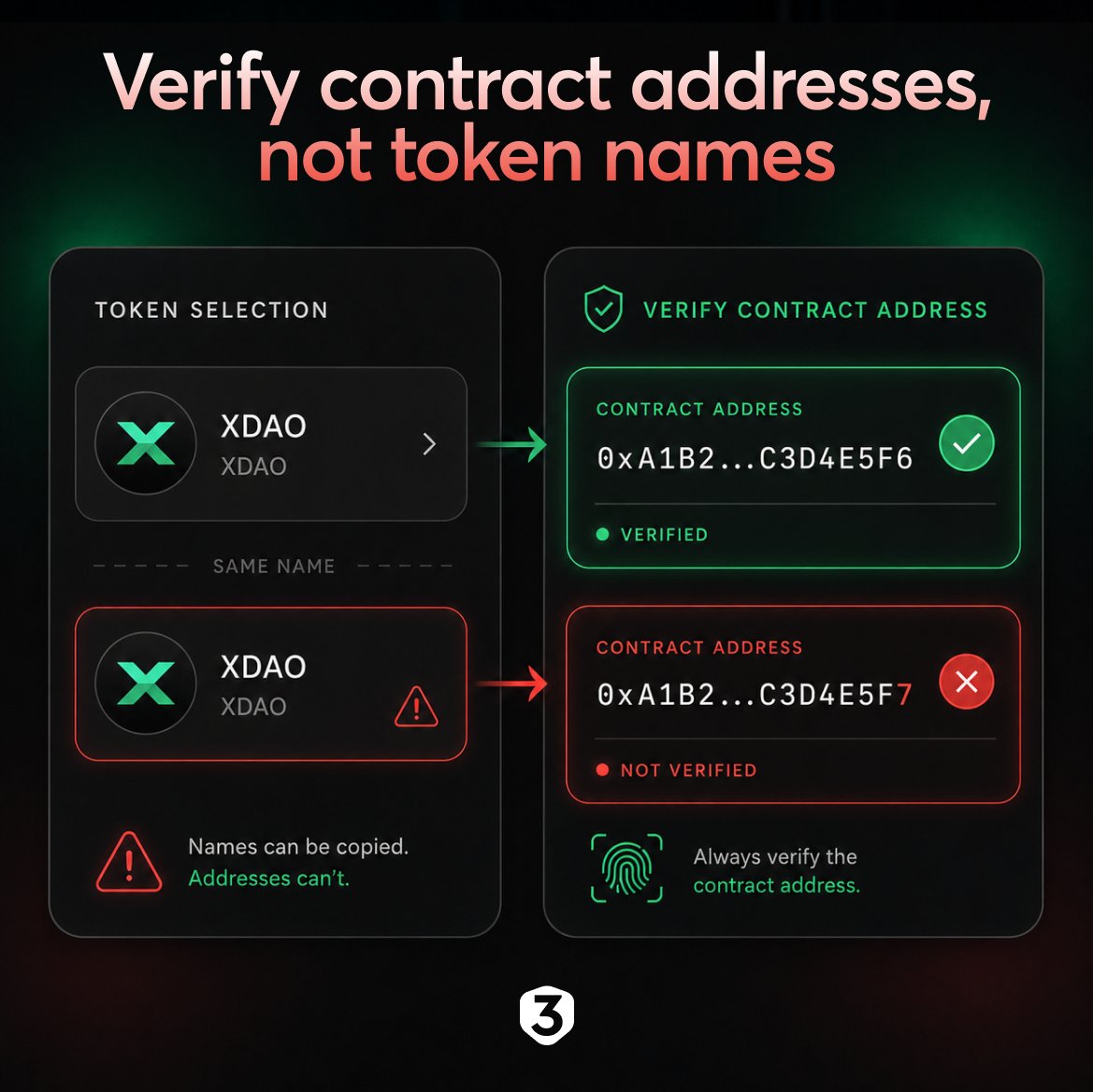
A token name is easy to copy, but the contract address is what actually identifies the asset.
Scammers rely on users recognizing the token name and skipping the one detail that matters most. Before swapping, approving or accepting any token, check the contract address through the project’s official website, verified docs or trusted token lists.
The wrong contract can turn a familiar token into a scam.
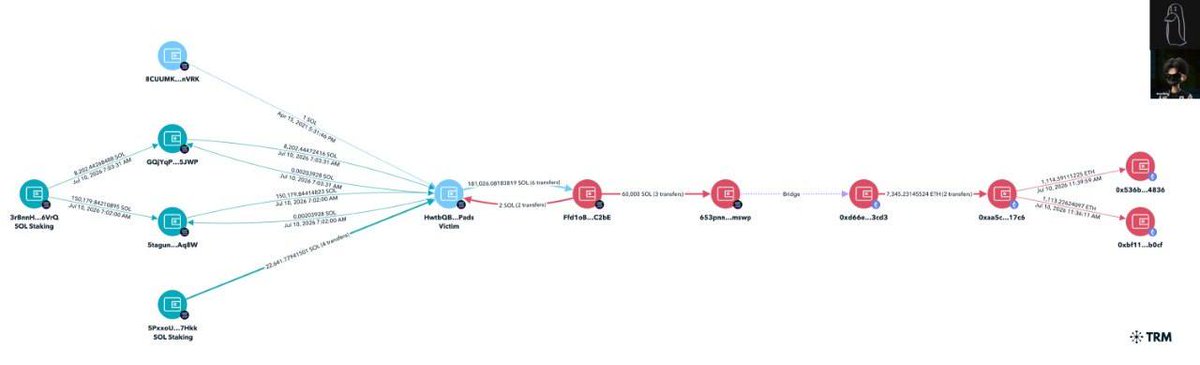
An early Solana whale tied to the initial Genesis block distribution appears to have lost 180.9K SOL, worth around $14.2M.
The activity stood out because of irregular unstaking on Solana, followed by bridging toward Ethereum. That pattern points to a likely private key compromise rather than a protocol exploit.
Victim
HwtbQBNnLERakdUDuCCLWmUs2oETLFQZeHUWeQdPads
Theft address
Ffd1oB2aYM5UzMYUM7TmxULDRQb6KzgrBwmgj9U1C2bE
653pnn5fzF51FfotBwxua55Es4QXxTdaXJLbPczVmswp
0xaa5cfa4e96dda0f9aa30f4dc948b542a9b5817c6
0x536b4ee7507c41143e1b0bd1bf3f2b84be404836
0xbf11bdfbeb9ed137c352c81e45d191cacae6b0cf