Last October, Dr. Francisco Olea-Popelka joined global experts as a speaker in the webinar “Zoonotic Tuberculosis After the Roadmap: Where Are We Now?”.
Watch the webinar on the current state and future direction of zoonotic TB efforts worldwide: https://t.co/wyDnzJXKXl
We are pleased to announce the 2026 Allan Donner Lecture, featuring Dr. Robert Platt, taking place on March 27 in PHFM 3015 or via Zoom (please request the link at [email protected]).
Stop by our booth at the ITR Fair today until 4 PM or tomorrow until 11 PM to learn more about our program!
We’d love to connect, answer your questions, and share what we do. Come say hi — we’re excited to meet you!
https://t.co/bt4YSlQ6Jz
#ITRFair#ThisIsEpiBio
📢 Everyone is welcome!
Join us this Friday for a seminar with Dr. Josette Rosine Aniwuvi Gbeto on "Adolescent Mental Health and Peer Support"
Date: March 20
Time: 1:30 pm
For Zoom access, please email [email protected] 🖥️
Want to learn how large population studies support cancer, disease, and health research?
Join us this Friday, March 13, for Dr. Victoria Kirsh’s talk, “The Ontario Health Study: A Resource for Cancer, Disease and Health Research in Ontario and Canada.”
Interested in learning about the importance of sleep health as a major—yet often neglected—global public health priority? Join us this Friday, March 6, for Dr. Stranges’ talk "Sleep Health as a Public Health Priority"
Join us this Friday for an in-person seminar featuring Dr. Obidimma Ezezika:
“From Evidence to Impact: Leadership and Systems in the Scaling of Health Innovations”
📍 Location: PHFM 3015 (Public Health & Family Medicine)
More info: https://t.co/JSTLbsn9JR
Subject Workshop | Building Resilient Public Health Systems: Equity, One Health and Innovation for Population Well-Being
📅 Date: 14 March 2026
📍Park Hyatt Toronto (4 Avenue Rd, Toronto, ON)
Free registration & more information: https://t.co/Kn1GVGl6n7
We invite you to come and support our PhD candidates, David Piskin and Jahin Khan, at their PhD Thesis Proposal Defense Public Lecture on this Friday, February 13
A sick child does not start sick in the hospital.
The sickness starts somewhere else. Dirty air. Unsafe water. Food stored badly. Systems that failed before the fever arrived.
I shared this at @westernuepibio@WesternU Department of Epidemiology and Biostatistics.
Why do we wait for people to get sick before we act?
Over 60 percent of infectious diseases come from animals.
75 percent of new diseases start in damaged environments.
Heatwaves killed 70,000 in Europe in one year.
Climate shocks push 280 million into hunger annually.
Different places. Same pattern. Damage nature, human health pays.
My grandmother used to say, "You do not fix a leaking roof when the rain is already inside."
She understood systems before we had that word.
The problem is not data. We have data. The problem is what happens after.
Reports written. Conferences held. Nothing changes.
This is where the Public Policy to Practice Ladder matters.
Think of building a house:
Step 1: Diagnose. Find the root cause, not the symptom.
Step 2: Co-design. Those affected help design solutions.
Step 3: Resource. Investment that pays back, not charity.
Step 4: Implement. Start small. Test. Learn.
Step 5: Scale. What works in one village works in a thousand.
We saw this work.
Waste to clean fuel reduced respiratory illness
Solar drying cut food losses from 40 to 12 percent.
Prevention returned three times more than emergency response.
Universities exist to turn knowledge into decisions before crisis forces action.
If there is anything I have said that you should remember, let it be this:
Health starts in how we treat air, water, land, and food. Fix the system, fix the outcomes. That is systems thinking. That is how evidence becomes action.
#PublicHealth #ClimateAction #SystemsThinking #OneHealth #WesternUniversity
We are pleased to announce that this Friday, Dr. Lawrence Loh will deliver a lecture titled “From Academia to Application: The Many Ways Public Health Skill Sets Drive Change.”
Everyone is welcome to attend in person at PHFM 1150 or join via Zoom.
📢 Everyone is welcome! Join us this Friday for a seminar with Dr. Joel Gagnier on "Clinimetrology: An empirical science of clinical research methods"
Date: Jan. 30, 2026
Location: PHFM 3015 (for Zoom access, please email [email protected])
What if the secret to solving our health crises was never in a hospital?
I stood before @WesternU@westernuepibio epidemiology students and asked a question that made the room go silent.
"Why do we keep treating symptoms when the disease lives in the soil, the air, the water?"
I told them about floods in my village as a teenager. The fevers that followed. Children coughing through the night. Mothers crying. And me, asking questions I didn't know were epidemiology: Who is getting sick? Where? When? Why?
My grandmother used to say around the fireside: "You cannot heal the child if the river that feeds them is poisoned."
She wasn't a scientist. But she understood what policy is only now discovering.
Health outcomes are decided upstream, in how we produce energy, manage waste, grow food, and steward ecosystems.
The data confirms it:
→ 60% of infectious diseases originate from animals
→ 75% of emerging diseases have environmental roots
→ 70,000 died from heat in Europe in one summer
→ 280 million face food insecurity annually
These are not health statistics. They are environmental failures wearing medical masks.
#Climateaction is health action.
#Pollutionaction is disease prevention.
#Natureaction is economic liberation.
But evidence alone does not save lives.
What changes lives is what we do after the data.
That is the Public Policy → Practice Ladder:
𝗗𝗶𝗮𝗴𝗻𝗼𝘀𝗲 → Find the environmental root cause
𝗖𝗼-𝗱𝗲𝘀𝗶𝗴𝗻 → Partner with communities leveraging accessible structures
𝗥𝗲𝘀𝗼𝘂𝗿𝗰𝗲 → Pool local savings with global guidance
𝗜𝗺𝗽𝗹𝗲𝗺𝗲𝗻𝘁 → Build solutions that fit context
𝗦𝗰𝗮𝗹𝗲 → Move from village pilots to national standards
I have watched youth biodigester fabricators climb this ladder. Result? Over 1,000 tCO₂e avoided. $5,000/year in new incomes. Respiratory illness down. Communities transformed.
I have seen solar dryer cooperatives do the same. Post-harvest losses dropped from 40% to under 12%. Farmers earning $1,800 more per year. National food safety standards now include their innovation.
This is not charity. This is enterprise.
This is not theory. This is systems transformation.
When this ladder is climbed deliberately, something powerful happens:
Health improves. Jobs emerge. Climate action accelerates. SDGs move from aspiration to delivery.
Universities now face a choice: remain repositories of knowledge or become laboratories of solutions.
My grandmother never satisficed a policy document. But she taught me this: "The tree does not bear fruit for itself. It bears fruit so others may eat and plant again."
That is the Public Policy Practice Ladder (PPPL) in one sentence. Solutions that feed forward. Evidence that scales. Policy that breathes.
If there is anything I have said that you should remember, let it be this:
𝗧𝗵𝗲 𝗴𝗿𝗲𝗮𝘁𝗲𝘀𝘁 𝗵𝗲𝗮𝗹𝘁𝗵 𝗶𝗻𝘁𝗲𝗿𝘃𝗲𝗻𝘁𝗶𝗼𝗻 𝗶𝘀 𝗻𝗼𝘁 𝗮 𝗽𝗶𝗹𝗹, 𝗶𝘁'𝘀 𝗮 𝗽𝗹𝗮𝗻𝗲𝘁 𝘁𝗵𝗮𝘁 𝘄𝗼𝗿𝗸𝘀.
Join us this Friday for an in-person seminar featuring Dr. Richard Munang, held at PHFM 3015 (Public Health & Family Medicine). For Zoom access, please email [email protected]@RichardMunang@SchulichMedDent
More info: https://t.co/ChyB2aXp6y
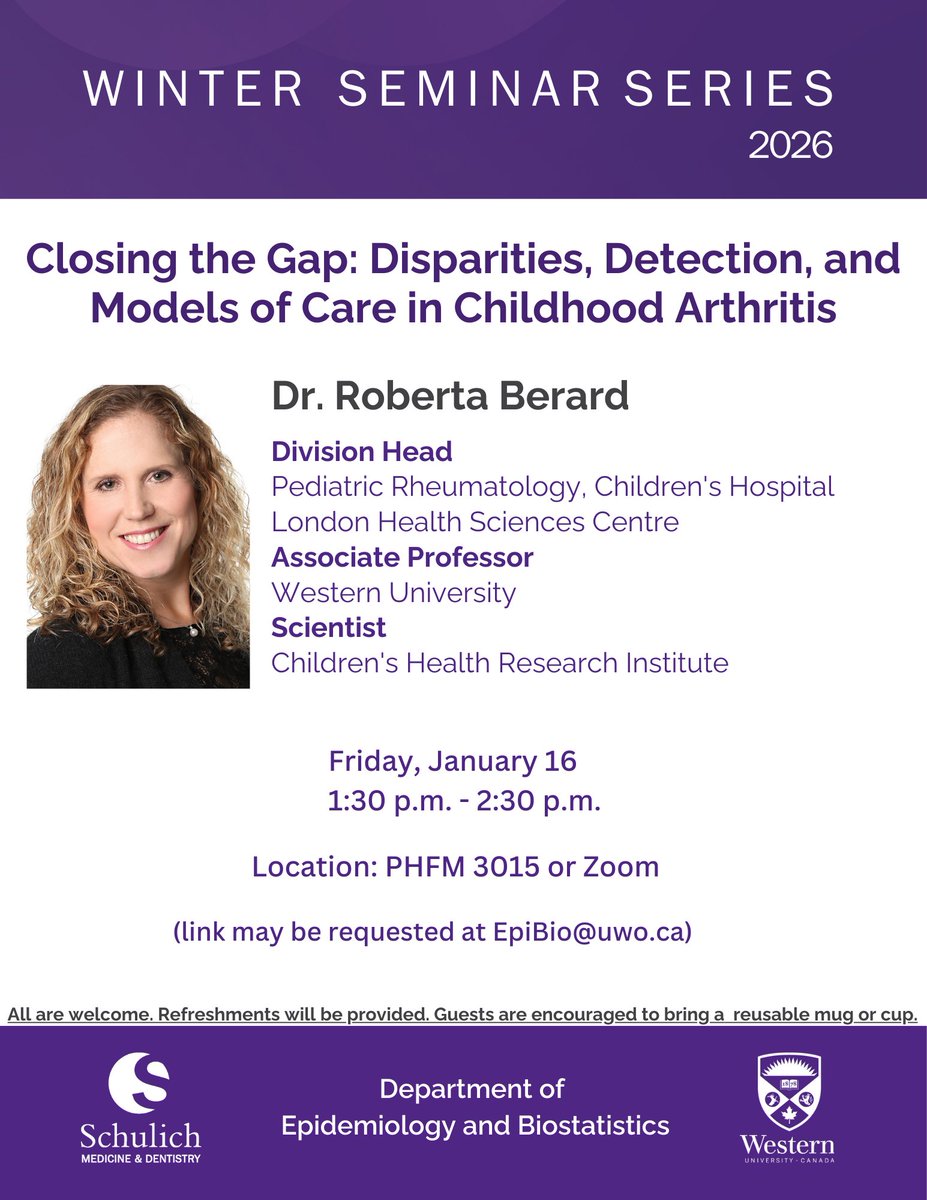
📢Join us for our weekly Seminar Series featuring Dr. Roberta Berard, Division Head of Pediatric Rheumatology at the Children’s Hospital.
Topic: "Closing the Gap: Disparities, Detection, and Models of Care in Childhood Arthritis"
Date: Friday, Jan 16, 1:30 pm
@SchulichMedDent
We are back!
Join us for an enlightening seminar with Dr. Kelly Anderson!
📖Topic: Understanding the evolution of psychotic disorders and related outcomes among migrant groups in Ontario
📍Location: PHFM 1150
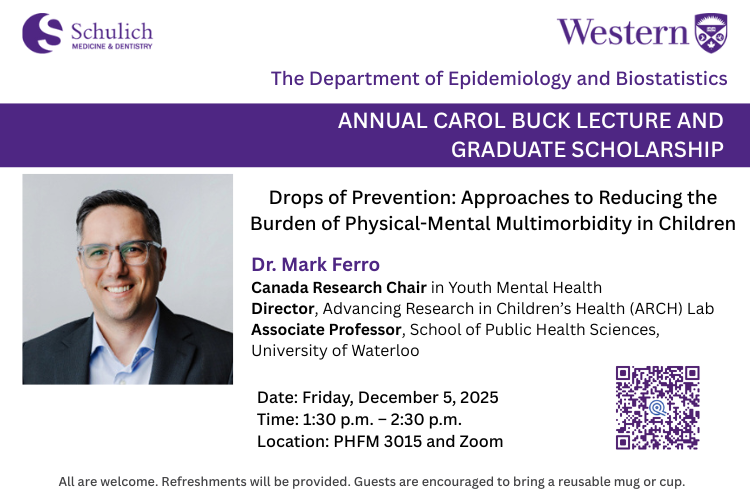
We are happy to invite you all to the Annual Carol Buck Lecture and Graduate Scholarship with Dr. Mark Ferro on December 5, at PHFM 3015 or via Zoom (please request the link at [email protected]).
📢 Join our upcoming seminar, Friday, November 28!
Dr. Noha Gomaa will discuss current evidence on the impacts of individual and population-level oral health interventions on mitigating oral disease risk, strengthening resilience, and improving oral health equity.
#ThisIsEpiBio