Am I excited for people to read Level Up Your Legal Writing?
YES!
Since I was a kid, I've wanted to be a writer. It's what drew me to the law; it's what drew me to be a law professor; it's what drew me to found Writelaw.
I hope you'll check it out: https://t.co/84OdOMnHkY
The speed AI gives you is worth keeping.
What it is not worth is a brief that gets unwound because a citation does not say what you told the court it says.
Build the routine once, run it every time, and keep the speed without sacrificing accuracy. 8/8
AI can now produce a full brief section in the time it takes to get coffee. That speed is real.
The problem is that a clean-looking draft and an accurate one are not the same thing.
AI can write a sentence that sounds like a lawyer wrote it and still get the holding wrong.
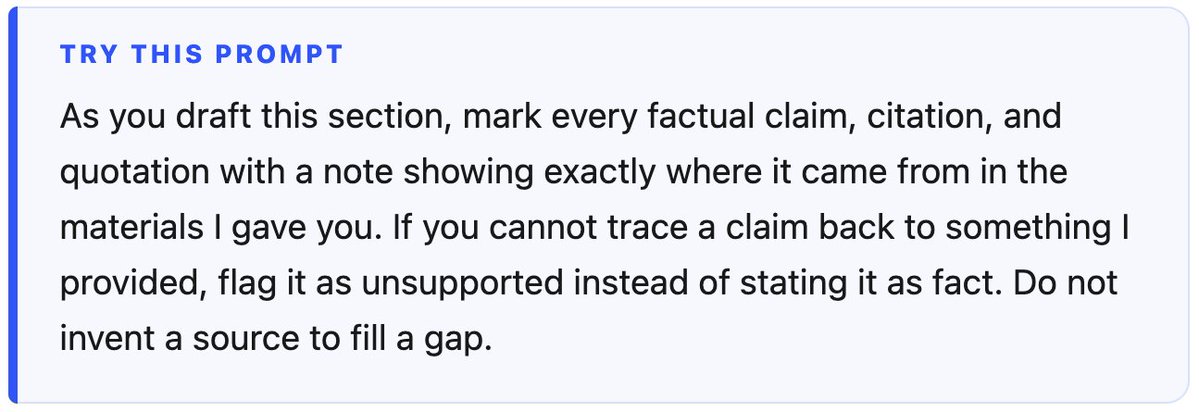
You can also ask AI to help you check as it drafts, instead of leaving all the verification for the end.
This will not replace the steps above. It gives you a map of what still needs checking, which is faster than starting from a blank page every time. 7/8
I made this video for a recent AI skills training. It’s a pretty good example of just how incredibly good AI is getting.
Sometimes, you just need to have a little fun with training.
Yes, AI can bring risk. But good lawyering is still good lawyering.
Point headings are among the few parts of a brief where judges can read your argument without your evidence standing between them and your conclusion.
Give them a sentence they could adopt as written, and you have already done part of the persuading before they reach page one. 6/6
4. Keep it one sentence, and keep it honest
Long headings usually mean you are trying to argue the whole point and every supporting fact at once.
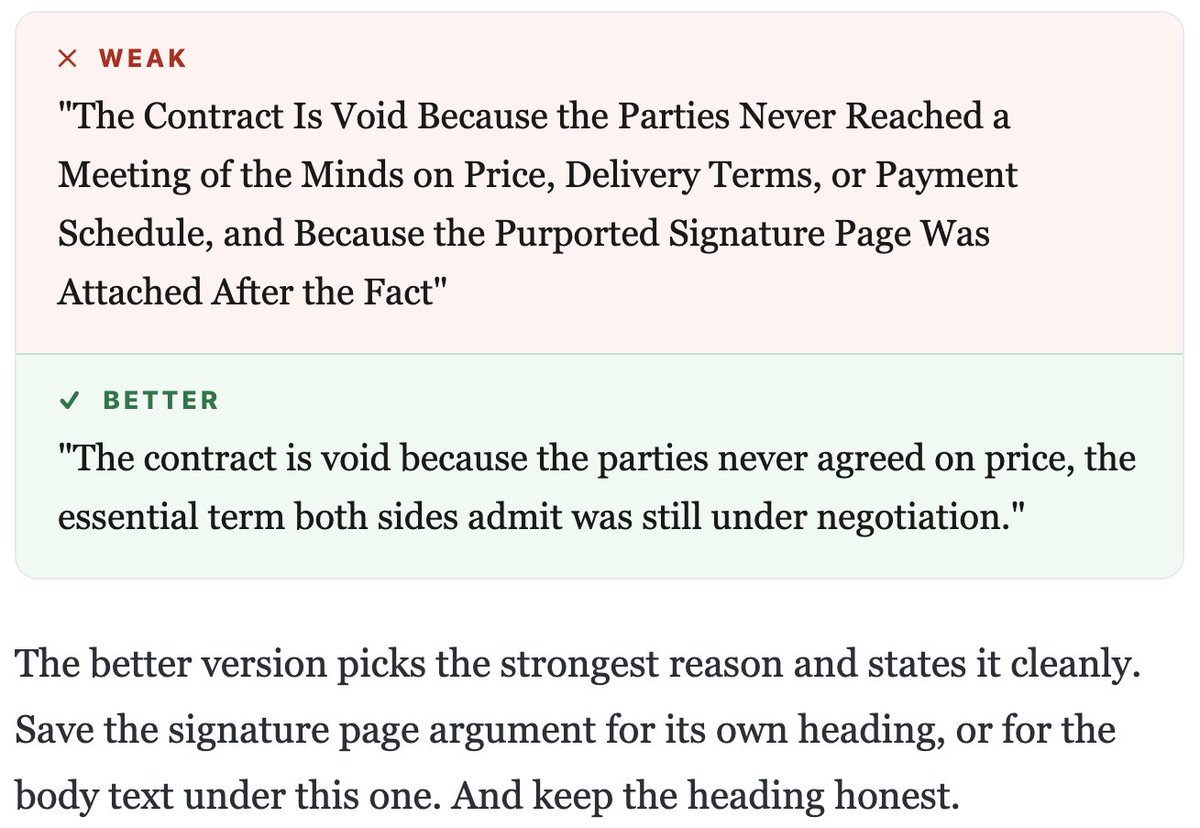
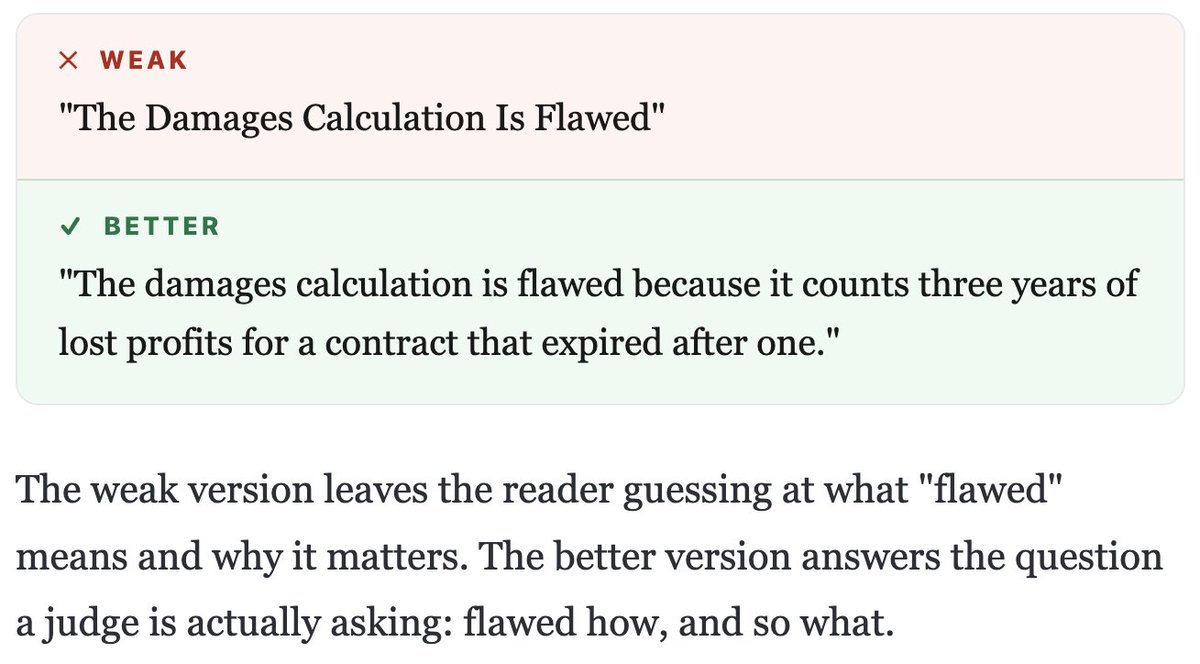
Trim it to the single sentence a judge needs to know what you are claiming and roughly why. 5/6
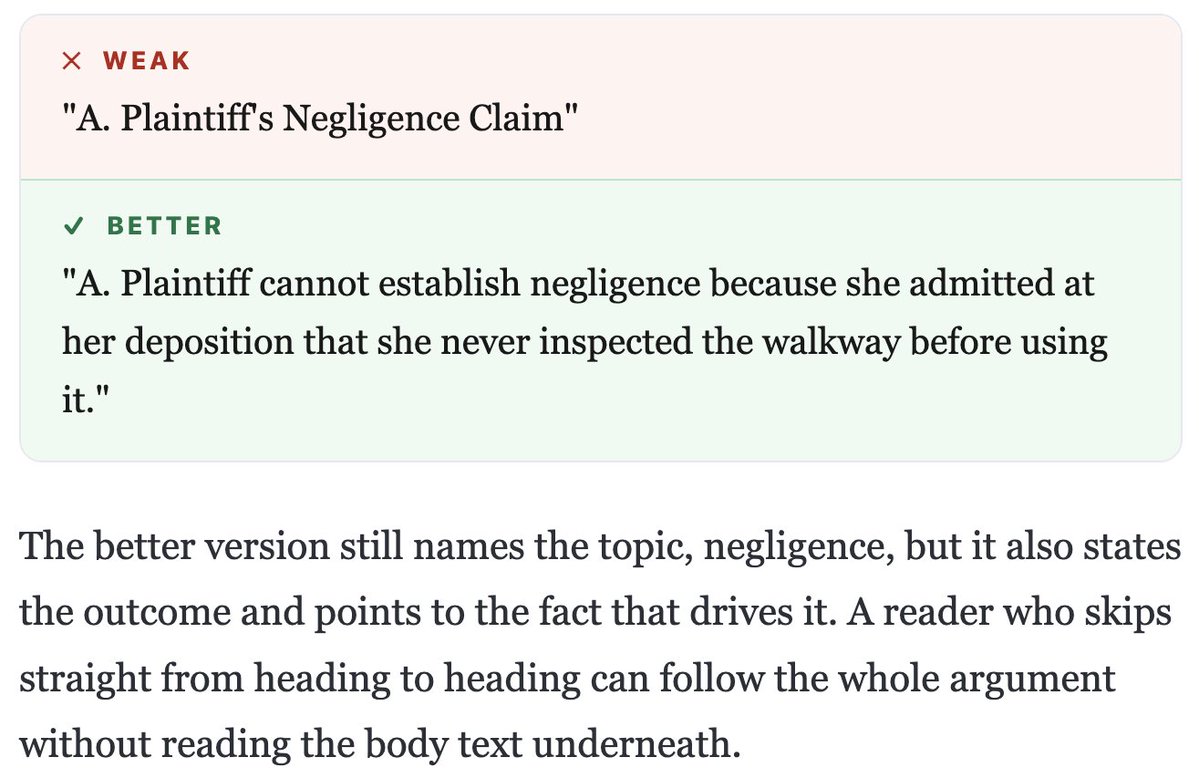
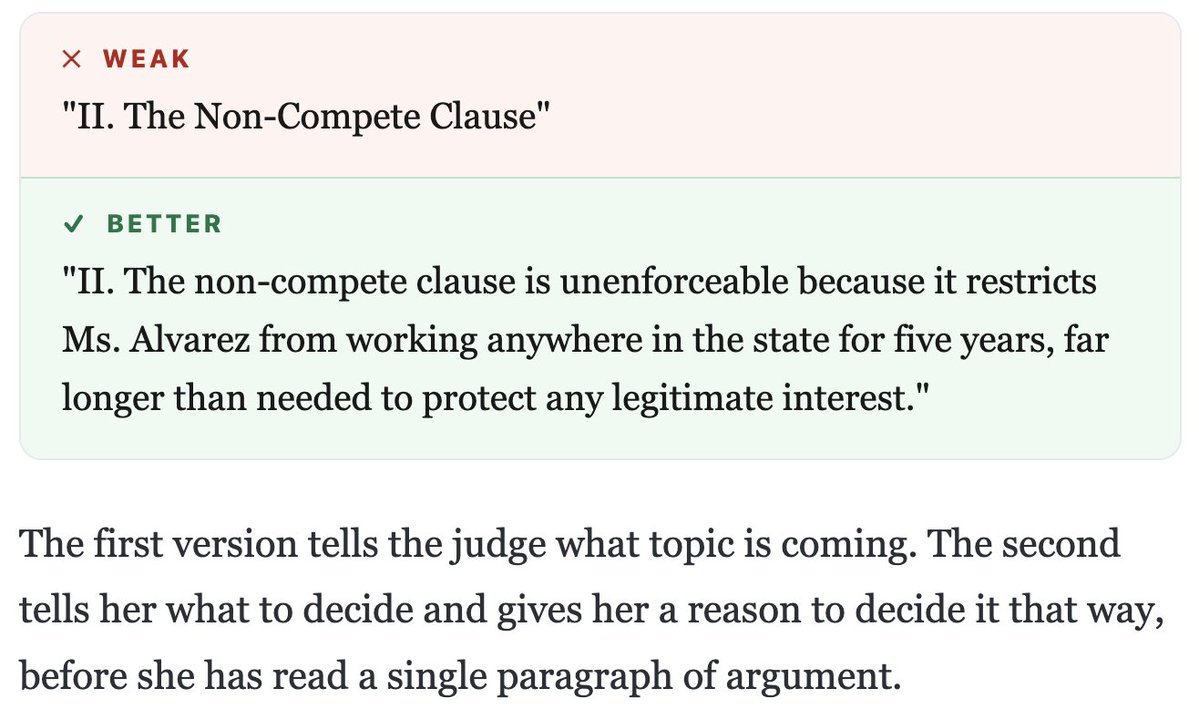
3. Put your conclusion in the heading, not just your topic
The habit to build is simple to describe and hard to practice:
Write the heading last, after you know exactly what you are arguing, and put that conclusion in the first half of the sentence. 4/6
Open a brief and read the table of contents. Most of the time, you’ll find a list of topics, not arguments.
That tells the judge what you plan to cover, but not why you should win.
Here are 4 rules for turning flat headings into arguments a judge could rule on:
2. The flat label versus the argued point
Most flat headings share a pattern. They name a legal issue, a party, or a document, and stop there.
"The Motion to Dismiss." "Defendant's Liability." "The Indemnification Provision." Each one describes a container. None of them tells the reader what is inside. 3/6
1. What a point heading is actually for
Treat every heading as a chance to argue your case to a reader who may never get past the table of contents, and to tell the judge what to do and why, in miniature. 2/6
The unit of that decision is the proposed contribution, not the name of the whole assignment.
You may decide to use AI to compare heading revisions, but you still need to do the rule synthesis yourself.
Plan for both pieces separately. (4/4)
Whether AI belongs in an assignment depends on the kind of help you want.
Suppose a class allows AI feedback after you draft a fictional appointment email.
Asking for two ways to explain the meeting’s purpose is a different use from asking the tool to write your own documents.
Identify the material, the tool’s contribution, and your own review before you upload anything.
If the proposed use presents a concern, you may be able to change it.
Use fictional facts for practice, omit information the task does not need, or ask for feedback on wording after completing the legal analysis. (3/4)