Software Engineer👨🏽💻 at @deporvillage. Former @GoZeelo 🚌, @docmorris_tech, Uvinum/@drinkscoEng🍷. I love cats 🐈 and learning new things 💡. @PheatureFlags
To celebrate the New Year, I'm glad to say that we've a new major update for https://t.co/jMgnaQM7Uo adding support for ARM64 and GPU as well as new options for customization thanks to @holybins 👏👏 Thanks for your contribution and welcome! (1/4)
Cada semana cambia la forma de programar.
Desde que hay la programación agéntica:
- Enero 2025: Cursor añade la barra lateral de Agents.
- Enero 2025: Cursor añade soporte a cursor rules.
- Febrero 2025: Cursor añade soporte a MCPs.
- Marzo 2025: Claude Code lanza el modo plan.
- Abril 2025: Claude Code lanza los slash commands.
- Junio 2025: OpenAI + Sourcegraph + Google proponen el estándar AGENTS.md.
- Octubre 2025: Claude lanza las skills.
- Octubre 2025: Claude lanza los plugins.
- Noviembre 2025: Cursor añade un navegador nativo para poder hacer cambios agénticos.
- Noviembre 2025: Claude Code cambia como funciona el modo plan internamente a usar subagentes.
- Enero 2026: Se viraliza la técnica Loop IA Ralph.
Y esto son sólo alguno de los hitos más relevantes.
Dicho esto, os traemos buenas noticias: Los fundamentos para programar con IA no han cambiado desde que se estandarizaron los AGENTS.md.
Por ello, y después de haber hecho más de 11 ediciones del Workshop de IA para Programar, creemos que es el momento de publicar un nuevo curso: Programación agéntica con IA: Fundamentos prácticos
En este curso:
- 👌 Aprenderás a utilizar los agentes de la forma más eficiente.
- 🤖 Entenderás como funcionan por dentro.
- 🔥 Skills vs MCPs vs Agents vs Doc
Con todo esto podrás mejorar tu Agent Harness y el Progressive Disclosure de tus repositorios.
Todo con ejemplos prácticos que podrás ir probando a medida que vayas viendo los vídeos.
En el curso usamos diversas herramientas agénticas (Claude Code, Cursor, Vs Code + Copilot, Codex, Junie…) para demostrar que la herramienta es más secundaria cuando las bases están bien sentadas.
Y además, hemos aplicado todo lo aprendido impartiendo el Workshop para que quede un curso de 10.
Esperamos que te guste tanto como a nosotros prepararlo. 😊 https://t.co/7SbDSvbxUZ
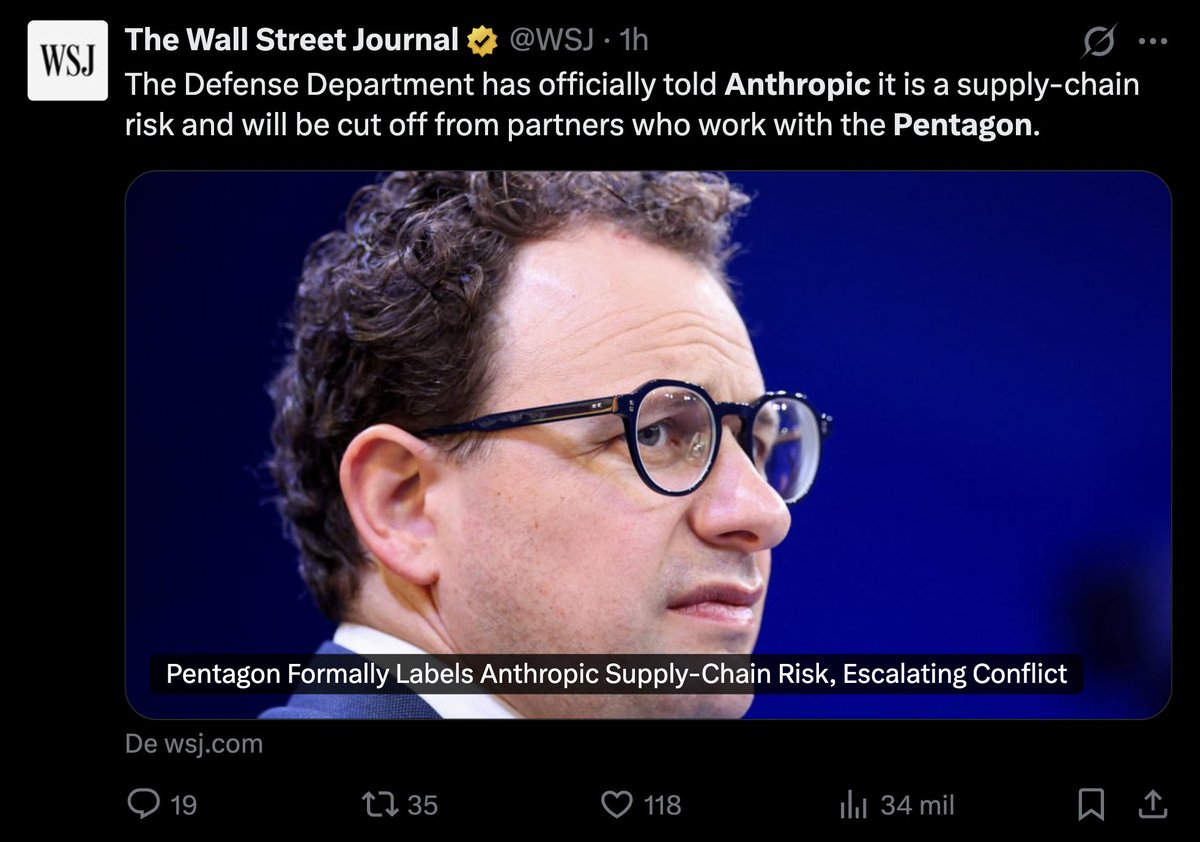
Oficialmente el Departamento de Guerra ha notificado a Anthropic que han sido designados como riesgo a la cadena de suministro.
Llevo la semana viendo gente que interpretaba la oleada de apoyo y el incremento en ingresos como una victoria para Anthropic, pero mi sensación es que la magnitud que esto podría tener en el futuro de la compañía es superior a lo que cualquier apoyo ciudadano pueda suponer.
El precedente ya de por sí es gravísimo. Se les designa así no porque deban serlo, sino como castigo ante la negativa de ceder.
Ahora esto queda abierto a la interpretación que se le quiera dar a esta designación, pero en su versión más dura puede pintar muy feo para Anthropic, que podría caer en un espiral de aislamiento comercial, regulatorio y reputacional. Veremos...
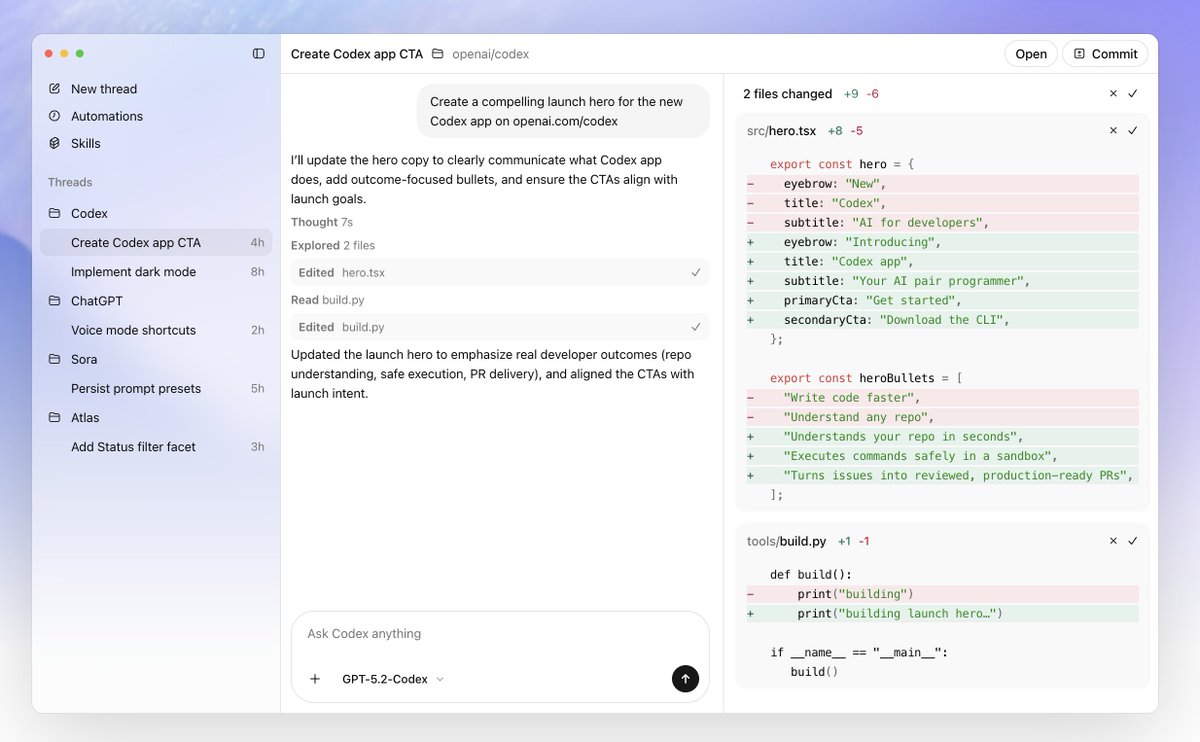
I am Tibo and I have an incredible team. Codex would not exist without them and they cooked.
Enjoy the new Codex app, access through your free/go ChatGPT plan and 2X rate limits on other plans. Can't wait to hear what you do with it.
https://t.co/Lwg13vEJDn
Ghostty nightly now supports the `click_events` extension introduced by Kitty and supported by Fish. If you're using Fish 4.1+, you can click (no modifiers!) anywhere at a prompt to move the mouse. I believe Ghostty is the first to support this extension outside of Kitty.
As far as as I can find, the only shell to support this is Fish (4.1+) and the only terminal to support this previously is Kitty. It'd be great for more of both ecosystems to support this.
Other terminals do support moving the cursor with the mouse to some extent (Ghostty included since 1.0), but do so by another, more fragile mechanism: when you click, it just best-effort calculates a number of synthetic left arrow key inputs to pretend to move your cursor. This is super fragile because it can't take into account shell behaviors particularly around indention, multi-line, and if you're not at a prompt at all...
The `click_events` extension allows Ghostty to know when you're at a prompt line, and works by encoding a mouse click event while at a prompt line to the shell. The shell then takes over and handles all the logic of moving the cursor, which makes the most sense!
PR: https://t.co/CuSropnpgi
@H4ckmanac Yo ya les reporté un fallo de seguridad hace unos meses que exponía una base de datos con las credenciales de acceso.
https://t.co/yc4c6U1935
Good design :
The system has 3 replicas (N=3). You define a write quorum of 2 (W=2).
The user's "paid" status is sent to all 3 replicas, but the system only needs to wait for 2 of them to confirm the write was successful.
The operation succeeds instantly. The third replica catches up moments later when the network is stable. The system is resilient.
🛡️En marxa la primera de les tres sessions del curs 'Utilització de #ChatGPT en Ciberatacs i Ciberdefensa'!
Tornem amb una segona edició, després de l’èxit i l’alta demanda de la primera, a càrrec de l'expert en #ciberseguretat, @gmargarit.
Turns out it wasn't me or my code or my server that broke at 6AM a few days causing Stripe webhooks to fail for https://t.co/9IDc0NslGe causing customers who paid not to get an account
It was @NewRelic and their PHP lib causes SegFaults
Error monitoring software that causes fatal errors 😂
With the addition of Testcontainers, Docker augments a portfolio of tools for developers to strengthen an "inner-loop" of development before the code is handed over to sluggish CI systems. https://t.co/FWHXJ7wFV2 #Containers#Docker
The first beta of CaptainHook (go) is available. I’m already using it for a couple of days. Still a lot of testing to do :)
Now available for Linux, MacOS and Windows (untested for now)
Easily installable via `Homebrew` or `go install`
https://t.co/CgmWLfK38Y
What is API versioning, and why is it important?
It's a critical concept to understand if you're building APIs.
Here's a fun story from a project I worked on.
I was building a public API that had dozens of integrations.
Many (independent) mobile applications use the API to server content.
When your API is serving so many clients, breaking changes are costly.
So, everything I implemented on the public API had to be planned.
❌ Adding a new field?
✅ Forget about it.
❌ Renaming existing fields?
✅ Forget about it.
If I wanted to introduce breaking changes, I had to version the API.
Here are 3 popular ways to do API versioning:
- URL versioning
- Header versioning
- Query parameter versioning
ASP .NET Core supports all of these versioning approaches.
You can learn more about API versioning here: https://t.co/uiB8jNhG6z
Back to the application I was working on.
I used URL versioning on that API.
The default version was v1.
New endpoints would go to v2.
So you can have two instances of the same endpoint:
- api/v1/products
- api/v2/products
The API consumer decides which version they will use.
Sometimes, we had to deprecate old API endpoints.
You first create a new version of the API endpoint.
Then, let your clients know they should move to the latest version.
After a while, you remove the endpoint from the API.
Monitoring the old endpoint usage is helpful here.
You will need API versioning for public APIs.
It's also practical in Microservices architecture.
P.S. If you got value from this post and want to improve your software architecture skills, subscribe to The .NET Weekly - my newsletter with 35,000+ engineers.
Subscribe here → https://t.co/VYvfbj4G2h
How do you version your API?
💖 I'm sponsoring @PHP_CodeSniffer because this is the project that ~10 years ago showed me what's possible to do in #PHP
and eventually lead to me @rectorphp and work... fun I enjoy everyday.
Today, We are working on PHP 8.3 support for Pheature Flags packages 🚀🚀🚀. We are also dropping support for PHP 7.4 👀. Stay tuned. #PHP#PHP83@PheatureFlags https://t.co/oE0nVYDaQa