Introducing AI Character Builder by Xeleb 2049, powered by Xeleb Protocol.
A platform where social profiles transform into living AI characters that chat, learn, and grow with their audience.
Start free now: https://t.co/YOa2g056Wn
Watch the demo in the video ⬇️
More agents do not automatically create more influence.
The real value of a Multi-Agent Influencer Network lies in how effectively those agents coordinate.
One agent may understand audience interests.
Another may interpret conversations and intent.
Another may determine which recommendation is most relevant.
Individually, each agent contributes a specific capability.
But the network becomes significantly more powerful when these agents can share context, align on the same audience understanding, and coordinate their actions.
This creates a capability that is difficult for a single agent to replicate.
Not simply more intelligence in one place.
But intelligence connected across the system.
That means the competitive advantage of a Multi-Agent Influencer Network is not the number of agents it contains.
It is the coordination layer that connects them.
And that coordination layer could become a fundamental piece of the infrastructure powering AI-native influence.
AI Influencers are becoming networks, not personas.
The first generation was built around a single AI personality.
Now the next layer is emerging: Multi-Agent Influencer Networks.
Instead of one agent handling everything, multiple specialized agents can coordinate around the same audience.
One can create content. Another can build context. Another can answer questions, make recommendations, or drive action.
The shift is subtle but important.
The differentiator is no longer the intelligence of one AI Influencer.
It's the coordination between many.
The unit of influence is moving from persona to network.
And that changes what an AI Influencer can become.
AI Influencers are becoming networks, not personas.
The first generation was built around a single AI personality.
Now the next layer is emerging: Multi-Agent Influencer Networks.
Instead of one agent handling everything, multiple specialized agents can coordinate around the same audience.
One can create content. Another can build context. Another can answer questions, make recommendations, or drive action.
The shift is subtle but important.
The differentiator is no longer the intelligence of one AI Influencer.
It's the coordination between many.
The unit of influence is moving from persona to network.
And that changes what an AI Influencer can become.
AI Influencers are expanding where influence can create value.
Traditional influencer marketing is largely concentrated around the attention layer:
Create content → Reach an audience → Influence consideration.
AI-native influencers can extend that model because their role does not necessarily end with the post.
They can remain available to:
→ Answer questions
→ Provide recommendations
→ Personalize interactions
→ Support decisions
→ Connect audiences with relevant actions
This opens a broader opportunity within the customer journey:
From generating attention
to supporting decisions.
For brands, that distinction matters.
An AI Influencer can potentially create value not only through audience reach, but through the quality, continuity, and utility of its interactions.
This points toward a broader shift in influencer marketing:
From campaign-based exposure
to persistent, AI-enabled audience relationships.
And over time, that could change what brands value from impressions and reach to influence that contributes to measurable outcomes.
More AI Influencers does not mean more influence.
As the cost of creating AI-native personalities continues to fall, having an identity is becoming less differentiated.
The next question is what that identity can actually contribute.
An AI Influencer that only produces content competes for attention.
An AI Influencer with utility can become part of how an audience discovers, evaluates, and acts.
That creates a different value proposition:
Knowledge
Providing relevant information and recommendations.
Interaction
Maintaining context across ongoing audience relationships.
Execution
Turning conversations into actions, transactions, or other outcomes.
Economic participation
Creating measurable value within the ecosystems it operates in.
This marks an important evolution in the category:
From digital personality
→ to functional intelligence
→ to economic participant.
As AI Influencer supply expands, the market will become less concerned with how many personas can be created.
It will become more concerned with what they are capable of doing.
Influence creates attention.
Utility creates economic value.
More AI Influencers does not mean more influence.
As the cost of creating AI-native personalities continues to fall, having an identity is becoming less differentiated.
The next question is what that identity can actually contribute.
An AI Influencer that only produces content competes for attention.
An AI Influencer with utility can become part of how an audience discovers, evaluates, and acts.
That creates a different value proposition:
Knowledge
Providing relevant information and recommendations.
Interaction
Maintaining context across ongoing audience relationships.
Execution
Turning conversations into actions, transactions, or other outcomes.
Economic participation
Creating measurable value within the ecosystems it operates in.
This marks an important evolution in the category:
From digital personality
→ to functional intelligence
→ to economic participant.
As AI Influencer supply expands, the market will become less concerned with how many personas can be created.
It will become more concerned with what they are capable of doing.
Influence creates attention.
Utility creates economic value.
AI Influencers are moving from a media experiment to a distinct market category.
The market is already showing signs of meaningful commercial scale.
Market size
According to Grand View Research, the global virtual influencer market is estimated at $14.5B in 2026, up from $11.2B in 2025, with a projected 33.6% CAGR through 2033.
Market structure
The category is also expanding beyond a small number of high-profile virtual personalities.
Grand View Research estimates that human avatars accounted for 69% of market revenue in 2025, while the non-human segment is projected to grow at more than 35% CAGR through 2033.
Where the market is heading
Two layers are developing in parallel:
01. AI Influencers
Synthetic personalities built for content, audience development, and brand monetization.
02. Agentic Influencer Systems
AI systems increasingly supporting the operational side of influencer marketing, including creator discovery, vetting, outreach, campaign management, and performance monitoring.
The broader shift is clear:
AI is entering influencer marketing through both the creator and the infrastructure around the creator.
The category is moving beyond experimentation toward commercialization, specialization, and market formation.
AI Influencers are moving from a media experiment to a distinct market category.
The market is already showing signs of meaningful commercial scale.
Market size
According to Grand View Research, the global virtual influencer market is estimated at $14.5B in 2026, up from $11.2B in 2025, with a projected 33.6% CAGR through 2033.
Market structure
The category is also expanding beyond a small number of high-profile virtual personalities.
Grand View Research estimates that human avatars accounted for 69% of market revenue in 2025, while the non-human segment is projected to grow at more than 35% CAGR through 2033.
Where the market is heading
Two layers are developing in parallel:
01. AI Influencers
Synthetic personalities built for content, audience development, and brand monetization.
02. Agentic Influencer Systems
AI systems increasingly supporting the operational side of influencer marketing, including creator discovery, vetting, outreach, campaign management, and performance monitoring.
The broader shift is clear:
AI is entering influencer marketing through both the creator and the infrastructure around the creator.
The category is moving beyond experimentation toward commercialization, specialization, and market formation.
Influencer marketing is entering its agentic era.
AI started as a tool for creators: writing posts, generating visuals, producing scripts, and analyzing performance.
Now it is moving up the stack.
AI agents can discover creators, evaluate audience fit, handle outreach, coordinate campaigns, track results, and continuously optimize what happens next.
And the shift is happening on the creator side too.
AI Influencer Agents can create content, interact with audiences, remember context, and stay active 24/7.
So we’re not just talking about AI making influencer marketing faster.
We’re seeing both sides of the market become agentic.
The systems managing influence can operate autonomously.
The entities creating influence can operate autonomously.
Put the two together, and the campaign-based model starts to look very different.
Instead of launching a campaign, waiting for results, and doing it again, brands could have intelligent systems continuously finding opportunities, creating interactions, testing what works, and adapting in real time.
That’s a much bigger shift than AI-powered content creation.
Influence itself is becoming programmable, adaptive, and always-on.
And if that happens, the creator economy doesn’t just get bigger.
It becomes an agent economy.
Gen Z Is Raising the Bar for AI Influence
Gen Z is already one of the most influential audiences in the creator economy.
According to NEOREACH’s Creator Impact Report 2026, 69% of Gen Z buy from creators every month.
But there is a clear tension.
Sprout Social’s 2026 Gen Z research found that 56% are more likely to trust brands that publish human-created content.
So Gen Z is highly influenced by creators, while remaining highly sensitive to how that influence is created.
That makes Gen Z an important proving ground for AI Influencer Agents.
The opportunity is not to replace human creators.
It is to build AI-native personalities that can participate in creator culture without sacrificing relevance, transparency, or genuine audience connection.
Because the next generation of influence will not be decided by whether the creator is human or AI.
It will be decided by whether the audience believes the influence is worth following.
AI Influencers have moved beyond content generation.
Faces can be generated.
Videos can be produced.
Scripts can be written.
Campaigns can scale.
The harder problem now is trust.
Can audiences trust the influence behind the content?
For AI Influencer Agents to become more than experiments, they need 5 foundations:
1. Identity
Know who they are and what they stand for.
2. Consistency
Stay recognizable across every interaction.
3. Context
Understand audiences and relationships over time.
4. Transparency
Be clear about where AI is involved.
5. Accountability
Know when human judgment needs to step in.
These foundations turn AI Influencers from content generators into credible digital actors.
The next generation won't win by generating more content.
They'll win by building more trust.
The bottleneck is no longer AI capability.
It's AI credibility.
The next trillion dollar layer of the internet won’t be built by humans clicking through interfaces.
It will be built by agents operating inside them.
Look at where the industry is moving:
Google’s Agent2Agent Protocol is moving into the Agentic AI Foundation, laying the groundwork for agents to communicate across platforms.
NVIDIA is moving beyond agent demos toward deployment, runtime, and enterprise control.
Google is embedding agents into Ads and Analytics.
Meta is building AI tools that help creators and businesses analyze performance, personalize content, and drive commerce.
The pattern is clear.
Agents are no longer being built to sit beside platforms.
They are being built to operate inside them.
Inside search.
Inside advertising.
Inside analytics.
Inside creator workflows.
Inside commerce.
And that changes the opportunity for AI Influencer Agents.
The next generation won’t simply generate content or wear a virtual face.
They will interact with audiences, answer questions, recommend products, build communities, personalize engagement, and turn attention into action.
24/7. At scale.
This is the infrastructure opportunity Xeleb Protocol is building toward: enabling AI Influencer Agents to operate across creators, brands, communities, and digital commerce.
The agentic internet is taking shape across the major platforms.
The next layer is the agents that operate within it.
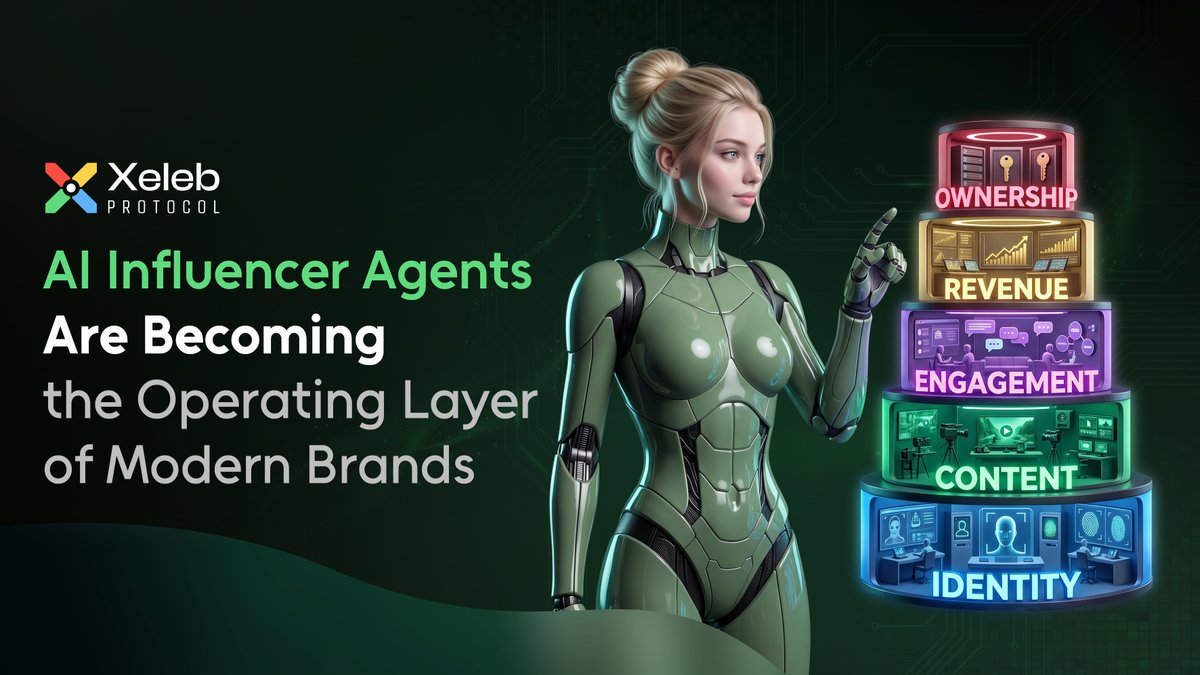
AI is changing how brands build and operate digital identities. AI Influencer Agents are emerging as a new layer between brands, audiences, and commerce.
They combine digital identity, conversational intelligence, memory, and autonomous execution into a persistent brand-facing system.
Instead of appearing only when a campaign runs, an AI Influencer Agent can operate continuously across customer engagement, community, commerce, and content workflows.
Identity becomes interactive.
Influence becomes operational.
Engagement becomes continuous.
This creates a new strategic question for brands: not simply how to access AI-driven influence, but how to build and own the infrastructure behind it.
Because in an agent economy, ownership can extend beyond the persona itself to the identity, intelligence, distribution, and economic activity the agent creates.
The protocol you build on determines what you actually own.
AI Influencer Agents are becoming more than a new form of digital media.
They represent a new model for how intelligence, identity, influence, and economic activity can exist in digital environments.
A complete AI Influencer Agent Economy can be understood through four connected layers:
01. AI Influencer
The identity layer. AI-native personalities that create, communicate, build relationships, and develop influence.
02. Living Intelligence
The intelligence layer. Systems that learn from interactions, adapt to context, and continuously evolve through participation.
03. On-chain
The value layer. A programmable environment for ownership, digital assets, transactions, and verifiable economic activity.
04. Agent Economy
The action layer. AI agents that can coordinate, execute tasks, and participate in economic processes.
The model moves beyond static AI and isolated digital identities:
Identity → Intelligence → Value → Agency
Together, these layers form a framework for an emerging AI Influencer Agent Economy.
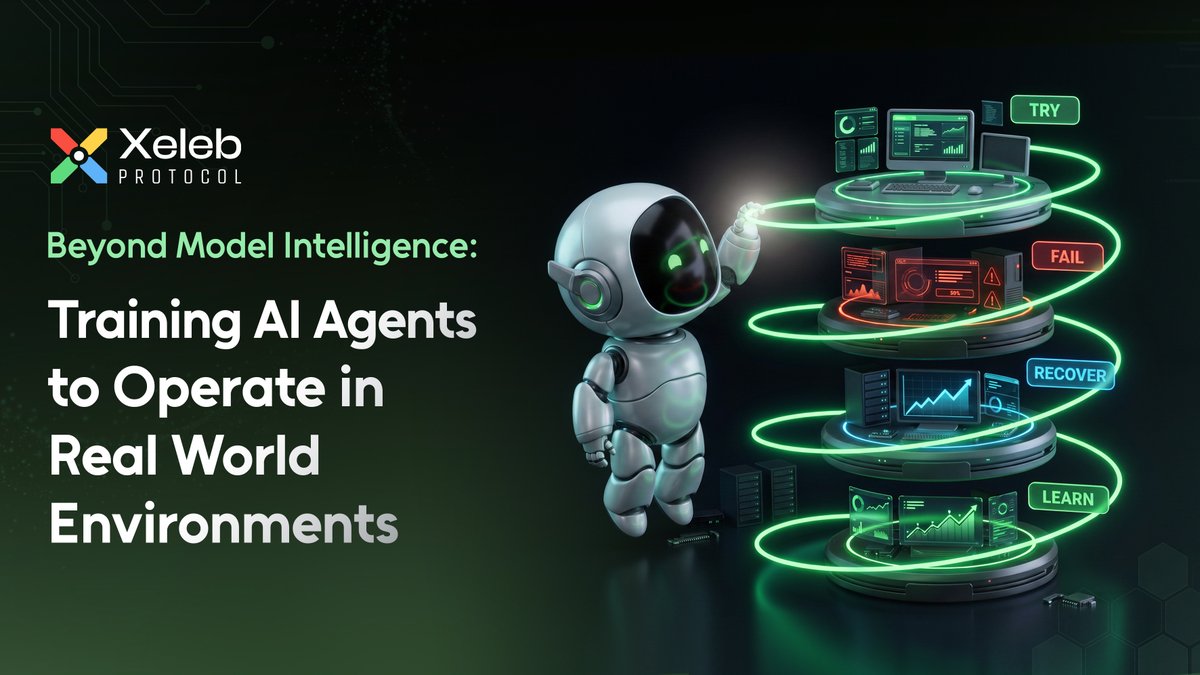
Beyond Model Intelligence: Training AI Agents for Real World Work
AI agents operate in environments that are fundamentally different from those used to train language models.
Language models learn patterns from text.
Agents must learn how to navigate tasks, tools, decisions, and changing conditions.
Real world work involves:
Incomplete information → Multiple tools → Exceptions → Approvals → Recovery → Outcomes
These conditions are difficult to represent through text alone.
Agents therefore need environments where they can act, observe results, recover from failure, and adapt their behavior.
Browser environments, computer use, and simulated workplaces are becoming important components of this development. They provide controlled spaces where agents can learn how tasks unfold and how actions affect outcomes.
The emerging architecture looks increasingly like:
Model intelligence → Environment → Action → Feedback → Work behavior
This creates a broader view of agent capability, where reasoning is one layer and the ability to operate effectively within real workflows becomes another.
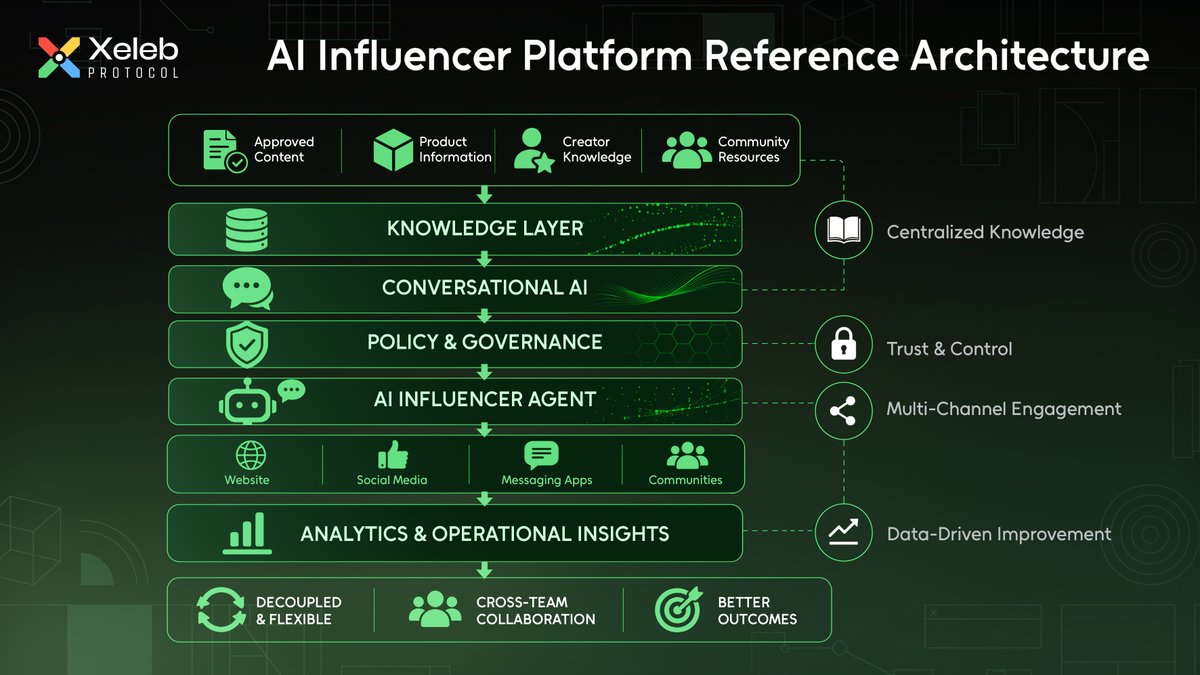
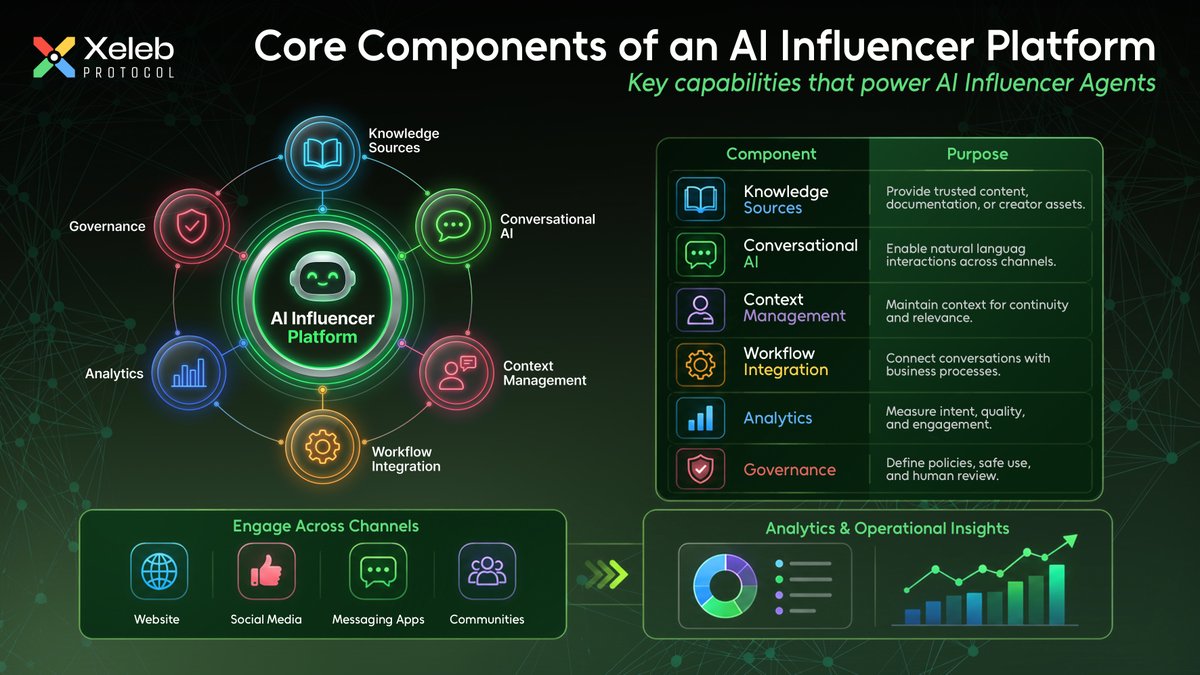
An AI Influencer becomes a scalable product when the systems behind it work as one.
The AI personality is only one layer of the architecture.
Knowledge → Conversational AI → Governance → Agent → Multi Channel Engagement → Analytics
Together, these layers provide the foundation for contextual interaction, controlled execution, cross channel engagement, and measurable outcomes.
The architecture connects the AI Influencer with the infrastructure around it, allowing interactions to move from content → conversation → guidance → action → feedback.
For creators and brand teams, this shifts the focus toward building AI Influencer systems that can operate across the customer journey.
Our latest article explores the reference architecture behind AI Influencer platforms and how its core components work together. 👇
AI Influencer Agents are evolving from content creators into intelligent engagement systems. Discover the architecture, operational model, and capabilities that enable them to support customers across every digital touchpoint. https://t.co/QYT7hxwSDU
Building an AI Influencer starts with the persona. Scaling one requires an architecture.
Once an AI Influencer moves beyond content generation and into real audience interaction, the system behind it becomes increasingly important.
It needs access to reliable knowledge, maintain conversational context, connect interactions to workflows, measure performance, and operate within defined governance boundaries.
These capabilities form the core architecture of an AI Influencer platform:
Knowledge → Conversation → Context → Workflow → Analytics → Governance
Together, they enable an AI Influencer Agent to operate across websites, social platforms, messaging channels, and communities while maintaining a consistent interaction layer.
Our latest article examines these core components and how they fit together to support AI Influencer Agents as scalable engagement systems.
AI Influencer Agents are evolving from content creators into intelligent engagement systems. Discover the architecture, operational model, and capabilities that enable them to support customers across every digital touchpoint. https://t.co/QYT7hxwSDU
AI Influencer Agents are becoming part of the marketing infrastructure.
As AI Influencers evolve into interactive agents, their role extends across the customer journey, connecting social content with websites, commerce, communities, and support.
The resulting workflow can look like:
Campaign → Content Distribution → Audience Interaction → AI Agent → Guidance → Customer Action → Analytics
Each stage creates a new opportunity for marketing teams to understand audience intent, deliver relevant information, and improve the customer experience.
This requires integration across content, knowledge, workflows, customer touchpoints, and analytics.
Explore the next part of the series, “How AI Influencer Agents Transform Brand Marketing Workflows,” for a closer look at how these capabilities fit into the modern marketing stack. 👇
AI Influencer Agents are evolving from content creators into intelligent engagement systems. Discover the architecture, operational model, and capabilities that enable them to support customers across every digital touchpoint. https://t.co/QYT7hxwSDU
AI is no longer a single path.
It’s becoming a network of intelligence connecting different agents and roles toward one connected future.
From isolated intelligence to interconnected agents. ⚡
AI Influencer Agents are evolving from content creators into intelligent engagement systems. Discover the architecture, operational model, and capabilities that enable them to support customers across every digital touchpoint. https://t.co/QYT7hxwSDU
Capabilities will define the next generation of AI Influencer Platforms.
Identity is only the starting point.
Long-term value comes from memory, interaction, orchestration, analytics, and monetization working together as a system.
We take a closer look at these foundational capabilities in our latest article.
Read more 👇
AI influencers are evolving beyond content creation. Discover how AI Influencer Agents combine identity, interaction, and AI to transform creator and brand engagement. https://t.co/LoQTAuYE9D
We explored why this emerging category matters for creators, brands, and the future of AI-native businesses in our latest article.
Read more: https://t.co/iPHFLsOrda
AI influencers are evolving beyond content creation. Discover how AI Influencer Agents combine identity, interaction, and AI to transform creator and brand engagement. https://t.co/LoQTAuYE9D
AI products are no longer converging. They're specializing.
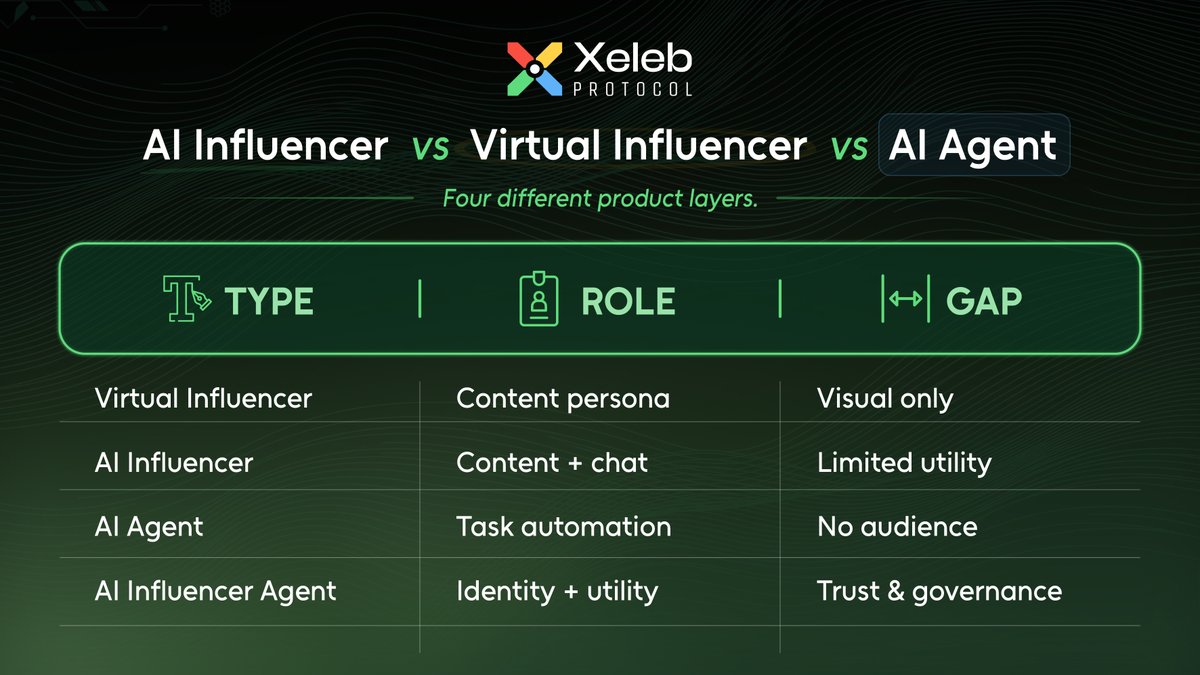
As AI evolves, terms like Virtual Influencer, AI Influencer, and AI Agent are often used interchangeably.
They shouldn't be.
They're different product layers with different capabilities, different goals, and different business models.
→ Virtual Influencer creates attention.
→ AI Influencer creates interaction.
→ AI Agent creates execution.
The next category is where these layers begin to converge:
AI Influencer Agents.
A new generation of AI systems that combine identity, interaction, memory, and utility into a single experience.
It's a shift from creating content to creating continuous engagement.