"Money market" sounds like something only bankers understand.
It's not.
It's just a place where governments, banks, and big companies go to borrow money for short periods.
Your money can be the money they borrow. And they pay well for it.
Here's how. ↓↓
Check your wallet.
Find how much USDT you've held for the last 6 months.
That balance hasn't grown.
It has shrunk in real terms.
Idle dollars protect you from one problem and hand you another. The fix is putting them somewhere they earn while they sit.
Stillness is not safety. (3/3)
The USDT sitting in your wallet is losing value.
Not fast.
Around 4% a year right now, depending on U.S. inflation.
You moved to dollars to stop the bleeding.
The bleeding got slower. It did not stop.
The reason it never fully stops is the part nobody explains. ↓↓
USDT is just a digital wrapper for the dollar.
It holds whatever the dollar holds, including its slow loss of value. The more dollars exist in the world, the less each one buys.
The fix is not which currency you hold.
It is whether the money is working while you do. (2/3)
You find a P2P buyer.
You send your USDT. Then you wait, follow up, and hope they pay.
On Xend, there's no buyer to wait on.
We convert your USDT or USDC to naira and settle it into your Nigerian bank account.
No counterparty. No middleman.
The catch:
You used to need ₦50 million and a relationship manager to access most of these directly.
Today, platforms like Xend pool smaller deposits together and invest them across these instruments on your behalf.
Your ₦50k joins thousands of others and generates yields for you. (3/3)
"Money market" sounds like something only bankers understand.
It's not.
It's just a place where governments, banks, and big companies go to borrow money for short periods.
Your money can be the money they borrow. And they pay well for it.
Here's how. ↓↓
The government borrows through treasury bills. They need cash now, they pay you back in 91-364 days with 18-22% returns.
Banks borrow through certificates of deposit. They need funds to lend out; they pay you for the loan.
Large companies borrow through commercial paper. Short-term funding for operations, paid back with interest.
Every "money market return" comes from one of these three.
But there's a catch most people miss. (2/3)
🇳🇬 Five Nigerians shared their P2P horror stories last month:
• One had her account frozen for 11 days.
• One got fake-alerted twice in one week.
• One lost ₦4.2M to a coin-locking scam on.
• One just gave up and started using Western Union.
• One was kicked from a P2P platform with funds inside.
Advice: Trade on Asset Chain DEX.
🚨 Three things make a money market worth your trust:
• Money that's actually working, not sitting idle
• Proof of where every naira goes
• Returns you can see, not guess at
That's why $1.40B has been put to work across 1,283 investments so far on Xend Money Market.
Your money should be doing the same.
"A payment network is only as useful as the number of people on it." ⌳ Metcalfe's Law
▴ One person with cNGN can do nothing.
▴ 10,000 people with cNGN means a market.
▴ 1 million means an economy.
This is why every new user on Xend makes the platform stronger for the ones already here. 💙
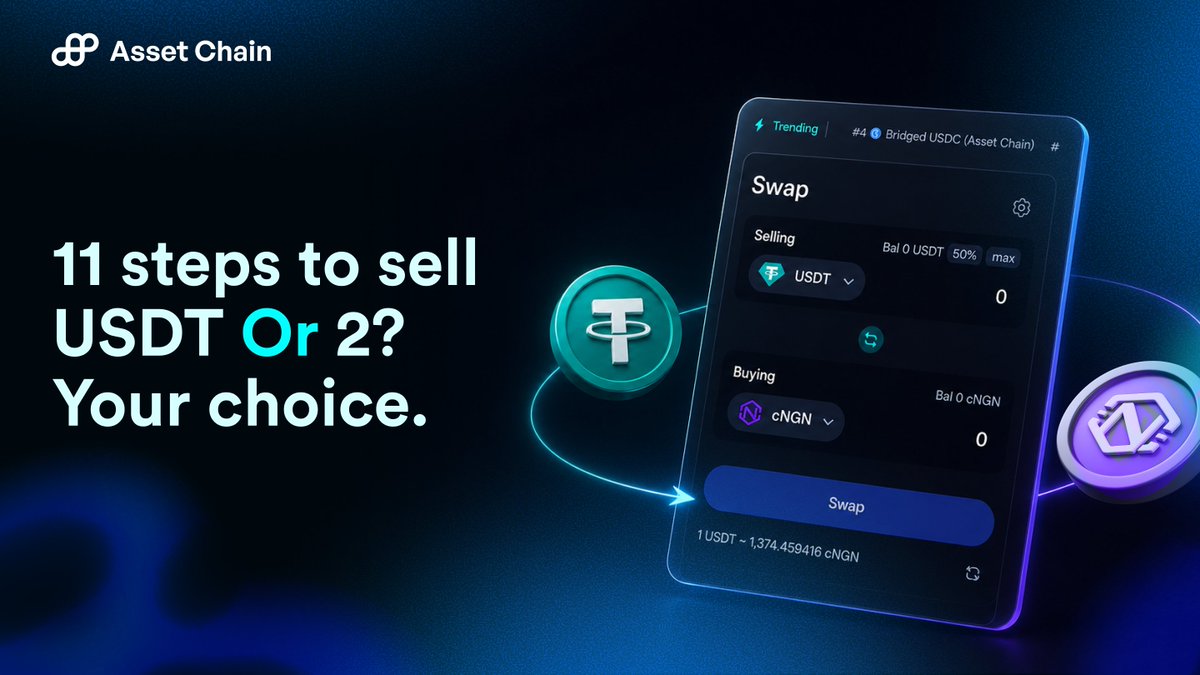
🇳🇬 Selling USDT in Nigeria today:
1) Open a random P2P platform
2) Find a merchant with a good rating
3) Place ad / accept ad
4) Wait for "payment sent"
5) Check your bank app
6) Check your SMS
7) Wait for the real credit alert
8) Verify the amount
9) Verify the sender name
10 Release coins
11) Pray your account doesn't get flagged
🌀 Selling USDT on Asset Chain DEX:
1) Swap USDT → cNGN
2) Withdraw cNGN to your bank via @xendfinance
That's it.
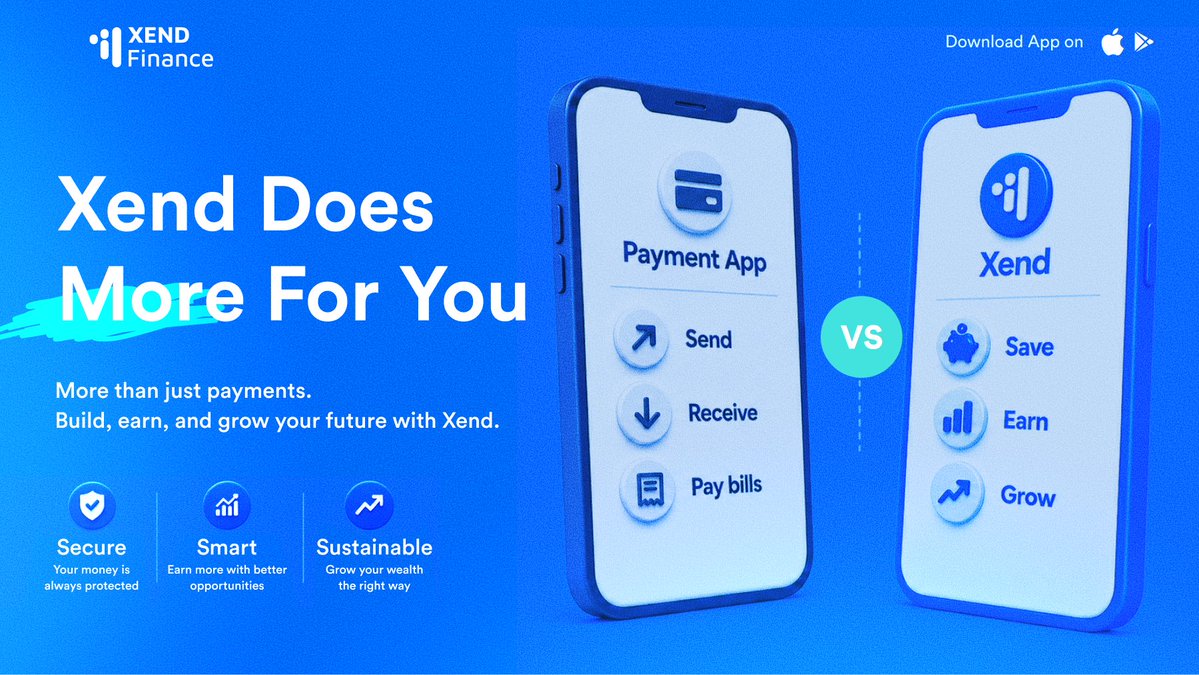
Your payment app moves money. It doesn't grow it.
That ₦500k in your wallet today earned you ₦0.
But it didn't sit still.
Someone earned on it.
Just not you.
Here's where your money actually goes. ↓↓