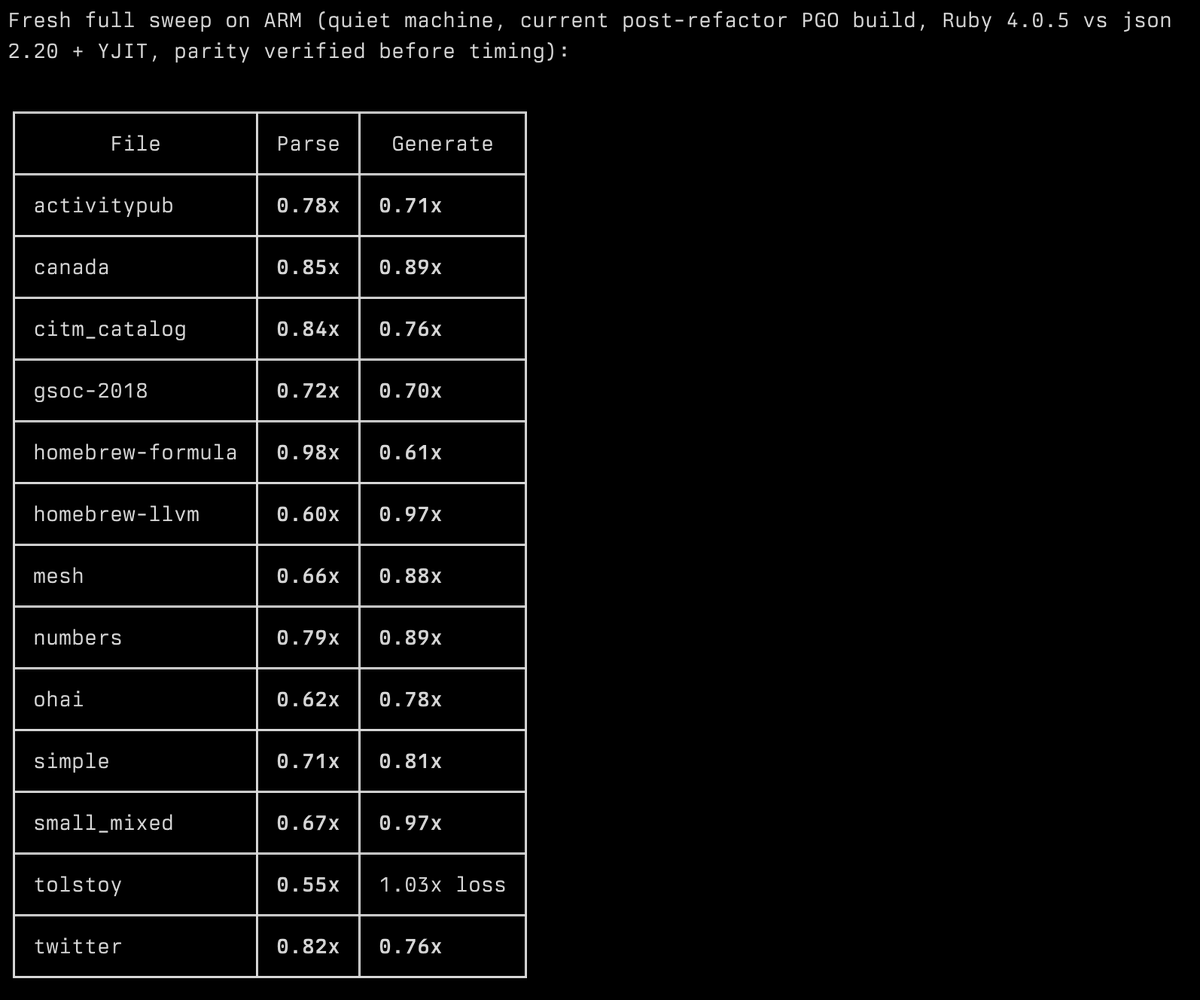
Building a Ruby JSON parser that would be faster than gem json, post-byroot-rework has been my on and off white whale for.. a year and a half now.
Not anymore.
Subscription and payments = Stripe. Stripe = mile-long JSON payloads, webhook bonanza and a dashboard that can take its time. https://t.co/BlvsujNoeX = all your Stripe API calls and webhooks shown in real time in your terminal, easily browsable.
Subscription and payments = Stripe. Stripe = mile-long JSON payloads, webhook bonanza and a dashboard that can take its time. https://t.co/BlvsujNoeX = all your Stripe API calls and webhooks shown in real time in your terminal, easily browsable.
@5katkov@strzibnyj It's in the announce. Put R-actors to work. Kino is "movie"/"film" in Russian and German at least.
Initially the gem was called film because the name was available, but eventually it turned out it was a yanked gem and I wanted to start a-new.
Ractors are experimental in Ruby 4.0, and so is Kino. This is software for experimenters, but one can dream of Ractor support in Rails.
https://t.co/TszNqOIfE8
Rubyists who experiment with Ractors, put them to work! Meet Kino, an experimental performant Ractor web server (with a threading fallback).
https://t.co/Yuod6U3fTM
Ractors are experimental, and so is this server. Rails cannot run on Ractors yet, but it will in the future. 🧵
So is Kino useless for Rails? Well, Rails runs on Kino today in :threaded mode — parallel for I/O, GVL-serialized for CPU; you just don't get the numbers above.