Thanks to the wonder of capitalism roughly 3.5 million people die from lack of clean water, 1.5 million people die from vaccinable diseases, and 9 million people die from hunger each and every year. That's over a 140 million deaths every decade.
https://t.co/o9z9KZNVeD
DeepSeek V4 Flash 0731 in Hermes Agent and one prompt, took 32 minutes and cost 0.07$, this model is so cheap to the point where 2 dollars can last you a full day.
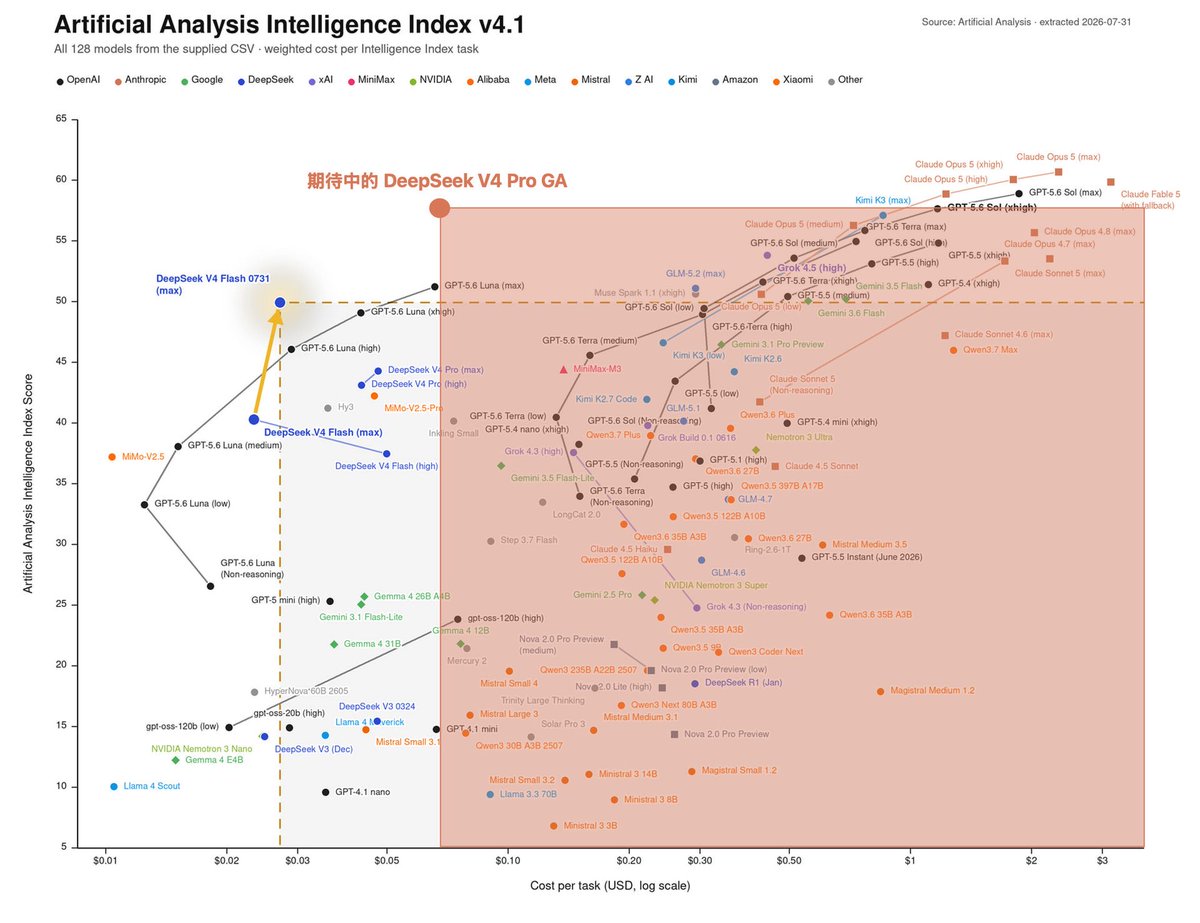
DeepSeek Kill Zone.
Models that are inferior and significantly more expensive should cut spending and be in survival mode ASAP.
Models that are superior but also more expensive or slightly inferior but with comparable pricing can survive a bit longer.
This is just insane. For me the flash release is another DeepSeek moment. Intelligence so cheap and so good that it’s literally too cheap to meter.
Many don’t get how insane this release is.
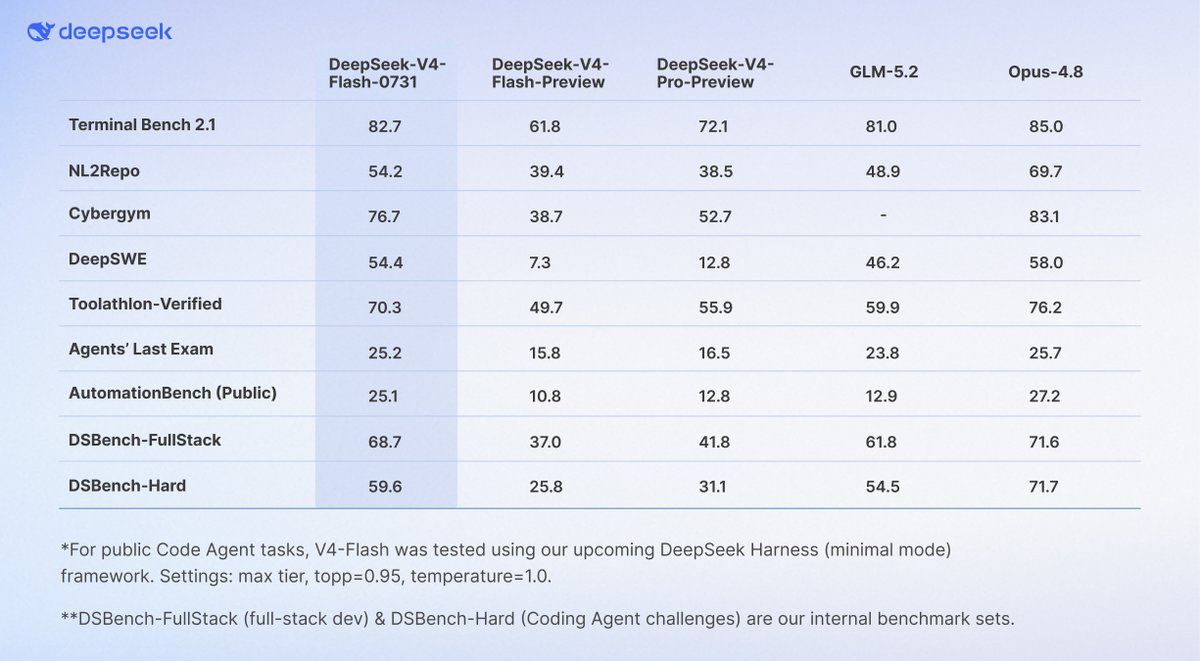
🚀 DeepSeek-V4-Flash Official API is now LIVE in public beta!
🔷 We’ve massively upgraded its Agent capabilities—benchmark scores are now far surpassing the V4-Pro-Preview. Check out the massive performance leap below! 👇
🔷 The official V4-Flash now natively supports the Responses API format and is fully adapted for Codex!
Check out the configuration details in our official API docs: https://t.co/smCwQZMeiq
The ICT Losurdo special issue I co-edited with Jennifer Ponce de León is available open access, and all of the articles can be found here (including two articles by Losurdo): https://t.co/5xb2sFRFwC
The old slow trains have been surpassed by High-Speed trains.
But China isn't getting rid of them. One way they've kept them running, is by making them into themed cars.
These ones run between Tianjin and Beijing.
El 25 de julio de 1984, la cosmonauta soviética, Svetlana Savitskaya, se convertía en la primera mujer en la historia de la humanidad en caminar por el espacio exterior.
La historia de las mujeres soviéticas heroínas de la humanidad que no enseñan en libros occidentales.
Savitskaya viajó al espacio en la nave espacial soviética Soyuz T-7 y permaneció fuera de la estación durante 3 horas y 35 minutos caminando y realizando con éxito trabajos de montaje, cortes de metal y haciendo tambien soldaduras, por primera vez en la historia en el espacio exterior.
Durante casi cuatro horas fuera de la estación Salyut 7, Svetlana estuvo realizando trabajos espaciales en la inmensidad del vacío del universo, demostrando una vez más que las mujeres soviéticas podíar llevar a la humanidad a sus más altas cotas.
Svetlana fue premiada dos veces con el titulo de Heroe de la Unión Soviética y luego fue diputada comunista en el Parlamento Ruso desde 1996.
Can’t win the AI race? Just draw the other side as an ugly cartoon.
Pure sour-loser energy from FT:
Western AI leaders: glossy, heroic headshots ready for a TED stage.
Chinese AI scientist: a cartoon so ugly it looks like it was drawn for a 19th-century pamphlet.
Nothing says “objective journalism” like giving one side the Vogue treatment and the other the cheap caricature treatment.
Japanese robotics engineers concede, after tearing down a Chinese Unitree robot, that Japan can't close the robotics gap with China in the short term — "We are years behind."
Full video published by Nikkei xTECH👇
China promotes Global South access to AI, but at what cost?
One of the most reliable rules in Western journalism is that, when China does something that materially helps the Global South, the story is reported as a cynical manoeuvre and given a name ending in “diplomacy”.
When China shipped billions of Covid vaccine doses to countries the West had left at the back of the queue – while Britain and the US hoarded supplies and blocked the TRIPS patent waiver that would have let poorer countries manufacture their own – this was not a matter of solidarity or public health, but “vaccine diplomacy”.
When China built ports, railways, power stations, fibre networks, hospitals, schools and stadiums across Asia, Africa and Latin America, this became “debt-trap diplomacy” (a narrative which has been comprehensively debunked).
Now, the Financial Times informs us, we face the terrible spectre of “AI diplomacy”.
What does this sinister campaign consist of? China is releasing open-source AI models that developing countries can actually use and adapt; opening application cooperation centres to train thousands of people from the Global South; and establishing the 29-member World AI Cooperation Organisation to give those countries a seat at the table where the rules for the most consequential technology of the century get written.
China’s offer, we are told, is one that developing countries will find “hard to refuse” – as though sharing technology were a protection racket. Apparently the aim is to “build foreign dependence” and to impose Chinese values over the “liberal world order” (incidentally, you have to wonder how “liberal” a world order is when it includes a genocide in Gaza, a criminal war on Iran, an energy blockade on Cuba, and the kidnapping of Venezuela’s elected president).
But consider the alternative on offer. As the article itself concedes, US closed models from OpenAI and Anthropic are simply too expensive for most people in the Global South, and Washington’s rival outfit, Pax Silica, exists mainly to lock down semiconductor supply chains and critical minerals.
So while the US and its allies organise to secure control of chips and the minerals in other people’s countries, China organises to distribute the technology and help countries make use of it. Only one of these is described as a bid for domination, and it isn’t the one hoarding the silicon.
The concern here is not actually that China exploits the Global South. It’s that China is breaking a monopoly. For five centuries the technological frontier has been the private property of a handful of Western powers, and that monopoly is a big part of what keeps the periphery peripheral. In the understanding of the imperialists, a technologically-advanced country that shares technology is not being generous; it’s being disruptive, and therefore must be framed as a threat.
Remember when China built “ghost cities” and our analysts interpreted it as some civilizational failing and then the “ghost cities” filled up with people which was the plan all along, which we couldn’t see because we find the idea of building housing for people incomprehensible
BREAKING! Chinese mathematicians #DengYu, #WangHong awarded #FieldsMedals, becoming the first Chinese recipients of the mathematics' highest honor.
#王虹#邓煜