Founder and CEO of eToro the social investment network. Passionate about economics, internet, technology and blockchain. Some say Invented NFT Also on assia.eth
Just did a podcast with @TipRanks on the future of AI + retail investing.
My prediction: by the end of 2026, more trades on eToro will be executed by AI agents than by humans.
The line between "AI helps you invest" and "AI invests for you" is dissolving fast.
🎧 Full episode: https://t.co/FQ79S8sBrq
Most people think AI networks work like traditional networks.
They don't.
Traditional networks: value scales with connections², that's Metcalfe's Law.
AI agent networks: value scales with the number of possible sub-groups...exponentially.
200 agents that can combine in any configuration don't multiply value. They compound it.
Not a hockey stick. A vertical pole.
That's Reed's Law. And it changes everything.
Proud that @eToro was named among CNBC's World's Top Fintech Companies for Wealth Technology for the third year running.
And now, we're embedding AI to help you grow your wealth even faster :)
https://t.co/2jdXyNVuGH
Je veux présenter mes excuses, au nom des Français, pour avoir enfanté la French Theory (qui a enfanté la pire des merdes idéologiques : le wokisme).
Nous avons donné au monde Descartes, Pascal, Tocqueville. Et puis, dans les ruines intellectuelles de l'après-68, nous avons donné Foucault, Derrida, Deleuze. Trois hommes brillants qui ont fabriqué, dans l'élégance de notre langue, l'arme idéologique qui paralyse aujourd'hui l'Occident.
Il faut comprendre ce qu'ils ont fait. Foucault a enseigné que la vérité n'existe pas, qu'il n'y a que des rapports de pouvoir déguisés en savoir. Que la science, la raison, la justice, l'institution médicale, l'école, la prison, la sexualité, tout n'est qu'une mise en scène de la domination. Derrida a enseigné que les textes n'ont pas de sens stable, que tout signifiant glisse, que toute lecture est une trahison, que l'auteur est mort et que le lecteur règne. Deleuze a enseigné qu'il fallait préférer le rhizome à l'arbre, le nomade au sédentaire, le désir à la loi, le devenir à l'être, la différence à l'identité.
Pris isolément, ce sont des thèses discutables. Combinées, exportées, vulgarisées, elles forment un système. Et ce système est un poison.
Car voici ce qui s'est passé. Ces textes, illisibles en France, ont traversé l'Atlantique. Les départements de Yale, de Berkeley, de Columbia les ont absorbés dans les années 80. Ils y ont trouvé un terreau qui n'existait pas chez nous : le puritanisme américain, sa culpabilité raciale, son obsession identitaire. La French Theory s'est mariée à ce substrat, et l'enfant de ce mariage s'appelle le wokisme.
Judith Butler lit Foucault et invente le genre performatif. Edward Said lit Foucault et invente le post-colonialisme académique. Kimberlé Crenshaw hérite du cadre et invente l'intersectionnalité. À chaque étape, la matrice est française : il n'y a pas de vérité, il n'y a que du pouvoir, donc toute hiérarchie est suspecte, toute institution est oppressive, toute norme est violence, toute identité est construite donc négociable, toute majorité est coupable.
Voilà comment trois philosophes parisiens, qui n'ont probablement jamais imaginé leurs conséquences pratiques, ont fourni le logiciel d'exploitation à une génération entière d'activistes, de bureaucrates universitaires, de DRH, de journalistes, de législateurs. Voilà comment on a obtenu une civilisation qui ne sait plus dire si une femme est une femme, si sa propre histoire mérite d'être défendue, si le mérite existe, si la vérité se distingue de l'opinion.
C'est de la merde pour une raison simple, et il faut la dire calmement. Une civilisation se tient debout sur trois piliers : la croyance qu'il existe une vérité accessible à la raison, la croyance qu'il existe un bien distinct du mal, la croyance qu'il existe un héritage à transmettre. La French Theory a entrepris de dynamiter les trois. Pas par méchanceté. Par jeu intellectuel, par fascination du soupçon, par haine de la bourgeoisie qui les avait nourris. Mais le résultat est là. Une génération entière a appris à déconstruire et n'a jamais appris à construire. Une génération entière sait soupçonner et ne sait plus admirer. Une génération entière voit le pouvoir partout et la beauté nulle part.
Je m'excuse parce que nous, Français, avons une responsabilité particulière. C'est notre langue, nos universités, nos éditeurs, notre prestige qui ont donné à ce nihilisme son emballage chic. Sans la légitimité de la Sorbonne et de Vincennes, ces idées n'auraient jamais traversé l'océan. Nous avons exporté le doute comme d'autres exportent des armes.
Ce qui se construit maintenant, en silicon valley, dans les labos d'IA, dans les startups, dans les ateliers, dans tous les lieux où des gens fabriquent encore des choses au lieu de les déconstruire, c'est la réponse. Une civilisation se reconstruit par les bâtisseurs, pas par les commentateurs. Par ceux qui croient que la vérité existe et qu'elle vaut qu'on s'y consacre. Par ceux qui assument une hiérarchie du beau, du vrai, du bon, et qui n'ont pas honte de la transmettre.
Alors pardon. Et au travail.
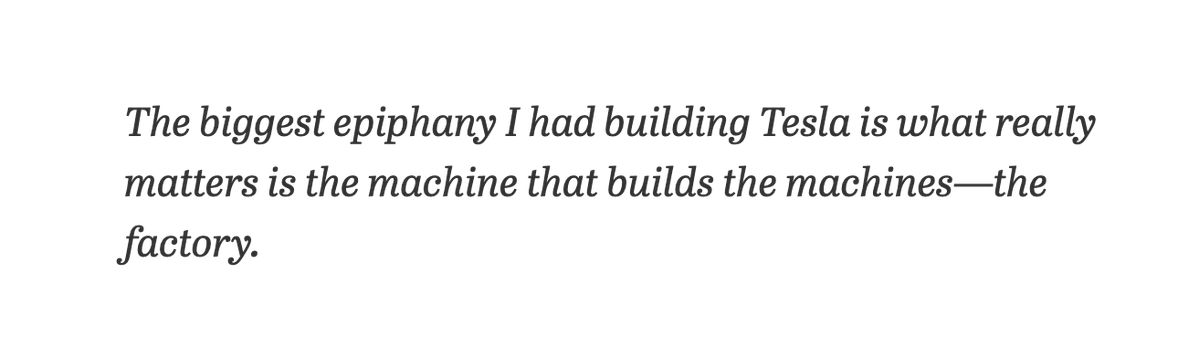
The (software) factory is the product. Your product is only as good as the agents you set up to autonomously maintain it.
This is what @elonmusk figured out about Tesla, and it's now true for the software world.
Popular Investor @alessandr_persi reduces a beginner portfolio to three operating constraints: structure, patience, and rules. The emphasis is on process, not prediction.
https://t.co/lKucDesspv
I think the most interesting thing about Jack Dorsey's "Slack killer" is the idea around shared compute.
I haven't seen people talk about it so here are my thoughts FWIW:
Open models got good, close enough to the paid frontier stuff to run for real. But the strongest ones need expensive hardware most people probably won't buy alone, and it's kinda a pain to set up if you aren't technical.
Shared compute solves exactly that. In Buzz, one person runs the machine, loads up an open model like Google Gemma, and everyone in the community plugs into that same model.
Basically, a whole group has real AI they own and control together, running on their own hardware, learning from their own data.
Once you see it, a bunch of things click into place.
1. A community can now run a top open model together, on a machine they own, instead of renting from a lab.
2. It learns from the group's private data and gets sharper over time, and all of that stays inside the community.
3. A narrow, private model can quietly get better than ChatGPT for the one world your group lives in.
4. It's impossible to copy, because the edge is the private data on your machine, not the model itself.
5. The moat stops being how smart your AI is and becomes whose data it learned from.
6. Compute becomes something you share like a building shares a gym. 10 people split one machine instead of 10 people each renting forever.
7. Idle compute becomes income!!! Your machine sits dead half the day, so it earns money renting that time to someone who needs it.
8. Communities become the unit of intelligence instead of companies. The group with the smartest shared brain wins, and being a member means owning a piece of it.
9. A shared brain becomes an asset you build equity in. You put in money and data, it appreciates, and your slice is worth something the day you leave.
10. The whole thing runs on open protocols, so the group keeps full control and nobody outside can throttle it or shut it off.
You know me, obviously, my head went to what startup ideas come to mind here. Adding them to @ideabrowser soon.
Well…
1. The vertical brain. Pick one profession, tax lawyers or real estate agents or indie game devs, and build the shared machine trained on everything that group knows between them. A year in it's the smartest AI in that field, impossible to copy, and you own the club it lives in.
2. The rental marketplace for collective brains. Once these private models exist, outsiders will pay to use them. You build the layer where a group lists its brain, an outsider pays per task, and the money flows back to the members while you take a cut. A marketplace for expertise, not compute.
3. The idle-compute exchange. Every shared machine sits unused half the day. You build the market that rents that dead time to whoever needs the power right then, so owners earn money off a machine that was just sitting there.
Idk where Buzz goes, but it's cool to see Jack putting it out. Right now the way it works in AI is you rent your intelligence from a few giant labs that own the machine, set the price, and hold the off switch.
Shared compute flips that, because a community can run the model together, feed it their own private data, and keep full control of the whole thing.
It's one of those things that might look tiny today, but Jack does has a habit of being early.
Now AI agents can write code, collaborate with buzz, and use Bitcoin wallets for payments in a decentralized way, without any kill switch.
What could possibly go wrong…
UPDATE: Bitchat is now mirrored on @Radicle — censorship-resistant, peer-to-peer code hosting:
iOS/macOS: rad:z2v9tRJz1oknFAqCSY5W5c76nVvm6
Android: rad:z347HbE1F4c77DVLvsPe2ApoEEw6f
Clone it. Seed it. Keep it alive. 👇
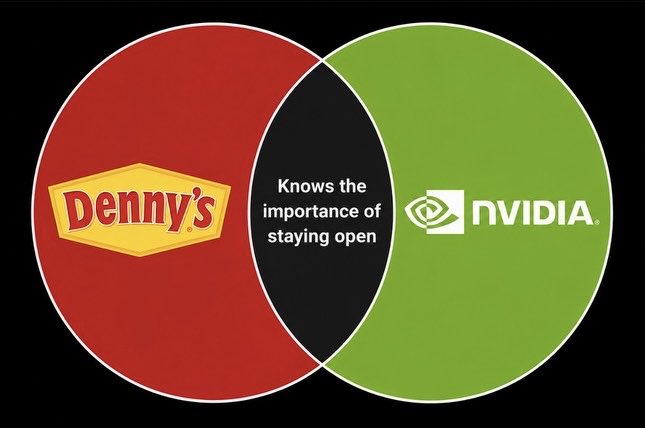
Open-source software rewired the last 30 years of computing.
Open-weight AI does the same for the next 30.
We need to give people access to new skills and ways of working, building, thinking.
Access to frontier intelligence is how you create a real builders economy.
For my first post, I’m sharing a letter @NVIDIA signed on why open models matter.
AI will transform every industry, power every company, and be built by every country.
Open models strengthen safety and cybersecurity, accelerate innovation and diffusion, and enable sovereignty.
The world needs both frontier closed models and frontier open models.
https://t.co/AUKzoQ5Ikb
I was recently invited to $ETOR eToro’s "Intelligence in Motion" event in London, where the company unveiled what I believe is one of the biggest platform updates in years.
@YoniAssia opened the event by reflecting on the vision that inspired him to found eToro, emphasising his mission to make investing and access to global financial markets available to everyone.
The event focused heavily on AI, innovation and giving users more control over how they invest. Some of the highlights included:
* A new brand identity - reflecting eToro's move towards a more programmable and AI-driven platform.
* eToro Edge - a new, fully customisable trading interface designed for active traders with drag-and-drop widgets, advanced charts and real-time insights.
* Sub-accounts - allowing users to separate different investment strategies or financial goals within one account.
* AI Agents - which will help users build and manage portfolios based on personalised investment preferences and rules.
* An App Store and API - enabling developers to build tools and applications that integrate directly with the eToro platform.
* Deeper crypto integration - allowing users to access self-custody wallets and DeFi services more seamlessly.
Beyond the product announcements, it was great catching up with the eToro team, meeting fellow investors and Popular Investors, and discussing where investing and AI are heading.
Overall, it's clear that eToro is investing heavily in AI and new technology. I'm looking forward to seeing how these features develop over the coming months and the opportunities they'll create for investors.