Follow me to learn about Crypto Sound Money | Build better money before fiat fail | Co-founder @HacashCom, not Hacash | @ns @ThreeDAOspace @BTCStartupLab alumni
Everyone wants to be a settlement layer now.
Institutions.
Public chains.
Stablecoin networks.
But most are still settling fiat-backed assets.
In 2018, an anonymous behind Hacash had already pointed to something deeper:
a native crypto settlement network.
Non-custodial.
PoW-based.
Built for value transfer.
It also placed Bitcoin inside a broader monetary system, not outside the discussion.
Eight years later, the market is finally catching up.
The real question is not only who settles stablecoins.
It is what settles crypto sound money.
“Make Ethereum the settlement layer of the global economy” sounds powerful.
But the real question is: Settlement layer for what?
If the final settlement asset is USDT/USDC, Ethereum becomes the settlement layer for stablecoins, not the monetary layer of the global economy.
ETH may be the most important asset inside Ethereum, but being gas, collateral, or programmable store of value is not the same as being money.
A global settlement layer needs a native monetary unit with settlement finality, purchasing power logic, and monetary neutrality.
This mission sounds familiar because crypto has been chasing it for years.
In 2018, Hacash already framed the problem directly:
Large-scale payments and real-time settlement.
The hard question was never only “which chain settles assets?”
The hard question is: What is the money being settled?
Final day to apply for HACD Labs Season 2.
We have received 40+ builder applications.
Now we are reviewing every one carefully.
If your idea makes sense, fits HACD Stack, and shows real builder commitment, we will reach out through your X account first.
Please check your DMs over the next few days.
Selected projects will have the chance to launch on HACD Launchpad.
Not selected this time? No worries.
More seasons are coming.
Apply: https://t.co/lnXvDAumi9
Money has three functions:
> Store of Value
> Medium of Exchange
> Unit of Account
Bitcoin became the strongest crypto-native Store of Value. Stablecoins became the dominant onchain Medium of Exchange and Unit of Account.
But one is not used as money every day. The other is not crypto sound money.
The next frontier is obvious: a crypto sound money that can do all three.
@zalemost Yeah, I think this is the key difference. ETH started from computation and later tried to become money. Hacash started from the money problem first. That sounds simple, but it changes almost everything in the design.
I was surprised by this Hacash vs Ethereum comparison.
A lot of Ethereum “upgrades” are trying to patch problems created by its original architecture:
> approve / transferFrom risk
> account abstraction complexity
> state bloat
> opaque signing
> MEV / sandwich attack surface
> reentrancy
> proxy upgrade risk
> token standard fragmentation
> gas estimation pain
But Hacash seems to approach many of these from a different starting point. Not “add another EIP.” But redesign the transaction and asset layer itself:
> native asset actions
> multi-action atomic transactions
> protocol-level multi-asset support
> declarative transaction bodies
> storage rent
> P2SH-style custom verification
> native account abstraction hooks
> readable signing intent
The most interesting part to me is not that Hacash is “more flexible” than Ethereum.
It is almost the opposite.
Ethereum maximized general-purpose programmability first, then spent years managing the complexity created by that freedom.
Hacash appears to make a different bet: make the most important asset operations protocol-native, auditable, atomic, and harder to abuse by default.
Less arbitrary flexibility at the base layer. More structural safety for money and assets.
This is exactly the kind of architecture worth studying if we are thinking beyond “smart contracts” and toward Crypto Sound Money infrastructure.
https://t.co/SflTAZC1Oc
Bitcoin’s monetary experiment took around 8 years to truly explode. The trigger was not only ideology. ETH ICOs gave people a way to create, own, and capture upside.
Hacash has now run its monetary experiment for 7 years. HACD makes PoW pluggable, stackable, and attachable to any asset.
Its fair distribution slowed early growth, but HACD-native PoW issuance may now give builders the same thing ICOs gave in 2017: controllable upside.
Maybe history rhymes. Watching closely.
HACD Labs Incubator Season 2 is open.
This is a 7-day launch sprint for builders who want to form new assets on HACD.
Up to 10 projects will be selected and launched on HACD Launchpad.
The Top 5 successfully launched projects will each receive 100 USDT.
Timeline: June 24 — July 1
Apply Now: https://t.co/cBOmxB98lb
“Make Ethereum the settlement layer of the global economy” sounds powerful.
But the real question is: Settlement layer for what?
If the final settlement asset is USDT/USDC, Ethereum becomes the settlement layer for stablecoins, not the monetary layer of the global economy.
ETH may be the most important asset inside Ethereum, but being gas, collateral, or programmable store of value is not the same as being money.
A global settlement layer needs a native monetary unit with settlement finality, purchasing power logic, and monetary neutrality.
This mission sounds familiar because crypto has been chasing it for years.
In 2018, Hacash already framed the problem directly:
Large-scale payments and real-time settlement.
The hard question was never only “which chain settles assets?”
The hard question is: What is the money being settled?
Announcing Ethlabs: a non-profit R&D lab for Ethereum and ETH
Our mission is to make Ethereum the settlement layer of the global economy.
The internet became global because shared protocols created a common language between networks. Private systems remained useful, but bounded. Finance is approaching a similar moment. As value, assets, and markets become digital, the world needs shared settlement infrastructure.
Ethereum is uniquely positioned to become that shared base layer, the neutral foundation on which users, institutions, and agents can transact without intermediation.
What we believe:
• We believe credible neutrality matters. Ten years of uptime and the lowest counterparty risk. Ground that cannot be pulled away by any one country, institution, company, or person.
• We believe ETH matters. The most valuable, programmable store of value. A decade of broad distribution, deep liquidity in onchain markets, and maximally trustless asset on Ethereum.
• We believe DeFi matters. Markets, liquidity, credit, exchange, and coordination, open to anyone.
• We believe adoption matters. Principles do not change the world until people benefit from them.
We sit between two worlds: real usage from the builders at the frontier, and the protocol that has to support it. We work with users, applications, wallets, L2s, infrastructure teams, institutions, ETH holders, core devs and researchers, then turn what they actually need into protocol work, shared standards, infrastructure, and shipped products.
Ethlabs is independent but Ethereum is a shared project. We are one node in a much larger network of stewards. This is the multi-node future.
We have spent the better part of the past decade contributing to Ethereum core research and development.
We are opinionated and transparent. We move with urgency, learn in public, and course-correct when we’re wrong.
We are building a lean, talent-dense team for people who want to do the most important work of their careers: [email protected]
Moneyness is not a single spectrum.
It is a barrel made of many spectrums.
One long board can create a narrative.
One short board can destroy monetary status.
This is what feels new about HACD.
You don’t have to only grow the whole token.
You can focus on making the exact HACD you own more valuable.
Stack something valuable on it.
Build value onto your own coin.
NUEEEU shows what makes $HACD Stack different.
Stacking a high-quality asset on HACD does not only create a new asset.
It can also increase the value of the HACD itself.
NUEEEU started with Cyberpunk Disk at 46 $HAC.
Now, the same HACD has attracted offers worth hundreds of HAC.
Asset and base asset grow together.
https://t.co/7Bq9S3dorz
Fun fact: Ethereum launched in 2015 with 72M pre-mined ETH.
In 2026, that genesis allocation still represents about 60% of the entire ETH supply.
Every EF governance drama should remind people:
ETH did not start from zero.
⚠️ALERT: ETHEREUM'S $30 MILLION A YEAR DEV BUDGET IS ABOUT TO DRY UP
Former Etherum Foundation contributor Trent Van Epps warns $ETH's core development could face a funding crisis within 3 to 9 months.
The Client Incentive Program that funded those teams expired in April with no replacement.
The EF is also cutting its own treasury spending from 15% to 5% a year.
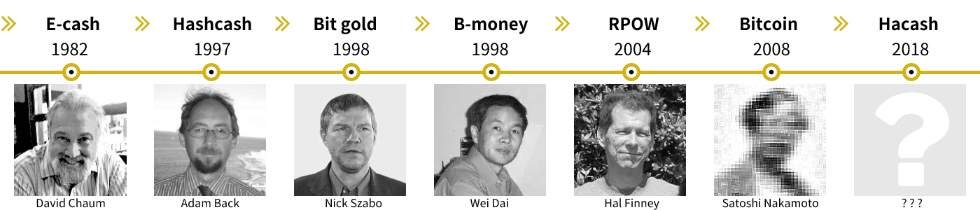
@RdvanBo43891036 Monetary innovation is slow because it requires both deep understanding of money and hard engineering. Bitcoin solved P2P cash in 2008 but left the deeper properties untouched.
Bit gold explored digital scarcity and store of value.
B-money explored non-sovereign digital money with stable purchasing power.
Bitcoin proved peer-to-peer electronic cash could work.
Hacash brings these three cypherpunk ideas into one monetary system:
> HACD as PoW store of value.
> HAC as adaptive purchasing power money.
> BTC one-way transfer as a way to bring BTC into the monetary adjustment system.
Hacash is one of the most important cypherpunk experiments still overlooked.
@zalemost Yes, absolutely. I’m writing the book first to build the intellectual foundation. After that, podcasts and conferences will follow as the idea gains wider acceptance. Either way, I’ll keep spreading Crypto Sound Money until more people understand why it matters.
I've been in crypto since 2013, and can say with certainty that this is the worst period for the industry in terms of number of teams closing shop, leaving, running out of money and cutting costs (we ourselves did that a couple of months ago).
Which makes me more hopeful than ever. With every past downturn we'd look around and say "the bright side is that some shit projects will finally get closed" but that hasn't happened. Till now.
I'm not saying that the projects that are closing shop aren't good. That's not the case. Some are amazing and I'm really sorry to see them struggle and close. But for the next summer to bloom, there will need to be cuts. This is good for the industry.
And where will the next wave of excitement come to crypto from? This is my thought and hope and what I'm working on.
It's not going to be AI.
It's not going to be Corpo stuff.
It's freedom of financial innovation. That's what I'm working on and believe in and am excited about.
What's your take?
ETH and SOL are not simply “money.” They are programmable network assets.
They pay for gas, secure execution layers, and capture ecosystem demand. That makes them valuable.
But being valuable is not the same as being sound money.
Most people classify crypto by sectors: L1 / L2 / DeFi / AI / RWA / Meme / Stablecoins.
I think this misses the deeper question: What is the monetary status of the asset?
From a Crypto Sound Money lens, Crypto Sound Money is not a coin category. It is the end-state standard. Every crypto asset is either a candidate, a monetary function experiment, or something else.
A better monetary classification looks like this:
> Crypto Sound Money Candidates
> Monetary Function Experiments
> Onchain Fiat / Stablecoins
> Programmable Network Assets
> Protocol Equity Assets
> Non-Monetary Crypto Assets
BTC is not finished crypto sound money. Not every crypto asset is money. Not every scarce token is sound money. Crypto needs a monetary classification, not just market narratives.
Stablecoins are useful. But they are not Crypto Sound Money.
USDT and USDC did not free crypto from fiat. They brought fiat onto crypto rails.
If the final settlement unit of crypto is still the dollar, crypto has not escaped fiat. It has rebuilt fiat onchain.
Stablecoins are useful. But they are not Crypto Sound Money.
USDT and USDC did not free crypto from fiat. They brought fiat onto crypto rails.
If the final settlement unit of crypto is still the dollar, crypto has not escaped fiat. It has rebuilt fiat onchain.
Most people classify crypto by sectors: L1 / L2 / DeFi / AI / RWA / Meme / Stablecoins.
I think this misses the deeper question: What is the monetary status of the asset?
From a Crypto Sound Money lens, Crypto Sound Money is not a coin category. It is the end-state standard. Every crypto asset is either a candidate, a monetary function experiment, or something else.
A better monetary classification looks like this:
> Crypto Sound Money Candidates
> Monetary Function Experiments
> Onchain Fiat / Stablecoins
> Programmable Network Assets
> Protocol Equity Assets
> Non-Monetary Crypto Assets
BTC is not finished crypto sound money. Not every crypto asset is money. Not every scarce token is sound money. Crypto needs a monetary classification, not just market narratives.