@tejatechie1 Hi Teja, we're working fine. Could you please DM and provide more details along with a screenshot/video recording so we can check this? https://t.co/1o2NjXZH7M
Indian investors keep getting regular reminders that ignoring corporate governance can come back to bite them in spectacular fashion. A bad stock pick and poor position sizing can wipe out a big chunk of your portfolio.
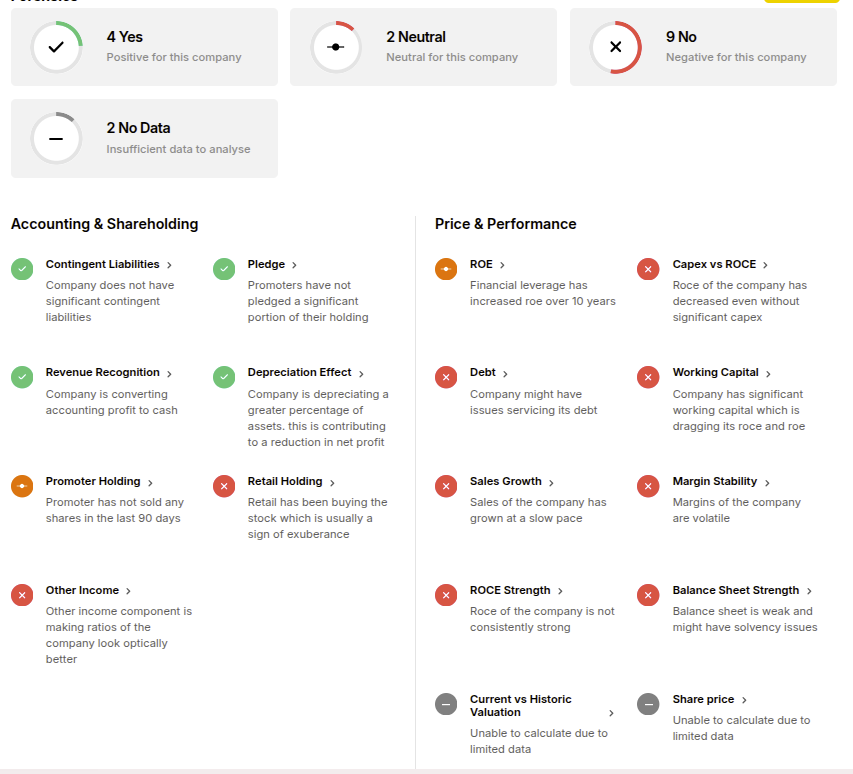
Avoiding the worst of the worst stocks is perhaps more important than choosing the best ones. @Tijori1 has two useful features that can help you screen out terrible stocks.
On Tijoristack, you can generate a Risk Probe Report that shows you all the risks, red flags, and vulnerabilities you should watch out for. This is a detailed report that analyzes all the company financials and disclosures.
The second is the forensics tab on their site that gives you a broad overview of things you should dig deeper into.
Tijori website: https://t.co/JZVRNGyANK
Tijoristack: https://t.co/1bmRi2APD1
Hi Paras, we’ve always been transparent about all our charges, which are explained here: https://t.co/8lyNZcmPM9
Could you please create a ticket at https://t.co/IA1ZAUTbuk with more details about the trades where you believe excess brokerage was charged? We'll review the charges and help clarify the same.
The average investor typically has 2-3 demat accounts with holdings spread across them. The problem with this is that it makes tracking one's investments and filing taxes a nightmare.
To make it easy for people to move their holdings to their @zerodha account, we'll now refund all depository charges (DP charges) that you incur to move your holdings to Zerodha. With this charge gone, pretty much everything at Zerodha is free, including investing in stocks, ETFs, direct mutual funds, and bonds.
Even the AMC is more or less free because of BSDA limits, and on top of that we're making the first-year AMC free. So you only pay if you do intraday or F&O trades.
For all transferred-in stock, we let you enter the acquisition price so that your P&L isn't messed up and you can track your portfolio properly. We also offer the option to open a secondary demat account if you want to segregate your holdings for whatever reason — short- and long-term investments, for example.
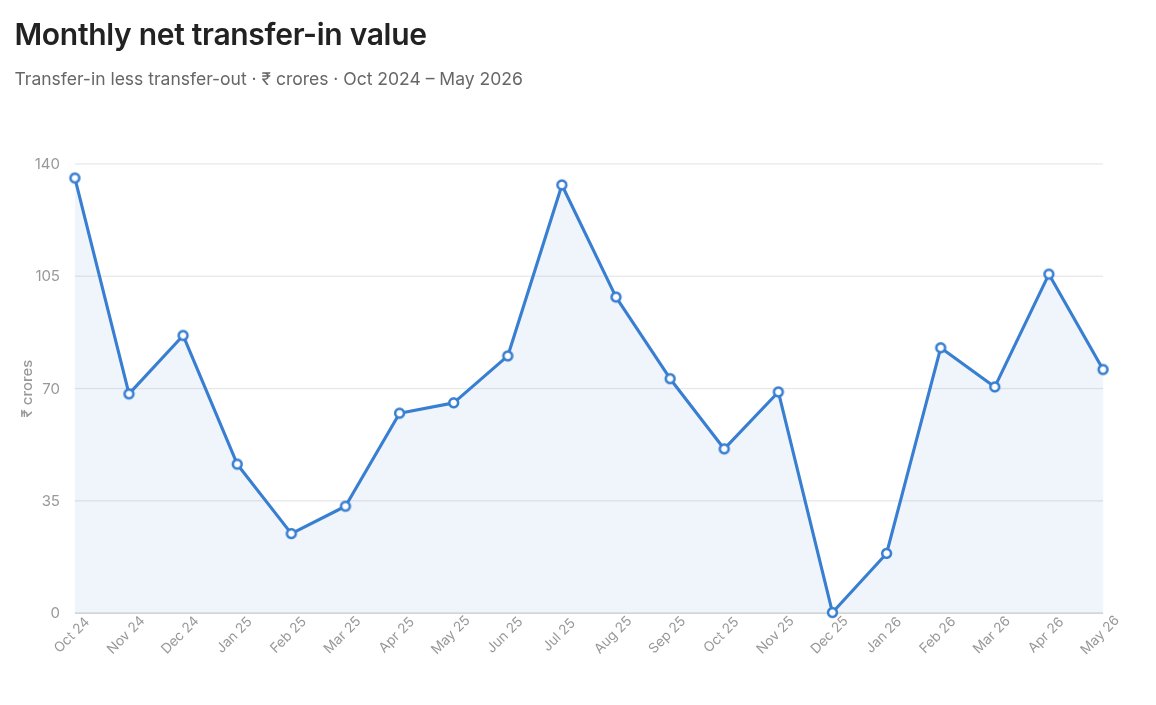
By the way, this is the monthly net delivery of stocks (transfer in − transfer out) at Zerodha. I'll share an updated chart in 6 months to see if us taking DP transfer charges on our head makes any difference😀
@brpalai@AskZerodha@SEBI_India Hi Bhakti Ranjan, we are sorry to hear this. Could you please elaborate on your query and DM us your registered details so that we can check on this?
https://t.co/aWeJ1E32Ng
The wait is officially over! The ALL-NEW Streak Trading App is live on iOS and Android. 📱🚀
Rebuilt from scratch based on your feedback, it is faster, smoother, and built for modern traders.
Here is what’s waiting for you:
⚡ Scalper Mode: High-speed execution with TradingView charts.
🚀 100 Live Strategies: Run your strategies across 100 instruments simultaneously.
🏛️BSE stocks & SENSEX options: We now support BSE stocks and options.
🔍 25x Live Scanners: Track multiple market setups concurrently with zero lag.
🎭 Dual Trading Modes: Switch between Equity Mode and Options Trader Mode to match your style.
📊 Option Chain & Payoff Graphs: Native, visual options workflows built specifically for mobile.
📋 Dashboard: Track favorite stocks and deploy strategies or scanners instantly.
👉 Download now and log in with your Kite credentials:
App link https://t.co/7g9GC5dWys
IOS App link: https://t.co/HLjZjCJcoB
#AlgoTrading #Zerodha #StreakApp #OptionsTrading #IndianStockMarket #TechnicalAnalysis
@Madhudba07@Nithin0dha Hi Madhu, we are sorry to hear this. Could you please DM us your registered details so that we can check on this?
https://t.co/aWeJ1E32Ng
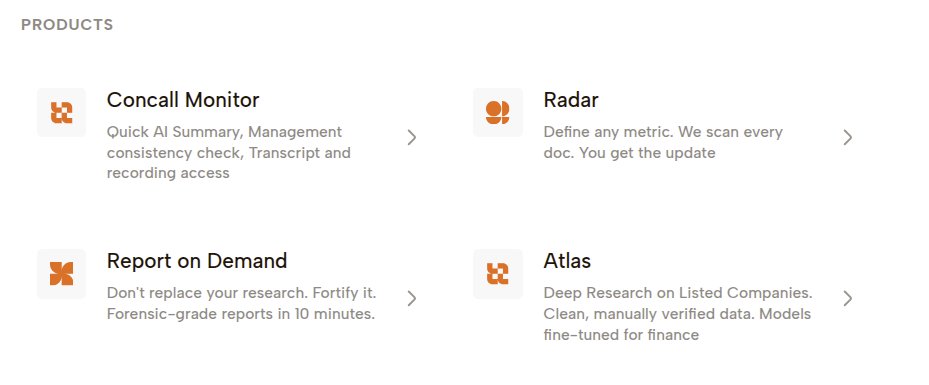
While everybody is busy stuffing an AI chatbot into every product, the folks at @Tijori1 are using AI to build high-quality market research tools. They’re calling it Tijori Stack, and what they are doing is taking the messy and scattered universe of company disclosures, financials, filings, concalls, and regulatory documents, and extracting useful insights.
They have several products:
1. Concall Monitor
Tracking concalls is annoying because the transcript comes after a few days. Then there’s the fact that you have to sit through one hour of management-speak just to find the three useful things they said. Tijori is trying to fix that.
With Concall Monitor, a few minutes after a concall ends, you get the full transcript and an AI-generated summary that extracts the key insights like pricing, margins, growth, demand, guidance, capex, risks, etc.
But the interesting thing is not just summarization but the management consistency check. Tijori tracks what management has said historically vs. what they are saying now. If a company promised something four quarters ago, the system can help track whether they followed through, changed the story, postponed the target, or pretended the earlier comment never happened.
2. Report on Demand
Tijori ingests pretty much all the filings and disclosures that a company makes, from financials, concalls, exchange filings, and regulatory disclosures to other company-specific documents. Using this, they generate different kinds of company reports:
Risk Probe Report gives you all the red flags and key risks.
Management Credibility Report looks at what management said versus what they actually did.
Five-year revenue and EBITDA estimate is an AI-assisted financial forecast grounded in company data.
All these reports are useful when you are doing first-pass research on a company. If you are tracking five companies and want to quickly figure out which are bad and which are worth researching further, these reports help. Instead of reading annual reports, concalls, exchange filings, presentations, and financials from scratch, you can use these reports to build a baseline view in minutes.
3. Radar
Radar is probably my favourite idea in the stack.
It allows you to define a metric or risk you care about for a particular company, and Tijori keeps scanning company disclosures and financials for relevant mentions. When the metric you define shows up, you get an alert.
And the metric does not have to be a typical financial metric.
You can track things like client concentration, employee growth, dollar revenue exposure, margin pressure, working capital stress, promoter pledging, regulatory risk, capex delays, inventory build-up, receivables, raw material pressure, or anything else that matters to your thesis. This is powerful because every investor has a different question.
Radar turns those questions into live monitors. I don’t think there are many products in India, or even in the world, that do this well.
4. Atlas
When you use ChatGPT or Claude to ask questions about a listed company, the answer is based on info that scraped from the public web. This is problematic because public web data about companies is messy.
There is news, commentary, rumours, stale articles, bad research takes, and gossip. Sometimes it is useful, but often it is noise. What makes Atlas different is that it gives you answers that are grounded in company-specific material like filings, disclosures, financials, concalls, and other company data.
Instead of asking a generic chatbot, “Tell me about this company,” and getting an unreliable answer scraped from the internet, you are asking a system that is constrained by the company’s own disclosures and financial history. This ensures there are no hallucinations.
MCX has introduced Silver 100, a 100-gram silver futures contract, starting today. This is the smallest silver futures contract currently available on MCX.
Silver 100 is also available for trading on Kite, just search for SILVER100 and add it to your marketwatch.
Key contract details:
- Symbol: SILVER100
- Lot size: 100 grams
- Price quotation: per 10 grams
- Tick size: ₹1 per 10 grams
- P&L per tick: ₹10 per lot
In a landmark judgment on May 22, 2026, the Delhi High Court held Google liable for trademark infringement.
The case was between Hindware and Google. The court held that, by allowing competitors of Hindware to purchase the keyword “Hindware” (a trademarked name) through Google Ads, Google enabled trademark infringement. The court said that “Hindware” is not a generic English word but a specific brand trademark. By allowing competitors to place ads on that keyword, Google is enabling competitors to divert traffic that should have legitimately gone to Hindware.
This has been a big challenge for companies, both big and small. Even today, if you search for Zerodha, you will see search results from competitors. This has been happening for well over a decade.
Although it is hard to quantify, we have lost a lot of business to this. Think about what happens. Whenever someone searches for "Zerodha", the traffic should rightfully come to Zerodha. But what often happens is that the first couple of results on Google Search are ads, leading the customer to a competitor's website. In the process, we lose business that should have come to us.
This is made worse by the fact that we do not advertise.
There is also an even more ironic thing here. A lot of brands, just to capture the traffic that should have come to them organically, end up bidding on their own keywords. Think about it. If you own a business and have a trademarked name for your business, you still have to pay Google just to hopefully make your name too expensive for your competition to run ads on it.
But now, thanks to the Delhi High Court judgment, we have the option of taking legal action whenever we come across instances of other companies squatting on our keyword.
The other brilliant part about this judgment is that it levels the playing field. And this matters even more for startups, who are already starved for resources and have the odds stacked against them. The last thing they need is for competitors to bid on their brand keywords and steal their traffic.
This judgment now opens up a route for legal recourse whenever such deceptive practices occur.
While keyword squatting is most visible in Google web results, it is an even bigger problem when it comes to app stores. Whenever someone searches for your brand, the first couple of results, both above and below your app listing, often tend to be those of your competitors. And in the case of app stores, I think the ads are even more problematic. When a user clicks on an app-store ad, they often end up installing an app. That is a much higher-commitment action than clicking on a competitor’s web search result and then just closing the page. Because the user has installed an application, the conversions, at least anecdotally, tend to be much higher.
Again, brands that do not advertise are at the receiving end of this. So I welcome this ruling and hope this changes the unfair norms we've been living by for so long.
In the last year or so, we've continued to launch new features, both big and small to make life easier for traders and investors. The latest feature that went live on the Kite mobile app is position grouping.
If you actively trade and have multiple positions across different indices and expiries, tracking those positions can be messy. Odds are, you may end up making a mistake because of this. To make this easy, we've built position grouping on Kite. What you can now do is group your positions based on things like the underlying index of an F&O contract and expiry.
You can also use the feature to exit multiple groups of positions in one go.
Starting with tomorrow’s stock F&O expiry, calendar spread margin benefits will not be available on the expiry day of the near-month leg of stock F&O calendar spreads.
Here’s all you need to know. 👇
Calendar spreads let traders hold offsetting positions in F&O contracts across different expiries, which lowers margin requirements because the overall risk is lower. Until now, this margin benefit was available for single-stock derivatives even on the expiry day, including when one leg of the spread was expiring.
SEBI has now aligned this with index derivatives. On the expiry day, if one leg of a calendar spread is expiring that day, the spread will no longer receive margin benefits.
For example, suppose you create a calendar spread in Reliance futures by buying May futures and selling June futures.
The margin requirement for a single position is around Rs. 1.2 lakh. With the calendar spread benefit, the margin for the May–June spread is around ₹24,000.
Currently, even on the May expiry day, the position continues to get the calendar spread margin benefit. From this month’s expiry onwards, the May–June spread will not receive a margin benefit on the May expiry day.
This means the required margin can increase from ₹24,000 to roughly ₹2.4 lakh (₹1.2 lakh for each contract).
If you instead hold a June–July spread on that day, the margin benefit will continue, since neither contract is expiring.
The reason for this change is risk management. When the current month's contract expires, margins on the remaining open position can rise sharply. Removing the benefit on expiry day allows traders to adjust positions or bring in margins in time.
In addition, existing physical delivery margins continue to apply for stock contracts nearing expiry: https://t.co/mClpfQp4ZT