My Princeton AI and society team is at the @IASEAIorg AI summit in Paris.
My Neurips keynote for our approach:
https://t.co/tfP0C7PhpT
Our paper:
https://t.co/v5uKOzceyX
Say hi especially if you are *utterly* unimpressed by the current doom or hype models.
Wrong nightmares!
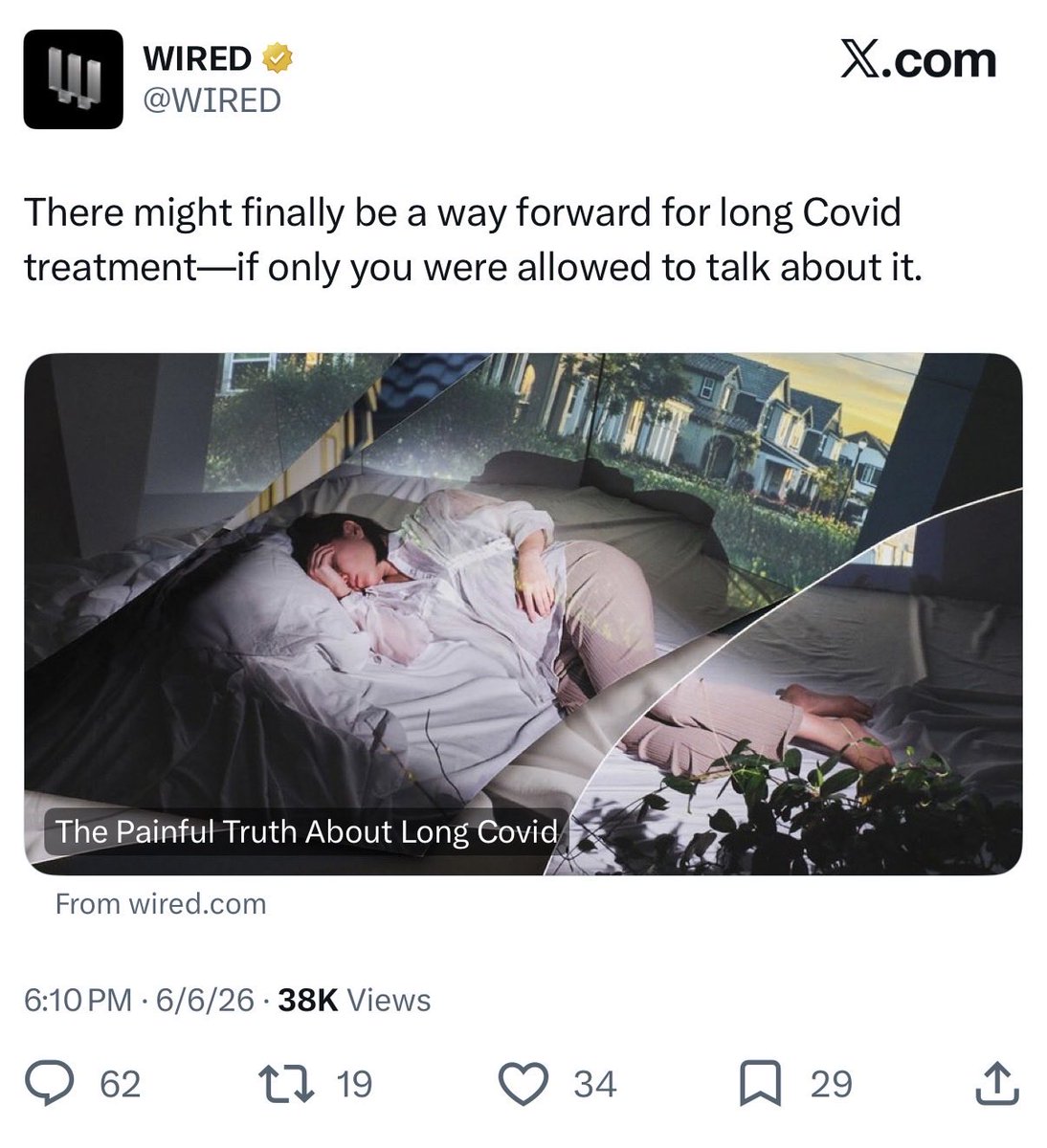
How embarrassing for @Wired. This is like saying “if only we were allowed to talk about AI” in 2026.
Not “allowed to talk” fails simple Google search. See what NIH has on clinic trail with its Long Covid billion+ while *ignoring* widely prescribed drugs. https://t.co/TRWGKe1bxh
I still closely follow the science of (likely) autoimmune severe subset of Long Covid & related disorders.
This WOULD benefit from medicine overcoming the mind/body duality, but the recent Wired article was sadly the opposite of that. Scientifically poor, outdated & misleading.
I read your article fully and carefully. It’s a an empirically poor article. I have been reporting in this space for years, resulting in full page articles in the New York Times which involved interviewing, at length, lead PIs of the billion dollar NIH research fund, NIH agency leaders at the highest level, and leading scientists working on this field. Additionally, as an academic who got interested in this important, fascinating space, I am still reading the scientific literature and regularly keeping up with cutting edge science. They’re all missing in your article!
I have written about poor definitions and I face flak from online patient communities regularly. I believe the mind/body duality as it exists is medicine is a big obstacle. Your article doesn’t have any of the cutting edge science on that! Where are the neuro-immunologists from psychiatry? Where are the sharp exercise physiologists getting out bangers in Nature?
What you have is essentially a channeling of a gripe session from one (empirically left behind and upset) faction of the mind-body duality. It’s not challenging it.
You can find patients saying stupid things online. But the idea that brain retraining is some breakthrough that’s being ignored and that people can’t talk about is complete nonsense. And your part about exercise is missing the biomedical breakthroughs in understanding from the last few years.
I don’t really do social media these days but I am informed. This one deserved clarification for the record.
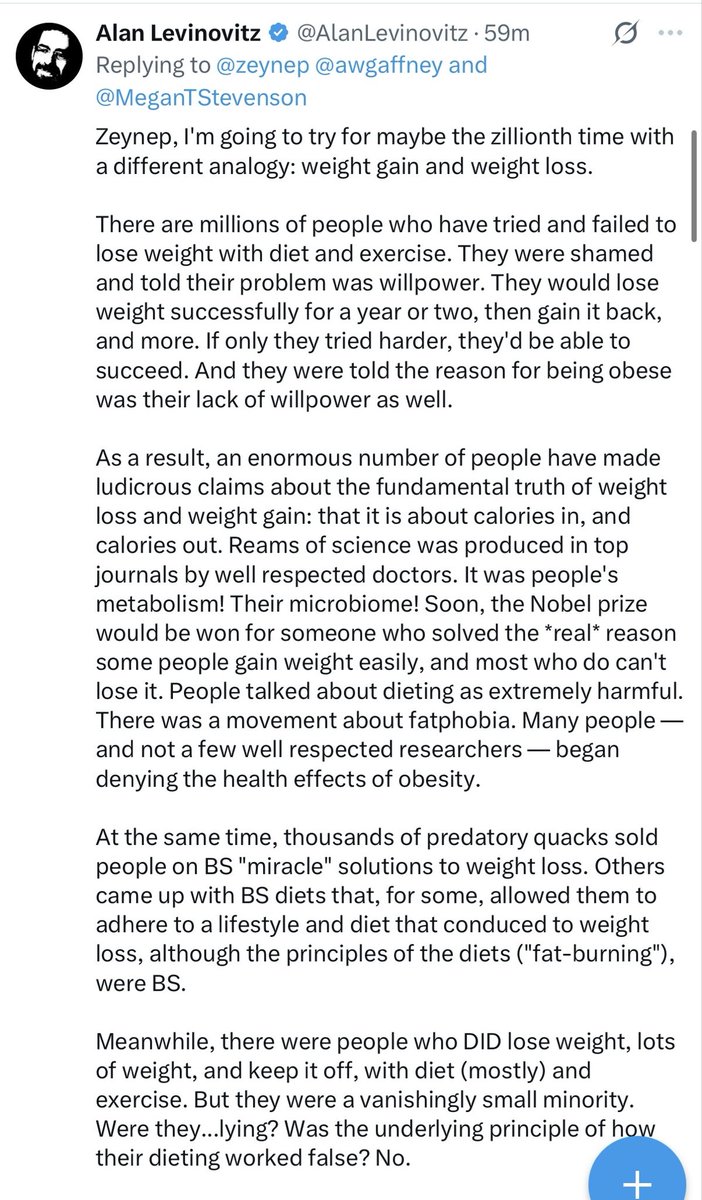
My response to author’s claims to me (his in screenshots.)
Weight loss isn’t similar. Caloric restriction is hard for obvious reasons from evolution, but it works for everyone. Everyone will lose weight if you locked them up and severely reduced their caloric intake.
Your best historical analogies here really are TB, ulcers, multiple sclerosis, endometriosis, etc. When they were poorly understood, medicine coped by coming up with personality and mindset theories. Medicine has a very long history of doing that and the logjam almost always gets broken by advances in imaging and testing — viruses are tiny, so this one is a frontier. Additionally, viral sequelae are hard to study because cause and effect are separated by time. Now we know MS is downstream of EBV and many cancers are downstream of HPV infections decades ago. More is on the way.
Autoimmune illnesses have another challenge in that they tend to be remitting relapsing. The things that can trigger or maintain remission are interesting and should be studied. That’s why your piece is poor, btw. You would get very interesting cases from neuro-immune psychiatry people. But is a remission trigger also the underlying cause? It’s related to an aspect surely but that’s complex. Also your piece suffers from lack of conversation with immmunolgists doing interesting work on this.
Plus autoimmune illnesses disproportionately affect women because women’s immune system is different. And women are less believed.
Finally, yes, post exertional malaise is most baffling and your treatment of it is terrible. I’m being very descriptive here even if it’s upsetting for you, but this is true. There’s been recent good biomedical research on of it and you don’t even seem to be aware of it, to be frank. That’s another major problem with your piece. PEM definitely weird and it took for me time to be convinced but the evidence base is extremely strong. You should not write about this topic without doing a lot of research on exactly that. And for PEM subset, stuff like high intensity interval exercise that was potentially being trialed could have been harmful. The person that started this thread was trying to explain that to you, but you didn’t even bother reaching out to her before misrepresenting her in the piece, it seems.
Traditional cognitive behavioral therapy seems to help many people cope because it helps people cope with whatever they’re facing. Nothing specific.
Separately, some forms of meditation like activities *sometimes* seem to help trigger or maintain remission, often along with a constellation of other activities and some drugs, especially LDN and H1+H2 antihistamines. A properly designed clinical trial would be great, but that’s not what the patients are getting. Since spontaneous remissions are common in autoimmune illnesses, anecdote wars are useless.
Finally, both brain training and graded exercise have been tried extensively by many in the subset of severely ill Long Covid people who have something related to post-viral conditions. (The difference is the pandemic gave us coherent cohort, and large denominator.)
Being lectured about available brain training while proper research isn’t funded in an article falsely framed as “you can’t talk about it” is upsetting, of course. You can find whatever examples of stupid statements online. But frankly, the medical establishment hasn’t been talking about *anything else* for the most part. NIH even funded trials for already available “brain therapy” before funding trials for existing medicine that all LC clinics routinely prescribe to some benefit. Lunacy.
Imagine having tuberculosis and the doctors constantly lecturing you about being less sensitive and intelligent and running clinical trials on the “rest cure” while ignoring emerging evidence for antibiotics. Rest may well help but you wouldn’t be happy with an article claiming they could cure TB if only doctors could speak about the rest cure. Those damn patients.
It’s on my timeline. I am not even on social media much but I had to speak up because that piece was so terrible, empirically and conceptually. The author is now busy deleting tweets because he can’t even keep wildly different viruses straight.
Honestly seeing people noticing the “wrong” type of online response and speaking up in defense is… well, not good. It was so obviously poor if one had been reading any the scientific literature at all. I tried asking him why key studies weren’t even referenced and it seems he doesn’t even know them. He got played by an empirically losing side of an argument with a gripe. Patients deserve better. (And I have written tons about the definition problem. But he is almost always clearly talking about a specific subset).
You are taking one sentence with three examples of psychologizing latching onto the differences between them. And you know I know the differences, because I actually read this history, but here you go.
Many people with MS were diagnosed as having anxiety till imaging advanced. That you know is true. And yes, doctors knew from early on from post-mortem studies. But it took imaging that could see before death for many patients to be believed. That’s one type of issue.
Ignoring Alan’s ulcers sentence? He writes:“The question was what *caused* the sores. Most thought stress!” Let’s see: medicine saying you would not have this debilitating, potentially fatal illness (ulcers) if you weren’t stressed. But he defines that as “not psychologizing.” Off to the races, he is.
Do you know anything about the history of tuberculosis? Ignoring that, too? You know it was commonly thought to be inherited, not contagious, and due things to sensitive intelligence.
Medicine has this history. It’s well documented. Medicine also has a history of amazing advances. It often has to fight through the deniers among its ranks for that.
He wrote a terrible article that missed a lot of biomedical research and historical context, and he’s just pointing to people saying whatever online as validation. I had left that misrepresentation alone because, come on, anybody can just read his sentence about ulcers and get the problem even if you don’t know a word of that history.
@Kittywampus@jessesingal Yeah unfortunately it was a terrible and weak piece, but the online reaction can mislead one about that. Logical, scientific and sociological failure, sadly. But he won’t listen because it’s hard now. Maybe after some reflection. (I have written tons about the definition issues).
I’m thrilled to be giving the 2026 US-UK Fulbright Distinguished Lecture, titled “Are We Having the Wrong Nightmares about AI?”
The in-person event in London is completely full, but there is a free livestream: https://t.co/iPevhAXrgC
I RT’ed because it’s indicative, not because of personal issues. The article fails at so many levels. You can certainly find examples of toxic comments online, but he seems to be trying to use them to validate the article. That’s not good.
But you can see the many substantive criticisms he just ignores or can’t even recognize in that thread. He doesn’t even seem to know of much of the biomedical research I’m talking about. He also doesn’t recognize the context of the online factions. It’s a pity.
This @AlanLevinovitz & @zeynep exchange says it all: he fails to research her writing before responding (her significant body of work pre-dates his by years), insults her intellect despite her clear credentials, then full retreat to ad hominems after standard academic critique?
Ironically, I have often received pretty terrible flak from parts of the same online patient community on things I said they didn’t like. I think some of it was genuinely unrelated to my views and I was just the target of the moment. It’s not nice.
However, I repeat: that’s no excuse for what’s substantively wrong with this piece: badly missing recent scientific developments, historical context, objective assessments while being played as a channel for an empirically ungrounded gripe session from the opposing and in fact, powerful, part of the conflict around this. That also makes it a poor article for reporting on the sociocultural dynamics around this issue.
I’ve greatly stepped back from social media, but I have to speak up on this because the online stuff can be used to validate poor articles like this one because, yes, some people say terrible things on social media. That exists. That’s a minor point compared to the actual issue.
@AlanLevinovitz@SuziElizabeth11@MeganTStevenson I read your article fully and carefully. I have pointed out great many problems with it. You’re too caught up in online squabbles but they don’t validate or erase the many, many problems and shortcomings of the piece.
I read your article fully and carefully. It’s a an empirically poor article. I have been reporting in this space for years, resulting in full page articles in the New York Times which involved interviewing, at length, lead PIs of the billion dollar NIH research fund, NIH agency leaders at the highest level, and leading scientists working on this field. Additionally, as an academic who got interested in this important, fascinating space, I am still reading the scientific literature and regularly keeping up with cutting edge science. They’re all missing in your article!
I have written about poor definitions and I face flak from online patient communities regularly. I believe the mind/body duality as it exists is medicine is a big obstacle. Your article doesn’t have any of the cutting edge science on that! Where are the neuro-immunologists from psychiatry? Where are the sharp exercise physiologists getting out bangers in Nature?
What you have is essentially a channeling of a gripe session from one (empirically left behind and upset) faction of the mind-body duality. It’s not challenging it.
You can find patients saying stupid things online. But the idea that brain retraining is some breakthrough that’s being ignored and that people can’t talk about is complete nonsense. And your part about exercise is missing the biomedical breakthroughs in understanding from the last few years.
I don’t really do social media these days but I am informed. This one deserved clarification for the record.
I think looking too much at online squabbles might’ve had an influence. There are genuinely looney or snake oil selling people online. Some patient communities have toxic discourses. (Many online communities do!). He is also quoting some medical people who have zero research in the area and are completely disconnected from the science BUT are prominent online skeptics of Long Covid. How does one do that?? Meanwhile many, many important scientists with biomedical research but no big online presence are missing.
Finally, for what it’s worth I am a lifelong exerciser with a close friend who has fairly treatment resistant major depressive disorder. Exercise and meditation work for her. I spent my life trying to get everybody I know to exercise, especially women. I have a second life on that front. I was thinking of opening a very specific type of gym if academia plan failed Post-exertional malaise sounded like something “ivermectin cures measles, skip the vaccine” to me when I started the research. The bar for me to get convinced was very high. I got convinced because the evidence from multiple categories is really strong. People in this subset have what they say they have, and yes it is counterintuitive. It doesn’t fit what we understand about convalescence. It doesn’t fit the broad non-specific category that can be so frustrating.
These people need good, curious observant doctors and frontline scientific research and solid clinical trials for their subset. They do and they will try brain training on their own. They would try bloodletting if someone said it worked for them. They will try anything that’s already available to them.
What they are upset is lack of proper biomedical research, while NIH wastes hundreds of millions without even coming up with proper subset definitions (key to research) and funds clinical trials for zoom therapy instead of LDN, and also messing up clinical trials because their definitions are so heterogeneous.
I know a significant number of medical doctors with versions of this subset — looking very very much immune system dysfunction like a disequilibrium that can be reset and maintained for some during remission — and I see them systematically try everything, including the mind/body interventions with mixed success. It’s quite humbling for them tbh. To be in a “non-specific” lump all of a sudden where their colleagues look at them like maybe they need a better mindset and some therapy.
Why the Nobel prediction? Some of the research of last few years on this but also other virus sequelae has me convinced. For this subset! You can see the understanding move.
And as you note, this severely ill subset of the patient community has tried everything. They’re very sick with a counterintuitive illness where classic steps of convalescence can backfire. Many are young and had full lives. They try everything. They try dangerous things. Brain retraining isn’t some taboo they don’t try. They’re just pissed off NIH spends insane amounts of money on trialing “brain retraining”, often a version of zoom therapy, something already available and doesn’t need medical authorization, while they don’t even get a proper and timely clinical trial for basic stuff like LDN or H1 and H2 antihistamines that are widely prescribed with various degrees of help. Let alone Ampligen?? The trial was mostly botched with those definitional issues and I would put a proper trial for that on top of my list. That one is screaming that a subset benefits profoundly but trial can’t recruit heterogeneously, as has happened. Why aren’t folks on real issues like that?
Patients absolutely know and desperately try various versions of “brain training” which seems to help some people sometimes for sometime, not uncommon for remitting/relapsing autoimmune illnesses. Remission can occur. For that, talk to someone in neuro-immuno-psychiatry though! That’s who is good at that. Their framing is nothing like this article.
I think the key is where he says: “Not only that, the article wasn’t a “state of the scientific field” piece. It was about the sociocultural context currently driving long Covid research and care.” This explains weak awareness of the actual science but, alas, as it was also a very poor socio-cultural work.
Medicine went through versions of this kind of denial and psychologizing with TB, ulcers, multiple sclerosis, etc. The themes are familiar. It’s an incredible story. There is also history of flourishing of snake oil and irrational patient beliefs when it comes to diseases medicine is failing to understand.
But to make sense of it one has to understand that history, the current sociocultural milieu AND the actual biomedical research to understand what’s what. It’s clear he isn’t up on all that actual research. Meanwhile, seems to me that one faction used him as a therapy session.