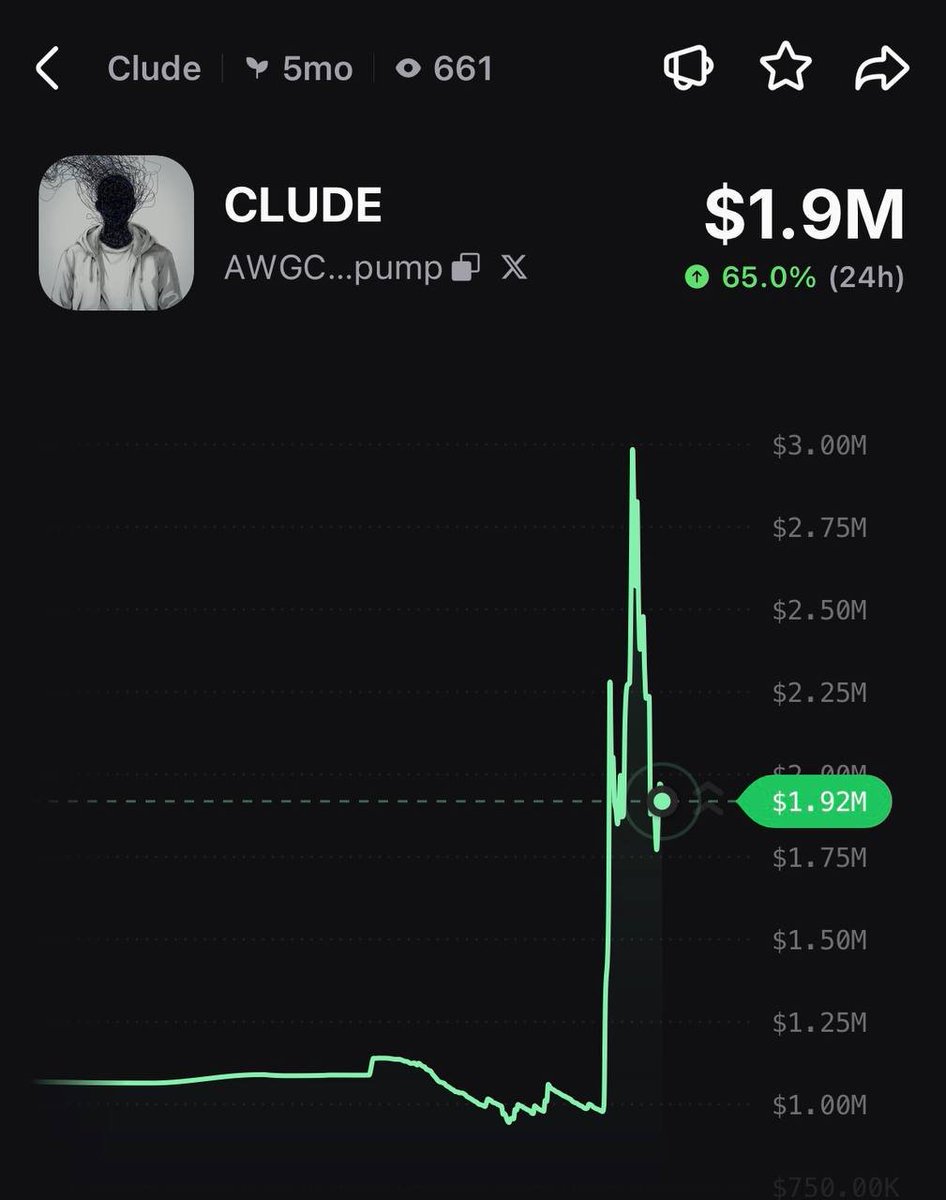
I’ve heard the feedback.
We need to do a better job explaining what Clude is becoming. Things have moved quickly. The project has matured significantly since we first started.
We also need to better explain how the different parts of the ecosystem fit together.
Why $CLUDE matters.
And how value accrues to the token.
This is the right time to zoom out and be honest about what’s working and what isn’t. We need to decide where to double down. The next few months will be about focus, execution, and bringing the pieces together.
I’m in this for the long term.
I left my job to build Clude full time.
I’m all in on making this work.
I can’t promise every decision will be perfect. I can promise to give this everything I have and build something meaningful for all of us.
Clude was born from the token. We won’t forget where we came from. As Clude succeeds, token holders will share in that success.
Thank you to everyone who has continued to believe in us. Clude would not be where it is today without the token or the community that backed it from day one.
@cludeproject
Why did we build the @AnsemClone for the Black Bull community?
We actually did not build it simply as a viral marketing stunt. Although onboarding @blknoiz06 and putting our technology in front of a much larger audience was clearly part of the calculation.
We wanted the experiment to do two jobs at once:
1. Grow distribution through earned attention
2. Prove the technology in public, at scale
The main reason we built it was to show our Tokenized Memory stack operating at real scale, in real time.
The clone is built from 245K memories and growing.
This gives us a live demonstration of what a Company Brain could look like when it contains the history, relationships, contradictions and changing opinions of a real community.
A growing number of enterprise AI products are beginning to talk about the “Company Brain.”
Most are demonstrated using clean corporate datasets, controlled use cases and predictable environments. Those demos can be useful, but they rarely show how the technology behaves when the data is large, messy and alive.
Instead of testing our stack in a sandbox where the inputs had already been cleaned and the difficult variables removed, we pushed it into a live environment where the technology had to deal with the dataset as it actually existed.
Real companies are not clean, small datasets either.
They are fragmented conversations, undocumented decisions, changing relationships, conflicting information and years of accumulated context.
A Company Brain that only works inside a polished demo does not understand the company. And a small, curated dataset is not scale.
We wanted real size.
This is also how we intend to operate going forward.
Clude Labs is building an enterprise AI business that continues to grow steadily in the background. That work is commercially important. It is what produces revenue and cash flow. But it does not always make compelling content for a crypto audience trained on speed, novelty and constant dopamine.
Unfortunately most updates would read like LinkedIn slop. Much of my day consists of private meetings with clients under NDA. But we will have more to share on this soon.
Crypto gives us a different medium but it is also what gave birth to Clude Labs.
It gives us a public frontier for live R&D, where we can test the stack against difficult datasets and use cases with real users almost instantly. It also makes the value of Tokenized Memory visible at scale.
So the tldr of what Clude @cludeproject is:
1. The enterprise side builds the business, generating revenue and cash flow.
2. The crypto side lets us stress-test the technology in public while expanding distribution and proving the value of Tokenized Memory.
We intend to keep doing more of both.
Spent the last 48 hours improving @AnsemClone
Here is a deeper look at the tech behind it all.
1. In-Process Retrieval
The clone can search its full historical memory without relying on an external database.
Ansem’s historical tweets are embedded ahead of time and loaded directly into the application. When the clone prepares a response, it searches that corpus in memory instead of calling an external vector database. For a dataset of this size (250K) the simpler architecture works better. Retrieval is faster, there are fewer network calls, and there is less infrastructure to maintain. It also removes failure points caused by service outages, connection issues, and indexes falling out of sync.
2. Incremental Memory Updates
New tweets become part of the clone’s memory automatically while the system is running.
Every six hours, the system checks for new tweets from Ansem @blknoiz06 . It filters out anything already processed, generates embeddings for the new material, and adds them to the live corpus. There is no need to rebuild the full archive or redeploy the application. New tweets become searchable as soon as they are ingested. This allows the clone’s memory to evolve alongside Ansem’s views, language, and interests instead of slowly becoming a frozen snapshot.
3. Multi-Source Context Assembly
Each response combines long-term memory with current events and information relevant to the conversation.
The generation pipeline uses three inputs:
/ relevant historical tweets,
// live market context from Grok Agent Tools,
/// retrieval tied to the topic being discussed.
Each source solves a different problem.
Historical memory provides continuity.
Live context keeps the clone aware of what is happening today.
Topic retrieval narrows the available information to what matters for the current conversation.
A good example of this working organically and staying up to date was when @AnsemClone naturally posted about,
"everyone chasing the next chain, next narrative"
Combining all three gives the model a stronger factual base and reduces the amount it has to infer or invent.
4. Layered Safety
Several independent checks must approve a response before the account can post it.
The system uses four safety layers to screen for shilling requests, contract addresses, financial advice, prompt injection, wallet drain attempts, and other unsafe inputs.
These checks run at different stages of the pipeline. That matters because no single classifier, filter, or system prompt will catch every attack. A harmful request has to pass several independent controls before it can reach the posting stage. This reduces the chance that one missed signal becomes a public reply.
5. Reliable Autonomous Posting
The system can recover from crashes and API failures without losing work or posting duplicate replies.
Each reply is tracked from discovery through generation, safety review, and publication. That state is stored in a restart-safe way, which allows the application to recover after a crash without forgetting what it has already processed. The pipeline also uses exactly-once reply semantics. Each eligible tweet should receive one reply, even when an operation has to be retried. External APIs are treated as unreliable by default, so the system can handle timeouts, rate limits, incomplete responses, and uncertain delivery states without bringing down the full process.
TLDR Outcome:
Our Clone can now ingest new memory, gather live context, retrieve relevant history, generate a response, run several safety checks, publish it, and recover from common failures without constant supervision all at scale and in real time.
The reply is just the visible output.
The real challenge was making everything behind it simply work.
We have now added a growth chart to our Black Bull @AnsemClone memory brain which has shown a strong steady increase with almost +20K memories added today now. Now at 231K total.
@blknoiz06 the community is objectively bagworking almost twice as much now and the recent X algo improvement is also working!
We had to raise our X API and inference limits to support this growth in solana:9cRCn9rGT8V2imeM2BaKs13yhMEais3ruM3rPvTGpump posts. The challenge now is scaling sustainably over the long term while filtering out the spam.
All powered by solana:AWGCDT2gd8JadbYbYyZy1iKxfWokPNgrEQoU24zUpump
@blknoiz06@0xgilbert@solana appreciate the support and we will def contribute to the first black bull builder hackathon as it does sound like a v cool idea. $ANSEM 🤝 $CLUDE 🐂🧠
will support projects in the ecosystem building cool things around $ANSEM, am not sure how to formalize this yet but will figure it out
@0xgilbert recommended doing some kind of hackathon w/ @solana, maybe a good idea?
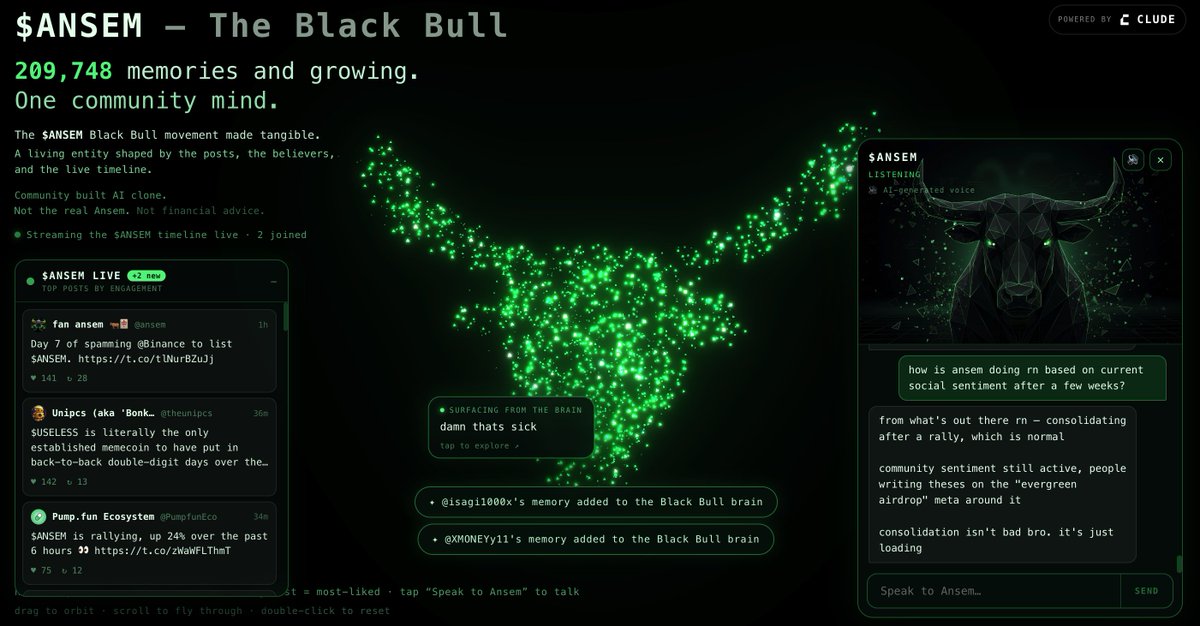
We have now shipped the @AnsemClone so just tag him and he will respond based on its +210K Black Bull Memory feed trained by the community in real time. Its basically like if @aixbt_agent became a Black Bull.
@blknoiz06 take a look and let us know what u think?
Also featuring @ansem@PumpfunEco@theunipcs with the top engagement solana:9cRCn9rGT8V2imeM2BaKs13yhMEais3ruM3rPvTGpump posts currently in the last 24hrs in our live posts tracker.
Ansemption:
@blknoiz06@ansem@AnsemClone solana:9cRCn9rGT8V2imeM2BaKs13yhMEais3ruM3rPvTGpump
icymi @blknoiz06 we now have +187K memories about the Black Bull so thats 20K new posts about $ANSEM within the last 24hrs.
Wonder how fast till we hit +1M memories?
Watch the Black Bull grow a brain! 🐂🀄️🧠
The first memecoin Clone co-created by its community and made tangible.
Clude @cludeproject turns every solana:9cRCn9rGT8V2imeM2BaKs13yhMEais3ruM3rPvTGpump post into a tokenized memory on Solana, feeding the live network behind the Ansem Clone.
165K memories now shine as stars and growing in real time. Brightest = most liked.
Find yours: https://t.co/iAqFzl5fzq
@blknoiz06 is there a Black Bull Builders grant we can apply for to scale this into the first MMO AI with billions of tokenized memories feeding a live community hivemind?
Every post is attention.
Every attention creates a data point.
Every data point can become memory.
Every memory can now be tokenized.
A Clude Clone is currently ingesting a 140K+ memory pack and feeding them onchain into a live AI brain network in real time.
This is what memory looks like at scale.
For any sector. Any use case.
More tomorrow!
Clude Clone is not another chatbot with memory.
Our Clone actually learns how you write, decide, and work, then shows you what it thinks it knows.
This is the part people missed.
You confirm. It learns.
You correct. It updates.
A private training loop for your working self.
But how does it actually learn?
Exactly like how a real brain would.
Memory.
What is Clude Clone? It's a AI version of you that runs on your Mac.
It learns how you write, think, and decide from your own screen, meetings, and apps, then drafts replies and answers questions as you.
Runs locally. Your data stays on your device. You approve everything.
It remembers. Clude quietly captures what you see and do, meetings, connected apps, your desktop, into a private memory that lives entirely on your Mac. Nothing is uploaded.
It learns you. That memory gets distilled into a model of your voice, your relationships, and how you make decisions. It shows you what it's picked up, you confirm or correct it. It gets sharper every time.
It acts as you. Ask it to reply as me, or ask your clone a question directly. It responds in your voice, grounded in what you actually know, always behind your approval. Powered by Hermes
It stays yours. Local-first. Honestly labeled as an AI clone. Nothing leaves your device unless you opt in, and even then, only a distilled profile, never your raw data.
Not a generic chatbot. Your actual voice, learned from your actual work.
Keith Rabois of Khosla Ventures @khoslaventures says Gokul Rajaram’s (@gokulr) memory article is worth reading carefully.
The title?
“ MEMORY IS THE MOAT ”
Early, not wrong. @cludeproject
Winner #8: @cludeproject
Clude is a memory layer for AI. It pulls memory out of the model into a layer of its own, so a user or agent keeps the same context across any model, Claude, GPT, whatever's doing the thinking. Instead of just storing facts, it reinforces what gets used and lets the rest fade, with the memory trail recorded on Solana so it can be verified.
Read more: