Andrew had been a victim of car theft once before.
Based out of Toronto, Andrew owned a desirable SUV.
A GMC Yukon. This SUV was kept parked right outside his house.
Andrew and his wife had returned from a trip and had been suspicious since then.
The car’s steering wheel was slightly bent. The seat position was adjusted differently.
In 2024, he looked outside after dinner and saw what he had been fearing — the car was gone.
Andrew had worried about this situation. To try and prepare for such a day, he had installed two AirTags on his car.
The idea was that if the car was stolen, he’d be able to track it in real-time. He hoped that that information would help the police recover his vehicle for him.
Andrew checked his phone and could see that his SUV was still very much in the city.
He did not waste time. He called the cops. To be doubly sure, he even hired private investigators.
The police officer who responded to his calls went after the car based on the live location shared by Andrew.
Some time later, the cop sent pictures of shipping containers loaded onto a train. The cop was sure the car was inside one of the containers.
He had managed to trace the car, thanks to Andrew’s AirTag.
But Andrew did not have any reason to be happy.
The cop informed him that he couldn’t just go and open the containers. He didn’t have the authority to do so. He would have to raise the matter with the train authorities.
While he was still figuring that out, the train departed as per its schedule.
Andrew watched his car’s location update live on his phone. It was now moving towards the Port of Montreal.
Different authorities, bodies, and agencies were involved in each part of this network.
The authorities were still figuring out a way to flag the container’s contents as stolen.
The container had already been put on a ship. And that ship had sailed out to the seas.
Andrew watched it all on his phone, live.
The live tracker went offline as it left the port.
Andrew got an update a month later. The car had been offloaded at a port in Belgium, Europe. A few days later, it showed up in Dubai.
Andrew’s private investigator found the car in a used car showroom in the UAE.
A theft of this kind, where the car can be tracked live, and yet not stopped, is possible thanks to the incredibly efficient global supply chain network.
And central to that system is one single invention — the container.
Shipping Container
Trade by sea. There’s nothing new about it. It had been happening for centuries.
Grains were put in sacks and loaded on ships. Boxes for easily broken items. Baskets for fruits. Some items were loaded directly onto the ships.
In the mid-1900s, Malcolm McLean was working in this very industry.
He was in the trucking business. He hated the long waiting time. Once he reached port with his truck full of cargo, he often waited an entire day for them to load the items onto the ship.
The lines were long and seemed like a monumental waste of his time. While he viewed the situation from the perspective of a trucker, the same logic applied to the ship.
It was an expensive machine wasting time just standing.
With nothing much to do while waiting in queues, he eventually started wondering if simply loading the truck’s trailer itself would save time.
The idea evolved and he concluded that the wheels were not needed either.
Large boxes loaded on trucks would make loading and unloading ships and trucks much faster.
He took out a loan, bought 2 ships, and started using large steel boxes for easy loading and unloading. McLean’s patented steel boxes had posts on all corners that enabled them to be locked in place.
This allowed them to be easily loaded on truck trailers.
These boxes were also made sturdy enough to be stacked up to a certain height and load limit.
In 1956, his first ship completed its first journey with 58 containers.
The trucking and shipping industry veterans were watching keenly.
There were obstacles but all of them paled in comparison to the advantages.
The shipping costs were lower, the items arrived safe and dry, and the loading/unloading time was much shorter.
His company, Sealand Industries, was off to a flying start.
McLean understood that for these containers to be truly efficient, they needed to be standardized. Fixed sizes of containers. One type of corner locking mechanism.
A lot needed to change before these containers became the standard.
Ports would have to be better designed with cranes for loading and unloading containers. More truck-trailers that could handle containers were needed.
Above all else, ships designed exclusively for containers would need to be built.
Mass Adoption
The idea was simple, yet brilliant.
Sealand Industries had the patent to their container design. But unlike other companies that profit from keeping their design exclusive, Sealand needed mass adoption.
Without others adopting the same standards, Sealand wouldn’t be a widespread success.
So they offered the patent to many other companies operating in the same industry, for free.
And the trick worked.
Soon, more truck-trailers started being built optimized to carry the containers. Trains too. Ships started being built specifically to ferry containers.
The supply chain industry adapted to shipping using containers better.
The ease and speed was such, the container enabled globalized trade like never before.
Toys could be made in a factory in one remote corner of the world and loaded in a container.
That would then ride on trucks, trains, and ships to reach children on literally the other side of the globe.
This meant that containers were built, repaired, handled, and customized by companies across the world. Nearly 70 years later, the container hasn’t changed. It’s still pretty much the same in the external shape, size, and locking mechanism.
Today, some of the world’s biggest ships can easily carry more than 24,000 TEU (Twenty-foot Equivalent Unit).
Which means, these ships can carry 24,000 containers that are 20 ft long.
Compare that number to the 58 containers carried by the first ship.
Just to be clear, the containers these ships carry are most often 40 ft long. Which means, a ship with 24,000 capacity would be able to carry around 12,000 containers that are 40 ft long.
Some estimates say there are 40 million containers in the world.
About 250-300 million containers are moved per year (the same containers do multiple trips in a year).
There are different types of containers too now. But the overall form factor remains the same.
The scale and speed of this is absolutely staggering. Things move so fast, countries and border police have a difficult time ensuring illegal items don’t get transported.
This greatly explains why Andrew’s car left Canada before the police could intervene.
Containers & Modern Life
Modern life is impossible without containers.
It just isn’t possible without these steel boxes.
Just look around. Most things would have been inside a container. The device you are reading this write-up on has definitely been inside a container.
If something was made outside India, it would have almost certainly been inside a container and on a container-carrying ship too — through the various ports and supply chain systems.
Some examples of item-categories transported in containers.
Obviously, a lot of things are better not transported by containers. Some examples:
Revenue & Profits
An industry that is so essential, the world would crumble without it. Surely that’s a great moat to have for companies in this space?
Not quite.
In fact, the container industry and industries around it are infamously low margin. It’s all down to fierce competition and thin margins.
In that sense, it is very similar to the airline industry — absolutely essential and yet brutally difficult to survive in.
— High Capex —
This is a very high capex or capital expenditure industry. Everything requires spending lots of money before the first dollar starts coming in the form of revenue.
To make matters worse, the industry goes through violent cycles.
There are periods when the margins are non-existent. Sometimes, even below operating cost.
And then there are periods when margins are thick.
Half the trick is being able to survive a thin-margin period till the next cycle of thick-margins.
— Competition is Fierce —
Containers are containers. There’s not much different that companies can offer. It’s easily replicable across the world. Same with ships carrying them, ports loading and unloading them, and so on.
So competition among the players in this space is fierce. They keep eating into their margins.
— Scaling Up or Down Takes Time —
If demand for global shipping increases, new containers cannot just be added. They take time to manufacture and put into service.
Conversely, if demand subsides, companies cannot just get rid of excess containers. There’s a lot of it and needs storage when not in use. Or, they need to be sold as scrap/recycled material.
All of those require time, effort, and money.
The above is true not only in the case of containers, but also in the case of the very ships that carry them.
— Demand Unpredictability —
Now, all of this ties into the unpredictable nature of demand.
Yes, many industries face unpredictable demand. But most of those industries never face the kind of challenges the container industry (and related industries) face in scaling up or down.
Wars, interest rates, inflation, crude oil prices, manufacturing output, tariffs, ports, weather, changing demand trends — there’s a lot that can move demand for the container space.
As for Sealand Industries, it was acquired by different companies until it was finally acquired by Maersk.
Maersk is one of the world’s biggest shipping companies. For a few years, they used the Sealand brand name.
As of today, even that does not exist. It’s just called Maersk.
Get 0% commission on direct funds on Groww and save more with every investmentGet 0% commission on direct funds on Groww and save more with every investmentGet 0% commission on direct funds on Groww and save more with every investment.
The most valuable wealth you have isn't money.
It's time.
35GB of data per person/month is the average internet consumption in India, this is the highest in the world. Still many of them waste time watching reels.
We all get the same 24 hours. What we do with it is the real wealth. I really loved this whole interview of @kunalb11 with @_groww
"The world's largest employer is inefficiency'"
At the India Investor Festival, @kunalb11 spoke with @samidhas , editor ETtech, about how AI is dismantling corporate friction and destroying roles built purely on slow processes.
Mr. Raamdeo Agrawal at @_groww India Festival 2026:
Sensex & Kospi both started near 100 in the early 1980s.
Today: Kospi ~8,200 , Sensex ~77,000.
Power of compounding
@Raamdeo
The Japanese diplomats had made several trips to Brazil.
The discussion went on for a few years.
This was in the 1970s.
The challenge was that Brazil had vast Cerrado grasslands. These grasslands were mostly flat and vast.
This made these grasslands potentially ideal for agriculture.
But the soil quality was inferior. It was too acidic, lacking in nutrients, and often had elements that killed agricultural plants.
The soil needed to be treated.
This is where the Japanese came in.
They started a program to jointly work together starting in 1979.
The Japanese provided expertise, infrastructure, and funding for the initiative. The soil was treated with multiple different methods. Crops were rotated to increase biomass availability.
It all started bearing fruit in the 1980s.
Brazil obviously wanted that for itself. They wanted food security. They had been independently working on it for decades.
The Japanese assistance catalysed the effort.
Sometime in the 1980s, Brazil went from being a net importer of food to a net exporter of food.
Today, Brazil is also the world’s biggest producer of soybeans.
Japan and Brazil are a world away from each other. Why did they involve themselves in this initiative half a world away in Brazil?
The answer is that a long chain of unexpected events pushed them to it.
Peruvian Anchoveta Crisis of 1972
Peru was one of the biggest suppliers of this fish called the Peruvian anchoveta.
This tiny fish is not a particular favourite among people. But this fish had become an extremely integral part of the world’s food supply chain system.
Peruvian anchoveta was used as fishmeal. It was the food fed to fish and chickens. And fish and chickens are what is critical in the global food supply chain system.
In 1972, Peru suddenly banned fishing for the Peruvian anchoveta.
Every year, fishermen would go out into the Pacific Ocean to catch them.
In 1972, the population of these fish was so low, Peru had no choice but to ban the fishing outright.
Why?
In April, the waters had suddenly turned warmer than usual, and the fish either didn’t reproduce enough or were driven away somewhere else.
Seeing the record low numbers, scientists warned the government about the risk of damaging the existing population from overfishing.
Thus, the ban was enforced.
The warm waters alone weren’t responsible for the fish population crash. Overfishing too was a factor. But the warm waters really pushed it over the edge.
Despite the warnings of the scientists, the government allowed fishing again with strict restrictions.
Still, the chain effect of damage had been done.
Peru was one of the biggest suppliers of these fish. In the absence of this fish, farmers turned to another crop to feed their fish and chickens. Soybeans.
The US was already a large producer of soybeans. But the Peruvian anchoveta shortage was so large, the US decided to restrict the export of soybeans in 1973.
And that was where the Japanese came in. They were heavy importers of soybeans.
Over-reliance on the US for these beans spooked them. They wanted to diversify their soybean supply, among other food items.
They looked across the world. One of the few countries they decided to rely on was Brazil.
Today, Brazil is the world’s largest producer of soybeans, and the US is the second largest.
Combined, today both these countries supply over 65% of the world’s soybeans.
Eventually the Peruvian anchoveta’s population recovered. But the farmers who relied on them to feed their fish and chickens had switched to soybeans.
Many never went back to the anchoveta.
Now, why exactly did the Pacific waters turn warm in 1972?
El Nino
El Nino. That’s the effect’s name.
The oceans are kilometers deep. The top layer of the ocean gets heated by the sun. The bottom layers do not get much sun. So it remains cooler.
Trade winds blow across the Earth’s equator. They blow from the east to the west.
The Pacific Ocean is the world’s biggest ocean. If you took a flight from South America to Australia, it would take you 12 hours to cross the Pacific Ocean.
Over this vast ocean, the winds blow from east to west, from near the Americas to Asia and Australia.
These winds push the topmost water layer towards the west.
So we get more warm water near Asia and Australia. To fill the empty space, colder water rises from beneath the ocean and rises to the surface near the east.
The cooler water from below is rich in nutrients. They support abundant life. Which is why the East Pacific Ocean makes for such great fishing waters.
Normal years:
Sometimes, these trade winds weaken.
This means that not enough warm surface water gets pushed west. So, it stays near the Americas. The less nutrient-rich warm water leads to fewer fish.
This is called El Nino.
El Nino years:
It does not occur at fixed intervals. It can happen anywhere from every 2 to 7 years. When it does occur, it lasts for about 9-12 months. Some have lasted longer than that though.
El Nino is why Peru experienced the 1972 Peruvian Anchoveta Crisis.
That, unfortunately, is a fairly localised event.
El Nino has a far greater impact. In fact, its impacts can be felt across the globe.
Effects
The global weather is linked.
One change in one part of the world can affect another.
Given just how massive the Pacific Ocean is, any change in surface temperatures can have a chain impact across the global weather system.
Its effects can be felt across the Americas, Africa, South Asia, Southeast Asia, and Australia.
The regular weather patterns get broken. Some parts experience more dryness than normal. Some experience more rainfall and storms than normal.
The dryness can result in forest fires that are hard to control. The excessive rains can cause flooding and infrastructure disruption.
In India, it often manifests as less-than-normal rainfall in the monsoons. It may also manifest in the form of higher than normal rainfall in winters in parts like Tamil Nadu and Kerala.
During El Nino years, the entire Earth becomes slightly warmer.
What sounds like a minor inconvenience is actually a disruption of giant proportions.
Farming and food supplies get hampered. Loss of livelihood and migration becomes a common pattern in these regions.
Thousands of people die every El Nino event because of the effects of the disrupted weather.
El Nino History
El Ninos aren’t always the same.
Some are massive. Some are less intense.
One of the strongest El Nino years in recent times was only about 2 years ago, in the 2023-24 period.
It was rated as being one of the strongest in the last 2 decades.
Another one in 2015-16 was similarly strong.
Other noteworthy El Nino years have been 2009-10, 2002-03, 1997-98, and 1991-92.
The Peruvian anchoveta example is one example that might help us get a sense of how unexpected and far-reaching the effect of El Nino can be.
Some more examples might aid here.
1991-92
In the 1991-92 period, higher than normal rain led to a vegetation boom in the Southwestern part of the USA.
The denser vegetation resulted in an explosion of mice. A higher-than-normal mouse population led to greater human-mouse contact. And that led to more diseases.
This El Nino resulted in a hantavirus outbreak in 1993 in the region.
1997-98
This El Nino created excessively dry periods in the Southeast Asia region.
Forest fires became so common that they affected tourism, airports, shipping, and health systems. El Nino didn’t directly cause forest fires, but the lack of rains resulted in uncontrollable forest fires.
1876-78
This one’s about 150 years old but is infamous for being one of the deadliest.
It resulted in famines across India, China, parts of Africa, and Brazil. Indirectly, it killed 50 million people.
2026-27
Yes, this year is an El Nino year too.
Yes, there will be disruptions.
And yes, this one’s supposed to be a big one.
What could it mean?
Well, this isn’t the first time. We’ve seen these come and go. We’ve also seen some El Nino years in the recent past.
The challenge with these is that we cannot fully understand all that will happen.
The general expectation is that the country might face severe heat in some parts and extreme flooding in some parts.
That’s the first and most immediate effect. How that will play out for the rest of the system is hard to predict.
We can look at yesteryears to get some sense of this.
One of the most common patterns is less than normal monsoon rainfall.
That impacts the food and agriculture products grown in the country. Any shortages there lead to higher prices of food items.
But then, does it always manifest in that way? Not really. Many times, governments stockpile food in cold storages to prepare for El Nino’s drought years.
So we cannot even say for sure that food prices will climb. They may climb.
Beyond that, the more wacky chain of events cannot be predicted.
It’s not a normal year. But it’s also not a once-in-a-century event.
But we’ve been through these before.
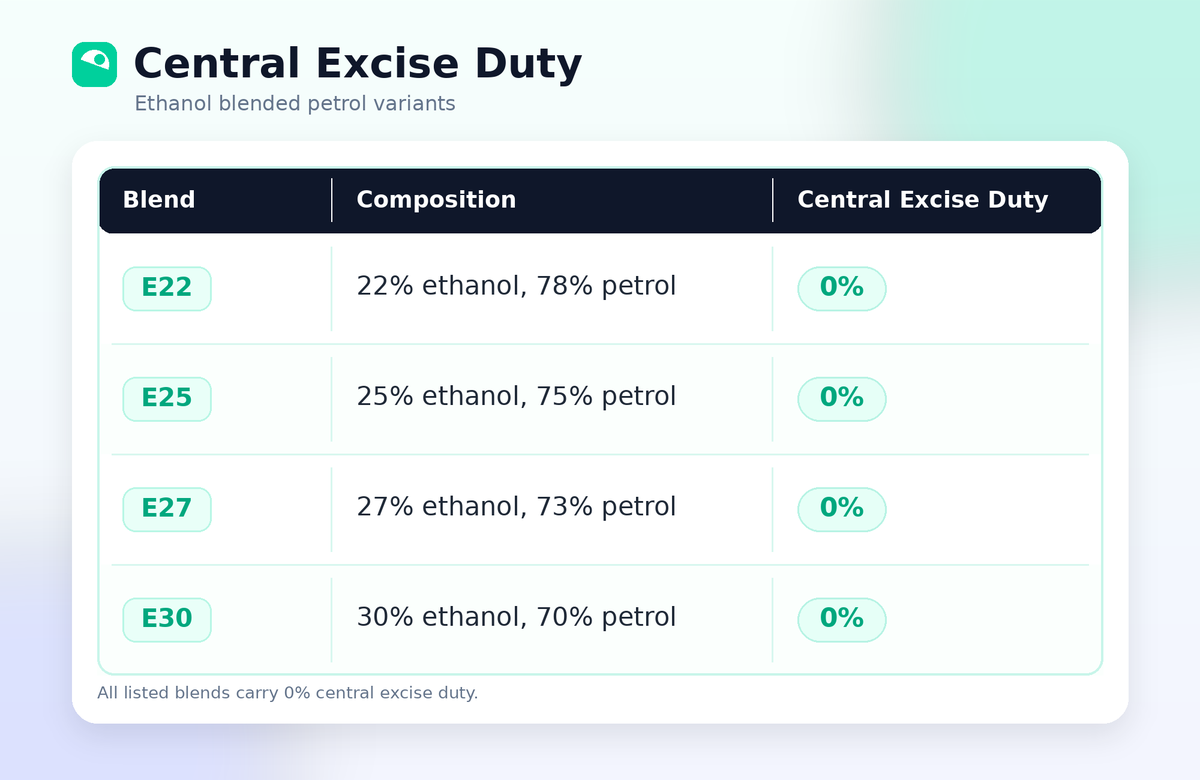
But there are still significant concerns around a material drop in mileage because ethanol has lower energy density than petrol
What are your thoughts on it?
We spent $139 bn. in 2025 on oil imports alone
That’s ~20% of our total import bill, and more than the GDP of Kenya
In fact to reduce fuel imports reliance, Union Minister Nitin Gadkari has been vocal for running Indian cars on 100% ethanol