This was the bottom of $ETH back in November when I wrote this thread.
The general sentiment to $ETH hasn’t changed. But it is at another psychological extreme (some technical stuff too.)
Let’s start by saying that it is of course a serial underperformer, and whether you choose to hold it or not comes down to your preference and optimism for the future.
However, if we look at the bullish case for ETH here:
- Held Weekly support at $2500
- ETHBTC support
- Post-ETF correction of -40%
- Psychological destruction of ETH holders and traders
The TA stuff is self explanatory.
The SOL side I think is a more interesting discussion. Personally I love SOL but this isn’t really about that, it’s about the general nature and mindset of the market.
We’ve seen multiple points in which people have said “fuck ETH I’m never touching this piece of shit again” but, they come back.
Now this latest sell off is another version of that, but kind of worse because it came post ETF (when we were supposed to rally) and because SOLETH broke out to highs.
The misery compounded on ETH holders and the jubilance of SOL holders is a very interesting market psychology point. (PS. Hold more than one asset you plebs)
So we have very confident SOL holders (rightly so) and very very beat down ETH holders.
But we have a market holding support, has had a significant correction and now has a vehicle for institutions.
BTC was in a similar position post ETF where people called the launch a failure, that it was a cycle top and that lower prices were on the cards.
After that initial disappointment it was quickly dispelled and ran strongly into fresh ATHs.
I think you’d be very unwise to ignore ETH.
You might have been beaten up, you might have had enough, and I can understand that, but it’s also why I think it does some serious work over the coming months.
We'll hit the AI thread.
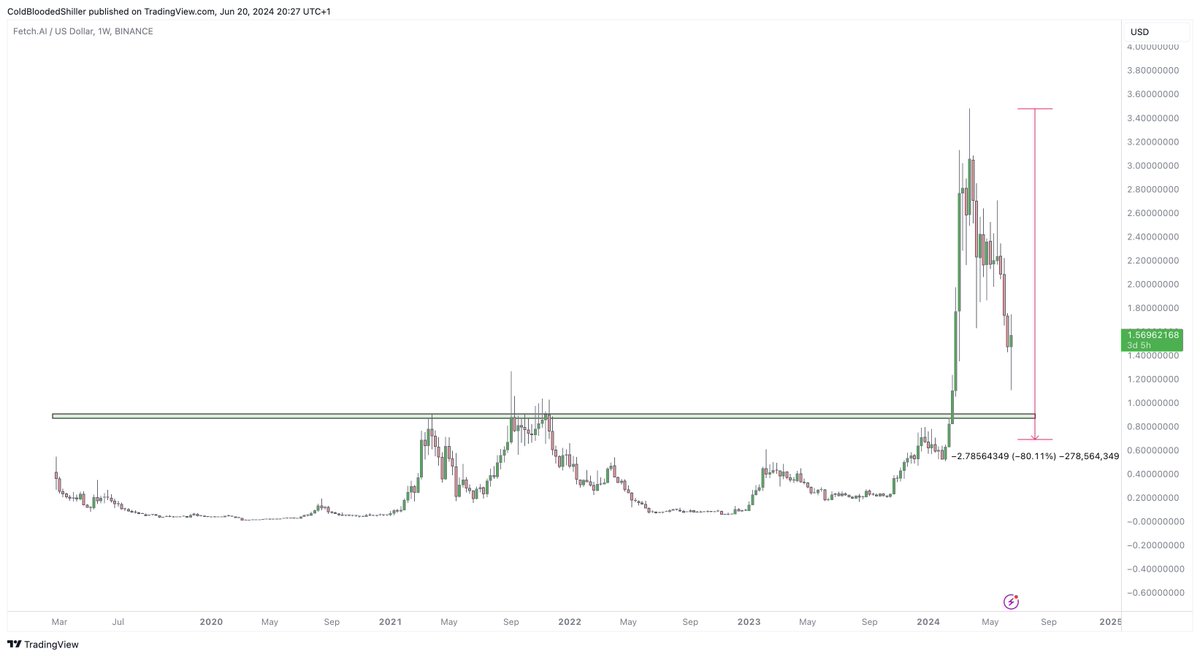
Let's start with $FET.
Weekly chart showing the effects of a correction in a market that's been in monstrous uptrending conditions.
Savage on the downside, but not a lot of regions of established potential demand.
-80% wouldn't surprise me.
"Rotating" is one of the biggest psyops.
It requires you to not only nail market direction, but also nail the timing of relative strength/weakness between strongly correlated assets.
Most "rotations" are traders buying weak stuff because they missed the strong stuff.
Generally, strong stuff stays strong and by the time it's weak, the entire market is screwed and the only "rotation" should be USD to your bank account.
As with anything, there are exceptions and at times there are truly banger pair trades available.
But if you're a newer trader in strong positions, your first thought shouldn't be "How do I get rid of these and buy something weaker?"
Also, GM.
#Bitcoin
I thought we'd get a weekly open scam pump to EMA resistance but looks like buyers aren't even interested in that down here.
Still following main breakdown scenario.
I was not hacked. My manager just joined the community space and answered all questions to the participants- as I am out golfing. We are sending this coin to the moon!!!🚀🚀🚀
https://t.co/SiYwteBGkv
Massive $ETH move
Waiting for ETF formal approval + new all-time high yearly candle close for bullish confirmation
Then I'll wait for the yearly bullish retest to confirm the confirmation
Trading should be boring.
You should know what you're looking for, how to execute the idea, and how to manage it.
The majority of the time is spent waiting - doing nothing when there's no trade, and doing very little whilst letting the trade play out in most cases.
If you have a good trade selection process in place, going through your watchlist or dashboard shouldn't be an arduous or time-consuming process. You should be able to more or less eyeball the chart/price/spread/whatever you trade and quickly tell if there's something there.
The best trades should jump out at you, begging to be traded.
Once you've punted, don't fall for the low time frame false idol of being stuck on the tick chart micromanaging every little move. Most of the time that is unproductive.
Instead, it is often a symptom of not having a clear trade management process in place. It is also a symptom of not being comfortable with the risk you've taken. If you've put on too much size on a mediocre opportunity, that is something you subconsciously recognise and compensate via obsessively managing the trade. It does little more than offer you a false sense of security and increase the odds that you fumble an otherwise salvageable trade.
Social media makes this difficult. You're bombarded with charts, shills, PnL cards, random squiggles labelled as 'trade ideas', the next big narrative, and so on. It can make you feel like if you're not in a trade making money right this second, you're losing.
In reality, most of that stuff is noise. In crypto, a disproportionate majority of your lifetime PnL will come from a handful of good positions in a relatively short period of time.
Focus on building your process for those opportunities instead of arbitrarily filling your 'positions' tab to feel something.