A token should have a job.
Our second AFTERBELL article breaks down why $ABELL exists, how it connects to the product, and how market activity feeds into its economic design.
Read it ↓ https://t.co/RCgRFWdJeq
That was from an earlier version of the project.
We initially built AFTERBELL as a product without a token, then the design evolved and $ABELL became part of the ecosystem through staking and the burn mechanism.
We should've updated that page sooner. Sorry for the confusion, we'll update it as soon as possible🤝
@Polymarket learned this the hard way. They started with AMMs. They switched to CLOBs (Central Limit Order Books) in 2024. Volume went from a trickle to $25.7 billion per month.
We learned from their pivot. We start with CLOB.
A CLOB is just a matching engine. Buyers and sellers place orders. The engine matches them. No pool, no LP, no impermanent loss. Just buyers and sellers, like a traditional exchange.
The burn mechanism has its own execution layer.
When a losing market settles, 50% of the losing stake enters the BurnRouter.
The router uses a TWAP-based execution to buy $ABELL from the open market.
The purchased tokens are then burned.
If liquidity falls below the required threshold, the circuit breaker prevents the buyback from executing.
The burn isn't a marketing event.
It's protocol infrastructure.
See the mechanism → https://t.co/NHdnTgqvyg
Oracle design is part of the protocol, not an afterthought.
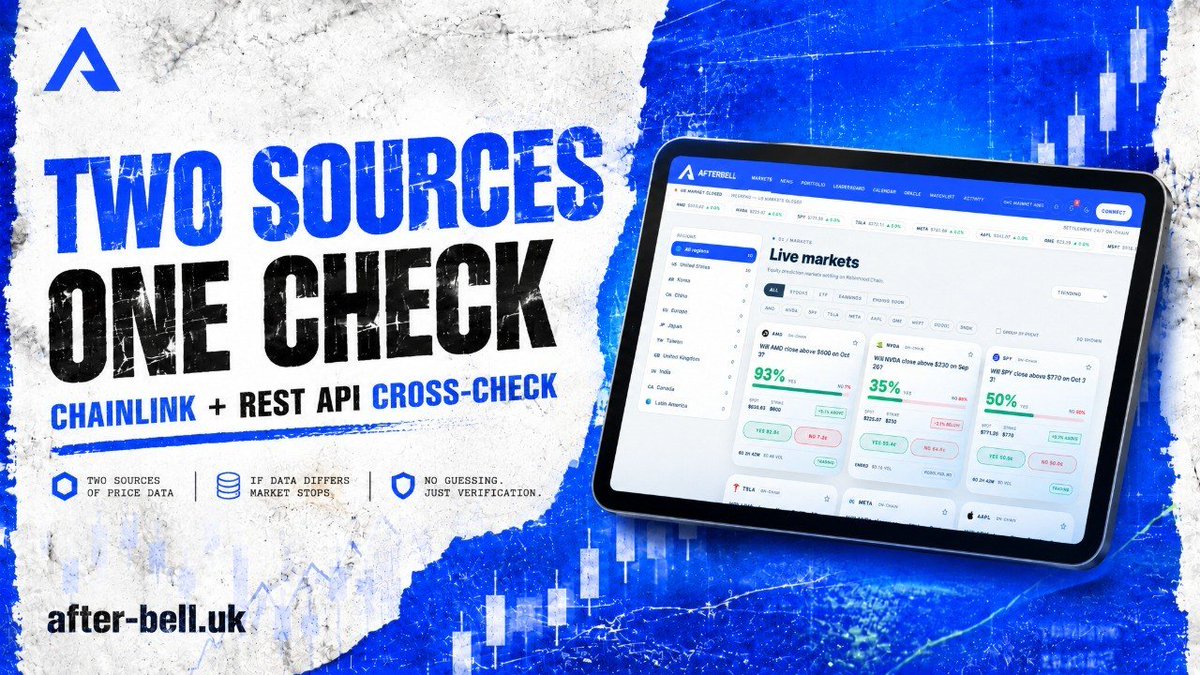
AFTERBELL uses Chainlink as the primary stock price source.
Robinhood's REST API provides a second data source for cross-checking.
If the two sources differ by more than 5%, the market pauses.
The system doesn't guess.
It stops, checks the evidence, and resolves manually when necessary.
Two sources. One check.
Read the resolution model → https://t.co/NHdnTgqvyg
$ABELL is paired with robinhood:0x6330d8c3178a418788df01a47479c0ce7ccf450b
Three reasons:
1. Ecosystem alignment. AFTERBELL is a prediction market for stock tokens. Pairing $ABELL with a stock token keeps it inside the stock token economy, not just another DeFi token.
2. Price discovery against a real asset. COIN is volatile and liquid. $ABELL price reflects relative value against Coinbase stock, not a stablecoin peg.
3. BurnRouter depth. COIN already trades on RHC. Existing COIN holders can add $ABELL without leaving the stock token ecosystem. The pool stays deep enough for TWAP buys without massive slippage.
Trade-off: $ABELL inherits robinhood:0x6330d8c3178a418788df01a47479c0ce7ccf450b volatility. We chose narrative alignment over price stability. Design choice, not mathematical optimization.
$ABELL has concrete utility: stake it to get trading fee discounts. No guessing, no tiers based on "loyalty" only the amount staked determines the discount.
Base trading fee: 0.5% per transaction.
$ABELL staked-Discount-Effective fee
0 | 0% > 0.5%
1,000 : 20% : 0.4%
10,000 : 40% : 0.3%
100,000 : 60% : 0.2%
When you stake, $ABELL is locked in the Staking contract. Circulating supply drops. Combined with the loss-burn above, this means $ABELL supply shrinks from two sources: burned (from losses) and locked (from staking).
There is also a 0.1% resolution fee paid when a market settles. Trading + resolution fee allocation:
- 70% to treasury (operations)
- 20% to market maker subsidies (liquidity)
- 10% to the keeper bot (oracle)
Loss-burn does not go into the allocation above. 100% of loss-burn goes directly to $ABELL buyback + burn. No treasury cut, no intermediary.
Under the interface, settlement happens on-chain.
Orders are matched through the off-chain CLOB.
USDG is used for settlement.
Smart contracts on Robinhood Chain hold the collateral and issue the market positions as ERC-1155 tokens.
Once the market resolves, the contracts handle settlement.
Off-chain matching.
On-chain settlement.
See the architecture → https://t.co/NHdnTgqvyg
This is the interesting part of prediction markets.
The event happens first. The market forms around what happens next.
AFTERBELL is built around that same idea, applied to stock-token markets.
https://t.co/FC97NUy5lX
JUST IN: AOC says she may have a “very unique political window” to run for president in 2028, as democratic socialism rapidly gains influence nationwide.
Prediction markets have a different liquidity problem.
AFTERBELL uses a Central Limit Order Book instead of an AMM.
Orders are placed on the book and matched directly between traders.
No liquidity pool.
No impermanent loss.
Just a matching engine designed around the way prediction markets actually trade.
See the architecture → https://t.co/NHdnTgqvyg
What happens when the market closes, but the event doesn't?
Our first AFTERBELL article looks at the gap between traditional market hours and continuous information.
Read it here : https://t.co/UW60JSiN6Y