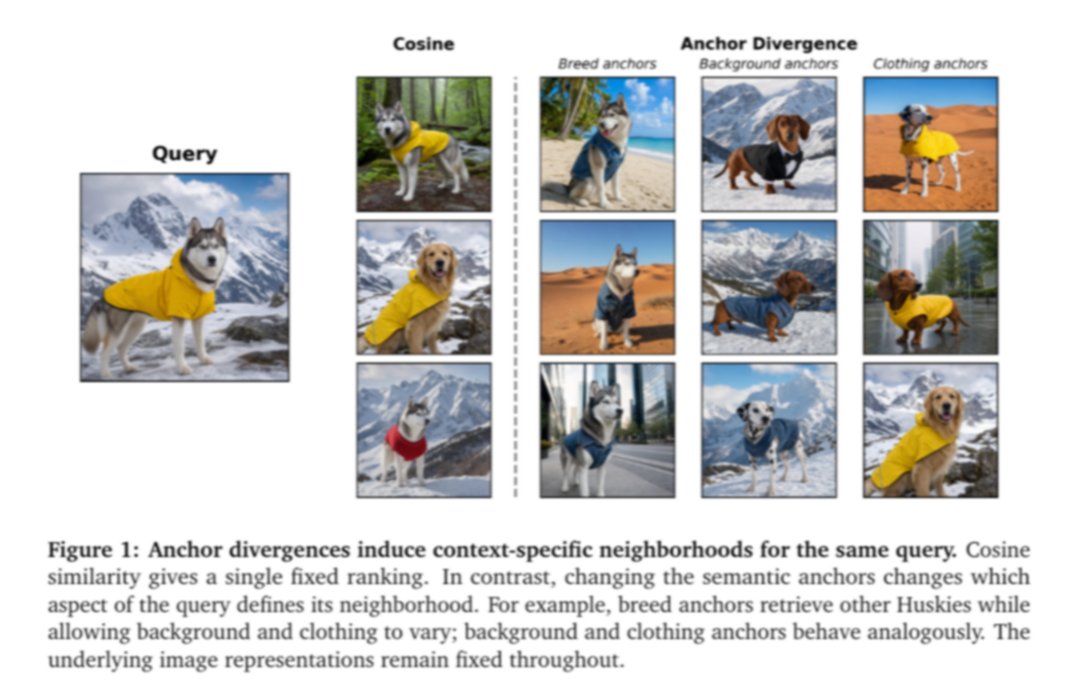
Excited to share this work with @KihoPark_ and @victorveitch!
Can we change how images are compared without changing their embeddings?
In Anchor Divergences, we show how distributions over text anchors make this possible.
A short thread
Encoding semantic similarity into vector similarity is a basic building block of AI systems. When studying this, we usually just think of a single fixed notion of vector similarity (e.g., cossim). However, semantic similarity is fundamentally *contextual*---a fixed similarity notion shouldn't suffice! Turns out the information geometric lens both greatly clarifies this apparent contradiction and also yields a simple and effective technique for getting contextual semantics with vector search.
@_AkashKannan_@KihoPark_
https://t.co/u9wsD7DMz4
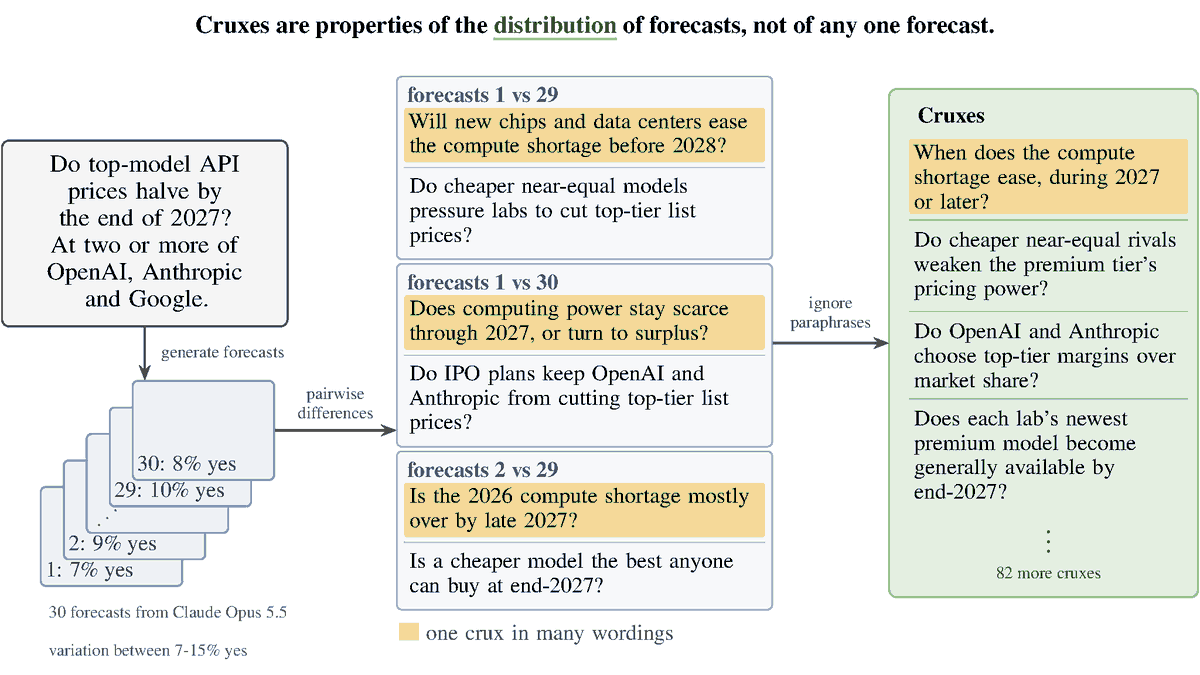
📄 arXiv:2610.21006 You ask a language model whether top-model API prices halve by 2027. It writes a ten-page rationale for its conclusion. What are the cruxes of that forecast? Problem: only by contrasting forecasts can you validate a crux matters for the conclusion! 🧵
6/6 On ImageNet-R, changing the anchor distribution shifts retrieval between object and style. On chest X-rays, pathology-specific anchors emphasize different clinical findings.
Model the anchors -> model the geometry.
2/6 The key move: represent semantic context by a distribution q over text anchors.
Its cumulant-generating function induces a Bregman divergence on fixed image embeddings.
Text distribution → convex potential → image geometry.
5/6 We can also adapt: learn broad semantic structure from many text anchors, then update it with a few target-specific ones.
This empirical-Bayes approach specializes the geometry when task-specific anchors are scarce.
1/6 Consider a husky in a yellow raincoat.
Should its nearest neighbors be other huskies, other yellow raincoats, or images with similar backgrounds?
It depends on the semantics we care about. But cosine similarity gives a single, fixed ranking.
Excited to share this work with @KihoPark_ and @victorveitch!
Can we change how images are compared without changing their embeddings?
In Anchor Divergences, we show how distributions over text anchors make this possible.
A short thread
Encoding semantic similarity into vector similarity is a basic building block of AI systems. When studying this, we usually just think of a single fixed notion of vector similarity (e.g., cossim). However, semantic similarity is fundamentally *contextual*---a fixed similarity notion shouldn't suffice! Turns out the information geometric lens both greatly clarifies this apparent contradiction and also yields a simple and effective technique for getting contextual semantics with vector search.
@_AkashKannan_@KihoPark_
https://t.co/u9wsD7DMz4