THIS IS GOING VIRAL SO I WANTED TO SHARE IT HERE TOO:
A bit from my past:
My first job after getting my PhD was working as a therapist for people from low socioeconomic backgrounds.
Almost all of them were diagnosed with depression, GAD, bipolar, or BPD. Most were highly medicated— some to a point that still sticks with me years later.
As I got to know their background and lives 3 things were very clear:
1. A vast majority had been emotionally neglected, emotionally abused, or physically abused as children.
2. A vast majority had experienced domestic violence or were currently living in it.
3. Basic needs were never met. Life was an hour by hour struggle. Treatment was an attempt to allow them to get to work in most cases. To just continue to surviving.
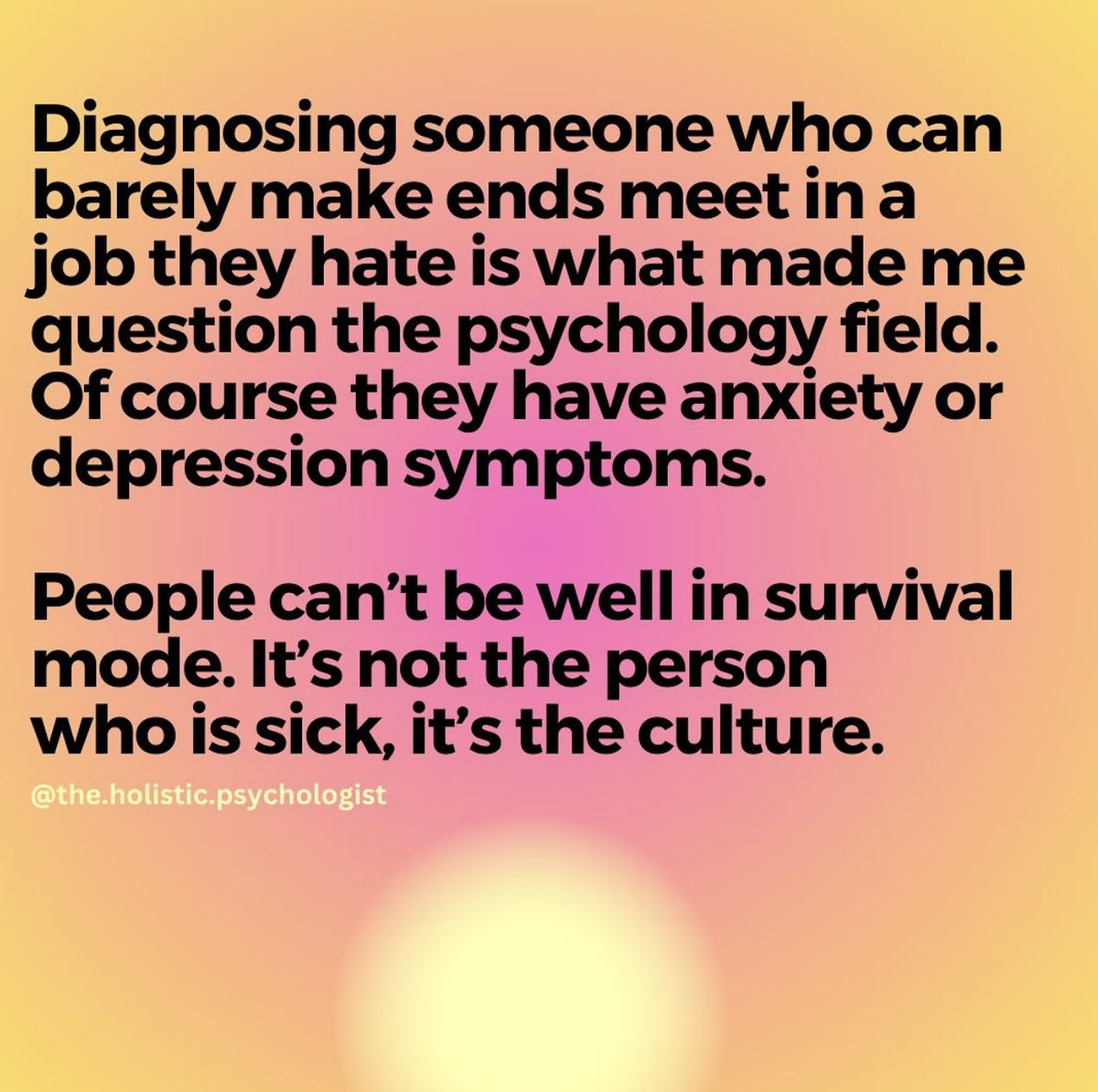
It was the start of me questioning the field I had been trained in. One that diagnoses people with disorders without taking a look at the whole picture. It began my path of holistic understanding.
A person cannot be well when one unexpected bill will have them fall behind on rent. When they lay their head on a pillow and all they can think about is expenses piling up. When a bill at the grocery store is almost double what they paid last year when their income has stayed the same.
An entire family unit deeply struggles within survival mode. When a job is lost. When daycare needs to be paid, but so does the light bill— what do you choose? When parents can’t even think about the emotional needs of their children because they have to figure out where their next meal is going to come from.
In 1942, 10 years before the diagnostic manual of mental illness was released Maslow knew what was once just common sense: we have a hierarchy of needs.
At the bottom are basic needs food and shelter. Then safety (resources, security). Then belonging (connection, friendship, intimacy.) Without three things we *will* be sick, period.
I get pushback for questioning the status quo. And I’ll continue to do it. The status quo is keeping people sick. It denies their experience. And it says we should bandage people’s symptoms so they can return to the environment that made them sick.
May we wake up, heal ourselves, and build conscious communities to help each other.
Retweet if you feel this is true in your body 🙏
12 Reasons Why Cities Need More Trees:
1. Temperature Control
One large tree is equivalent to 10 air conditioning units, and the shade they provide can reduce street temperature by more than 30%.
2. Noise Reduction
Trees can reduce loudness by up to 50%. In urban areas filled with the sound of cars, construction, sirens, aeroplanes, and music, trees are essentially the best way to block noise and keep cities — along with the homes and workplaces in them — quieter.
3. Air Purity
Trees remove an astonishing amount of harmful pollutants and toxins from the air. In urban areas air quality is often disastrously bad — with severe consequences for our health. Trees make the air we breathe much cleaner.
4. Oxygen
And, while absorbing all those pollutants, trees also put more oxygen back into the urban environment. Oxygen levels are significantly lower in cities compared to the countryside; trees help to solve that problem.
5. Water Management
Trees do more than just shelter us and our buildings from rain — which is, in fact, extremely important. They also absorb huge quantities of water, reduce run-off, neutralise the severity of flooding, and make flooding more unlikely altogether. Not to forget that their roots absorb pollutants and prevent them from feeding back into a city's water supply.
6. Psychological Health
Studies have proven what we instinctively know to be true: that human beings are significantly happier when surrounded by nature rather than sterile urban environments. Our emotions, behaviour, and thoughts are shaped by the places we spend time — and trees have a profoundly positive effect on our psychology. The consequential benefits of being happier and more peaceful — as individuals and as a society — are immense.
7. Physical Health
Beyond all the other ways in which trees improve air quality and the urban environment, much to the benefit of our health, they also encourage people to go outside. Cycling, running, and walking are all more common in urban areas with plenty of trees. A knock-on effect of people spending more time outdoors is also social integration and stronger communities.
8. Privacy
A simple point, but not inconsequential, is that trees provide privacy.
9. Economics
The total economic benefit of urban trees is hard to calculate. There are costs, of course, including the repair of infrastructure damaged by roots and maintaining the trees themselves. But the total economic benefit — a consequence of everything else in this list and more — far outweighs the expenditure. Trees make cities wealthier.
10. Wildlife
Trees are miniature cities all of their own, serving as a habitat for hundreds of different species, including birds and mammals and insects.
11. Light Pollution
Trees don't only block the light shining down, therefore keeping us and our cities cooler — they also disrupt light shining up, from street lighting, cars, houses, and billboards. Skies are clearer in cities with more trees.
12. Aesthetics
And, finally, trees are beautiful. They break up the potential monotony of urban environments — the sharp geometry, the greyscale roads and buildings, the endless rows of cars — with their trunks, boughs, canopies, and flowers.
Just think: the gold and red of falling leaves in autumn, the white and pink blossom of spring, the vast green canopies of summer, and the branches lined with hoar-frost in winter. Every single tree is a myriad of intricacy and texture, of colour and scent, of dappled light on the pavement, mottled bark, knotted roots, of clustered leaves and delicate petals and stern boughs.
Few streets would not be improved by the kaleidoscopic aesthetic delights of a tree, not to mention the many different species of tree, all over the world, whether willow, oak, lime, cherry, aspen, maple, birch, horse chestnut, dogwood, hornbeam, ash, sycamore... the list goes on.
There are some drawbacks to urban trees, most of them context-specific, and they are not — of course — universally appropriate. But it seems fair to say that many cities would benefit from at least a few more trees here and there.
Mexican people really ate when it came to Mexican food. Our brown brothers and sisters took the same 8 ingredients and freaked them 75 different ways and THE BITCHES LOVE IT. And the margaritas be tasting like Margarita herself came down and mixed it up??? BIDI BIDI BITCH.
PLEASE READ SLOWLY...
Sometimes you and someone else were only meant to share a moment. Sometimes friendships and relationships are not built to last forever, they are built to teach you a lesson.
A sign of maturity is you don’t interject your opinion into everything. You can listen, observe, and try on another perspective, even when it makes you uncomfortable.
i saw someone posted "i was put into his life to teach him unconditional love and he was put in mine to teach me self love." and as heartbreaking as that truth is, maybe we can simply be grateful that the universe sent us something so deeply hurtful that it forced us to come +
STOP APOLOGIZING...
You don't have to say sorry for how you laugh, how you dress, how you make your hair, how you do your makeup, how you speak. You don't have to be sorry for being yourself. Do it fearlessly.
Irritability will be at a high when you go through changes. Let yourself be moody. Don’t judge it. It will pass. Change creates friction— flow through it. Don’t fight it.
Expect to want to do nothing but sleep when coming out of survival mode. Your body is healing itself and learning how to live beyond survival. Remember to eat and get in the sun. Make your bed a sanctuary and rest, guilt free.
Accomplishments in life that go unnoticed:
1. Building a healthy relationship.
2. Quitting something that crushes your soul.
3. Divorcing when it’s time to choose yourself.
4. Switching careers to something you love.
5. Finding friends who become chosen family.
6. Breaking the trauma cycle.
Are you compatible with your partners flaws?
It’s not just about what you love about them.
It’s also about accepting their short comings.
Nothing creates more resentment than two people constantly trying to change each other.
We all want to be accepted.
Emotionally healthy people have had toxic relationships.
They grew from them.
And forgave themselves for not seeing the red flags.
They’ve learned who they are and what they want.
They’re smarter, now.
Your brain is plastic.
It can be re-wired.
Your personality isn’t fixed.
You can re-create yourself at any time.
It just takes self compassion, commitment, and a willingness to be an active participant in your healing.
My 4yo woke up this morning crying that she didn't want to go to daycare. 30 minutes later, she skipped out the door, smiling and ready to see her friends.
You might be wondering how this happened. As a parenting expert, let me explain. 🧵
Not everyone is meant to parent.
Having a child is not an afterthought.
It take emotional awareness, intentional choices, and a willingness to heal your own wounds.
To raise a healthy adult, you need to become one.
You’re safe.
No one is mad at you.
You can stop assuming.
You’re not that small child in trouble, who can’t relax.
The hypervigilance is from your past.
You’re safe, now.