Three key trends I am increasingly excited about...
1: Our industry has started caring much more about the security and reliability of the infrastructure, standards and oracles/dependencies that it is built on top of. This shift in focus towards security is already massively benefiting Chainlink because it is built with security and reliability in mind from the start e.g. 16 nodes vs 1 of 1 or 2 of 2 (which is actually often just a 1 of 1 in disguise). This focus on reliability and security makes a better system for everyone in the DeFi/TradFi industry to transact with less risk and also leads to more overall Chainlink adoption over time. The way Chainlink became the leading data oracle is through security and reliability, I think that will happen across all categories where Chainlink deploys services for the same reasons.
We are now clearly seeing this dynamic take place in cross-chain interoperability, with many large users migrating onto CCIP after conducting deeper security reviews of bridging providers, more and more of which are now being published, some telling quotes below:
https://t.co/7ANpmqIlPn
Kraken chose Chainlink CCIP because it offers enterprise-grade infrastructure with strict security & risk management requirements, including:
• ISO 27001 and SOC 2 Type 2 certifications
• Secure by default architecture
• 16 independent nodes
• Native rate limits, and more.
https://t.co/hPnqT7CFcT and https://t.co/QHXnyjO2fp
The analysis covers how Chainlink CCIP delivers strong decentralization, native safeguards, and issuer control as default protocol-level guarantees, which insulates wstETH from a number of attack vectors behind the Kelp / LayerZero exploit.
https://t.co/AObyg1Nunx
Chainlink CCIP has emerged as the standard in cross-chain infrastructure, providing an enterprise-grade framework to secure high-value assets
With over $4Billion migrated in just a few weeks and more on the way, I am clearly seeing the industry's clear preference for security and reliability being a key trend leading to accelerated adoption of Chainlink and CCIP.
2: Chainlink has always continued to build and added many of its best features during down markets, when there is less noise to distract top teams from building. Because Chainlink already has clear product market fit, being able to focus on building the future is a powerful accelerant for future progress and is actually what I and many of the people building Chainlink are here for.
I am very excited about both the use case specific features e.g. collateral management and the increasing number of reusable primitives e.g. verifiable confidential compute in CRE, which are now actively being built, refined and launched with top users. In my experience, during the down market lulls is when the best things get built, and I am truly thrilled to see Chainlink being built to better serve its existing users and entirely new users.
3: The RWA, TradFi Tokenization and Digital Assets industry has now decoupled from crypto prices as a determining factor of its success and is a rapidly growing market of its own. Great news for the technologies, standards and infrastructures that can serve this new and growing demand, of which Chainlink is at the very top of the list. By having the relevant certifications; https://t.co/PlGDKLrJDi, being the historically most secure/reliable option with the largest amount of value enabled and being able to compose multiple key primitives (Data + Interoperability + Identity/compliance + verifiable off-chain orchestration) into full end-to-end solutions like no other platform can, puts the Chainlink platform/ecosystem in a unique place to be adopted by this new and growing market.
This is now becoming increasingly clear in practice through Chainlink's adoption in various parts of the capital markets; from collateral management with some of the most recent examples being...
DTCC using CRE and Data for their production plans; https://t.co/IiXXFfUwJu + https://t.co/sHe6QvquYR
Data providers like SGX using DataLink for key data; https://t.co/P7uPeOzliY
Top asset managers like State Street; https://t.co/Jh08KBnCvN and Fidelity International; https://t.co/06noNUEbEt, being powered by Chainlink on the backend.
The above are just a small number of recent examples, with many more being worked on all across the TradFi ecosystem, from payments, to tokenized equities, to tokenized funds; all of these on-chain finance use cases need multiple Chainlink components working together.
I can't wait for the next stage, where the leading DeFi applications and the top TradFi institutions start interoperating through their use of shared on-chain standards, interoperability connections and data/identity oracles, all of which are being provided by Chainlink, together with existing infrastructures. Solving each of these market's individual problems is already exciting, but helping them merge into the new global financial system is something that I and many others in our ecosystem have been working towards for a while.
If the above sounds like something worth spending many late nights on, and you can see the future I am talking about, this is the best time to join a top team like Chainlink Labs... if you're the best of the best, excited about the future of the blockchain industry, DeFi, TradFi and building the future of the new global financial system, we are excited to work together with you: https://t.co/zhTgEzBUm0.
Excited about the continued rollout of top institutional data on-chain via Chainlink; @sixgroup, the exchange of Switzerland has adopted @chainlink as the data standard it is using to get critical market data on-chain: https://t.co/GpQP6dnYnJ.
Chainlink is the global leader powering DeFi and TradFi RWAs, with this data helping increase institutional demand for both. This is now starting to be driven by TradFi users wanting their existing data sources on-chain as they move more capital into institutional grade RWAs, which require market data to function in similar ways to how DeFi couldn't operate without a reliable data layer like Chainlink. Below are just some more examples of top institutional grade data providers choosing to put their data on-chain via Chainlink as the leading data standard powering over 70% of DeFi globally, with it now becoming the data standard that their institutional users will be asking for in order to consider an RWA as reliable enough to put institutional capital into.
Also, being able to easily access key market data from CRE workflows should accelerate your speed of building a tokenized fund, tokenized equity, on-chain vault and many other on-chain financial products. If Chainlink is the place you can receive all your needed market data, reference data and identity data on-chain, that is just the first initial level of Chainlink integration for your RWAs. If you are then choosing to build your entire on-chain financial product via CRE because it can help you reliably create key conditional statements around the use of that data, with privacy and off-chain level compute scalability, that is a whole new level of Chainlink integration. The type of data listed below opens the door for DeFi, Prediction Markets, RWAs and many new categories of on-chain smart contracts to adopt Chainlink, but then once the full capabilities of reliable on-chain data are combined with CCIP cross-chain and CRE chain abstraction, that becomes a whole different level of orchestration, reliability and privacy.
S&P: https://t.co/6udBRjSzTU
FTSE Russell: https://t.co/gCpz6Eu99v
Tradeweb: https://t.co/d18kWaCifK
Deutsche Börse Group: https://t.co/KANxCI6uIF
Intercontinental Exchange: https://t.co/QWS7ETO9Kd
Coinbase: https://t.co/FS2MLqy4VB
Among many others....
Excited to see that being the most secure cross chain technology across DeFi and TradFi is attractive to top technical teams who do deep diligence and security review.
I also think that being able to provide real reliability for a bridge during cloud outages like AWS, while other bridging systems go down for extended time periods, is a large advantage when being considered by highly technical teams that want high uptime/reliable systems.
I personally feel that all the security and reliability work that was put into CCIP is starting to pay off, which feels very familiar from when Chainlink was chosen to power the top DeFi and TradFi systems with the most secure and reliable data. I think the consistent security and reliability properties of Chainlink will continue to make the choice of top teams and institutions in our industry.
Join me on Aave App to start earning 6.00% APY on your savings! Enter the referral code 6B8084 during sign up to move up the waitlist. https://t.co/YP0OlplIyL
SMARTCON DAY 1 RECAP:
• Chainlink Runtime Environment (CRE) now live—the all-in-one orchestration layer powering the next massive leap in onchain finance.
• UBS has completed the world’s first in-production, end-to-end tokenized fund workflow leveraging the Chainlink DTA technical standard.
• Introduced Chainlink Confidential Compute, a breakthrough service that unlocks private smart contracts on any blockchain.
And much more ↓
https://t.co/EcPEI5xNKa
#Chainlink CCIP cumulative transfer volume just hit $7.77B.
The same day last year it was $375M.
That’s a 1,972% increase in just 12 months 📈.
And we’re still early.
That’s nearly 21× YoY growth in real cross-chain activity — before major financial infrastructure has even touched the network.
No SWIFT.
No DTCC.
No Euroclear.
No JPMorgan.
No tokenized T-bills.
Just organic onchain usage.
Now imagine what happens when global financial plumbing moves onchain — and CCIP becomes the standard for cross-chain value transfer.
Billions will look small.
We’ll be measuring in trillions.
Chainlink’s CCIP is the connective tissue for the next financial era.
📊 Track live metrics here →
https://t.co/OHxVb7axx1
The rails are already being laid — and the numbers don’t lie. 🚀
$LINK #Chainlink #LinkTheWorld #4IR #PoweredByChainlink
Steady lads, I've deployed more capital at https://t.co/6lZjwEC4pm.
Time to realize financial freedom and sovereignty without the games.
https://t.co/7rNdCG5bYr #
This years SIBOS is the biggest one yet for Chainlink. Moving our work forward with Swift on interoperability, as well as announcing our work with the DTCC, Euroclear, UBS, DBS, BNP and many others on solving key problems like corporate actions for successful institutional tokenization by the TradFi industry.
Digital Transfer Agency launching with UBS and DataLink launching with Deutsche Borse are also very big because Chainlink clearly solves two of institutional tokenization's largest challenges; on-chain transfer agency and institutional grade data for digital assets.
At this SIBOS I think it has become clear to everyone in the TradFi and DeFi community that the Chainlink Stack is the only system where you can get all of your digital asset challenges solved using a single standard.
It is important to remember that solving just one of these problems is not enough to make institutional transactions happen on-chain at scale. Institutional tokenization and institutional capital flows in the trillions require multiple conditions to be met; on-chain data, cross-chain connectivity, on-chain compliance, on-chain asset servicing e.g. corporate actions, legally binding transfers e.g. transfer agency and many others depending on the use case. If we want institutional tokenization to happen at scale and for that scale to turn into trillions of dollars in capital flowing on-chain, there needs to be a single global standard that solves these problems on-chain, in a way that works for both the institution and the regulators they are overseen by.
More to come and very excited about the Chainlink Stacks ability to solve these problems in one standard.
We’re excited to announce a strategic partnership between Chainlink and SBI Group one of Japan’s largest financial conglomerates with the USD equivalent of over $200 billion in total assets.
https://t.co/eZFGt8ysDK
SBI Group and Chainlink will focus on powering several innovative use cases centered around tokenized funds, tokenized real-world assets such as real estate and bonds, regulated stablecoins, and more.
SBI Group and Japanese financial services companies will leverage Chainlink services, including the Cross-Chain Interoperability Protocol (CCIP), SmartData (NAV), and Proof of Reserve to unlock secondary market liquidity and enhance the operational efficiency of tokenized assets while seamlessly fulfilling compliance and privacy requirements.
Yoshitaka Kitao, Representative Director, Chairman, President & CEO of SBI Holdings, stated:
“Chainlink is a natural partner for SBI complementing our financial footprint with their market leading interoperability and reliability onchain. With our combined strengths, we are delighted to be working together on developing groundbreaking, secure, compliance-focused solutions, including powering compliant cross-border transactions using stablecoins, that accelerate the widespread adoption of digital assets in Japan and the region.”
Chainlink, UBS Asset Management, and SBI Digital Markets previously completed a solution for automated fund administration and transfer agency using smart contracts under the Monetary Authority of Singapore's (MAS) Project Guardian.
THE CHAINLINK ENDGAME
The updated Chainlink vision is here.
What started as a data solution is now an extensive platform of essential services for integrating the world into the onchain economy ⬇️
https://t.co/HlnmFeiEWY
What TCP/IP did for the Internet and the Java Runtime Environment (JRE) did for online development, Chainlink is doing for blockchains and onchain apps.
In the early days of the Internet, scaling required more than innovation—it required unification and seamless orchestration.
TCP/IP and the JRE emerged, bringing coherence to a fragmented digital world and abstracting away complexity so developers could focus on building.
Blockchains are at the same turning point.
With more chains and even more financial institutions and real-world assets moving onchain, the main challenge now is building apps that efficiently orchestrate across blockchains and existing systems.
Advanced blockchain apps now involve multiple types of data, cross-chain interoperability, compliance policies, integration with legacy systems, and much more.
Building these next-gen apps is nearly impossible to do in-house and overly complex if you have to rely on a growing list of vendors, who each only solve a small portion of the application’s overall requirements.
Chainlink changes that.
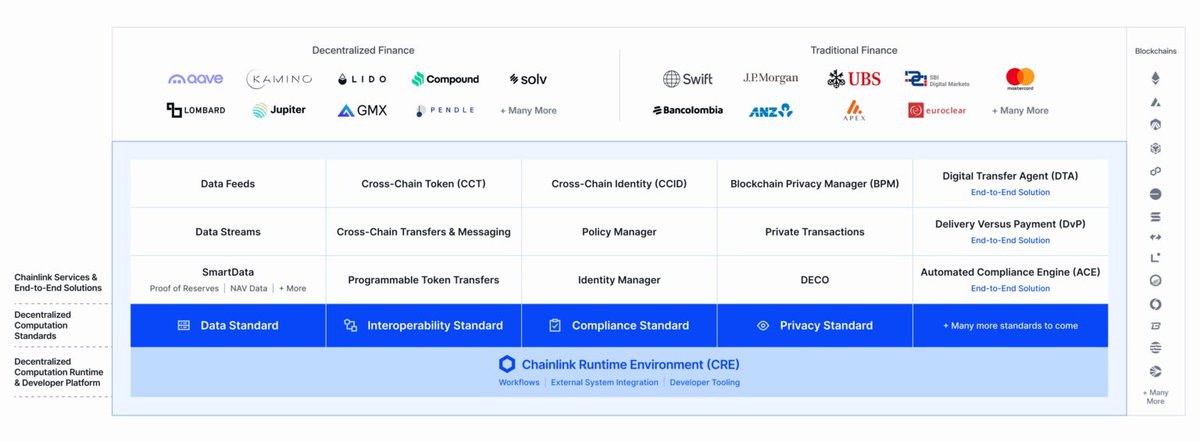
Chainlink is not just a price feed. It’s a unified oracle platform that underpins critical standards, services, and end-to-end solutions needed to unlock advanced blockchain applications:
• Data oracles for publishing mission-critical data onchain
• Interoperability oracles for moving data and value cross-chain
• Compliance and privacy oracles for meeting regulatory and internal business requirements
• Legacy system integration for seamless connecting between onchain and offchain systems
• Verifiable orchestration and compute to power entire applications in a decentralized manner
Like Java and TCP/IP before it, Chainlink unifies blockchains and abstracts away complexity, empowering developers and institutions to build and power the entire lifecycle of onchain use cases via a single, secure platform.
Now, enterprises can efficiently build onchain apps that mirror the sophistication of traditional finance yet benefit from the transparency, security, and composability of blockchains and Chainlink technology.
Chainlink is how the world integrates into the onchain economy.
We’re excited to share that Chainlink is now the industry’s first data and interoperability oracle platform to achieve ISO 27001 & SOC 2 compliance.
This is a major step toward unlocking in-production use cases with the world’s largest financial institutions & governments.
https://t.co/yjBEDok5re
ISO 27001 certification and SOC 2 attestation thoroughly validate that multiple Chainlink oracle services meet rigorous security, availability, and confidentiality standards.
Officially certified services include CCIP, Price Feeds, and SmartData (Proof of Reserve & Net Asset Value).
The establishment of secure standards across data, cross-chain interoperability, and beyond is critical to unlocking the next wave of onchain finance, where tens of trillions in real-world assets are tokenized onchain and seamlessly transacted by the world’s leading financial institutions.
Understand why everyone is excited about @Chainlink & $LINK in 5 easy steps 🧵
1. What is the future of the crypto industry?
Tokenized real-world assets (RWAs).
Basically, the tokenization of anything of value and the creation of services for those assets. It's the next iteration of the global financial system.
2. What's the most important technology for launching and building services for tokenized assets?
Chainlink.
3. Why do tokenized assets need Chainlink?
Chainlink is a platform of critical services (similar to AWS) for tokenized assets and services. It provides six important services:
• Data (Prices, interest rates, proof of reserves, etc)
• Cross-chain (move data/assets across blockchains)
• Compliance (KYC, AML, rate limits, ID checks, etc)
• Privacy (conceal sensitive information)
• Legacy system integration (connect existing systems onchain without modifying them)
• Orchestration (power the full lifecycle of apps that interact across chains and legacy systems)
4. But who actually uses Chainlink?
The largest financial institutions and most adopted Web3 apps.
Some big names include: Swift, J.P. Morgan, Mastercard, UBS, Euroclear, ICE, Apex Group, Fidelity International, Brazil Central Bank, ANZ bank, Aave, GMX. Pendle, Kamino, Jupiter, Etherfi, Lido, Compound, Solv, and many more.
5. Ok, but how does the adoption of Chainlink relate to the LINK token?
The Chainlink Reserve.
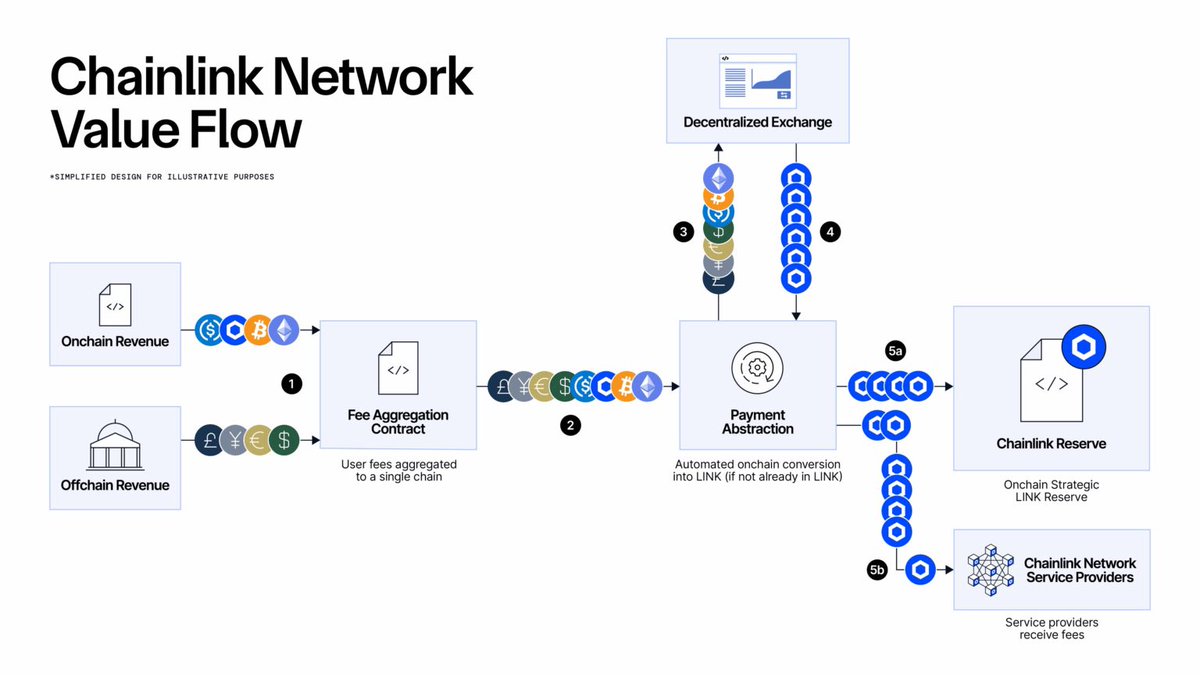
Apps and enterprises pay to use Chainlink in their preferred method: onchain or offchain; in LINK, blockchain gas tokens, or fiat (e.g. USD). Chainlink then converts revenue from those payments to LINK and stores it in the Reserve, effectively creating more demand for LINK the more that Chainlink services are adopted.
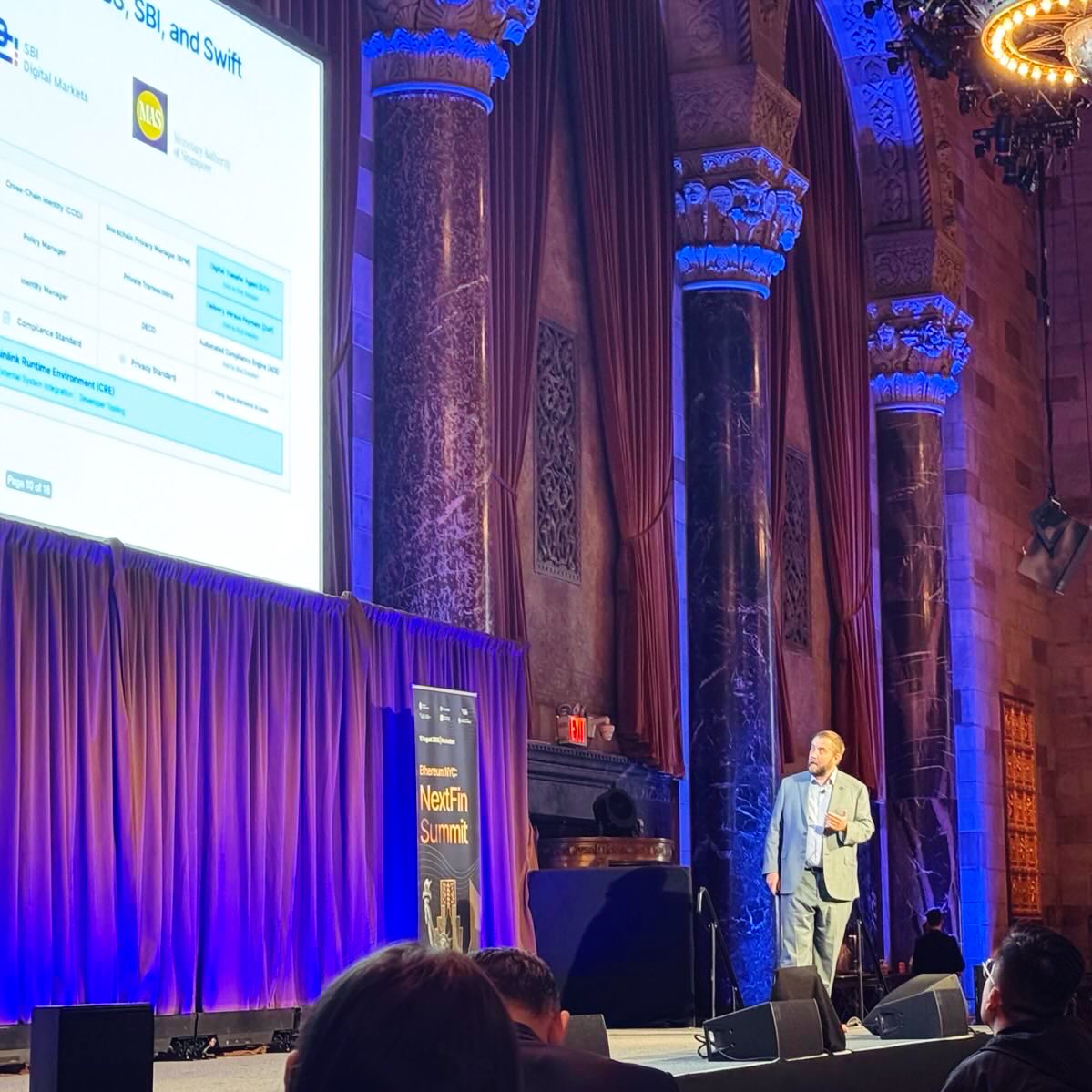
Chainlink co-founder Sergey Nazarov just delivered the keynote “Institutional Adoption on Ethereum” at NextFin during #EthereumNYC, outlining how Chainlink is powering the infrastructure banks, markets, and global institutions need to operate onchain.
Chainlink 🤝 Ethereum = 🏦
We’re excited to announce that Intercontinental Exchange (@ICE_Markets) and Chainlink are collaborating to allow Chainlink to now bring high-quality derived forex and precious metals data onchain.
https://t.co/6Hf4ccqiaR
ICE is a global financial powerhouse that operates markets, clearing houses, and data services critical to the functioning of the world's economy, such as the New York Stock Exchange. Its FX rates and precious metals prices are relied on by world-leading banks, asset managers, and other institutions. The use of ICE’s Consolidated Feed data further enhances Chainlink’s data standard, delivering an onchain experience that meets the rigorous requirements of traditional capital markets and unlocks a new class of institutional-grade applications.
ICE VP, Global Data Delivery Platforms, Maurisa Baumann on the collaboration:
“With content from over 300 global exchanges and marketplaces, the ICE Consolidated Feed offers trusted, structured multi-asset class data to banks, asset managers and ISVs located around the world. We’re happy to work with Chainlink to securely and reliably provide data for onchain markets, which is an important step in growing the global blockchain economy.”
This collaboration marks a new milestone on the pathway towards the mainstream adoption of onchain finance. With demand for tokenized real-world assets expected to reach $30.1 trillion, forward-looking institutions have the opportunity to establish leadership in the digital asset space and power the rapidly growing blockchain ecosystem.
ICE serves as one of multiple high-quality data providers supporting Chainlink Data Streams, supplying established institutions and Web3 innovators with access to tamper-resistant data—paving the way towards the mainstream adoption of onchain finance.
The Chainlink Reserve enables offchain revenue from large enterprises adopting the Chainlink standard and onchain service usage revenue to be converted into LINK and stored in a strategic reserve.
@SergeyNazarov joins @scottmelker on The Wolf of All Streets podcast to explain ⬇️
We're excited to announce the launch of the Chainlink Reserve, a new upgrade centered on the creation of a strategic onchain reserve of LINK tokens.
https://t.co/Fgib8zR9uj
The Chainlink Reserve is designed to support the long-term growth and sustainability of the Chainlink Network by accumulating LINK tokens using offchain revenue from large enterprises that are adopting the Chainlink standard and from onchain service usage.
The Chainlink Reserve is being built up by using Payment Abstraction to convert offchain and onchain revenue into LINK, using a combination of Chainlink services and decentralized exchange infrastructure.
Demand for Chainlink has already created hundreds of millions of dollars in revenue, substantially from large enterprises that have paid offchain for access to the Chainlink Platform.
With increasing demand from a number of the world’s largest banking and capital markets institutions, this form of paying for the Chainlink standard is expected to grow into the future as the industry grows.
The Reserve has already accumulated over $1M worth of LINK from this early stage launch phase, which is expected to gradually grow in the coming months as more revenue is converted into LINK and placed into the Reserve.
We do not expect any withdrawals from the Reserve for multiple years and thus it is expected to grow over time. We believe that as the industry demand for Chainlink’s unique capabilities increases, that adoption of Chainlink services will enable the Reserve to grow further.
🧵👇
Very excited about this report from Visa, showcasing how Chainlink is able to solve the three biggest problems of next generation smart contracts for institutional transactions, all in one platform.
1. Providing the critical data needed to properly price the assets in the transaction and enable transfer agents.
2. Connecting multiple chains to enable the value and the data of the transaction to move across multiple chains. Powering a public chain to private chain connection in this case.
3. Enabling compliance by providing on-chain identity proofs and matching them against various policies from two different jurisdictions and regulatory frameworks.
Smart contract transactions in the institutional world are complex, they require various sources of data, multiple cross-chain connections and a reliable form of on-chain identity/compliance, all of which the Chainlink standard is able to uniquely provide in one secure and reliable platform.
This transaction between ANZ and Fidelity International, two existing institutional users of Chainlink, all happening within the HKMA regulatory framework which Chainlink has now been being built work within for many years. Complicated flows like this, being executed in a compliant way, is a clear sign of the unique value that Chainlink is now able to provide.
As more top institutions adopt the Chainlink standard for data, connectivity and compliance, I expect that they will begin to transact with each other more frequently, as the friction for the institutions on this comprehensive transactional standard is much less than the cost of a transaction on institutions that are on various seperate standards with multiple ways of proving data, connecting chains and creating compliance. As more and more top institutions join the Chainlink standard for institutional transactions to happen on-chain, the network and the standards become more valuable to the current participants and the ones considering joining the transactional standard.
Excited about seeing more of these coming up and having Chainlink power the next stage of our industry's growth through mainstream institutional adoption.
https://t.co/4RApSpL6Pi
“CCIP is going to be the key pathway for institutions to reliably interact with Solana.”
Watch @SergeyNazarov’s presentation from @SolanaConf today to discover how Chainlink is powering internet capital markets ↓