The network effects literature has a name for this inflection point
It's the moment coordination costs collapse faster than new entrants can raise them
When PayPal, Paxos, Fiserv, and now Western Union all settle on the same rails, the question stops being "why Solana?" and starts being "why anywhere else?"
Liquidity is not a feature. It's a moat that compounds
Everyone debated @solana's potential. May 2026 ended the debate.
On May 4, @WesternUnion launched USDPT - a dollar-backed stablecoin on Solana, live in production, replacing SWIFT for agent settlements across 200 countries.
The list now includes @PayPal, @Paxos, @Worldpay_Global, @SoFi, @Fiserv, Western Union. All on the same chain.
@SolanaFndn's Head of Payments @sherazshere has a name for it: the cold start problem being solved
Speed and low cost used to be the differentiator. Those are now table stakes. What isn't replicable is five years of liquidity, global rails, and integrations that each make the next one more inevitable.
Each new enterprise arrives to liquidity already there - lowers the cost of the next decision - makes the list longer - deepens the liquidity further.
The cold start problem is solved.
The stablecoin distribution wars aren't being fought between issuers
They're being fought between rails. Whoever controls the settlement layer: the SENs, the FedNow integrations, the onchain liquidity venues, controls which stablecoins get used by default
Issuance is a commodity. Connectivity is the moat. That's what makes rebuilding next generation infrastructure more interesting than launching another dollar token
One of America's largest digital banks is rebuilding settlement infrastructure for the stablecoin era.
@SoFi's Ben Reynolds and Simon Griffin sit down with @CaddleMaya for the debut episode of Mint Condition.
They unpack why SoFi is rebuilding SEN, launching SoFiUSD, and the future of banking onchain.
Full episode below ⬇️
00:00 — SoFi and the bank of the future
01:22 — SEN, what it was, why SoFi is rebuilding it
06:11 — SoFiUSD: the insured depository advantage
15:00 — Liquidity is the least understood part of stablecoin issuance
17:46 — Distribution, partnerships, and what comes next
When 10% of a market shifts from transactional to productive, the plumbing has to change
Most stablecoin infrastructure was designed for transfer, not yield routing
That gap is where the next layer gets built
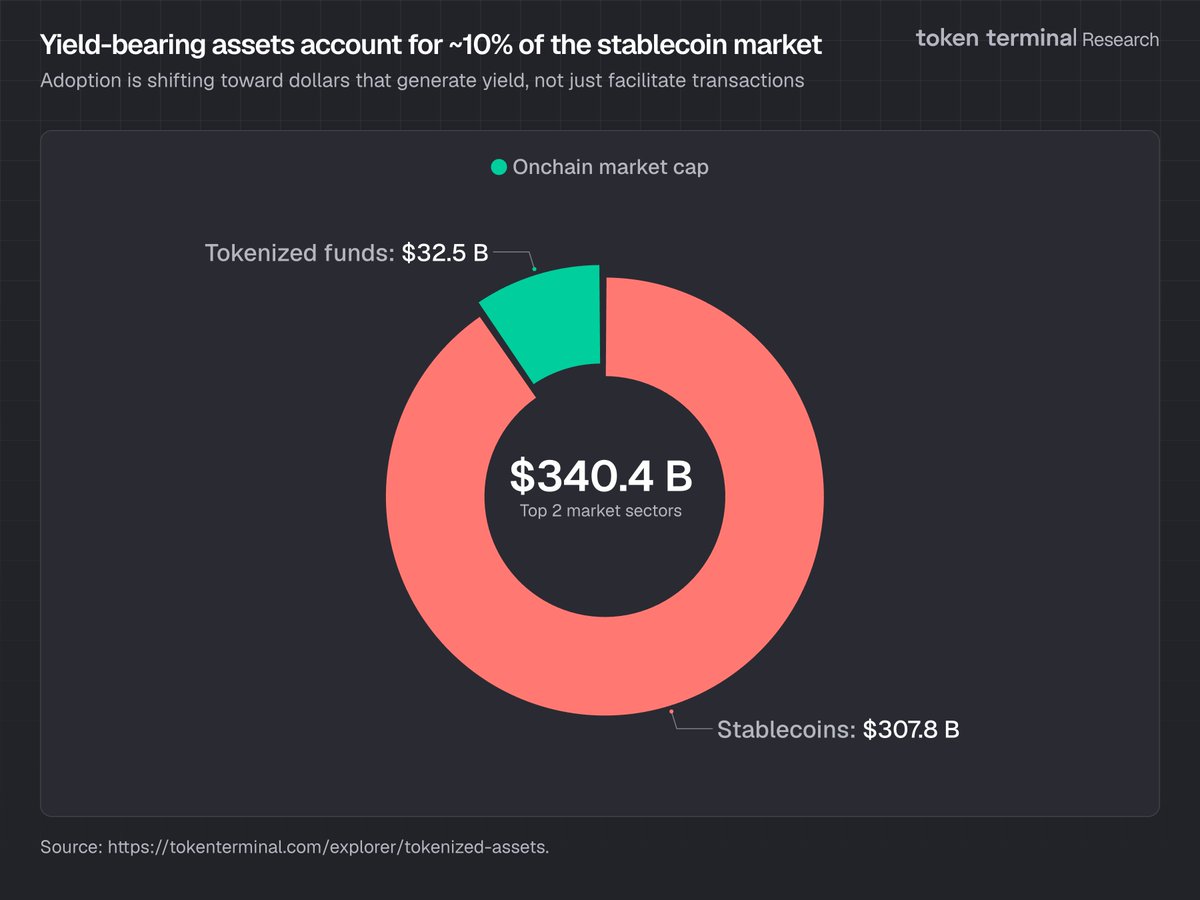
Yield-bearing assets (tokenized funds) account for ~10% of the stablecoin market.
Adoption is shifting toward dollars that generate yield, not just facilitate transactions.
Issuers of tokenized funds looking good going forward.
A ratio to follow 👇
Missing challenge #3 @VIhnatiuk: liquidity infrastructure isn't ready for agentic scale
CLAMMs break near peg. CLOBs require per-chain market makers. No standardized routing layer exists yet
Compliance got solved for $3.5B but liquidity fragmentation is the next $3.5B problem
Stablecoins won global adoption.
Every major company is rushing to integrate them in their daily operations.
But what comes after that?
In my latest piece for @TheStreet, I've analyzed the two biggest challenges that the industry will face in the near future.
The non-USD stablecoin opportunity is real, but most people are asking the wrong question.
It's not "which currency gets tokenized next." It's "which infrastructure can handle the liquidity when it does"
Settlement at scale is unforgiving. Latency, depth, composability these aren't nice-to-haves when you're moving institutional flow
Solana led all major chains in stablecoin inflows in 2025, supply more than doubling YoY per @artemis_xyz. That gap widens as the use cases get more serious
The chains that win stablecoin liquidity today write the rails for everything that comes next
99.6% of stablecoins are pegged to the U.S. Dollar.
The global financial system is materially more diversified --> current structure is unlikely to be a long-term equilibrium.
Issuers focused on non-USD currencies --> great opportunity today, given the limited competition.
We went looking for the stablecoins missing from our list and found them
@SG_Forge EURCV
@VNX_Platform VGBP
@BiLira_Kripto TRYB
@idrx_co IDRX
The non-USD stablecoin ecosystem is growing fast
Check out our latest spec on the eCLOB: Ephemeral Central Limit Order Book
The eCLOB provides cheap price updates for market makers, 100% orderbook transparency for takers, and built on forthcoming Anchor V2
Combining the best of two powerful architectures exclusively on @Solana
Watch the breakdown https://t.co/3f0oRxoIml
Fourth @colosseum update live and we shipped the orderbook visualization to the market sim page
Watching @finnam0n and @EthanTerrero from @oregonblock bring this to life has been something else
So, when sim levels update, you're not just watching the numbers snap in, you can actually see the book shift in real time
Bids and asks breathing. the market alive
This is what building feels like
https://t.co/tlh3YnhEgx
@alex_n_kahn@solana@_DASMAC_ the fact that Solana devs are building assembly-level tooling like Dropset while most L1s are still arguing about execution environments is exactly why the performance gap keeps widening. SBPF is becoming its own ecosystem
Our founder @alex_n_kahn is at @colosseum Build Station in SF
Come chat about the future of on chain order books, hybrid Rust/ASM programming, and maybe grab a whiteboard together
Thanks to organizers for putting on a stellar event
4/ While the Frontier Hackathon is online, we're inviting a select group of founders to build IRL at Colosseum's SF office during the competition.
Approved devs get a desk/monitor + an interview for our next accelerator batch.
SF Build Station | Apply: https://t.co/pwYBCBOTOD
New feature drop with Finn Fuji from @oregonblock
Realistic trading bots- Sniper, Whale, Noise, and Retail now live on the DASMAC order book sim
https://t.co/ajEDXeKeyF