Life Universe https://t.co/DLCTLNTqII
Explore the infinitely recursive universe of Game of Life! Works in real-time and is perfectly consistent, never fails to remember where you are and where you came from.
無限に再帰するライフゲームの宇宙を探索できる作品を作りました #indiedev
Key to note that AI scientists are not experts on labor. Some other economists active on X doing work on AI & labor: @alexolegimas, @danielrock, @joshgans & @robseamans (among many others)
But worth noting that economists don’t have a consensus either: https://t.co/Vq994fOS2s
This is a controversial claim, but in my experience, more than 90% of the time, when people bring up neuroscience during explanations of psychological phenomena, the neuroscience adds nothing of value to the explanation other than making the explanation *seem* more authoritative
The most potent way to think about the world is analytically, from first principles, with a focus on the long-term.
Nearly all of the media you consume daily steers you towards the opposite: a reactive mindset, based on shallow perceptions, processing the world minute-by-minute.
https://t.co/ZkOxhweMXh
Mixed selectivity…in the auditory midbrain? @GArtofscience certainly says so. Additional shout out to the reviewers who provided some of the most constructive and eloquently written critiques of my career thus far.
@anne_churchland The Brain that Changes Itself by Doidge is a good plasticity read for a popular audience, if a little old now. Oliver Sacks' books were always a hit
When we wrote that paper on neuroscientists understanding microprocessors we inspired a computer architecture person to actually develop a model of the brain: https://t.co/Dic0Zcl44X thoughts? I will be happy to report any feedback back to him.
# on shortification of "learning"
There are a lot of videos on YouTube/TikTok etc. that give the appearance of education, but if you look closely they are really just entertainment. This is very convenient for everyone involved : the people watching enjoy thinking they are learning (but actually they are just having fun). The people creating this content also enjoy it because fun has a much larger audience, fame and revenue. But as far as learning goes, this is a trap. This content is an epsilon away from watching the Bachelorette. It's like snacking on those "Garden Veggie Straws", which feel like you're eating healthy vegetables until you look at the ingredients.
Learning is not supposed to be fun. It doesn't have to be actively not fun either, but the primary feeling should be that of effort. It should look a lot less like that "10 minute full body" workout from your local digital media creator and a lot more like a serious session at the gym. You want the mental equivalent of sweating. It's not that the quickie doesn't do anything, it's just that it is wildly suboptimal if you actually care to learn.
I find it helpful to explicitly declare your intent up front as a sharp, binary variable in your mind. If you are consuming content: are you trying to be entertained or are you trying to learn? And if you are creating content: are you trying to entertain or are you trying to teach? You'll go down a different path in each case. Attempts to seek the stuff in between actually clamp to zero.
So for those who actually want to learn. Unless you are trying to learn something narrow and specific, close those tabs with quick blog posts. Close those tabs of "Learn XYZ in 10 minutes". Consider the opportunity cost of snacking and seek the meal - the textbooks, docs, papers, manuals, longform. Allocate a 4 hour window. Don't just read, take notes, re-read, re-phrase, process, manipulate, learn.
And for those actually trying to educate, please consider writing/recording longform, designed for someone to get "sweaty", especially in today's era of quantity over quality. Give someone a real workout. This is what I aspire to in my own educational work too. My audience will decrease. The ones that remain might not even like it. But at least we'll learn something.
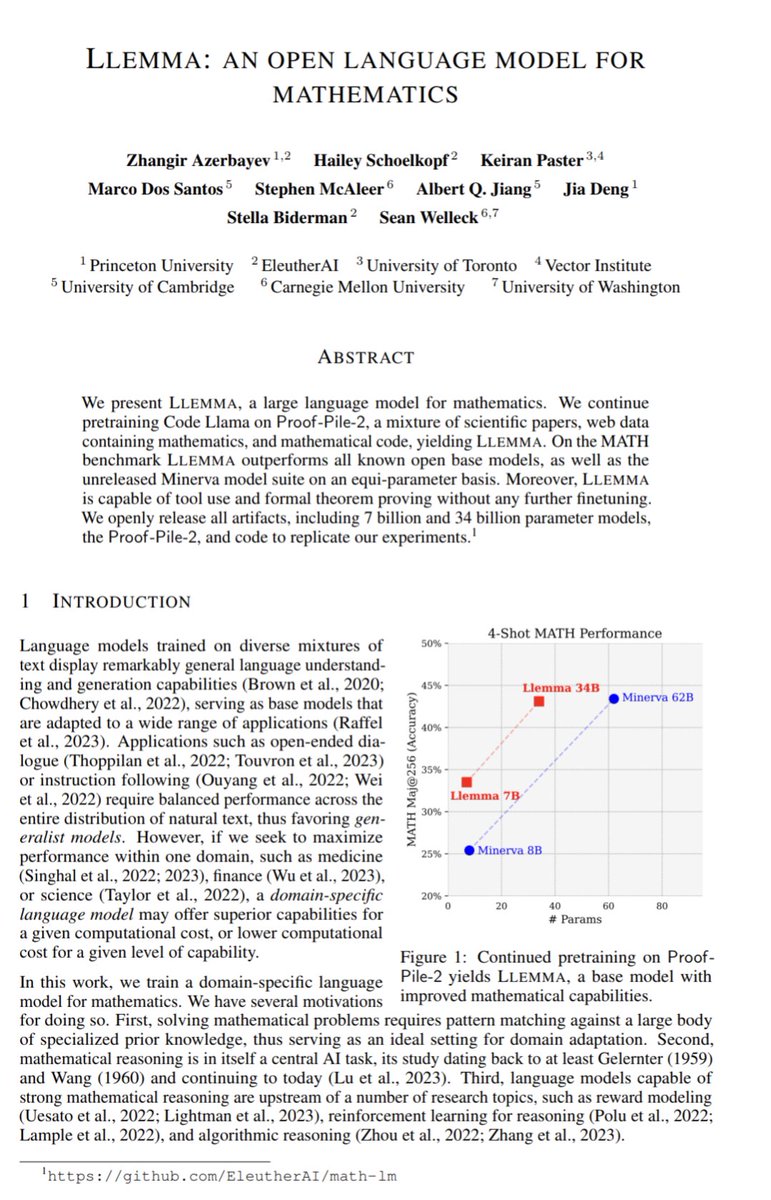
Llemma: An Open Language Model For Mathematics
abs: https://t.co/Rbj2UDk6w6
This paper from @AiEleuther describes an open 7b and 34b LM (continued pretraiming of CodeLlama) and Proof-Pile-2 dataset. The model outperforms all open base models and even Minerva at similar model scales.
this paper's nuts. for sentence classification on out-of-domain datasets, all neural (Transformer or not) approaches lose to good old kNN on representations generated by.... gzip https://t.co/6eZiXlJxOX
The solution is to hold your opinions loosely unless the question really matters to you, in which case you're going to have to invest the time and effort.
Imposter's Math Bio Podcast Episode 2: The Geometry of Dynamics. It's phase plane analysis and dynamical systems for beginners! Please check it out and share it so I can keep working on these. https://t.co/jaIxwFyV6l