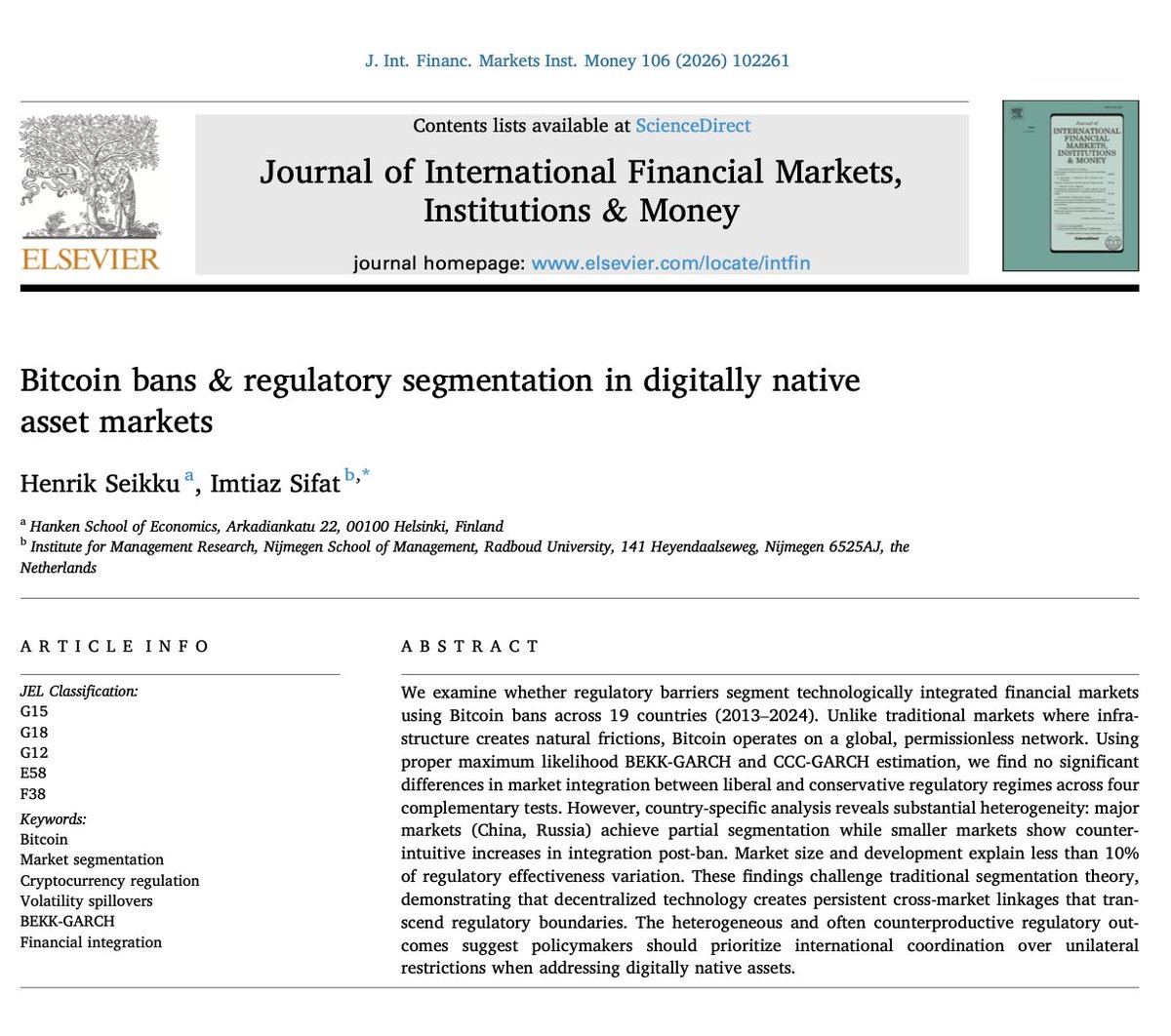
You Can't Ban Math: Research Shows Bitcoin Prohibition Fails
New research by Seikku and Sifat from Hanken School of Economics and Radboud University examines the effects of Bitcoin bans by analyzing 19 countries between 2013 and 2024.
They compare nations with Bitcoin bans to those with more liberal regulatory approaches.
The finding? Bitcoin bans don't work and sometimes backfire spectacularly.
The authors exploit a "natural experiment" with staggered Bitcoin bans across countries such as China, Russia, India, Morocco, and Nigeria. They employed BEKK- and CCC-GARCH models to test if bans segment markets.
Three critical insights:
1. Limited Regulatory Impact:
Although market integration showed statistical significance, Bitcoin bans had little economic impact. Bitcoin-stock correlations dropped by just 0.05 post-ban, far less than the usual 0.20 to 0.30 drops seen with traditional capital controls.
As the authors put it: "Decentralized technology creates persistent cross-market linkages that transcend regulatory boundaries."
You can ban the on-ramps, but you can't ban the network.
2. Heterogeneous Market Responses:
Major markets (China, Russia) achieve partial segmentation while smaller markets show counterintuitive increases in integration post-ban. Morocco and India showed increased correlations and spillovers while Turkey displayed higher correlations but reduced spillovers. Reflects complex regulatory effects.
Bans did not isolate these markets; in some cases, they made Bitcoin more connected.
3. Market Characteristics Do Not Predict Outcomes:
Market size and development explain less than 10 percent of regulatory effectiveness variation, challenging traditional regulatory theory. Conventional metrics fail to predict success in decentralized networks.
The paper concludes:
"The heterogeneous and often counterproductive regulatory outcomes suggest policymakers should prioritize international coordination over unilateral restrictions when addressing digitally native assets."
Unilateral Bitcoin bans are largely for show. Countries can declare Bitcoin illegal and shut down local exchanges, but they cannot stop the permissionless, global, 24/7 network that adapts around obstacles.
Before banning Bitcoin, countries should carefully study the data.
Over 11 years, bans have:
1. Redistributed activity rather than eliminated it
2. Pushed users to less regulated channels
3. Encouraged technological workarounds like VPNs, decentralized exchanges, and P2P trading
4. Led to more volatility in smaller markets post-ban
Bitcoin operates on infrastructure fundamentally different from traditional finance.
It is a feature, not a bug.
You are not banning a company or product. You are trying to ban a protocol. Essentially, you are trying to ban math.
TL;DR:
Bitcoin bans create "heterogeneous and often counterproductive" outcomes. You can ban exchanges but you cannot ban Bitcoin. The network does not care about borders.
Meine Erkenntnisse von gestern:
Windows will Geld.
Chromebooks wollen Kontrolle.
Linux will nichts von dir.
Linux dient dir.
Open Source ist mehr als Software. Es ist ein Statement für Selbstbestimmung.
Ich find das Meme echt gut gemacht, muss ich zugeben. Die Ironie ist natürlich, dass in dieser Simpsons-Halloweenfolge der echte Bart der Böse und der verwahrloste Zombie-Bart eigentlich der Gute ist.
#TheLeftCantMeme
@PiusSprenger Nach PL sind wir in 20 Jahren bei 10Mio Fiat-Einheiten. Somit sind 0,1 BTC dann 1Mio, was ganz gut hinkommen könnte mit Preisverfall etc. Evtl etwas zu wenig, die Entwertung wird wohl stärker sein
If we socially lose the ability to make rational changes, Bitcoin has far worse problems. Socially attacking, urging rejection of security & robustness fixes from 200 most skilled people on the planet is itself an attack on Bitcoin. There are security fixes in v30.