@helenrey@KateJones_teach Typed your request into a fresh session, it went full on learning styles as it did for you. However the same request as a follow up to my "What do you think about learning styles" question:
Incentives miss the point. AP is double graded, firstly by continuous assessment and then by the end of course AP exam. These are two different education philosophies which trade off against each other, easy to get better performance on an end of course exam by reducing continuous assessment. Exam incentives will end up being a way of telling teachers to prioritize end of course performance over frequent summative assessments.
There is no continuous assessment system which gets good exam results (Singapore is at 4 per subject per year, that seems to be about the most you can do before you see academic performance drops). The Netherlands PISA scores plummeted as they shifted from end of high school exams to more American style grading. This does not mean they worked less, student stress tripled over that period.
Many of the better schools have started to discover that their students were being penalized wrt college admissions and merit awards by their more rigorous grading. Have to address that first.
When it comes to multiple shots at high grades, keep in mind that America is fairly unique in the way students are assessed on work they have only just learnt. It makes it far mor difficult to set a high standard if students are not given time to master the material. This is one of the reasons England went back to all grades being determined by external end of course exams at the end of 10th and 12th grade (year 11 & 13).
I suspect that 1992 was when grading really started changing to increasingly prioritize homework. That was the year the AAUW released a report arguing that girls were being shortchanged in school and standardized tests, placing greater emphasis on homework grades was a well known way to favor girls. While this achieved its goal, a possible secondary effect is that if homework is seen more as assessment than learning, this could affect how much of it is assigned.
Speaking to students who have mixed online courses in with traditional high school courses (allowed by our state), they really miss the shared experience of working on a topic at the same time as other students.
It is certainly doable for a motivated student to race ahead in a single subject (usually to address prerequisite issues) but not seeing much beyond that.
A mistake to look to AI for a solution. The big problem is that American students are being spammed with large numbers of assessments, several times that of other countries which also use continuous assessment. Deadly combination of high stress and artificially inflated workload relative to outcomes.
It's really bad. I asked ChatGPT how many assessments per course continuous assessment systems (not pure EOC exam systems) outside the US typically have and to compare it to the US. Its answer:
Number of assessments per course in continuous assessment systems:
Outside USA 3–6
USA 10–20+ (often more in K–12)
Being foreign educated with American born kids, I was surprised how artificially inflated the workload was, American kids have to work harder to reach the same level as their international counterparts.
@MatRyanELATeach@rpondiscio@esanzi I am in favor of exams, but if high school diplomas are treated as being equivalent between states and Massachusetts sets a higher standard than everyone else, then their students are unfairly penalized.
The flip side of the anti-exam trend has been the spamming of students with large numbers of out of class assignments. This becomes unmanageable quickly which is one of the main sources of downward pressure on standards and increasing the pressure to cheat.
Some perspective from ChatGPT (of course):
Number of assessments per course in continuous assessment systems:
Outside USA 3–6
USA 10–20+ (often more in K–12)
Check with any foreign educators, most would argue that the above numbers represent a massive systemic failure more serious than students cheating.
What annoys me about Reeves is that he went through a system where his grades came from: exams at the end of 10th grade (O levels), exams at the end of 12 grade (A levels) and end of degree exams at Oxford (seriously they still do that). He is critical of his son's lack of diligence with his graded homework but never mentions the fact that graded homework was never anything he had to deal with (sure the British could be mean to kids who did not do their homework, but it never counted towards anything).
Most kids, but boys especially, perform better in systems where all or most transcript grades come from external exams and teachers only grade for feedback. Americans are just so opposed to the concept, but for those of us who went through systems like that it enabled us to reach a higher standard with less effort.
Watching my kids being pecked to death by a myriad of busywork assessments quickly explained why American kids struggle to reach the same level as some of their foreign counterparts.
@marcportermagee@CharlesOCasey No. My observation is that in systems with mixed assessment types (America), girls underperform slightly in exams. In exam dominant systems (UK) they don't. Basically, all these busywork assignments are causing girls to misdirect their effort.
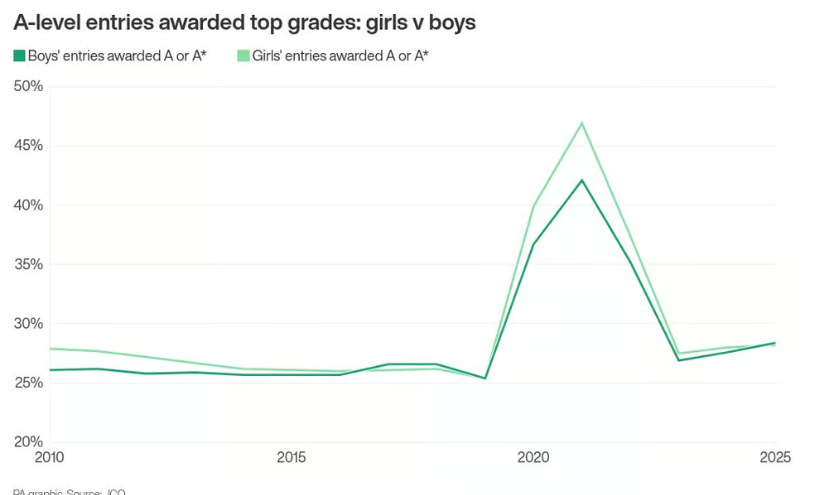
@marcportermagee During the pandemic, the UK switched temporarily from almost all grades coming from exams to teacher assessed grades. Look at the trend in male and female grades during that period. In 2025, with everyone back to exams, boys beat girls in earning the top grades.
A lot of harmful educational trends are partly a result of data like this. In order to give girls an edge, the SAT was deemphasized and grading in schools was changed to emphasize compliance, partly by increasing the importance of graded homework and reducing the role of traditional exams.
Unfortunately avoids the key question: How do we ensure that student grades are valid and reliable? This forces one to address what grades are really supposed to mean, do they represent effort, compliance, academic performance or pace of learning? Are grades relative to the class and school or relative to a broader standard?
Many of our current issues are directly related to previous decisions made about grades.
There is far more focus on application in these courses. Student transcript grades generally come from up to about 50 assessments throughout the year, students are tested on topics almost as soon as they are taught it (all these grades count). These courses can be demanding but there is a limit to how academic you can make them without overloading the students.
Of course, whether it is busywork or actually teaching students how to think like a scientist is in the eye of the beholder...
A lot of effort needs to go into ensuring that grades are fair, part of that is ensuring that grades between teachers and schools are comparable. In the current system, "rigorous graders" are just ensuring that less capable students at other schools get the best college admissions and merit awards.
Keep in mind that in most educational systems, students get most/all their grades from end of course assessments. Grades earned during the course usually don't count towards anything. In the situation you describe, it would be better for the student to be given the option of European style end of course assessment instead of hacking the existing grade.