🦈 𝐑𝐢𝐚𝐥𝐨 𝐒𝐡𝐚𝐫𝐤 𝐓𝐚𝐧𝐤 → 𝐇𝐚𝐩𝐩𝐞𝐧𝐢𝐧𝐠 𝐞𝐯𝐞𝐫𝐲 𝐓𝐡𝐮𝐫𝐬𝐝𝐚𝐲
The Rialo Shark Tank provides a dedicated platform for builders to present their ideas, showcase projects, and engage directly with the community.
Participants have the opportunity to receive constructive feedback, gain visibility, and contribute to the growing Rialo ecosystem.
From early-stage concepts to more developed applications, this session brings together innovation across automation, AI, and real-world use cases built on Rialo’s infrastructure.
🕥 Every Thursday
📍 Rialo Discord
Hosted by @ericargent31113
alongside @RollinsR79
Whether you are building or simply exploring, this is an opportunity to observe, learn, and engage with the direction the ecosystem is taking.
Join the session and be part of the conversation ➟ https://t.co/uuPKJhMuPk
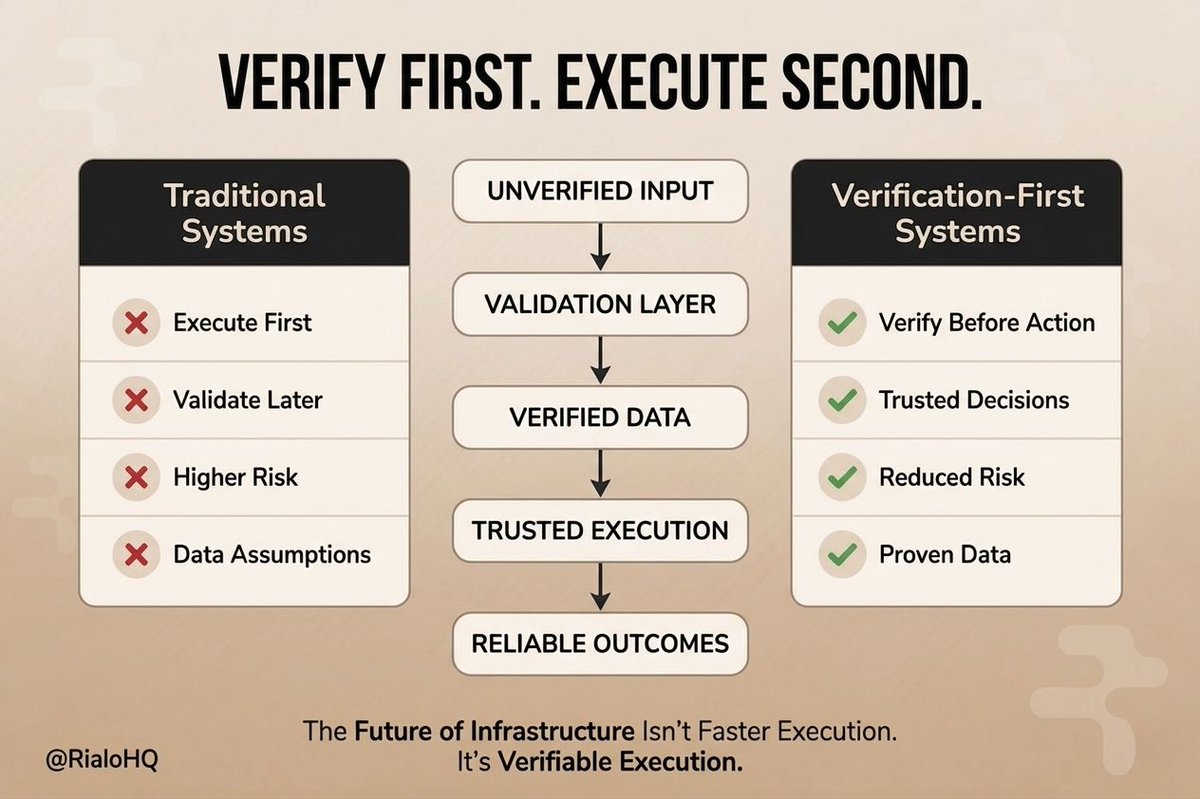
𝙄𝙣𝙛𝙧𝙖𝙨𝙩𝙧𝙪𝙘𝙩𝙪𝙧𝙚 𝙄𝙨 𝙉𝙤 𝙇𝙤𝙣𝙜𝙚𝙧 𝘼𝙗𝙤𝙪𝙩 𝙋𝙧𝙤𝙘𝙚𝙨𝙨𝙞𝙣𝙜 𝘿𝙖𝙩𝙖. 𝙄𝙩'𝙨 𝘼𝙗𝙤𝙪𝙩 𝙏𝙧𝙪𝙨𝙩𝙞𝙣𝙜 𝙄𝙩.
For years, blockchain innovation has focused on execution.
Faster transactions.
Higher throughput.
Lower fees.
But execution alone doesn't solve the biggest challenge facing real-world adoption:
How do systems know the information they act on is actually correct?
Every financial application, automation workflow, and digital agreement ultimately depends on data.
If that data is delayed, manipulated, or unverifiable, even perfect execution produces imperfect outcomes.
This is where the next phase of infrastructure begins.
Verification-first architectures are shifting the focus from "execute quickly" to "verify before execution."
Instead of treating validation as an afterthought, trust becomes part of the system's foundation.
That approach has major implications:
• More reliable automation
• Stronger security guarantees
• Reduced operational risk
• Greater confidence in real-world integrations
• Better support for institutional-grade applications
This is one of the reasons projects like Rialo are attracting attention.
The goal isn't simply to move information faster.
It's to create an environment where data, permissions, and execution can be validated before critical actions take place.
As digital systems become increasingly automated, the ability to verify truth before execution may become more important than execution speed itself.
Because in the long run, the strongest infrastructure won't be the one that processes the most transactions.
It will be the one people trust to make the right decisions.
@RialoHQ@RialoBangladesh
I don't really care what people think but i do care about how they treat me, if their treatment includes violence. Not everyone has the option to immediately leave, cut people off and go no contact. That's only in fantasy land.
IRL, people have rent to pay, disabilities, ableist bosses, a garbage economy and no good relatives to help.
𝗪𝗵𝗲𝗻 𝗦𝘆𝘀𝘁𝗲𝗺𝘀 𝗕𝗲𝗰𝗼𝗺𝗲 𝗔𝘂𝘁𝗼𝗻𝗼𝗺𝗼𝘂𝘀, 𝗩𝗲𝗿𝗶𝗳𝗶𝗰𝗮𝘁𝗶𝗼𝗻 𝗕𝗲𝗰𝗼𝗺𝗲𝘀 𝘁𝗵𝗲 𝗣𝗿𝗼𝗱𝘂𝗰𝘁.
For years, blockchain infrastructure has focused on one primary objective: executing transactions securely.
But the next generation of applications introduces a different challenge.
AI agents, automated financial systems, and real-world digital infrastructure are no longer simply executing predefined instructions. They are making decisions, responding to changing conditions, and interacting with external environments.
As autonomy increases, the critical question shifts.
Not "Can the system execute?"
But "Can the system prove that execution happened correctly?"
This is where architecture begins to matter more than raw performance.
Traditional blockchain models require broad replication of computation across the network. While effective for security, this approach becomes increasingly inefficient as applications grow more complex and data-intensive.
A different model is emerging.
Execution can occur where computation is most efficient, while verification remains decentralized and cryptographically enforceable.
The focus moves from repeating work to validating results.
From trust in process to trust in proof.
This shift has implications far beyond scalability.
It creates a foundation for systems that can:
• Handle complex computation efficiently
• Preserve privacy during execution
• Maintain verifiable outcomes
• Support autonomous decision-making at scale
• Reduce unnecessary infrastructure overhead
What matters is not how many times a computation is repeated.
What matters is whether its correctness can be independently verified.
That principle is becoming increasingly important as blockchain infrastructure evolves beyond simple transfers and into environments that support finance, automation, AI, and real-world coordination.
The future may not belong to systems that execute the most.
It may belong to systems that verify the best.
@RialoHQ@RialoBangladesh