@HiroNishikawa There are a number of applications and libraries using OCCA on machines like Frontier and Aurora—e.g., nekRS (the new Nek5000), libParanumal from @paranumal, and hipBone from AMD.
Feel free to send me a DM if you want to chat about how to get started.
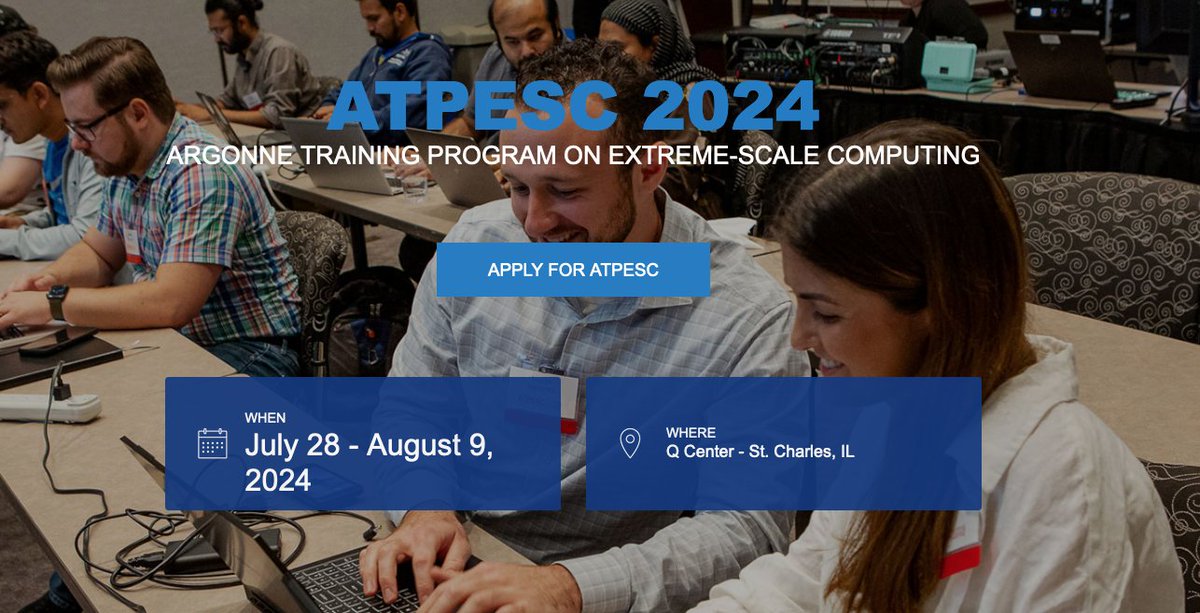
📣 The @Argonne Training Program on Extreme-Scale Computing (ATPESC) is set for July 28-August 9, 2024.
Apply by February 28 for an opportunity to learn the ins and outs of supercomputing from some of the world's leading #HPC experts.
https://t.co/PNlnczQVvQ
Aimed at undergraduate and graduate students, @argonne's annual #AI training series will focus on using large language models (#LLM) for science. The weekly series begins Feb. 6.
Don't miss out! The deadline to register is Jan. 15.
https://t.co/9iy9k3HmJ4
Learn about libCEED’s development journey with SYCL backend implementations. Then, hear about advancements in energy-efficient heterogeneous computing with SYNERGY. It's all happening at the #oneAPI DevSummit: https://t.co/DaNQGsGwfI
#SYCL#DevSummit@argonne@argonne_lcf
On Dec. 6 at 10:05 AM CT @umesh_aero talks about the development of a SYCL backend for libCEED: a library for fast element-based discretizations created by the @exascaleproject's #CEED co-design center and @LLNL_OpenSource.
https://t.co/Xgrq5B4nZk
#HPC#SYCL#oneAPI#Aurora
Don't miss out on @IntelSoftware's oneAPI DevSummit for AI and HPC 2023 (Dec. 4-6). ALCF's Yasaman Ghadar, Kris Rowe and Umesh Unnikrishnan will contribute to talks on using SYCL, a key programming framework for @argonne's Aurora exascale supercomputer.
https://t.co/wlJGhtaPtW
Join us this December for the next #oneAPI DevSummit for AI and HPC! Take a deep dive into the oneAPI cross-architecture software development, which spans industry-standard frameworks, what's new with oneAPI, workshops, and more. Register today: https://t.co/ICvwQIzCA6
#AI#HPC
The @ENERGY's INCITE program is accepting proposals for high-impact research in science, engineering, and computer science domains until June 16.
Apply now to access world-leading scientific tools and resources at facilities like @argonne_lcf! - https://t.co/H54ldKzjHq
@HPC_Guru@usacomp2k3@thoefler@argonne Additionally, device partitioning isn’t all-or-nothing. For example, SYCL allows for device partitioning at a programmatic level: one part of an application could use the entire GPU, while another part could target a single stack/tile.
@HPC_Guru@usacomp2k3@thoefler@argonne 6 GPUs = 12 logical GPUs—no, yes, and no
Intel Max Series GPUs can be used as a single device, partitioned into sub-devices, or even sub-sub-devices. Which mode is best depends on the workload.
https://t.co/8Dc52jMm6P
Spicy new opening with the Performance Engineering Group at ALCF:
https://t.co/tjp8drB7j1
This is the most talented yet humble group of people I have had the pleasure to work with.
Have an impact on the current generation of #exascale#hpc and help shape what comes next.
Spicy new opening with the Performance Engineering Group at ALCF:
https://t.co/tjp8drB7j1
This is the most talented yet humble group of people I have had the pleasure to work with.
Have an impact on the current generation of #exascale#hpc and help shape what comes next.
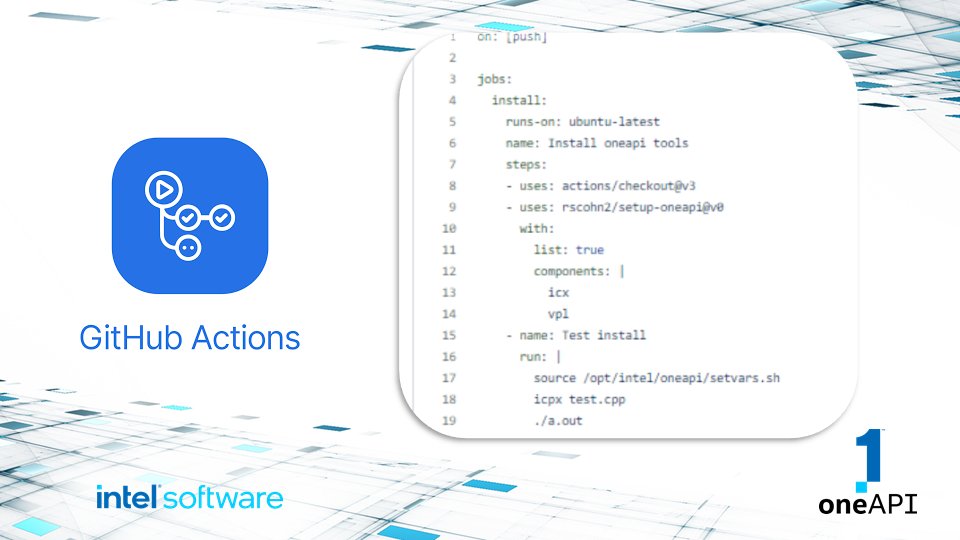
Check out #oneAPI support for @github Actions. Using setup-oneapi simplifies the installation of compilers and libraries in your workflows and accelerates the install with caching. Learn more: https://t.co/YDf6gt8CD3
#githubactions
Attend Intel's upcoming Dev Summit to learn how #oneAPI can help with software development for @argonne's Aurora system. On Dec. 7, ALCF's JaeHyuk Kwack, Kris Rowe and Scott Parker will present "Preparing Applications for Aurora: Early Successes in Porting HPC Workloads to PVC."