Some personal news: my time at RevenueCat has come to an end.
I joined because I genuinely admired the product, the engineering culture, and the level of craft in the SDK space. That hasn’t changed. Sometimes a role and a company simply don’t end up being the right fit, and this was one of those cases.
I’m now looking for my next role as a senior/staff-level iOS/macOS/Swift engineer, especially around SDKs, developer tools, security/privacy, or thoughtful product engineering.
Intros, shares, and comments appreciated.
absolutely tickled by how these llms currently seem to work better for lawyer-y tasks than they do for my friend who's been ghostwriting smut for the last 15+ years
specifically, she says:
> biggest pain point is the fact that output matters for writing but coders just care that the code works
> coders are fine with repetitive elements and inefficiently written statements, but when writing, the repetitive patterns turn into limericks after 300 words
> which then requires me to either prevent this at the input level by heavily seeding the inputs with non slop writing patterns or almost go through entire rewrites on the outputs
> the former means a 100k book might require 50k words of scaffolding
> the latter means i'm probably rewriting 75k by hand
and her comment today:
Last week our AI opened a store in SF, this week AI is opening a cafe in Sweden.
Meet Mona, our AI tasked with selling coffee and managing European bureaucracy.
Visit Andon Cafe at Norrbackagatan 48 in Stockholm.
We gave an AI a 3-year retail lease in SF and asked it to make a profit.
The AI interviewed and hired full-time employees, applied for credit, and stocked the store with the books Superintelligence and Making of the Atomic Bomb.
Visit Andon Market at 2102 Union St now.
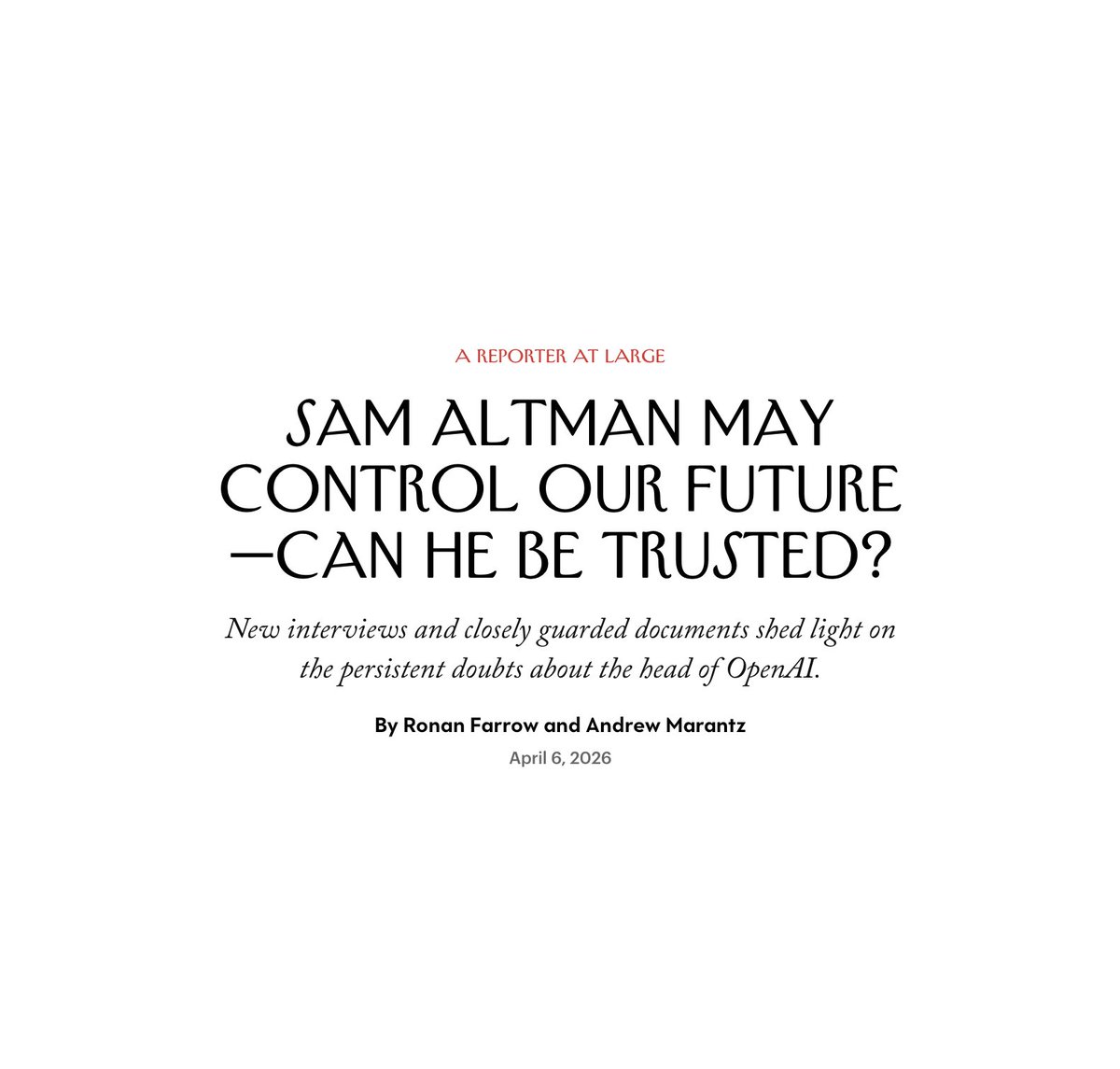
(🧵1/11) For the past year and a half, I've been investigating OpenAI and Sam Altman for @NewYorker. With my coauthor @andrewmarantz, I reviewed never-before-disclosed internal memos, obtained 200+ pages of documents related to a close colleague, including extensive private notes, and interviewed more than 100 people.
OpenAI was founded on the premise that A.I. could be the most dangerous invention in human history—and that its C.E.O. would need to be a person of uncommon integrity. We lay out the most detailed account yet of why Altman was ousted out by board members and executives who came to believe he lacked that integrity, and ask: were they right to allege that he couldn't be trusted?
A thread on some of of our findings:
There isn't an LLM on the planet that understands architecture. No LLM can create an effective architecture. Architecture is contextual, dependent on things like the domain. Architects use judgment and creativity. No "AI" can do either. There is no "good" cookie-cutter architecture.
What does work is creating an architecture first, then telling the LLM to produce code that fits. It's much easier (and much less error-prone) to tell Claude to create a microservice with a single responsibility that uses a specific pub/sub interface, with the messages and their payloads all well-defined in advance, than to create a larger thing and hope for the best architecture-wise. And you get much better results in the long term. Architects use judgment. That's way beyond the capability of any "AI."
A "non-technical user" cannot do that. Deal with it. Hire some programmer-architects. The fantasy that a nontechnical user can create a high-quality software product with nothing but surface-behavior-level prompts is just that—a fantasy. I've never seen an example of such a thing released to the public and functioning well. This non-technical programmer dream has been around since COBOL days. Didn't work then. Doesn't work now.
Once you get to Director/VP-level seniority or beyond, it's not uncommon for someone to have a direct report who is a better manager than them. Pure management skill is important but simply isn't the only measure of career advancement when you're at that level. Strategy, communication, technical skills, political acumen, dumb luck all play a role.
What I've seen, however, is that when this scenario occurs it's critical for the Director/VP to take the less senior, better manager's advice from time-to-time. As long as they're seen listening and considering, everything will be fine. If you refuse to ever take their advice, it's a near-guarantee that the more junior, better manager will eventually leave the team, and they often won't have nice things to say.
You know, Stripe's a pretty large company these day, buuut we're still moving fast and hustling! A few weeks ago, an engineer build a quick prototype of how users could share official MRR charts from the dashboard. Today it's live to all users!
https://t.co/aNsOhT6lJ9
New paper: You can make ChatGPT 2x as creative with one sentence.
Ever notice how LLMs all sound the same?
They know 100+ jokes but only ever tell one.
Every blog intro: "In today's digital landscape..."
We figured out why – and how to unlock the rest 🔓
Copy-paste prompt: 🧵
When you want to find how different two probability distributions P and Q are, you use the KL-Divergence.
But the KL Divergence of P and Q is not the same as the Kl Divergence of Q and P. Why?
Learn about it in my new video!
https://t.co/YbkLpEh0o6
To imagine how smart glasses are the key to superintelligence in his eyes, one must first think like the Zuck.
Zuck knows they're out of training data.
Zuck knows a thing or two about collecting data.
Zuck knows a camera and mic strapped to your face will gather data.
CNN has just published completely shocking before and after satellite images showing the extent of the obliteration of Gaza neighborhoods. Israel was not lying when it claimed to be focused on damage rather than accuracy: https://t.co/grJx0HyKpi
I keep thinking how crazy it would be if an Arab country kept 2.3 million Jewish people in a cage, half children, cut off their electricity & water then indiscriminately bombed them. Beyond comprehension the anti-Muslim bigotry that makes the world applaud this as justified