This version also allows any LUTs installed in ImageJ to be applied to images and for different composite modes (min, max and invert) to be used via ShowImages
MIA version 1.7.0 is now out via the ImageJ updater. This adds modules for converting large images to tile stacks and converting them back. These support tile overlap with linear gradient mixing.
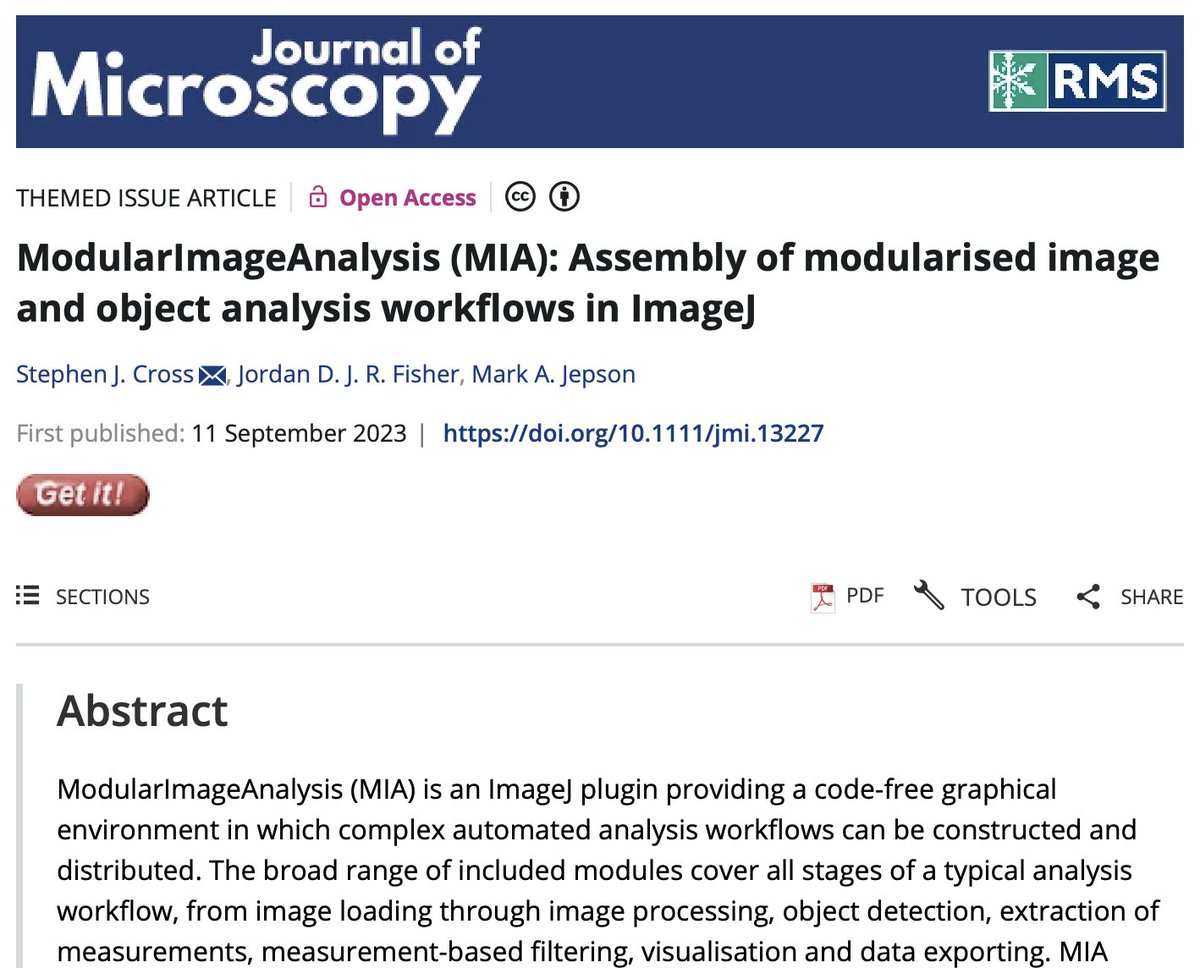
The @RoyalMicroSoc Journal of Microscopy special issue for Data Analysis In Microscopy (DAIM) is now out and includes the paper on MIA!
https://t.co/5VbvUdYAVd
MIA version 1.6.9 is now available via the ImageJ Updater. The big new feature is compatibility with Meta's Segment Anything model, which is integrated using the fantastic SAMJ plugin for ImageJ. It's now possible to simply click objects in "Manually Identify Objects".
New example workflow at https://t.co/rZNDauKqo1. This one details how object relationships in MIA can be used to classify isolated and overlapping DNA molecules from AFM images.
Our shiny new website is now live thanks to the skills of @jdjfisher_. The site includes guides to using MIA as well as complete documentation for all modules. Speedy documentation search is courtesy of the excellent @algolia. Check it out at https://t.co/GX1ZiBJpOg
I'm pleased to share MIA (@_MIAnalysis) in its published format. The paper describes MIA using a series of real-world example analyses. https://t.co/FqZjrNTkaw
This example introduces the "Spot detection" and "Track objects" modules, which both use MIA's TrackMate integration. Example also demonstrates parent-child relationships in context of tracked objects.
We're proud to now be an official https://t.co/3TUgF9liQg forum Community Partner. We can be found on there with the tag modular-image-analysis https://t.co/Gy7Km69HON