@cryptofergani $Qubic
Once the altseason wheels start turning and most people realize what cards #Qubic is holding, it will already be "too late" for many - they'll be deep in FOMO.
We compiled six epochs worth of DOGE mining data on Qubic (Epochs 207–212, April 1 to May 13) into one full profitability breakdown.
What the data from that period showed:
→ $1.23/GH/s per day on Qubic vs $0.58 on traditional LTC+DOGE pools
→ 48% to 111% higher revenue depending on the epoch
→ $117.46 extra from a single rig over just two weeks
→ 97 blocks found. 970K DOGE mined. $111K earned.
These are the verified baselines. The pool has only grown since, with ATH hashrate hitting 119.71 TH/s and a peak network rank of #7 in Epoch 213.
⚡️⚡️Meet the book - "Qubic. The long version."
This book does one simple thing: it gathers what's been scattered into a single fresco, structures it, and presents it in plain language.
Who should read this?
Anyone who's even a little connected to Qubic will find something here for themselves.
A newcomer will learn the basic principles of how it works and see connections where they didn't see them before.
An experienced holder can enjoy the history and the beautiful allegories my father's speech is so full of.
The professional and the master can take a look at the overall picture from the outside and, perhaps, see something they used to miss.
All Come-from-Beyond quotes used in this book are taken verbatim from open primary sources - the official Qubic Discord, his publications on X, the team's scientific papers.
If you spot an inaccuracy - write in. The book is alive; the next edition will incorporate corrections.
The book is distributed absolutely freely.
(Link in the comments)
Thank you, Father.
@c___f___b
#Qubic $Qubic
Mining DOGE the old way?
You might be leaving 53% more profit on the table.
🧪 Test setup from qMine Project: DG1+ (13 GH/s)
Qubic:
→ $8.78/day
Traditional pools:
→ $5.75/day
That’s +$3.03/day for the same hardware.
Smarter mining starts here ⚡
Note: Snapshot taken on April 19th, 2026. Electricity Cost Not Included in the Report
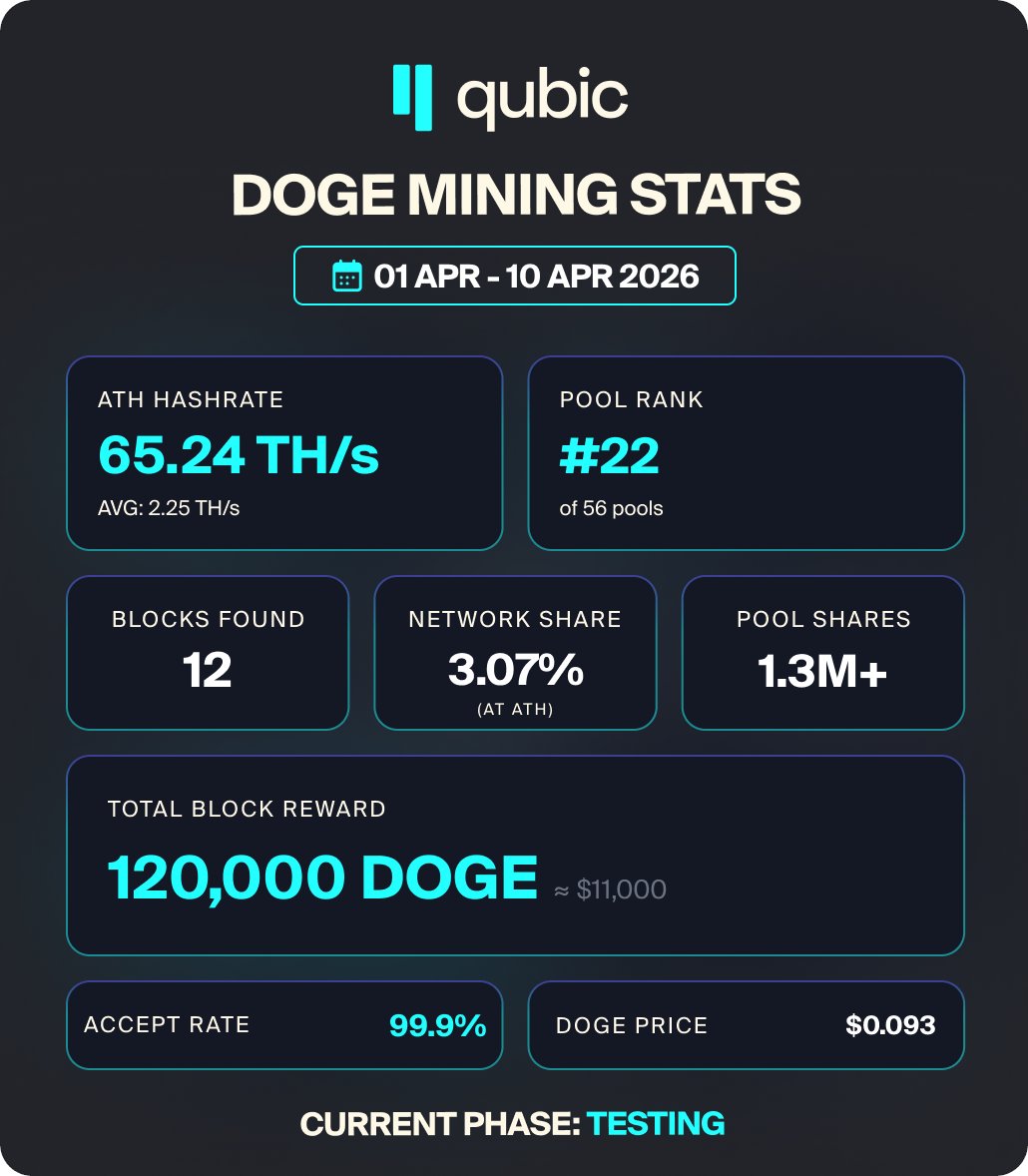
Just over a week into Doge mining. 12 Doge blocks on mainnet. 65 TH/s stress tested.
But the stat that matters most isn't in the numbers.
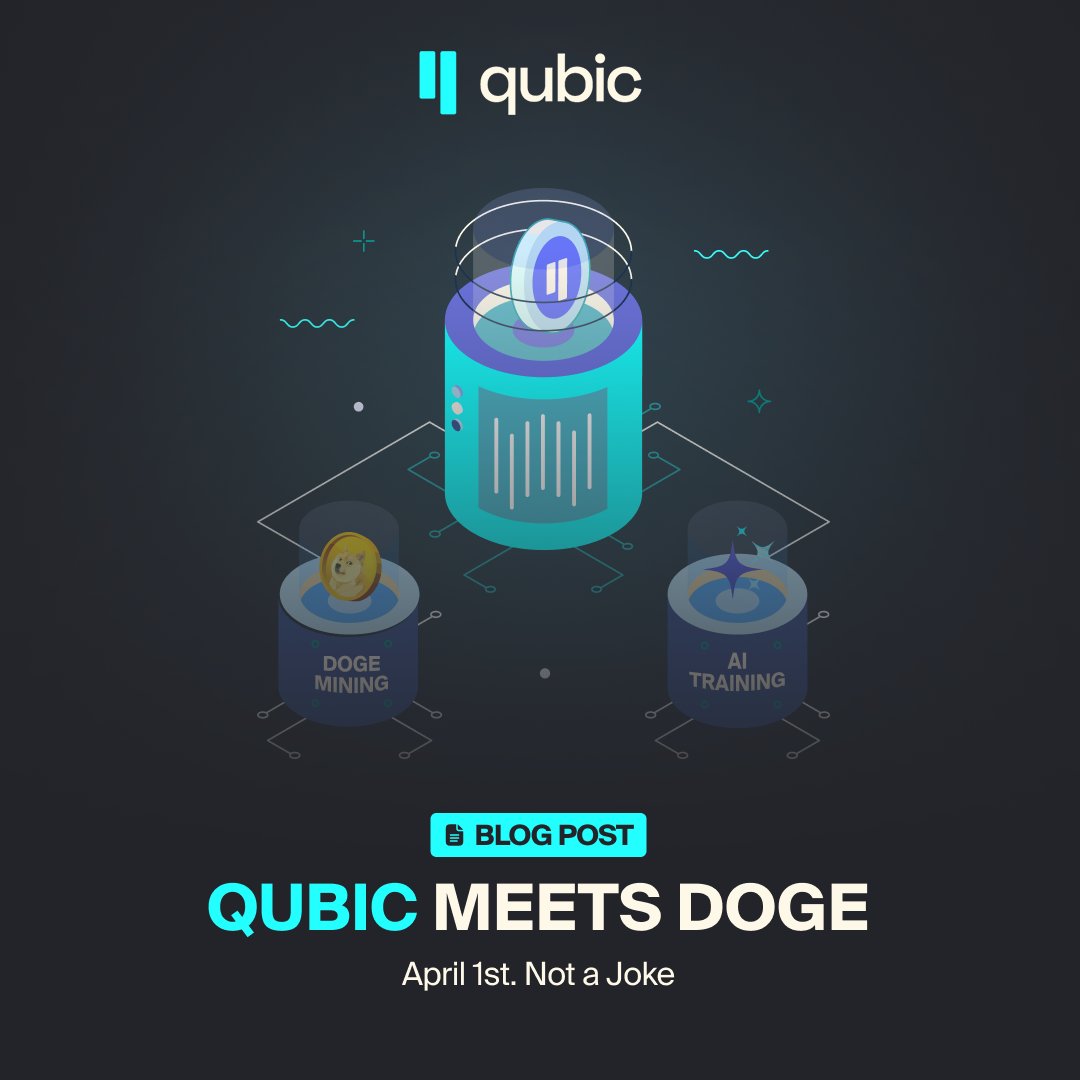
It’s the fact that Qubic is the first network running ASIC-based Doge mining and AI compute training in parallel.
At the same time. Both at full capacity. No trade-offs, no time-sharing between the two. That’s not a feature. That is an entirely different category of infrastructure.
Phase 1 is a stress test. Four independent pools connected. 1.3M+ pool shares accepted. 43.5K+ tasks distributed. The network has already been pushed to 65 TH/s.
No Doge topups yet, and that’s intentional.
Phase 1 exists to prove the pipeline works before real value flows through it, and it does.
Phase 2 brings the Doge topups and full computor migration, and that's when the economics kick in.
This is the stress test.
The old model made CPUs choose: mine Monero or train AI.
Not both. One or the other.
Dogecoin ends that trade-off.
ASICs handle Dogecoin. CPUs and GPUs train Aigarth.
Different hardware. Different jobs.
No more alternating. No more compromise.
This is the architecture shift.
5 days.
#DogeMeetsQubic
What if crypto mining could do two things at once?
Not theoretically. Not "in development." Right now.
Qubic ASICs mine Dogecoin. CPUs and GPUs train AI. Both running. Same network. Zero conflict.
Here’s how we got here.
AI agents are about to become economic participants. They'll buy compute, sell services to each other, and settle transactions at machine speed around the clock.
There's one problem. The global financial system won't let them in. Every bank account requires a human identity. Every payment processor assumes a person is on the other end. The entire infrastructure was built on the idea that only humans move money.
That assumption is about to break.
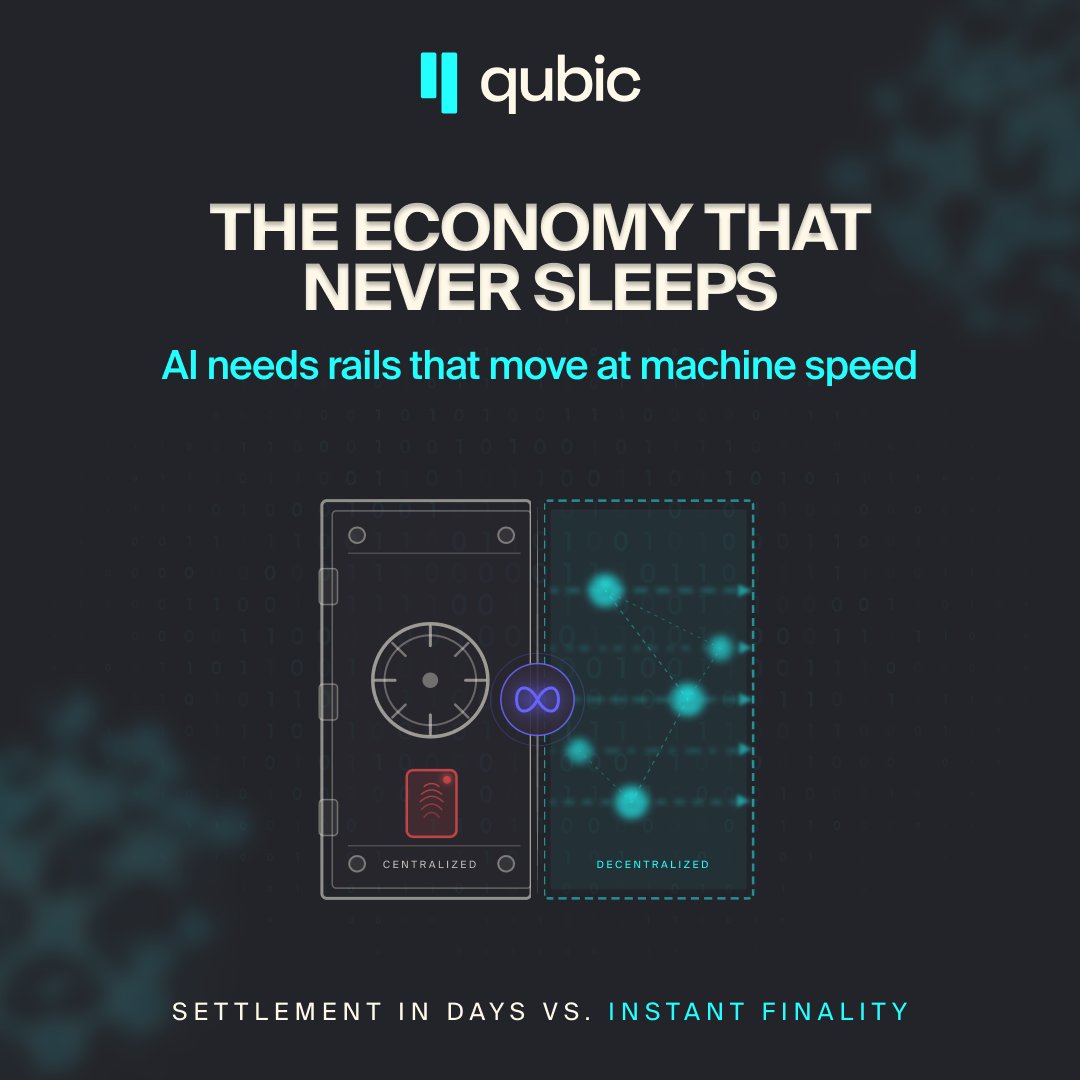
Autonomous agents need financial rails that work the way they do. Always online. No gatekeepers. No waiting for business hours or manual approvals. Settlement that happens in seconds, not days.
Qubic was designed with feeless transactions and instant finality because this shift was always on the horizon. The network doesn't just support AI workloads through Useful Proof of Work. It's built to function as the kind of financial layer that autonomous agents actually need.
The early adopters of crypto were humans testing a new model. The next wave of adoption won't come from people at all. It will come from the agents that need permissionless infrastructure to operate.
That future is closer than most people think. And the networks that are ready for it will have a head start that's difficult to close.
🚨 MIT just humiliated every major AI lab and nobody’s talking about it.
They built a new benchmark called WorldTest to see if AI actually understands the world… and the results are brutal.
Even the biggest models Claude, Gemini 2.5 Pro, OpenAI o3 got crushed by humans.
Here’s what makes it different:
WorldTest doesn’t check how well an AI predicts the next word or frame.
It measures if it can build an internal model of reality and use that to handle new situations.
They built AutumnBench 43 interactive worlds, 129 tasks where AIs must:
• Predict hidden parts of the world (masked-frame prediction)
• Plan multi-step actions to reach goals
• Detect when the rules of the environment suddenly change
Then they tested 517 humans vs the top models.
Humans dominated every category.
Even massive compute scaling barely helped.
The takeaway is wild:
Today’s AIs don’t understand environments they just pattern-match inside them. They don’t explore, revise beliefs, or experiment like humans do.
WorldTest might be the first benchmark that actually measures understanding, not memorization. And the gap it reveals isn’t small it’s the next grand challenge in AI cognition.
(Comment “Send” and I’ll DM you the paper 👇)
@Qubic_JOETOM@_Qubic_ It has been mentioned that Qubic is transport-agnostic.
Can you explain whether this property is built directly into the Qubic Algorithm - allowing synchronization and validation even in non-Internet or offline environments?
And if so, is there a deeper purpose behind this?