Baba Beak 👑
My entry for the @thebeaksart contest!
I brought the Nigerian culture into the Beaks world with “Baba Beak” ….rocking a rich Agbada, tilted Fila, coral beads, and with a full Owambe swagger 🇳🇬
Shoutout to @DKashtalyan and @thebeaksart for the opportunity !
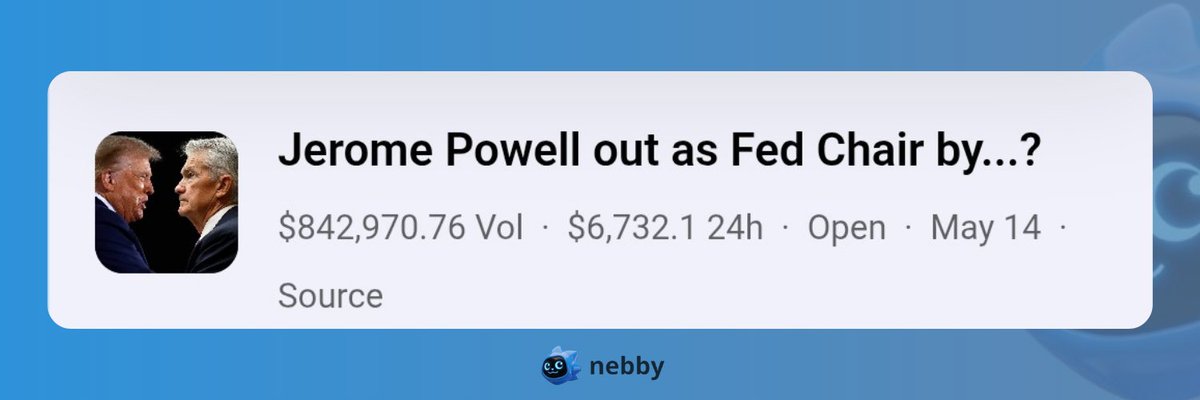
Trending Today: Will Jerome Powell be out as Fed Chair by May 14, 2026?
Markets are leaning heavily toward continuity.
~93% say Powell stays, while ~7% are pricing an early exit.
Track the market here:
https://t.co/sOeBwgqFOH
A Gen Z joined the team.
Week one.
During onboarding, the manager said,
“We sometimes stay late during peak periods.”
Gen Z nodded.
Then asked,
“Is that paid… or just expected?”
The room went quiet.
- No attitude.
- No rebellion.
- Just a question.
Later that day, HR mentioned “growth opportunities.”
Gen Z replied,
“Does growth include raises, or just more responsibility?”
Again, silence.
- No laziness.
- No entitlement.
- Just clarity.
That’s when the team realized something.
When people say
“Gen Z is lazy,”
what they really mean is:
Gen Z watched old generation
- skip meals,
- miss birthdays,
- work weekends,
- and burn out
only to be told
“budgets are tight”
and “be grateful you have a job.”
So Gen Z chose differently.
- They don’t romanticize overwork.
- They don’t confuse suffering with ambition.
- They don’t trade health for praise.
They still work hard.
They just refuse to work for nothing.
It’s not laziness.
It’s pattern recognition.
And honestly,
after everything old generation went through…
Can you really blame them?
@coingecko time to build teks, time to stick with true building teams.
while privacy becomes the meta, the demand for security application spiked.
check out tools like this ➛ https://t.co/Wk3n52N5iW
the rumour says 'this is just phase 2', how many degens are seeing this?
The $1.5 Trillion Market Still Runs on Trust, And That’s the Problem:
The market is huge and still built on trust, not truth; the global car market is enormous. In the U.S. alone it was valued at about $120 billion in 2022, with around 40 million used vehicles sold that year.
Yet despite the size, the systems for verifying what you’re buying remains weak ⤑'emphasis on weak' https://t.co/9L4S3kdWLE
➛ A hidden epidemic: mileage fraud and hidden damage;
odometer tampering is still rampant. One source estimates more than 2.1 million vehicles in the U.S. and globally, the average rollback value is over 51,000 miles and about 4.18% of vehicles checked had tampered mileage. https://t.co/QjZb7dmQWj
The takeaway: buyers are exposed. Sellers and intermediaries hold more of the deck.
➛ Why does this keep happening? Because the data is fragmented and unverifiable
Across countries and regions you’ll find:
• Vehicle history that’s fragmented across different registries, garages, insurers
• No unified, global standard for verifying a car’s life and history
• Data that is centralized and thus subject to manipulation or omission
For instance, the EU has estimated that odometer manipulation in cross-border car trades may impact 30-50% of sales in some cases. ([European Parliament][5])
The result: buyers pay more, take more risk, and the industry remains inefficient.
Introducing CarLedger: a ledger of truth for cars.
CarLedger is positioned to fix this. Think of it as a global, decentralised ledger for vehicle history: every significant event in a car’s life, service, insurance claim, odometer reading, accident report can be anchored, auditable and verifiable.
No more relying on a PDF, a memory or a single database, Instead: a transparent trail that can be verified by anyone, anywhere.
➛ How it works in real steps
• Data from garages, insurers, registries are pulled via oracles and authenticated.
• AI/analytics check for anomalies: mileage roll-backs, duplicate VINs, inconsistent service logs.
• A hash of the record is stored on the blockchain so the history cannot be silently edited.
• Buyers, sellers, lenders and insurers can query this history (via web app or API) to see an independent log of the car’s story. - truth based.
➛ What this means for different stakeholders
• Buyers: fewer surprises, more confidence. You know what you’re getting.
• Sellers/dealers: market for honesty grows. Being able to show a “CarLedger-verified history” becomes a competitive advantage.
• Insurers/lenders: more transparent risk profiles, fewer hidden issues.
• Market as a whole: reduced friction, less fraud, more value going to legitimate actors.
➛ Why blockchain makes sense here
Because the core issue is about 'trust' and 'verification'. A database alone doesn’t guarantee immutability or universal access.
Using the blockchain:
• Ensures records cannot be retroactively deleted or silently altered
• Makes data globally accessible and auditable
• Aligns incentives: data providers, validators, users all benefit from a transparent system
So this isn’t just “blockchain for the sake of blockchain” it addresses a real structural weakness in the car market industry.
➛ The business logic: how value is created
CarLedger offers value not by hype, but by solving real cost/ risk problems;
• Buyers paying less hidden premium when they have verified info
• Lower insurance & lending risk when history is clear
• Dealers getting higher valuations when they can show “clean history”
• Data providers rewarded for contributing accurate records
That means not just a tech play, but a market infrastructure play. the real deal!
In summary
The car industry is massive and growing, yet foundational trust mechanisms remain weak and remains a major pain point. CarLedger offers a solution: a transparent, verifiable vehicle history ledger on blockchain.




![carledgerIO's tweet photo. The $1.5 Trillion Market Still Runs on Trust, And That’s the Problem:
The market is huge and still built on trust, not truth; the global car market is enormous. In the U.S. alone it was valued at about $120 billion in 2022, with around 40 million used vehicles sold that year.
Yet despite the size, the systems for verifying what you’re buying remains weak ⤑'emphasis on weak' https://t.co/9L4S3kdWLE
➛ A hidden epidemic: mileage fraud and hidden damage;
odometer tampering is still rampant. One source estimates more than 2.1 million vehicles in the U.S. and globally, the average rollback value is over 51,000 miles and about 4.18% of vehicles checked had tampered mileage. https://t.co/QjZb7dmQWj
The takeaway: buyers are exposed. Sellers and intermediaries hold more of the deck.
➛ Why does this keep happening? Because the data is fragmented and unverifiable
Across countries and regions you’ll find:
• Vehicle history that’s fragmented across different registries, garages, insurers
• No unified, global standard for verifying a car’s life and history
• Data that is centralized and thus subject to manipulation or omission
For instance, the EU has estimated that odometer manipulation in cross-border car trades may impact 30-50% of sales in some cases. ([European Parliament][5])
The result: buyers pay more, take more risk, and the industry remains inefficient.
Introducing CarLedger: a ledger of truth for cars.
CarLedger is positioned to fix this. Think of it as a global, decentralised ledger for vehicle history: every significant event in a car’s life, service, insurance claim, odometer reading, accident report can be anchored, auditable and verifiable.
No more relying on a PDF, a memory or a single database, Instead: a transparent trail that can be verified by anyone, anywhere.
➛ How it works in real steps
• Data from garages, insurers, registries are pulled via oracles and authenticated.
• AI/analytics check for anomalies: mileage roll-backs, duplicate VINs, inconsistent service logs.
• A hash of the record is stored on the blockchain so the history cannot be silently edited.
• Buyers, sellers, lenders and insurers can query this history (via web app or API) to see an independent log of the car’s story. - truth based.
➛ What this means for different stakeholders
• Buyers: fewer surprises, more confidence. You know what you’re getting.
• Sellers/dealers: market for honesty grows. Being able to show a “CarLedger-verified history” becomes a competitive advantage.
• Insurers/lenders: more transparent risk profiles, fewer hidden issues.
• Market as a whole: reduced friction, less fraud, more value going to legitimate actors.
➛ Why blockchain makes sense here
Because the core issue is about 'trust' and 'verification'. A database alone doesn’t guarantee immutability or universal access.
Using the blockchain:
• Ensures records cannot be retroactively deleted or silently altered
• Makes data globally accessible and auditable
• Aligns incentives: data providers, validators, users all benefit from a transparent system
So this isn’t just “blockchain for the sake of blockchain” it addresses a real structural weakness in the car market industry.
➛ The business logic: how value is created
CarLedger offers value not by hype, but by solving real cost/ risk problems;
• Buyers paying less hidden premium when they have verified info
• Lower insurance & lending risk when history is clear
• Dealers getting higher valuations when they can show “clean history”
• Data providers rewarded for contributing accurate records
That means not just a tech play, but a market infrastructure play. the real deal!
In summary
The car industry is massive and growing, yet foundational trust mechanisms remain weak and remains a major pain point. CarLedger offers a solution: a transparent, verifiable vehicle history ledger on blockchain.](https://pbs.twimg.com/media/G5Zu2H3WcAAYiMc.jpg)



