The idea that ministers' LLM usage is FOI-able is insane. Government should have contested this way more strongly. Clearly should have fallen under the policy development exemption, otherwise we more or less guarantee no minister will use AI at a time that adoption is key!
A few random notes from claude coding quite a bit last few weeks.
Coding workflow. Given the latest lift in LLM coding capability, like many others I rapidly went from about 80% manual+autocomplete coding and 20% agents in November to 80% agent coding and 20% edits+touchups in December. i.e. I really am mostly programming in English now, a bit sheepishly telling the LLM what code to write... in words. It hurts the ego a bit but the power to operate over software in large "code actions" is just too net useful, especially once you adapt to it, configure it, learn to use it, and wrap your head around what it can and cannot do. This is easily the biggest change to my basic coding workflow in ~2 decades of programming and it happened over the course of a few weeks. I'd expect something similar to be happening to well into double digit percent of engineers out there, while the awareness of it in the general population feels well into low single digit percent.
IDEs/agent swarms/fallability. Both the "no need for IDE anymore" hype and the "agent swarm" hype is imo too much for right now. The models definitely still make mistakes and if you have any code you actually care about I would watch them like a hawk, in a nice large IDE on the side. The mistakes have changed a lot - they are not simple syntax errors anymore, they are subtle conceptual errors that a slightly sloppy, hasty junior dev might do. The most common category is that the models make wrong assumptions on your behalf and just run along with them without checking. They also don't manage their confusion, they don't seek clarifications, they don't surface inconsistencies, they don't present tradeoffs, they don't push back when they should, and they are still a little too sycophantic. Things get better in plan mode, but there is some need for a lightweight inline plan mode. They also really like to overcomplicate code and APIs, they bloat abstractions, they don't clean up dead code after themselves, etc. They will implement an inefficient, bloated, brittle construction over 1000 lines of code and it's up to you to be like "umm couldn't you just do this instead?" and they will be like "of course!" and immediately cut it down to 100 lines. They still sometimes change/remove comments and code they don't like or don't sufficiently understand as side effects, even if it is orthogonal to the task at hand. All of this happens despite a few simple attempts to fix it via instructions in CLAUDE . md. Despite all these issues, it is still a net huge improvement and it's very difficult to imagine going back to manual coding. TLDR everyone has their developing flow, my current is a small few CC sessions on the left in ghostty windows/tabs and an IDE on the right for viewing the code + manual edits.
Tenacity. It's so interesting to watch an agent relentlessly work at something. They never get tired, they never get demoralized, they just keep going and trying things where a person would have given up long ago to fight another day. It's a "feel the AGI" moment to watch it struggle with something for a long time just to come out victorious 30 minutes later. You realize that stamina is a core bottleneck to work and that with LLMs in hand it has been dramatically increased.
Speedups. It's not clear how to measure the "speedup" of LLM assistance. Certainly I feel net way faster at what I was going to do, but the main effect is that I do a lot more than I was going to do because 1) I can code up all kinds of things that just wouldn't have been worth coding before and 2) I can approach code that I couldn't work on before because of knowledge/skill issue. So certainly it's speedup, but it's possibly a lot more an expansion.
Leverage. LLMs are exceptionally good at looping until they meet specific goals and this is where most of the "feel the AGI" magic is to be found. Don't tell it what to do, give it success criteria and watch it go. Get it to write tests first and then pass them. Put it in the loop with a browser MCP. Write the naive algorithm that is very likely correct first, then ask it to optimize it while preserving correctness. Change your approach from imperative to declarative to get the agents looping longer and gain leverage.
Fun. I didn't anticipate that with agents programming feels *more* fun because a lot of the fill in the blanks drudgery is removed and what remains is the creative part. I also feel less blocked/stuck (which is not fun) and I experience a lot more courage because there's almost always a way to work hand in hand with it to make some positive progress. I have seen the opposite sentiment from other people too; LLM coding will split up engineers based on those who primarily liked coding and those who primarily liked building.
Atrophy. I've already noticed that I am slowly starting to atrophy my ability to write code manually. Generation (writing code) and discrimination (reading code) are different capabilities in the brain. Largely due to all the little mostly syntactic details involved in programming, you can review code just fine even if you struggle to write it.
Slopacolypse. I am bracing for 2026 as the year of the slopacolypse across all of github, substack, arxiv, X/instagram, and generally all digital media. We're also going to see a lot more AI hype productivity theater (is that even possible?), on the side of actual, real improvements.
Questions. A few of the questions on my mind:
- What happens to the "10X engineer" - the ratio of productivity between the mean and the max engineer? It's quite possible that this grows *a lot*.
- Armed with LLMs, do generalists increasingly outperform specialists? LLMs are a lot better at fill in the blanks (the micro) than grand strategy (the macro).
- What does LLM coding feel like in the future? Is it like playing StarCraft? Playing Factorio? Playing music?
- How much of society is bottlenecked by digital knowledge work?
TLDR Where does this leave us? LLM agent capabilities (Claude & Codex especially) have crossed some kind of threshold of coherence around December 2025 and caused a phase shift in software engineering and closely related. The intelligence part suddenly feels quite a bit ahead of all the rest of it - integrations (tools, knowledge), the necessity for new organizational workflows, processes, diffusion more generally. 2026 is going to be a high energy year as the industry metabolizes the new capability.
It is not constitutionally acceptable to have the Budget leaked a day early
This is a very serious issue - a resignation matter in itself for the Chancellor
@CommonsSpeaker must take action - the Budget is delivered to The House and Nation - not The Times!
As many of you know, for the last five months I've been working full-time on my next big thing. The challenge was to invent something new and implement it entirely using LLMs for writing code.
The first stage of the project is now complete: the web application, which I called https://t.co/xdrY0TMtmT, is now online and accepting users. You can see a short demo in the video.
100% of the code of the app was generated by LLMs (mostly Gemini and Claude, maybe 10% of ChatGPT). I haven't written a single line of code. The tech stack is TypeScript, React, and Supabase/Postgres which was (and still is) fully new to me.
During these five months, I implemented from scratch three versions of the software. It started as a Markdown editor to help me with my book writing and ended up as an AI-assisted reading and self-learning platform.
What makes ChapterPal unique is a novel reading experience where the user can use the keyboard keys to reveal or "unreveal" the content and ask questions at any moment. (Mouse wheel, touchpad, smartphone screen, and voice input are also supported.) The LLM receives the entire content of the chapter and tries to answer questions based on the chapter's content, which reduces the chance of hallucination to the minimum. (Though not to 0%, of course, but near it.)
This way of content consumption is known as **active reading,** a strategy for engaging with a text to improve comprehension and retention by consciously interacting with the material. The goal is to move beyond passive reading to a deeper understanding of the text and to remember key information more effectively.
The registration on ChapterPal is via the waiting list. This is to avoid unexpected load spikes and cloud charges. Usually, it takes less than 24 hours for me to activate a user. Give it a try and let me know what you think.
The next stage is finishing the content ingestion pipeline, which will automatically convert high-quality content from sources like HTML, PDF, and LaTeX into Markdown. Obviously, only those pieces whose licenses allow creating copies.
ChapterPal has its own collection of textbooks and articles on AI, machine learning, and data science topics. If you don't find a piece of content you would like to read in ChapterPal's collection, a Chrome extension, ChapterPal Uploader, allows you to upload any PDF or HTML page to ChapterPal in one click. The content is only available for you to read to avoid the possibility of copyright infringement.
I hope you enjoy using it as much as I enjoy building it.
My pleasure to come on Dwarkesh last week, I thought the questions and conversation were really good.
I re-watched the pod just now too. First of all, yes I know, and I'm sorry that I speak so fast :). It's to my detriment because sometimes my speaking thread out-executes my thinking thread, so I think I botched a few explanations due to that, and sometimes I was also nervous that I'm going too much on a tangent or too deep into something relatively spurious. Anyway, a few notes/pointers:
AGI timelines. My comments on AGI timelines looks to be the most trending part of the early response. This is the "decade of agents" is a reference to this earlier tweet https://t.co/NiSn6jftqq Basically my AI timelines are about 5-10X pessimistic w.r.t. what you'll find in your neighborhood SF AI house party or on your twitter timeline, but still quite optimistic w.r.t. a rising tide of AI deniers and skeptics. The apparent conflict is not: imo we simultaneously 1) saw a huge amount of progress in recent years with LLMs while 2) there is still a lot of work remaining (grunt work, integration work, sensors and actuators to the physical world, societal work, safety and security work (jailbreaks, poisoning, etc.)) and also research to get done before we have an entity that you'd prefer to hire over a person for an arbitrary job in the world. I think that overall, 10 years should otherwise be a very bullish timeline for AGI, it's only in contrast to present hype that it doesn't feel that way.
Animals vs Ghosts. My earlier writeup on Sutton's podcast https://t.co/rSp1noyGBr . I am suspicious that there is a single simple algorithm you can let loose on the world and it learns everything from scratch. If someone builds such a thing, I will be wrong and it will be the most incredible breakthrough in AI. In my mind, animals are not an example of this at all - they are prepackaged with a ton of intelligence by evolution and the learning they do is quite minimal overall (example: Zebra at birth). Putting our engineering hats on, we're not going to redo evolution. But with LLMs we have stumbled by an alternative approach to "prepackage" a ton of intelligence in a neural network - not by evolution, but by predicting the next token over the internet. This approach leads to a different kind of entity in the intelligence space. Distinct from animals, more like ghosts or spirits. But we can (and should) make them more animal like over time and in some ways that's what a lot of frontier work is about.
On RL. I've critiqued RL a few times already, e.g. https://t.co/mYrMFVdVDW . First, you're "sucking supervision through a straw", so I think the signal/flop is very bad. RL is also very noisy because a completion might have lots of errors that might get encourages (if you happen to stumble to the right answer), and conversely brilliant insight tokens that might get discouraged (if you happen to screw up later). Process supervision and LLM judges have issues too. I think we'll see alternative learning paradigms. I am long "agentic interaction" but short "reinforcement learning" https://t.co/2L7FiaoKsw. I've seen a number of papers pop up recently that are imo barking up the right tree along the lines of what I called "system prompt learning" https://t.co/df5mJDdN3C , but I think there is also a gap between ideas on arxiv and actual, at scale implementation at an LLM frontier lab that works in a general way. I am overall quite optimistic that we'll see good progress on this dimension of remaining work quite soon, and e.g. I'd even say ChatGPT memory and so on are primordial deployed examples of new learning paradigms.
Cognitive core. My earlier post on "cognitive core": https://t.co/q2s1ihGy0T , the idea of stripping down LLMs, of making it harder for them to memorize, or actively stripping away their memory, to make them better at generalization. Otherwise they lean too hard on what they've memorized. Humans can't memorize so easily, which now looks more like a feature than a bug by contrast. Maybe the inability to memorize is a kind of regularization. Also my post from a while back on how the trend in model size is "backwards" and why "the models have to first get larger before they can get smaller" https://t.co/6k0FZRGXsb
Time travel to Yann LeCun 1989. This is the post that I did a very hasty/bad job of describing on the pod: https://t.co/fQgqaXPyp6 . Basically - how much could you improve Yann LeCun's results with the knowledge of 33 years of algorithmic progress? How constrained were the results by each of algorithms, data, and compute? Case study there of.
nanochat. My end-to-end implementation of the ChatGPT training/inference pipeline (the bare essentials) https://t.co/SIetgyoKWN
On LLM agents. My critique of the industry is more in overshooting the tooling w.r.t. present capability. I live in what I view as an intermediate world where I want to collaborate with LLMs and where our pros/cons are matched up. The industry lives in a future where fully autonomous entities collaborate in parallel to write all the code and humans are useless. For example, I don't want an Agent that goes off for 20 minutes and comes back with 1,000 lines of code. I certainly don't feel ready to supervise a team of 10 of them. I'd like to go in chunks that I can keep in my head, where an LLM explains the code that it is writing. I'd like it to prove to me that what it did is correct, I want it to pull the API docs and show me that it used things correctly. I want it to make fewer assumptions and ask/collaborate with me when not sure about something. I want to learn along the way and become better as a programmer, not just get served mountains of code that I'm told works. I just think the tools should be more realistic w.r.t. their capability and how they fit into the industry today, and I fear that if this isn't done well we might end up with mountains of slop accumulating across software, and an increase in vulnerabilities, security breaches and etc. https://t.co/8556ESSpyY
Job automation. How the radiologists are doing great https://t.co/FVUI872dkD and what jobs are more susceptible to automation and why.
Physics. Children should learn physics in early education not because they go on to do physics, but because it is the subject that best boots up a brain. Physicists are the intellectual embryonic stem cell https://t.co/p72Elk8lPV I have a longer post that has been half-written in my drafts for ~year, which I hope to finish soon.
Thanks again Dwarkesh for having me over!
The 3rd edition of my book Deep Learning with Python is being printed right now, and will be in bookstores within 2 weeks. You can order it now from Amazon or from Manning.
This time, we're also releasing the whole thing as a 100% free website.
I don't care if it reduces book sales, I think it's the best deep learning intro around, and more people should be able to read it.
@v_chapman@Deliveroo Hope you fancied a call to India to speak with people who have absolutely no scope or authority to make any changes? And couldn’t give any empathy as to your situation, robots have more empathy.
@Deliveroo Why pick premium delivery when you don’t get your order for over an hour!!!
Call your support you say? And then they just do nothing. Daylight robbery, shocking behaviour, should ashamed at this service. Terrible
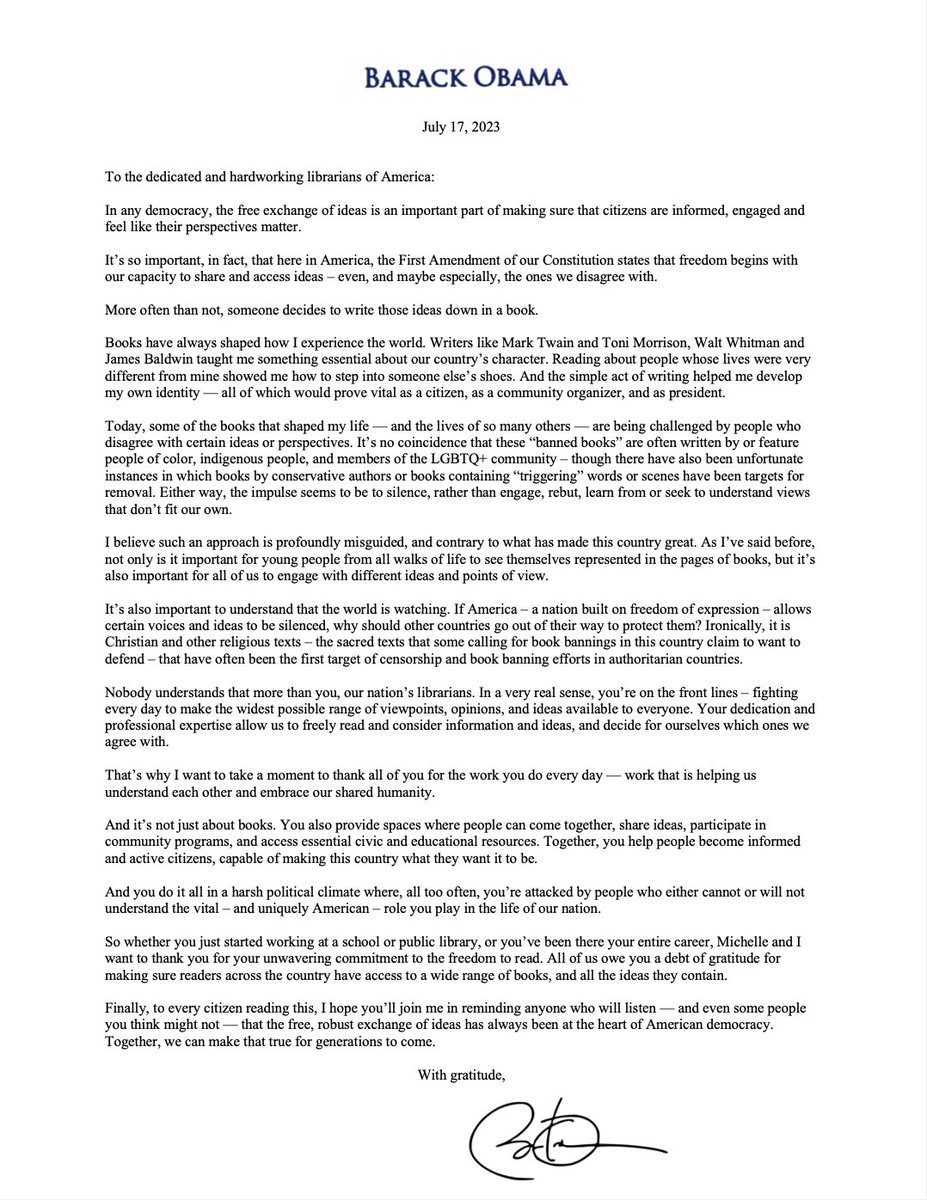
Today, some of the books that shaped my life—and the lives of so many others—are being challenged by people who disagree with certain ideas or perspectives. And librarians are on the front lines, fighting every day to make the widest possible range of viewpoints, opinions, and ideas available to everyone.
It's in! Django 3.0 will speak ASGI, though remain mostly a sync framework (well, unless I get the "async down to views" stuff done before feature freeze...)
And the Async DEP goes to the Technical Board very soon, once it reforms after the current election process.
"If anyone can refute me—show me I’m making a mistake or looking at things from the wrong perspective—I’ll gladly change. It’s the truth I’m after.” Marcus Aurelius
"Because most of what we say and do is not essential. If you can eliminate it, you'll have more time, and more tranquility. Ask yourself at every moment, 'Is this necessary?'" Marcus Aurelius
"Progress is made by trial and failure; the failures are generally a hundred times more numerous than the successes; yet they are usually left unchronicled."
-- William Ramsay (1852 - 1916)
1904 Nobel Prize winner - for his discovery of inert gases (Neon, Argon, Xenon, Krypton)
Can’t wait to be at the sprints for @DjangoConEurope ✨ I’ll be there working on Strawberry 🍓
If you want to know more about GraphQL, both frontend and backend come say hi 👋 to me, I’ll be happy to chat 😊 #djangocon