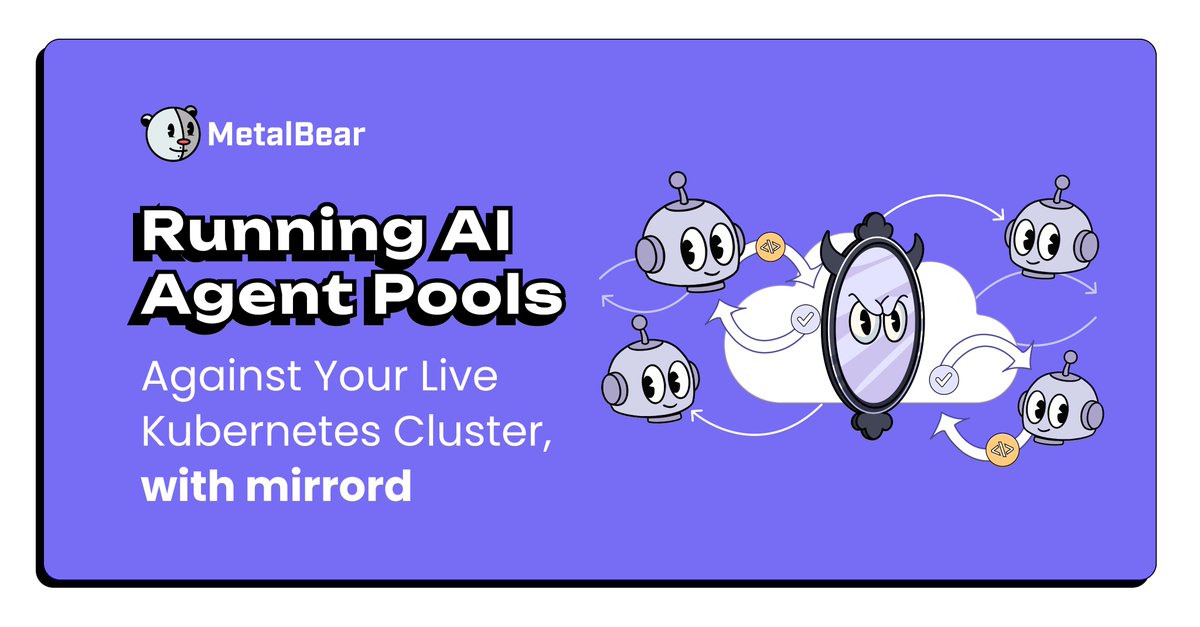
AI coding agents are migrating from IDE assistants to unattended cloud workers (@cursor_ai's self-hosted agents, @cognition's Devin, @claudeai's managed agents).
Once they leave the developer's laptop, they need access to your real cluster's services, data, and queues to write and test code better. And they need this access without trampling each other or blocking on deploy cycles.
Our latest guide walks through the "agent pool with mirrord" pattern that companies like @mondaydotcom and @PodiumHQ are already running in production, allowing them to fully utilize the benefits of AI coding agents.
Learn more about it here: https://t.co/Z3H3YZ71lR
Be like @mondaydotcom:
→ Test every change against the real staging cluster, without deploying.
→ Ditch slow, expensive ephemeral dev environments. No drift. No extra environments to maintain.
→ Let your entire team share one staging cluster for development using mirrord.
→ Cut feedback loops from minutes to seconds
Read more: https://t.co/t0cHdnfJD3
AI agents write code that looks correct. It follows the patterns, passes the linter, and ships.
Then it exposes your API keys. Or skips the auth middleware. Or calls a service that changed its response shape months ago.
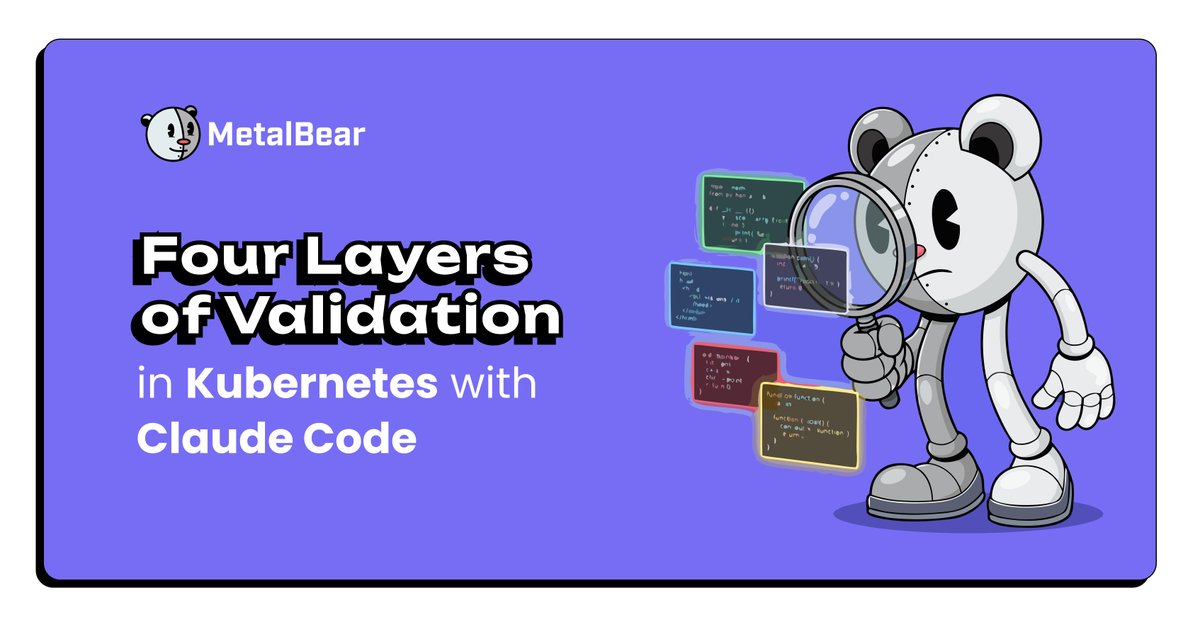
Static analysis catches some of this. But it can't catch everything. We wrote up a four-layer approach that closes the gaps:
1. Skills: rules that shape generation before the code gets written
2. Audit commands: static checks that run regardless of how the code was written
3. Integration tests: run tests against real dependencies, not mocks to be sure things work
4. Preview environments: so reviewers see the feature running, not just the diff
Read how to wire them together: https://t.co/Wujor4z8db
AI agents write code that compiles and runs locally, but usually breaks the first time it touches your @kubernetesio cluster.
This isn't because the AI models aren't good enough, but because the cluster is full of state the model never sees, things like:
- env vars on the running pod
- the schema in your databases
- the exact response structure of other services
To fix this, we recently shipped six @claudeai Code skills that close the AI agent feedback loop. Read the full blog post to learn more about them: https://t.co/TGW2bEcBYd
We just had our first company retreat last week in Biella, Italy — planning sessions, great food and wine, and river rafting in a thunderstorm (the thunderstorm part wasn't intentional)
We're a fully remote team spread across 15 countries, so moments like these are really special for us!
If you'd like to join the next one, we're hiring :)
https://t.co/8XuJ4CUtae
We'll be at @awscloud Summit Sydney next week on 13–14 May!
Working with AI coding tools? Kubernetes? Both? Come say hi 👋 and we’ll show you how mirrord helps Kubernetes teams fully leverage the productivity benefits of AI-driven development!
The only way to ensure AI-generated code won’t break staging is to actually test it in staging before deploying.
Learn how mirrord helps AI agents do just that here: https://t.co/aDmDRlgk6t
Kubernetes 1.36 was released a couple of weeks ago!
Going through all the release notes can be quite overwhelming, so to make things simple, we made a list of some of our favorite features from 1.36.
We also sat down with Ryota Sawada, the release lead for 1.36, to discuss the behind-the-scenes of this release and where Kubernetes as a project is heading.
Check them out:
📝 Blog: https://t.co/BeUsLYriqJ
📺 Webinar recording: https://t.co/mETygfkkST
HAPPENING TOMORROW!
Join Ryota Sawada and @RinkiyaKeDad for a webinar where they discuss all that's new in the @kubernetesio 1.36 release and how the release team behind one of the largest open-source projects works.
Add to your calendar here: https://t.co/4kAqcSNEVq
last week we closed a customer that’s been using our OSS for 2 years.
they always told us they loved it, but since their ephemeral environments worked “well enough”, they didn’t see a reason to consolidate environments.
i asked: what about the cost?
their answer: yeah it’s expensive, but we’d rather optimize other things than shake the system.
what changed? scale.
they now have a 10x engineering initiative. spinning up environments per agent just doesn’t work anymore. per engineer was manageable. per agent wasn’t.
during the PoC the dev experience didn’t change — just plug & play the operator. whoever wants to share an environment can.
gradual onboarding. infinite scale. zero extra cost.
lesson learnt in sales:
orgs optimize for growth before they optimize for cost.
this is super exciting. https://t.co/JYtX9SuEUb didn’t buy our vision at the beginning, but slowly became more open to it, and now it is how engineers develop. read the case study
@VanessaRo12@ungemeve Guten Morgen aus Netanya :) Es handelt sich laut allen hebräischsprachigen Israelischen Quellen um einen gemeinsamen Angriff mit den USA.
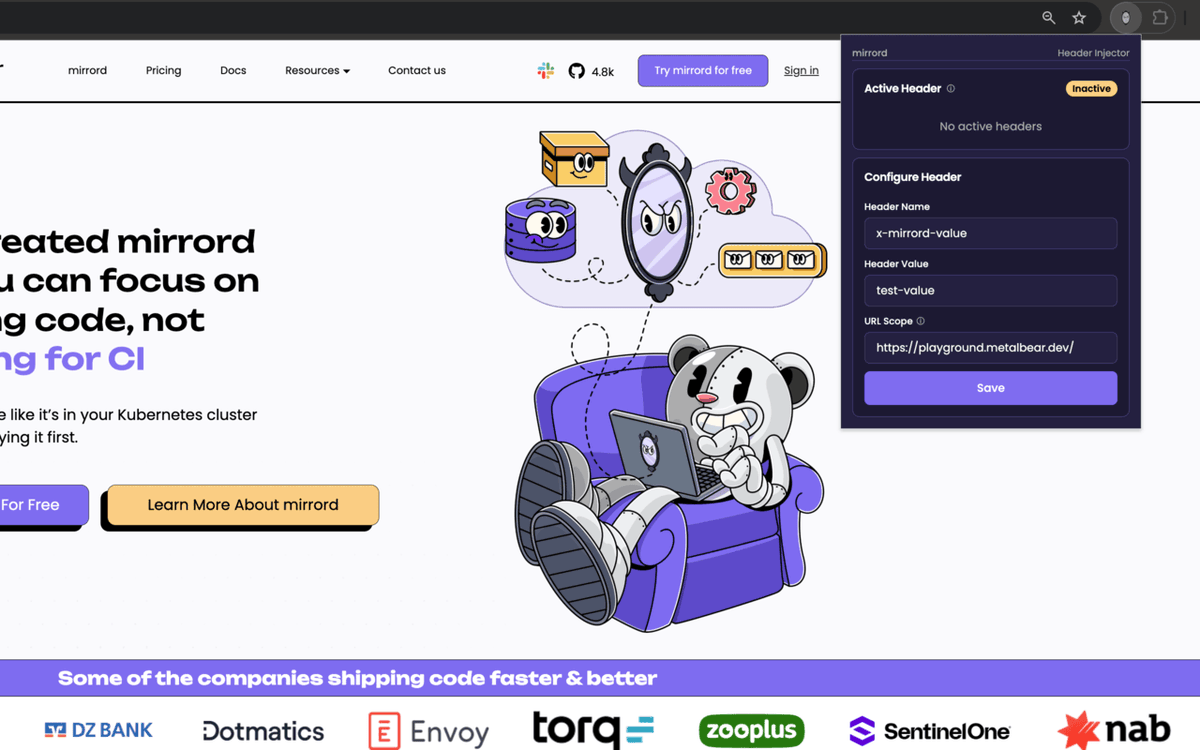
The mirrord Browser Extension lets you inject custom HTTP headers directly into your browser requests.
When combined with mirrord, it simplifies testing applications in browsers by automatically injecting an HTTP header that matches the HTTP filter defined in your mirrord configuration.
But it can also be used as a standalone tool for anyone who needs header injection!
Learn more in our docs here: https://t.co/4jlh3r18kC
If you're using @cursor_ai to write code, check out this video to learn how you can pair it with mirrord to let AI agents not only generate code, but also safely test it autonomously against a production-like #Kubernetes environment! 👇