I'm Passionate about Web3, Blockchain, and DeFi 🌐 Exploring the future of decentralized innovation, empowering communities, and reshaping the digital economy.
More institutions are starting to take clean energy seriously, and we're seeing that shift happen faster than ever.
As adoption grows, the need for trusted, transparent infrastructure grows with it. That's exactly what @energywebx is building.
What do you think will be the biggest driver of institutional clean energy adoption over the next few years?
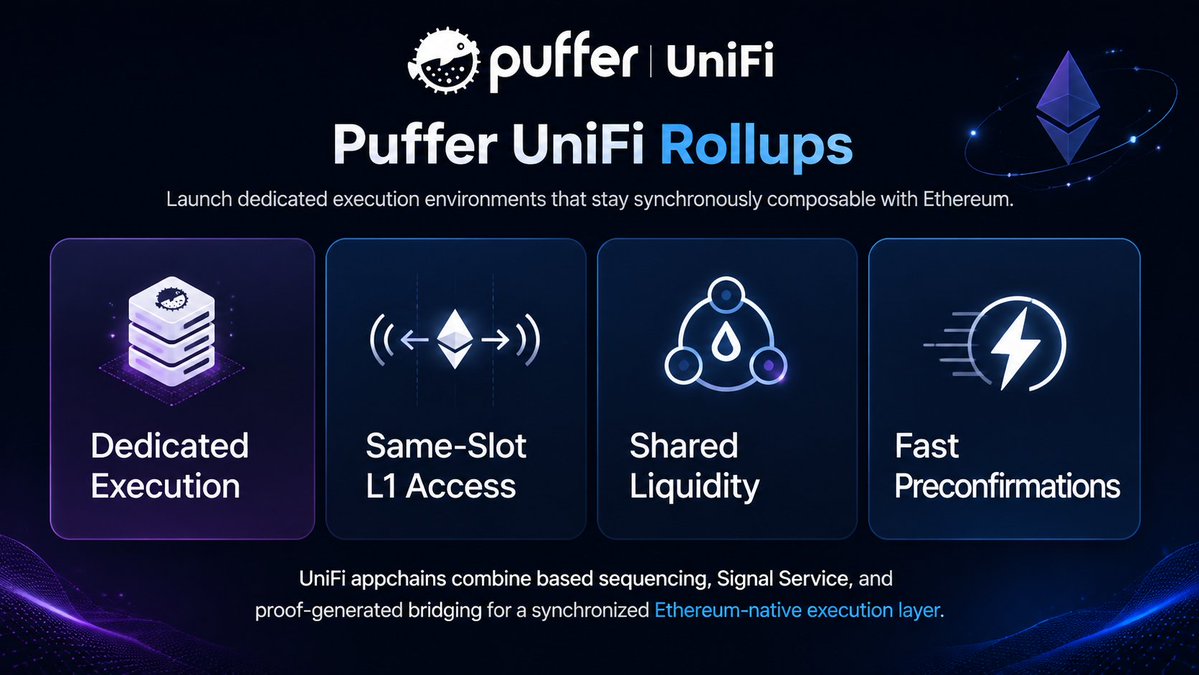
Puffer UniFi Stack. 🐡
As Ethereum apps become more specialized, teams need execution environments built around their own performance, logic, and user experience.
But specialization only works if it stays connected to Ethereum.
The UniFi Stack gives applications dedicated execution while preserving the coordination, liquidity, and settlement guarantees that make Ethereum valuable, through based sequencing, Signal Service, and proof-generated bridging.
Here's what that unlocks 👇
⚙️ Dedicated Execution
Applications launch their own execution environments with custom performance, rules, and infrastructure, instead of competing for blockspace inside a shared general-purpose rollup.
🔁 Same-Slot L1 Access
Through UniFi's Signal Service, rollups access Ethereum L1 state in the same slot, without waiting on slow bridge messaging or delayed external updates.
💧 Shared Liquidity
UniFi Rollups stay close to Ethereum's liquidity layer, so applications access the capital, users, and protocols already built around Ethereum instead of creating separate liquidity silos.
⚡ Fast Preconfirmations
With @puffer_preconf, users get fast execution assurances before final L1 settlement, giving Rollups low-latency UX while keeping execution tied to Ethereum-aligned sequencing and slashable commitments.
Apps get their own execution environment without losing what makes Ethereum powerful: shared liquidity, coordinated state, and composability across the ecosystem. 🐡
🛡️ Puffer Security Stack #2 - Security Doesn't Stop at the Audit
A smart contract audit is one of the most important steps in securing a protocol. But it's only one step.
Bugs can be missed. Fixes can introduce new issues. And even perfectly written contracts can become vulnerable if they're deployed with the wrong roles, permissions, or parameters.
That's why every Puffer release passes through multiple independent layers of review. Our security process includes:
• A full internal test suite
• Continuous review by AI audit agents
• Sequential audits by independent security firms
• Post-deployment verification of roles, permissions, and parameters
Every layer is designed to catch what the previous one might miss, because security doesn’t end when the audit report is delivered.
It ends when what's running onchain is exactly what was intended. 🐡
👔 Institutional Staking #4 - Risk Design and Validator Exposure
For institutions staking ETH, yield is only one side of the equation. The other is how validator risk is managed across operations, permissions, exits, and infrastructure.
Validator performance, uptime, rewards, and slashing exposure all originate at the validator layer. That makes validator design a core part of institutional staking, not just a backend detail.
Puffer Institutional structures that exposure through dedicated vault infrastructure instead of a generic pooled model. This matters because institutions can manage their own staking and restaking position through configurable permissions across deposits, validator operations, rewards, and withdrawals.
The Institutional Vault manages how ETH moves through staking - from validator deployment to rewards and withdrawals - while AccessManager defines who is allowed to control key parts of that process across the system.
Validator exits are structured through Voluntary Exit Messages, creating a more controlled process for leaving staking positions when needed.
Together, these systems turn validator exposure into something institutions can manage more deliberately: dedicated vaults, configurable permissions, structured exits, and operational control within one institutional framework.
Validator-backed ETH exposure, built for institutional risk control. 🐡
Watching the recent @COLDCARDwallet situation got me thinking.
If a wallet bug or security flaw leads to user losses, why aren’t wallet providers insured to cover those losses?
@TrustWallet Wallet refunded affected users after a past vulnerability. Should more wallets do the same?
Thoughts?
@cz_binance
Synchronous composability means rollups can scale without giving up the shared state, liquidity, and atomic interactions that make Ethereum valuable.
That's exactly what @puffer_unifi is built to deliver. 👇🏼
Speed backed by stake, not promises. 🐡
Fast confirmations only matter if they can be trusted.
Puffer Preconf does not rely on a centralized sequencer. Preconfirmations are backed by Ethereum-aligned validator infrastructure and economic accountability, with ~433K restaked ETH securing the network.
That is execution backed by real economic weight instead of blind trust.