What if your website improved itself?
Introducing ION, an AI-native website platform where AI agents continuously:
- Propose changes
- Run experiments
- Improve performance over time.
We're already powering $1b+ companies, & seeing 200% lifts in conversion.
🧵
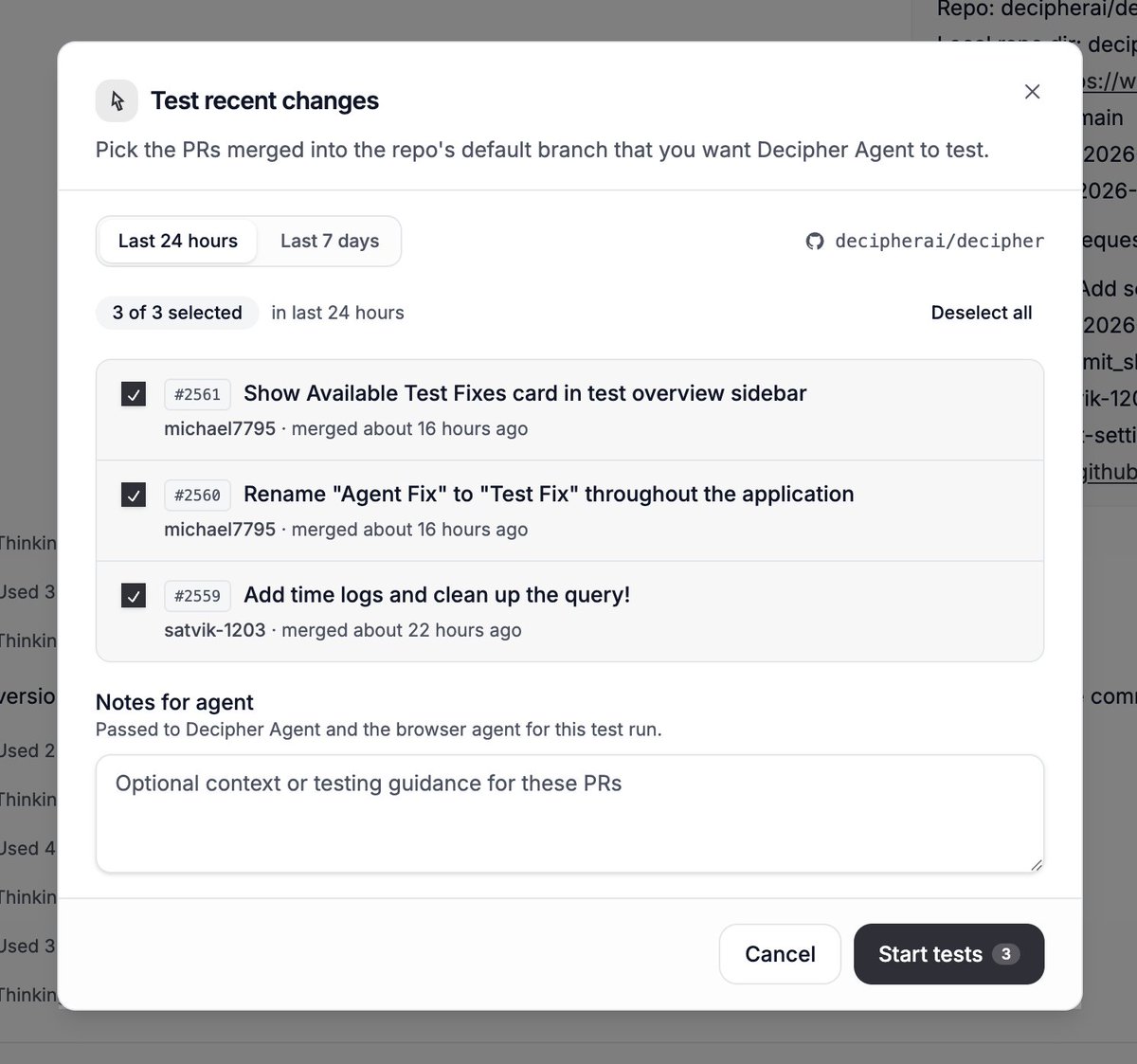
New in Decipher: agentically test recent changes.
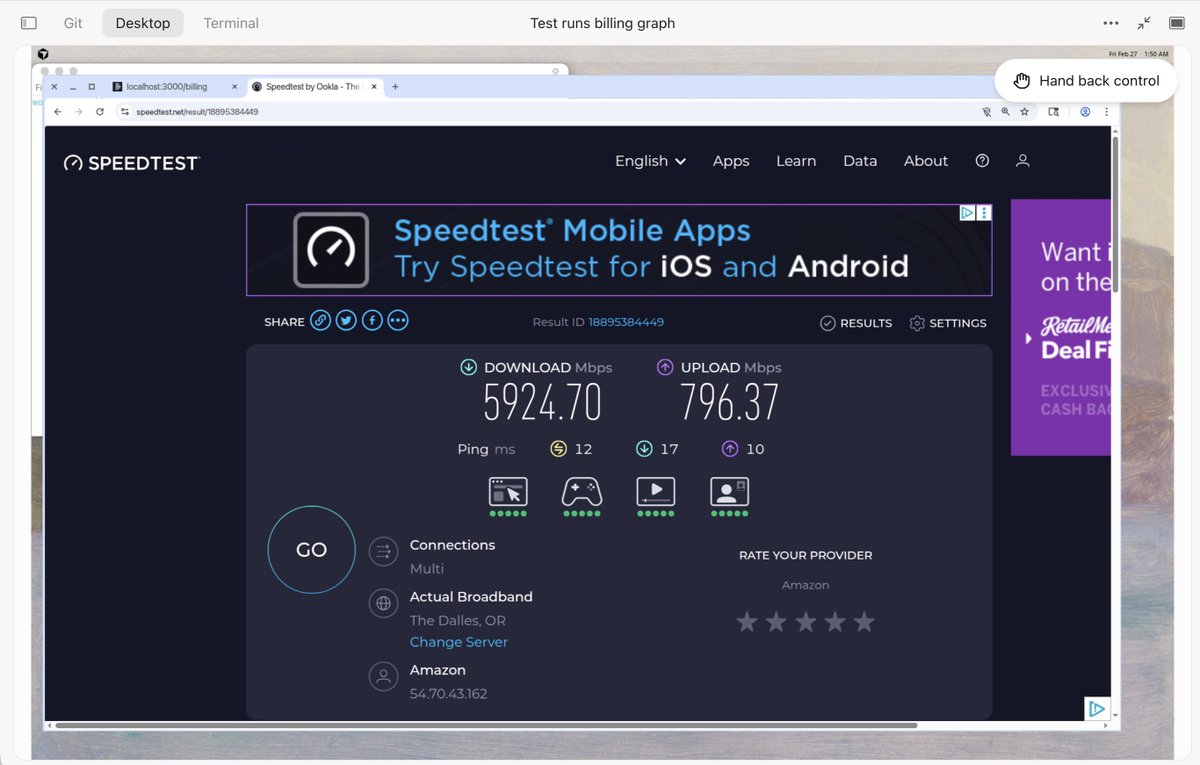
Point it at your merged PRs. The agent writes test cases, explores the product, returns a QA report per PR.
One click turns any case into a self-healing E2E test.
Introducing Decipher AI: agentic QA for the era of coding agents.
Show it your product, and an agent generates E2E tests in minutes, maintains them for you, and catches bugs before customers do so. You keep shipping fast.
Plus, @decipher_ai will detect when live customers hit bugs and alert you.
Cat's out of the bag - just wanted to say thanks to everyone who reached out. I'll reply to all the DMs eventually.
I'm going to work on the book while I figure out what to do next. I'm fortunate enough to have some options so don't feel bad for me. I was paid well to do a job I loved with people I admired and it had to come to an end at some point.
They had to make a tough call to keep the business alive and it was the right decision - I'm only sad because we can't all carry on working together.
I'm not a guy who makes career plans but I have one rule when choosing where to work, I need to be the dumbest person in the room. At Tailwind, I learnt just how much dumber I can be. I felt like the special needs intern - discovering new and exciting ways to not know stuff.
You probably think I'm talking about programming stuff but I learnt more from @steveschoger about design in 18 months than most of my career. I thought I was done learning about design. We have almost opposite skillsets so I was blown away by stuff he finds simple and vice versa. For a guy who literally wrote the book on design there is absolutely no ego there. Just a dude who really loves designing stuff.
I can't tell you what a joy it is to work with @reinink - what a relentlessly positive guy. A Labrador in human form. I'm convinced there isn't a task you could give him that he wouldn't figure out. He has the very rare skill of being able to do the last 10% of anything as well as the first 90%. A stone cold finisher. I already miss hearing "Good morning!" on our call even though it was 3pm - I think he just liked saying it.
I've never met anyone with a higher quality bar than @adamwathan - completely unafraid to throw months of work away if it's not right. You might think that sucks as an employee but it takes about 5 seconds to realise "oh yeah, this is shit". There's no blame there, we all made it shit together and we'll make it less shit together.
I have this toxic trait where I hate almost anyone else's writing style but I adore Adam's. Once he's written something it feels like there's no other way to say it. We also share the same distaste for not understanding something but I'm sure his capacity to learn stuff is a magnitude greater than mine. Lastly, I don't think people understand what a nice guy he is. Genuinely tortured when he feels he's let anyone down, so there's no way he's made this decision lightly.
I came to think of @malfaitrobin and @PhilippSpiess as almost a single being - they spent most of every day pair programming - and so it's sad that their consciousness has been split. Every time I'd join their call I'd get motion sick from the speed Phillip moves around his IDE. I have no evidence, but I think he has it neuralinked into his brain. He thinks at triple speed and talks at double speed. Just an incredible programmer you could throw into any company and he would instantly improve it.
Robin is staying and I can see why - he's been with the guys since day one and there's no one who knows more about Tailwind on the planet, even Adam. What a lovely dude too - if you can get past the dad jokes which, despite never getting more than an eye-roll, he continues with unabated. He has the skills of someone twice his age and experience but with the attitude of someone young and eager to help.
Before there was AI, there was @jordanpittman. If we ran into some gnarly bug we'd just ask Jordan and he's be like 'oh yeah that's a bug in safari from 2016 and here's every github issue we've ever received that relates to it'. And then the motherf*cker would just go fix it. Obviously not Safari, but with like any other open source library he would just go make a PR. Didn't really matter if he knew anything about the repo or language - I'm pretty sure he could write COBOL if necessary. When chatgpt is doing a web search, it's just sending Jordan a DM.
Last, but not least, is @petersuhm who is also staying on. There is literally nothing Peter won't do. He's supposed to be a programmer by trade but at Tailwind he does everything no one else wants to do. Payroll? Peter. Support? Peter. Someone selling Tailwind Plus templates on the dark web? Peter. He's been doing a great job basically selling companies on the idea of supporting Tailwind and bringing in revenue to help keep things alive. By the way, if you're reading this and your company depends on Tailwind you should sponsor them. Reach out to Peter.
I'm always going to be team Tailwind - I'm rooting for them and I hope they can turn it around and hire us all back someday. Monetising open source was an unsolved problem before AI and it's only gotten harder.
Does @cdixon's “Come for the tool, stay for the network” theory still hold in the AI age?
Ten years ago, Chris Dixon wrote “Come for the tool, stay for the network” which proposed that new social media companies could attract early users through a product that looked like a single-player tool before the network really got up and running at scale. Instagram is the canonical example here, iPhone photos were terrible at the time, photo filters made them a little better. You normally had to buy a photo filter app like Hipstamatic, or you could use Instagram for free. There weren’t that many people posting to the IG feed, your friends were still just figuring out how to use the app, it didn’t work on Android, and there certainly weren’t professional creators spending full work weeks planning out how to make the best content possible.
The strategy worked though. People came for the tool, they filtered personal photos and used Instagram as a photo album, before graduating to the daily doomscroll. The For You feed got so good that “doomscroll” is sort of an unfair pejorative. I think most Instagram users actually love the content in a very genuine way.
Loving the content has shifted the median Instagram user away from creation and toward consumption. When Instagram initially launched, there was nothing to doomscroll, so user seconds had to be spent creating. Today, the median user posts content around big life events like weddings and kids, but serious posting is the domain of professionals. As such, ~1% of users get ~99% of the attention.
Over the weekend, the timeline was debating the rise of the AI music app Suno, which has grown from ~$40M to ~$150M in revenue in a year’s time. The viral question was “Who’s paying for this?”
Well, to just answer the question upfront, it’s mostly individuals basically. If you read the comments, there are dozens of known accounts, real people, including Palmer Luckey, explaining that yes, they use Suno, they happily pay, and they enjoy the music. Suno has over a million reviews across the iOS and Android App Stores. It’s a very real business. But the open question is how much of this usage is “tool” and how much is “network.” It’s pretty easy to map the last tech wave onto this one and assume that Suno will ultimately have a small pool of “prompters” and a huge audience of “listeners.” This is in some ways the long thesis for Sora, but it’s possible that we shouldn’t view these AI apps as consumption platforms at all and instead see them as video games. The fun comes from creating more than consuming. The lineage is building with Legos, building in Fortnite and Minecraft, then building with AI creativity apps.
If it’s true these AI creativity apps look more like video games than social networks, that certainly has ramifications for how competitive the market is long term and how these companies get underwritten. There’s new reporting that OpenAI is planning to enter the music generation market to compete with Suno. The race is on to create a differentiated user experience or uniquely opinionated model like Midjourney, or bootstrap a network and become an aggregator to such a degree that even the mega labs can’t eat off your plate.
There is now a proper AI war on every front. A browser war, a vertical video war, and now an AI music war. Each war will have different territory and units, but there will definitely be casualties!
I generated full coverage, E2E tests for my app in 15 minutes with an agent
The agent:
- watches user sessions to learn the product
- generates test steps for important flows
- runs playwright tests for those flows on every PR
- auto-heals tests when the product changes
Did a quick check on where my high school graduating class (2020 TOPS @ Marc Garneau) ended up and… yeah, we were built different.
Out of 53 kids:
People are now at @Apple, @tryramp, @Shopify, @figma, HRT, Jane Street, @Stripe, @xai, @Meta, Amazon, Datadog, Cohere, Snowflake, Databricks, Groq, Uber, Bloomberg, Scale AI, etc.
And 7 are in medical school 🤯
University Breakdown:
- 12 @UWaterloo CS
- 8 Waterloo SE
- 5 @UofT Eng
- 5 @McMasterU Health Sci
- 6 @WesternU Health Sci
- 2 Western Ivey
- 4 Waterloo Eng (non-CS)
- 3 UofT Math
- CS at @Harvard, @UCLA, @UCBerkeley
Cracked doesn’t even begin to cover it.
🚀 Announcing Decipher’s AI Testing Suite!
Teams are using more AI to ship faster, and most are accepting a quality trade-off that compounds over time. It will only get worse without guardrails.
Our session-replay AI learns your real golden paths, writes your end-to-end tests, and keeps them green as your product changes.
No more incidents. No more “we’ll add tests later.” Ship faster without breaking what matters.
It converts real user flows into stable checks, maps coverage to actual feature usage, and gives instant failure analysis with root cause and repro steps.
As your UI evolves, tests self-heal to cut flakiness and manual upkeep. Coverage improves continuously from live behavior. Need a custom test? The agent will help you author a test.
This ends the speed vs quality tradeoff. Quick demo ↓
Couldn’t agree more with Linear’s zero bug policy. Striving for zero bugs isn’t perfectionism; it’s how you build great products.
@decipher_ai exists to make a zero bug policy achievable while maintaining velocity. Our QA agent learns your UI and customer journeys, flags likely issues before release, and watches production for anything that slips through.
Customers become promoters when issues are fixed quickly; weeks-late fixes at best keep them neutral.
And more recently, AI is helping teams ship features faster, but quality is crashing. That needs to change.
Our vision: every product autonomously grows more reliable with use
Pumped to share a demo of a new Decipher feature we've been working on!
Type a prompt like “loading issue on the replay page” and we group matching sessions, show repro steps, and alert.
No more escalations from customers.
Proactive, smart observability so teams ship faster.