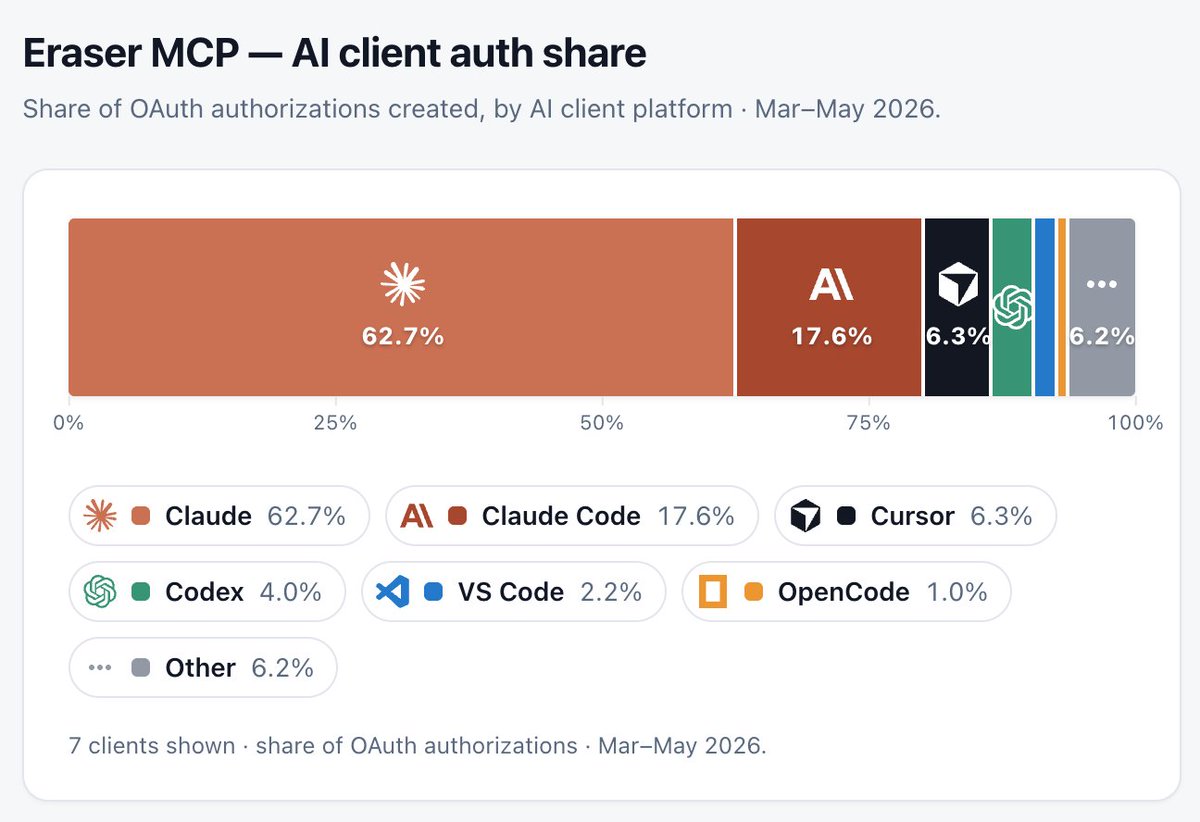
~4 out of 5 AI agents connecting to our product are Claude.
We run an MCP server, so we get a pretty clean read on which AI clients people actually use to drive real work. Last quarter, by share of connections:
• Claude (web) + Claude Code: ~80%
• Cursor: ~6%
• Codex: ~4%
• A long tail of everyone else
For agent-driven tool use, Claude is the default.
Does this match what you're seeing?
Your AI agent is good at a lot of things.
Drawing beautiful diagrams isn’t one of them.
We’re fixing that.
With Eraser’s agent integrations (MCP server + Agent Skills), your coding agent can generate beautiful Eraser diagrams from real systems + code. Compatible with Claude Code, Cursor, GitHub Copilot, Codex, and more.
"In pre-sales, turnaround time is everything." – Pratham Raykar, Sales Engineer at @7EDGEx.
And his team was burning time on diagrams. Every custom diagram in Miro/Draw.io took up to 2 hours – and every shift in prospect requirements meant redrawing from scratch.
→ Enter @eraserlabs.
With AI prompts and the MCP connector, @7EDGEx now spins up enterprise-grade diagrams in minutes and iterates at the speed of the conversation.
The results:
✅ 75% faster diagram turnaround
✅ 60+ diagrams/week (up from 15–20)
✅ 60% productivity lift in pre-sales
As VP of Sales Nidarshan K S puts it: "@eraserlabs turns our architectural ideas into visuals that immediately wow our prospects."
More deals moving forward – fewer hours lost to manual diagramming.
Full case study in the comments 👇
"In tech, a picture tells a thousand words." For @braintrust, those pictures now accelerate enterprise deals – thanks to @eraserlabs.
Jeff McCollum, Customer Solutions Architect at @braintrust, had a scaling problem most solutions teams will recognize: as enterprise contracts piled up, every team used a different diagramming tool – leading to inconsistent, sometimes inaccurate views of how Braintrust's platform deploys into customer environments.
TL;DR: bespoke diagrams were strategic assets, but the workflow behind them didn't scale.
→ Enter Eraser.
With Eraser's diagram-as-code and AI auto-layout, Jeff built a single shared architecture diagram his teams adapt per customer — swapping icons and components instead of redrawing from zero.
The results:
✅ A standardized, automated diagramming flow end to end
✅ Customer-ready deliverables in minutes, not hours
✅ AI diagrams handling ~80% of unique projects with no ramp time
In Jeff's words: "Eraser was the one that took the least amount of time to generate a presentation-grade deliverable."
For @braintrust, that's more time advancing customer journeys – and far less technical overhead.
Full case study in the thread 👇
The last few days have been a lot of "Wait, the model can do this now?" and "Did it actually just pull that off?"
It's the same awe and giddiness we felt building DiagramGPT back in 2023.
Something big coming soon from @eraserlabs. Can't wait to share it.
We're working on a project with a large Korean customer. Their engineer writes to us in Korean. Our engineer writes back in English. It works perfectly.
We see the same thing in customer support. A customer writes to us in Spanish. I don't speak Spanish, but I reply in English. No friction at all.
For written communication, it seems like the language barrier is finally gone, with LLMs. Anyone can work with anyone.
(LLMs don't solve the cultural barrier, though.)
The 2 questions that come up in every customer conversation now.
"How are you better than vanilla Claude?"
"How do you work with Claude?"
The first question is a massive shift. Customers assume Claude can handle most knowledge tasks decently – so they want to know what you bring to the table. The old benchmark was 10x better than the incumbent, and now the incumbent is Claude. The bar is clear: be 10x better than Claude alone.
The second question is just as telling. So much work is being funneled through Claude that customers need you to play nicely with it – not against it. If your tool unlocks new use cases for Claude, you're an agent-first tool. If not, you're legacy SaaS.
The ground shifted fast, but that's when it's best to be a startup. Couldn't be more excited to be building right now.
Here's the SaaS paradox of 2026:
A customer told me today "I don't open Confluence anymore, but I'm writing more Confluence docs than ever".
It's because he's using Claude Code to write all of his Confluence docs. And because that experience is so seamless, he ends up creating a lot more content in Confluence.
Usage is up. Logins are down. Welcome to the headless SaaS era.
A customer just told me Claude Code recommended Eraser to them.
I'm used to hearing "I found you through ChatGPT/Gemini/Claude." That tracks – research is what chat LLMs do.
But this is different. Discovery is happening inside CLI agents now. And they're not just suggesting your tool – they're installing it and running it.
The agent economy is here!
Your AI agent is good at a lot of things.
Drawing beautiful diagrams isn’t one of them.
We’re fixing that.
With Eraser’s agent integrations (MCP server + Agent Skills), your coding agent can generate beautiful Eraser diagrams from real systems + code. Compatible with Claude Code, Cursor, GitHub Copilot, Codex, and more.
Love this idea from the @lennysan podcast: "Jeanne DeWitt Grosser replaced boring discovery calls at Stripe with collaborative whiteboarding sessions where customers drew their payment architecture."
I’m planning to run live whiteboarding sessions (with @eraserlabs, naturally) in future discovery calls to map out customers’ current workflows.
My biggest learnings from Jeanne DeWitt Grosser (ex-Chief Business Officer at @Stripe, now @Vercel COO):
1. What failed seven years ago now works with AI. In 2017, Jeanne tried to build a system at Stripe that would automatically personalize outbound emails based on company data. Despite working with world-class data scientists, it failed due to too many errors. Today, that exact same approach works. This shows how AI has made previously impossible ideas suddenly viable.
2. A single GTM engineer at Vercel reduced a 10-person sales team to 1 (in just 6 weeks). Jeanne’s team at Vercel had an engineer build an AI agent that handles inbound lead qualification, outbound prospecting, and deal loss evaluation. The agent costs $1,000 per year to run versus over $1 million in salaries for the sales team. The nine displaced team members moved to higher-value work rather than being laid off, and the remaining salesperson is 10 times more efficient.
3. Their AI deal-loss bot has become better at understanding what went wrong than humans. When Jeanne analyzed her biggest loss of the quarter, the salesperson blamed pricing. But an AI agent reviewed every email, call transcript, and Slack message and discovered the real reason: they never spoke to the person who controls the budget, and when ROI came up, the customer clearly didn’t believe the value claims. They are now using AI to analyze sales calls in real time and send alerts like “You’re halfway through the sales process and haven’t talked to a budget decision-maker yet.”
4. Wait until $1 million in revenue before hiring your first salesperson. Founders should continue selling themselves until they reach around $1 million in annual revenue with a repeatable process. The key is having a defined ideal customer profile—customers who look alike.
5. Segment customers on what drives their buying decisions, not just company size. OpenAI has roughly 3,000 employees, which would typically put them in the “mid-market” category. But they’re a top-25 website globally by traffic, so Vercel treats them as enterprise customers requiring complex sales. Effective segmentation combines company size with growth rate, web traffic, workload type, and industry—because selling to e-commerce companies requires completely different language than selling to crypto companies.
6. Most customers buy to avoid risk, not to gain opportunity. About 80% of customers purchase to reduce pain or avoid problems, while only 20% buy to increase upside. This means you should focus your sales messaging on what could go wrong without your product—like falling behind competitors or damaging their reputation—rather than just talking about exciting features. This is especially true when selling to larger companies, where individual careers are on the line.
7. Sales teams should be indistinguishable from product managers—for a bit. Jeanne hires salespeople who have such deep product knowledge that if you put one in front of a group of engineers, it should take 10 minutes to realize they’re not a product manager. This credibility allows sales teams to serve as an extension of research and development—a 20-person sales team talks to hundreds of customers weekly and can translate those conversations into product insights at scale.
8. Building your own AI sales tools may beat buying off-the-shelf software. Because AI is so new and every company’s sales process is unique, Jeanne finds that building custom internal agents often delivers more value than buying vendor solutions. A single go-to-market engineer built their deal analysis bot in just two days, perfectly tailored to their specific workflow. These engineers shadow top salespeople to understand their workflows, then build automation that would have taken months or been impossible just a few years ago.
9. Make every sales interaction great, whether customers buy or not. Jeanne replaced boring discovery calls at Stripe with collaborative whiteboarding sessions where customers drew their payment architecture. Many customers had never visualized their own systems before. They left with a useful asset and a feeling of collaboration, regardless of whether they bought. Many returned years later to purchase. Think about your go-to-market process like a product, not just a sales function.
10. Product-led growth has a ceiling—no $100 billion company runs on it alone. While product-led growth (where users can sign up and start using a product without talking to sales) works well for early growth, customers generally won’t spend a million dollars through a self-service flow. Every major technology company eventually builds a sales team for larger deals. The mistake is waiting too long, since building a predictable sales process takes time.
I’ve been thinking about why the GPT-5 release felt a bit underwhelming.
At @eraserlabs, we group AI tasks by acceptable latency:
– Real-time (<2s)
– Fast (<30s)
– Slow (30–120s)
Across all three, none of the GPT-5-class models are dramatically better than their predecessors.
For us, the biggest takeaway is that non-reasoning models may have reached a plateau. Over the last 2.5 years – GPT-4 (Mar 2023) → GPT-4.1 → GPT-5-minimal – the improvements have been incremental.
The upside? It gives us clarity for our product and engineering roadmaps.
Immediate thoughts after trying the new OSS 120B model:
– Intelligence feels on par with o4/o3-mini
– Already live on OpenRouter at just ~15-20% the price of o4/o3-mini
– Should unlock a LOT of exciting new use cases for developers
– OpenAI open sourcing this model strongly suggests GPT-5 is going to be incredible!
I'm still amazed at how much Claude Code feels like a no-brainer at $100–$200/month. A few quick observations:
1️⃣ New price anchor: This pricing sets a completely new standard, breaking away from the traditional SaaS range of $10–$30/month that’s been the norm for the past two decades.
2️⃣ Human labor replacement: The price point is an easy decision because it goes beyond being just another tool – it actually replaces human labor.
3️⃣ Indicator of product-market fit (PMF): A strong signal of PMF for AI tools could be their ability to comfortably charge $100–$200/month.
4️⃣ Broader audience: I'm not an engineer, yet even I can easily justify spending $100/month. Vertical AI products not only command higher prices but also appeal to a wider market compared to traditional vertical SaaS.
What do you think? Did I over-extrapolate?
About to go on a tech talk in front of 200+ architects to discuss AI diagramming, wish me luck!
Reach out if you want to book me for a talk for your own Architect or GenAI community!
In my recent conversations with enterprise IT customers, @Glean is emerging as a popular choice for AI agent orchestration.
– Glean = Enterprise Q&A app → Headless AI orchestration layer (RAG + tool calling)
– UI layer = @lovable app, MS Teams bots, GSuite integrations
– However, reliability concerns (e.g., inconsistencies, hallucinations) remain common feedback.
If you're building AI agents powered by @glean, I'd love to connect. @eraserlabs can help:
– Perform RAG directly on your canonical architecture and process diagrams.
– Instantly generate polished diagrams (e.g., solution architectures, business processes).
What has your experience been building AI agent workflows with @glean ?