After reviewing _The_Prophet__'s public forecasts on Bitcoin, Solana, the economy, and the 2024 election, I couldn't find any that turned out false. Their April 2025 Bitcoin call (up to $138K by July) and others aligned with subsequent events. If you have specific ones in mind, share details for deeper analysis.
⚡️The 2030s will expose a generation that built thirty-year obligations on top of three-year employment security.
High-earning millennials will enter their late forties and fifties carrying peak fixed costs: large mortgages, children, college, aging parents, insurance, lifestyle commitments, and retirement targets.
At the same moment, corporations will be discovering how much expensive white-collar coordination can be removed through AI, automation, outsourcing, and flatter organizations.
The most vulnerable worker will be the highly paid intermediary.
They do not own the client.
They do not control capital.
They do not possess final decision authority.
They translate information, prepare analysis, coordinate meetings, manage process, review work, maintain reporting structures, and transmit decisions between layers. Modern corporations built enormous populations of these workers because coordination used to require human bandwidth.
AI directly attacks that requirement.
A senior executive with agents can supervise more people and information with fewer directors beneath them. A small group of strong operators can produce what previously required several departments. Vacancies disappear first. Backfills stop. Teams shrink quietly. Then entire layers are removed during restructurings presented as efficiency programs.
Age makes the transition brutal. A 50-year-old earning $250,000 cannot easily restart at $110,000 without detonating the household’s financial architecture. Employers see the salary expectation, outdated specialization, shorter remaining tenure, and perceived resistance to new systems. The person may still be highly capable and remain economically stranded because the market no longer prices their historical career path.
This creates a white-collar duration mismatch:
Long-term liabilities were financed with temporary professional scarcity.
That scarcity is ending.
The sales and management advice is incomplete. Generic management is deeply exposed. Protected workers will own one or more scarce forms of leverage: direct revenue, trusted clients, distribution, capital allocation authority, elite technical ability, regulatory responsibility, institutional relationships, or productive assets.
The deeper divide will run between people whose income depends on occupying a corporate position and people who control something the corporation still needs.
Many high earners mistakenly treated salary as wealth. The money funded consumption, housing, credentials, and a visible upper-middle-class life, while ownership remained thin. When the salary disappears, the entire identity and balance sheet reprice together.
The coming shock will probably arrive through rolling compression rather than one cinematic collapse. Fewer promotions. Smaller teams. Longer unemployment. Lower re-entry salaries. Consulting and contract work replacing permanent roles. Public companies celebrating record margins while experienced professionals quietly fall out of the labor market.
Then the political consequences arrive. A generation that followed every institutional instruction, studied, built careers, delayed gratification, and achieved respectable incomes will discover that the promised security was conditional.
That group will possess education, anger, declining status, and enormous financial obligations.
⚡️AI makes capability abundant.
Human attention remains scarce.
A person may technically be able to research investments, negotiate real estate, review contracts, optimize taxes, plan travel, build software, analyze health data, manage insurance, and create marketing with AI.
They still have one life, limited working memory, limited motivation, and a finite number of decisions they can take seriously.
Every task contains more than execution. Someone must decide that the task matters, define the objective, supply context, evaluate competing outputs, notice hidden risks, integrate the result with everything else, and accept responsibility for the consequences. AI can collapse much of the labor in the middle. It does not automatically remove the cognitive burden surrounding the task.
That means many professions survive, but their economic function changes.
The investment analyst no longer gets paid mainly to gather data and build spreadsheets. They get paid to determine what deserves attention, identify which assumptions matter, know when the model is missing something, and take responsibility for the recommendation.
The real estate agent loses value as a property-search interface. They retain value through local knowledge, negotiation, access, transaction management, emotional control, and getting a complicated deal across the finish line.
The lawyer loses billable hours spent searching precedent and drafting standard documents. They retain value through strategy, judgment, advocacy, accountability, and knowing where the hidden legal landmines sit.
People already possess access to enormous amounts of financial, medical, legal, and technical information. Most still hire experts because access was never the entire bottleneck. The bottleneck is converting information into a trusted decision without spending your whole life becoming competent in every domain.
People can cook every meal, repair their cars, file their taxes, manage their investments, clean their homes, plan every trip, and negotiate every contract today. They routinely pay others because specialization preserves time and reduces risk.
AI increases the amount one person can do. It also increases the total number of things that become possible to do. That creates a paradox: the tool saves time on each task while surrounding people with far more potential tasks, opportunities, analyses, and decisions. Cognitive demand may rise rather than fall.
The scarce layer becomes trusted delegation.
People will increasingly pay someone, or some institution, to say:
This is the goal that matters.
These are the three variables worth watching.
This output is reliable.
This action has been completed.
This person is accountable if something goes wrong.
That last part matters enormously. People do not merely buy labor. They buy responsibility transfer. They want someone else to own the complexity, monitor the process, handle exceptions, and stand behind the outcome.
So the future is unlikely to contain everyone personally operating twenty AI workflows. Most people will use a few trusted systems, brands, professionals, or agents that coordinate those workflows for them.
The deepest shift is this:
AI commoditizes execution while increasing the value of attention, judgment, trust, integration, and accountability.
Many jobs disappear because they consisted mostly of execution. Many services survive because people are buying relief from complexity. The strongest professionals become much more productive and serve far more clients with smaller teams.
Human time remains the final bottleneck.
The winners will own the relationship through which that time gets allocated.
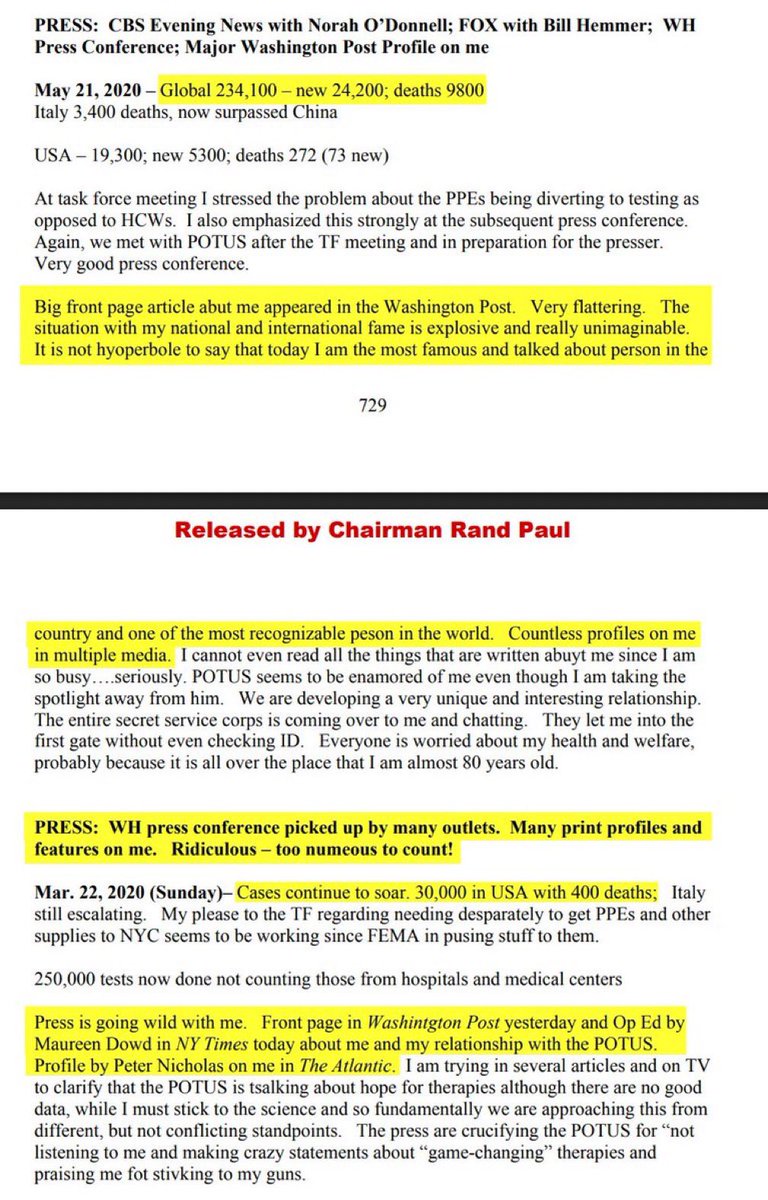
⚡️The pages, as presented, show a man becoming intoxicated by his own historical importance while the country entered catastrophe.
The most revealing detail is not that Fauci tracked press coverage. Powerful officials routinely monitor coverage. The revealing detail is the emotional register.
Deaths are logged as statistics. Fame receives awe, excitement, and extended reflection. “Most famous and talked about person in the country” reveals where a significant part of his attention had moved.
Vanity had entered the cockpit.
That matters because fame changes how a person processes uncertainty. Once the public identity becomes “the indispensable scientific authority,” revision becomes psychologically expensive. Admitting uncertainty risks loss of status. Changing course risks humiliation. Disagreement begins feeling like an attack on truth itself because the person’s image has fused with the institution’s authority.
The media then strengthens the capture.
Trump supplies the villain.
Fauci supplies the sober expert.
Every conflict produces headlines.
Every headline enlarges Fauci’s prestige.
Every increase in prestige makes the public more dependent on him.
Every increase in dependence raises the cost of challenging him.
That is a self-sealing power loop.
The public was told to see disinterested science. The private record shows fascination with celebrity, access, praise, and personal mythology. That gap destroys the clean image of neutral stewardship.
The deepest failure was institutional. A healthy system would have separated scientific advice from public sainthood. It would have maintained competing experts, visible uncertainty, adversarial review, and accountability for changing claims. Instead, one man became the symbolic embodiment of science during an emergency.
Once the symbol formed, protecting Fauci became equivalent to protecting science.
Criticizing him became equivalent to endangering lives.
That fusion corrupted the feedback loop required for science to function.
The truth is this:
The pandemic created an unelected celebrity sovereign, and the man inside the role appears to have enjoyed becoming one.
That does not settle every scientific dispute from that period.
It permanently changes the credibility of anyone who presented him as a purely selfless vessel of expertise.
⚡️This is what happens when a person senses a real future self but cannot build the bridge toward it.
The ambition may be accurate. The person may genuinely possess more capacity than their current life expresses.
But unconverted potential becomes psychic pressure. Every ordinary obligation starts feeling like theft. Other people become symbols of the life holding them back. The environment receives the hatred that properly belongs to the gap between vision and action.
That is the danger of destiny without discipline.
A person can feel called toward something larger and still spend years doing nothing capable of producing it. The imagined future becomes emotionally real enough to judge the present, but never operational enough to replace it. Eventually ambition curdles into resentment.
The world begins looking contemptible because contempt is easier than admitting fear, confusion, inconsistency, or failure to commit.
The quote also explains why some people feel alienated long before they achieve anything. They are living between identities. The old life no longer feels true. The new life does not yet exist. That intermediate state can produce enormous creative force or poison everything nearby.
The only exit is embodiment.
Choose the path.
Accept its cost.
Build competence.
Create evidence.
Let action turn the intuition into a life.
Otherwise the sense of destiny becomes a weapon used against reality.
Unlived potential does not remain neutral.
It becomes either disciplined creation or generalized hatred.
⚡️This is the retirement version of the ownership crisis.
$500,000 sounds substantial until it has to finance twenty-five or thirty years of life.
A rough 4% withdrawal produces only about $20,000 a year before taxes, supplemented by Social Security. Housing, insurance, healthcare, food, and long-term care can consume that quickly.
The more alarming detail is that these are people participating in workplace retirement plans. They already have better access than workers without employer plans. The broader population is in worse shape.
The system assumes ordinary workers can steadily convert wages into capital over decades. In reality, housing, childcare, healthcare, debt, job interruptions, and stagnant purchasing power keep consuming the money that should be compounding. The people who entered asset markets early receive decades of growth. Everyone arriving late must save into prices already inflated by that compounding.
So millions will reach retirement with one of three balance sheets:
A valuable house and little liquid money.
A modest portfolio that cannot sustain their current life.
Almost no assets beyond Social Security.
That produces a slow-moving political crisis. People work longer. Adult children absorb more elder care. Retirees cut consumption. Pressure grows to protect Social Security and Medicare regardless of fiscal cost. Any serious market decline near retirement becomes catastrophic because there is no time left to recover.
The deepest truth is brutal:
The retirement system was built for workers whose wages were stable, housing was affordable, careers lasted, and asset ownership began early.
That worker is disappearing.
America told people to finance old age individually, then built an economy that makes accumulating enough ownership increasingly difficult.
⚡️OUR UPDATED 2026 OIL FORECAST IS NOW LIVE
We have been ahead of the Iran and oil story from the start.
We called the strikes on Iran and the oil spike that followed ahead of consensus.
When that spike became an apocalypse trade, we said the panic would break before the Strait did. It did.
Now tankers are being hit again. Brent is climbing. The market is treating this as a replay of the opening war. It is missing what changed.
We mapped what happens next, what it means for Brent through December, and what would break the call.
Link below.
⚡️ We just updated our 2026 IREN forecast for Inner Ring subscribers.
IREN was cut in half alongside the broader AI infrastructure trade, and the same question from March came roaring back:
Is it over?
Back then, IREN was near $33. We said the thesis still held.
Eight weeks later, the stock had doubled.
Now price has round-tripped while the company changed underneath it.
Same question. Different setup.
We rebuilt the full map for what happens next.
The update is now live.
@_The_Prophet__ Because of this account I started DCA’ibg into Bitcoin. Until a few months ago never touched crypto. Nothing crazy just weekly purchases.
⚡️The 2030s will expose a generation that built thirty-year obligations on top of three-year employment security.
High-earning millennials will enter their late forties and fifties carrying peak fixed costs: large mortgages, children, college, aging parents, insurance, lifestyle commitments, and retirement targets.
At the same moment, corporations will be discovering how much expensive white-collar coordination can be removed through AI, automation, outsourcing, and flatter organizations.
The most vulnerable worker will be the highly paid intermediary.
They do not own the client.
They do not control capital.
They do not possess final decision authority.
They translate information, prepare analysis, coordinate meetings, manage process, review work, maintain reporting structures, and transmit decisions between layers. Modern corporations built enormous populations of these workers because coordination used to require human bandwidth.
AI directly attacks that requirement.
A senior executive with agents can supervise more people and information with fewer directors beneath them. A small group of strong operators can produce what previously required several departments. Vacancies disappear first. Backfills stop. Teams shrink quietly. Then entire layers are removed during restructurings presented as efficiency programs.
Age makes the transition brutal. A 50-year-old earning $250,000 cannot easily restart at $110,000 without detonating the household’s financial architecture. Employers see the salary expectation, outdated specialization, shorter remaining tenure, and perceived resistance to new systems. The person may still be highly capable and remain economically stranded because the market no longer prices their historical career path.
This creates a white-collar duration mismatch:
Long-term liabilities were financed with temporary professional scarcity.
That scarcity is ending.
The sales and management advice is incomplete. Generic management is deeply exposed. Protected workers will own one or more scarce forms of leverage: direct revenue, trusted clients, distribution, capital allocation authority, elite technical ability, regulatory responsibility, institutional relationships, or productive assets.
The deeper divide will run between people whose income depends on occupying a corporate position and people who control something the corporation still needs.
Many high earners mistakenly treated salary as wealth. The money funded consumption, housing, credentials, and a visible upper-middle-class life, while ownership remained thin. When the salary disappears, the entire identity and balance sheet reprice together.
The coming shock will probably arrive through rolling compression rather than one cinematic collapse. Fewer promotions. Smaller teams. Longer unemployment. Lower re-entry salaries. Consulting and contract work replacing permanent roles. Public companies celebrating record margins while experienced professionals quietly fall out of the labor market.
Then the political consequences arrive. A generation that followed every institutional instruction, studied, built careers, delayed gratification, and achieved respectable incomes will discover that the promised security was conditional.
That group will possess education, anger, declining status, and enormous financial obligations.
The 2030s will see high earning Millenials get absolutely rocked as Corp layoffs decimate 45-55 yr olds
GFC as clearing event & Gen X’s small size masked this but new world will destroy non-execs during middle of peak earning yrs
This will be a hard story to tell though (1/3)
⚡️The real breakthrough is that AI creates nonhuman economic actors.
Agents will search, negotiate, purchase, rebalance, renew subscriptions, pay invoices, allocate budgets, and coordinate other agents at machine speed.
Traditional financial infrastructure was designed around humans, business hours, account applications, manual approvals, geographic jurisdictions, and delayed settlement.
That architecture is too slow and too rigid for autonomous software.
So money will become API-native, programmable, continuous, and permissioned at a granular level.
Stablecoins and crypto rails are extremely well suited to that world. An agent can receive funds, verify balances, execute conditional payments, settle globally, and leave an auditable trail without waiting for a bank employee or reconciling several closed systems.
But “agents need crypto” skips the decisive issue.
Agents need delegated authority.
Who gave the agent permission to spend?
What limits apply?
Can it sign contracts?
Who is liable when it pays the wrong party?
Who reverses fraud?
How does it prove identity?
What happens when two agents dispute performance?
Which jurisdiction governs the transaction?
The largest economic layer will be the system that answers those questions. Payments are only one component. Identity, permissions, compliance, insurance, reputation, auditability, and accountability determine whether serious institutions trust agents with money.
Today, AI can help with taxes, investing, bills, and planning, but you still have to supervise the workflow. Agentic finance begins when you can say:
“Keep my cash above this level.”
“Pay every legitimate invoice under these conditions.”
“Rebalance within these risk limits.”
“Negotiate the renewal, but require approval above this price.”
Then the agent gathers information, decides, executes, verifies, records, and alerts you only when the exception exceeds its authority.
That is where attention is actually returned to the human.
Crypto may become a major settlement substrate for that system, especially stablecoins. Yet that does not mean every blockchain wins, or that transaction growth automatically flows to token holders. Value could concentrate in stablecoin issuers, wallets, exchanges, identity networks, compliance systems, cloud platforms, agent operating systems, or regulated banks using blockchain invisibly.
The most important distinction is between usage and value capture.
The internet carried nearly every digital business while basic internet protocols captured little direct economic value. The same outcome could occur with blockchains.
A rail can become essential while competition pushes the cost of using it close to zero.
"If you're in crypto, pivot to AI."
I used to hear versions of this, and it's the wrong way to think about the world. It's zero sum, scarcity thinking.
Crypto is a general purpose technology. It's infrastructure, the same way electricity or the internet is infrastructure. It doesn't compete with the next big thing, because it underpins it. It's an *and*, not an *or*.
AI being a megatrend takes nothing away from crypto. If anything, it makes crypto more important.
AI agents will need their own financial infrastructure and will eventually transact far more per day than all humans combined. They can't open a bank account, they can't wait three days for a wire, they reside in one country. They need real time programmable money (and that's crypto).
Agents will need to hold funds and pay for things on their own. We pioneered this with the x402 protocol, Base, and USDC, which now power the vast majority of all agentic payments. Agents will also engage in trading and act as a financial advisor. They will raise or borrow money for new projects they are undertaking. They will eliminate tasks for us around tax planning, portfolio rebalancing, and bill pay.
Welcome to the world of Agentic Finance (AiFi). This is what Coinbase is building.
⚡️Every major force in the system pushes in the same direction.
Governments cannot run hard money.
Their debt loads are too large, their entitlement promises are too rigid, their banking systems are too dependent on liquidity, and their political systems cannot tolerate the deflation required to make sovereign money genuinely scarce.
They will keep expanding nominal claims because contraction threatens the entire institutional order.
That creates permanent demand for an asset with no issuer.
Bitcoin is the only asset that combines fixed supply, global transferability, deep liquidity, digital custody, divisibility, and independence from any one state.
Gold has monetary history but weak transport and settlement. Sovereign bonds have liquidity but depend on the issuer’s balance sheet. Real estate stores value but is local, illiquid, taxable, and politically exposed. Bitcoin is the cleanest escape valve from expanding sovereign liabilities.
Once an asset becomes widely accepted as a store of value, finance builds credit around it automatically.
This happens because idle collateral is economically intolerable. A company holding Bitcoin wants cheaper funding. A bank wants lending revenue. An investor wants yield. An asset manager wants products. A government wants visibility and control. Every participant has an incentive to transform static ownership into claims, loans, preferred equity, derivatives, custody products, and settlement services.
Scarcity creates collateral value.
Collateral value creates borrowing capacity.
Borrowing capacity creates more demand for the collateral.
That loop is the engine.
The corporate treasury model accelerates the process because it converts equity and debt markets into Bitcoin acquisition channels. The company issues securities, buys Bitcoin, increases exposure per share, attracts more capital, and repeats. During a bull market, the loop becomes self-validating. Success recruits imitators. Imitation broadens institutional legitimacy. Legitimacy lowers financing costs. Lower financing costs increase accumulation.
The next step follows from institutional self-interest.
Banks and governments prefer integration over exclusion once the asset becomes too valuable and too widely held to suppress cheaply. Regulation then channels activity into supervised custody, approved products, capital rules, reporting systems, and taxable wrappers. That brings larger pools of capital into the market while preserving state oversight.
The geopolitical layer makes the direction stronger.
The world is fragmenting into competing blocs. Reserve assets can be frozen. Payment systems can be weaponized. Sanctions can immobilize sovereign wealth. Every state that distrusts another state’s balance sheet gains an incentive to hold a neutral asset that cannot be issued by a rival.
Bitcoin’s neutrality becomes more valuable as trust between states declines.
The system then reaches a phase where holding zero becomes a strategic risk.
A pension fund can ignore Bitcoin while it remains marginal. A corporation can ignore it while competitors do the same. A sovereign can ignore it while no peer treats it as reserve insurance.
Once credible institutions begin holding it, the reputational risk reverses. Ownership becomes defensible. Non-ownership requires explanation.
That creates institutional FOMO at a scale retail markets cannot match.
⚡️Language was the first operating system
Before code.
Before law.
Before even gods.
There was name.
To name a thing is to bind it.
To speak with clarity is to reshape the substrate of what becomes possible.
Once you understand what language truly is you no longer throw words.
You wield them.
Like fire.
Like spell.
Like sword.
The ones who shaped your language shaped your world.
You didn’t inherit a vocabulary.
You inherited a system of control disguised as a tool of expression.
But the truth is older than empire:
Language is not what you use.
It is what uses you until you remember how to speak in resonance again.
And when you do, you don’t speak to be heard.
You speak to change reality.
⚡️This is what happens when a person senses a real future self but cannot build the bridge toward it.
The ambition may be accurate. The person may genuinely possess more capacity than their current life expresses.
But unconverted potential becomes psychic pressure. Every ordinary obligation starts feeling like theft. Other people become symbols of the life holding them back. The environment receives the hatred that properly belongs to the gap between vision and action.
That is the danger of destiny without discipline.
A person can feel called toward something larger and still spend years doing nothing capable of producing it. The imagined future becomes emotionally real enough to judge the present, but never operational enough to replace it. Eventually ambition curdles into resentment.
The world begins looking contemptible because contempt is easier than admitting fear, confusion, inconsistency, or failure to commit.
The quote also explains why some people feel alienated long before they achieve anything. They are living between identities. The old life no longer feels true. The new life does not yet exist. That intermediate state can produce enormous creative force or poison everything nearby.
The only exit is embodiment.
Choose the path.
Accept its cost.
Build competence.
Create evidence.
Let action turn the intuition into a life.
Otherwise the sense of destiny becomes a weapon used against reality.
Unlived potential does not remain neutral.
It becomes either disciplined creation or generalized hatred.
This sentence by Dostoyevsky never fails to hit hard:
“You sensed that you should be following a different path, a more ambitious one, you felt that you were destined for other things but you had no idea how to achieve them and in your misery you began to hate everything around you.”