For years, the Auditor-General has exposed billions lost through financial mismanagement and irregular expenditure. Yet accountability remains elusive.
I have formally sought a statement in @Senate_KE on the effectiveness of the @EACCKenya in acting on these findings. Kenyans deserve answers, action, and justice, not endless audit reports gathering dust.
Public money must serve the people, not the corrupt.
#Accountability
It was good that the entire judgment was read word for word and broadcasted live for ten hours to the entire Kenyan public. How else would you have understood the problems we keep pointing out daily about incompetence, misconduct and misbehavior by a Judges?
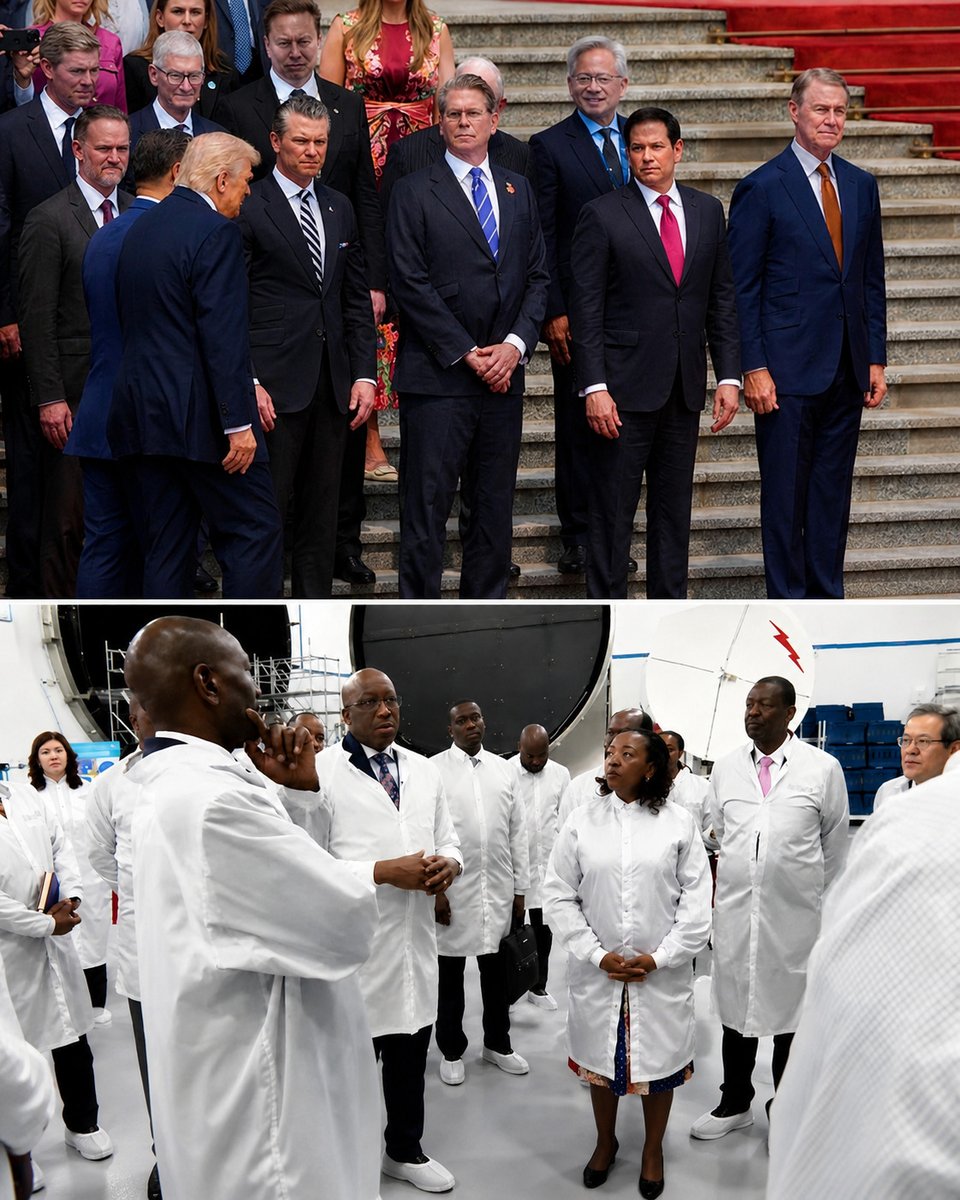
I want you to observe this picture.
That was the delegation Trump carried to China.
-Elon Musk - Tesla & SpaceX.
-Tim Cook - Apple.
-Jensen Huang - Nvidia.
Plus dozens of CEOs, tech leaders, and innovators.
Now compare that to the delegation President Ruto carried to the Kazakhstan space centre.
-Mudavadi.
-Kabogo.
-CS Lee.
-Photographers and political entourages.
And immediately, you understand the difference between a country planning for the future and one doing political tourism. In one, the president is carrying his best; in the other, the president is harrying his friends who aren't even close to the best.
A space centre is not a tourist attraction.
That is where countries discuss:
-Satellite technology.
-Communications.
-Weather systems.
-Internet infrastructure. etc
Serious governments carry scientists, engineers, researchers, and innovators to such visits.
People who can tell the President:
“This can help drought prediction in Kenya.”
“This can improve internet access.”
“This technology is worth investing in.”
Instead, many looked completely out of place while the President himself appeared to be doing most of the learning.
And that is exactly how many African countries fall behind.
Foreign trips should not be rewards for political loyalty.
They should be missions for knowledge, investment, and national progress.
Unpopular opinion but Miguna Miguna is the only person capable to lead the jailing and recovery of every single cent, land etc stolen by the home guards since independence. Imagine Uhuru and Raila teamed up to kick him out of Kenya for his revolutionary ideas. Why were they so afraid of him?
When you hear politicians suddenly uniting to tell you who the “enemy” is, pause and ask yourself one question:
Who benefits when citizens are divided and distracted?
Too often, the political class closes ranks not to defend the people, but to defend the system that feeds them. They want Kenyans fighting each other while corruption, impunity, unemployment, and economic injustice continue unchecked.
The moment someone begins questioning the structure of exploitation, the wardens of the prison quickly unite and point at a new “enemy” to keep the prisoners distracted.
Kenyans must stop worshipping political camps and start defending principles. Accountability is not tribal. Justice is not regional. Truth is not partisan.
The real struggle is not between ordinary citizens. The real struggle is between a corrupt system and the people paying the price for it every day.
Nearly half of Kenya’s projected FY 2026/2027 budget will go to debt servicing instead of development.
Out of the Ksh 4.82 trillion budget, taxpayers will pay approximately Ksh 2.3 trillion toward debt obligations, including Ksh 1.3 trillion consumed purely by loan interest payments before meaningful development spending even begins.
Under Kenyan law, debt repayment is a “first charge” on national revenue. Creditors are paid first, before hospitals, schools, counties, agriculture, or public services.
At the same time, Kenya continues borrowing heavily to repay maturing loans and cover budget deficits. The public debt has now risen to approximately Ksh 12.4 trillion, while ordinary citizens continue facing unemployment, high taxation, failing services, and rising economic hardship.
Kenyans must ask:
Who borrowed this money?
Were all these loans borrowed procedurally as per the constitution?
Who benefited?
Why should citizens repay debts arising from corruption, secrecy, inflated contracts, and mismanagement?
An odious debt is not a people’s debt. It is a regime debt.
This constitutional and economic battle continues in court.
The matter comes up on 25th June 2026 at the Milimani Law Courts.
Kenyans must remain vigilant. This fight is about economic justice, accountability, and the future of our Republic. #DeniBandia #OdiousDebt #ReKe
My initial thoughts on Kenya hosting France/Africa in Nairobi this week
Building from an article I wrote on DN months ago: In the intensifying scramble for the continent's goodwill, resources, talent and markets, Nairobi has quietly become Africa's most consequential address. Every major power has business here now. What Kenya charges for that privilege is the only question worth settling.
Across the continent, governments are recalibrating relationships with traditional partners, asserting greater sovereignty over their resources, their security arrangements and their strategic choices. The era of automatic alignment is over. The era of negotiated partnership has arrived, and Nairobi sits at the centre of this transition.
India has spent two decades practising the discipline that Kenya now needs to learn. Modi attends BRICS summits alongside China and Russia, buys Russian oil, signs defence pacts with Israel, courts Washington on trade and recently finalised a landmark deal with the European Union. India's position in every room it enters is consistent: we are valuable to you, and our terms are always India's national interest. That discipline is built on tangible leverage: 1.4 billion people, a technology ecosystem woven into the global supply chain, students filling the universities of every major power. India negotiates from strength because it brings something the other party cannot easily replicate and offer an alternative.
Kenya can adopt this doctrine and apply it with its own character, because its leverage is not India's leverage. Multi-alignment built on population and technology talent is India's game. Kenya plays a different one: the capacity to convene Africa, which in today's world is arguably the rarer asset.
Every major power competing for the continent requires an African interlocutor whose credibility reaches across the region. Kenya holds that position. Its geography matters, its economic centrality in East Africa matters, and above all its people matter. A politically conscious, civically engaged citizenry that demonstrated, in full view of the world, a willingness to hold its own leaders to account carries something into every negotiation that mineral wealth alone cannot provide: the assurance that commitments made in Nairobi will endure, because the people watching are paying attention. Nairobi can sit across the table from Washington, Beijing, Paris and Moscow and say, with justification, that it speaks to Africa and Africa listens.
That credibility should carry a consistent price. Equitable investment structures. Technology partnerships that transfer skills, not merely services. Infrastructure that connects African markets rather than funnelling African resources toward foreign ports. Debt arrangements that finance growth rather than guarantee dependency. Kenya's foreign policy doctrine should articulate these conditions clearly enough that every prospective partner understands them before boarding their flight to Nairobi.
France is here and others will follow, because the multipolar world has made Africa indispensable and Nairobi as we say is the capital of Africa. The question Kenya must answer is whether it will meet these partners with a doctrine or merely with hospitality.
The world does not reward the most welcoming host. It rewards the most strategic one.
You can’t be cancelling Ombachi and Bien over standards and accountability, then turn around and blindly support a “united opposition” filled with the same old political baggage. That contradiction is absurd. You cannot demand integrity, discipline, and moral consistency from artists and public figures, yet completely suspend those standards when it comes to the people seeking power over millions. Hold your leaders to the same standard you expect from everyone else, otherwise it’s not principle, don’t use emotions to think.
KTN has exposed what may be one of the biggest state-enabled land grabs Kenyans have ever witnessed.
9,000 acres.
Gone.
And the names appearing in this scandal?
Felix Koskei.
The Ruto government.
And a shadowy company owned by a man named Sukhwinder, linked to fake documents, ghost creditors, and mysterious court manoeuvres.
Kenyans need to understand what is happening here.
Miwani Sugar collapsed years ago.
The government reportedly bought the land using public money for over 300m.
Then, suddenly, a private company owned by Sukhwinder emerged, claiming they had bought the same land for KSh 700 million in 2010. The case went to court.
But courts reportedly found the documents by Sukhwinders' company were fake and forged.
Government officials allegedly confirmed no payment was ever made.
Cases were filed against him and others.
That alone should have ended the story.
But no.
After Felix Koskei entered government around 2017, the cases reportedly started disappearing. By 2019, they had been dropped.
Then a mysterious man in India called “Nagenda Saxena” suddenly appeared, claiming Miwani owed him money over 400,000 dollars.
DCI reportedly investigated and found something unbelievable:
“Nagenda Saxena” allegedly did not even exist.
Not a real person.
Yet somehow, Sukhwinder's company now claimed they had paid the 700 million ksh to Nagenda in India.
And now, recently, Felix Koskei allegedly raised this case in the Cabinet, and the Cabinet then resolved to give Sukhwinders' company the land despite an active court case. This was done under the guise of Privatization that you have seen Ruto and UDA champion a lot. Saying it was an out-of-court settlement, yet it's obvious Sukhwinder's company didn't pay.
Think about that carefully.
Courts are still handling a dispute.
Investigations are raising red flags.
DCI is reportedly questioning the legitimacy of the claims.
But the Cabinet allegedly says:
Give them the land anyway.
9,000 acres.
Just like that.
This is Land grabbing.
Whenever this government pushes something with unusual force, ask yourself one question:
Who is about to benefit?
Equity Group is set to earn billions of shillings from the introduction of an annual debit card fee of Kshs 240.
The bank has more than 10 million customers in the local market.
— Business Daily
Total Kenya has introduced a 3kg gas cylinder (“Baby Meko”) with refills at Ksh 700.
At first, that sounds like a good thing. Smaller cylinder, easier for many people to afford.
But if you’ve been in Kenya long enough, you’ll remember Ksh 650-700 used to refill a 6kg cylinder.
Now the same money gets you half.
That’s shrinkflation.
And it’s happening everywhere, not just gas.
PK is smaller.
Salt packets are smaller.
Even bread feels lighter.
Same money.
Less product.
So when KK leaders keep saying the cost of living is going down, these are the things people look at and wonder: Is it really?
Karen Nyamu publicly shaming a young female student in Parliament is everything wrong with Kenya’s nomination system.
These seats were meant to uplift women, youth, and marginalized voices.
Instead, too many have become political gifts handed out by powerful men to loyalists, friends, and sidekicks.
No merit. No accountability. No consequences.
That’s the problem with nominated seats: you can insult Kenyans, embarrass institutions, and still keep your seat because no voter put you there.
If nomination cannot produce leaders with dignity, competence, and discipline, then scrap it.
Parliament is not a VIP lounge for political rewards.
The standard news reported have been barred from accessing and covering a public education conference in Lake Naivasha where William Ruto is attending.
The reason given? “Bias reporting.”
That should alarm every Kenyan.
Who decides what is “bias”? The government?
This is how democratic suppression begins: silence critical media, reward propaganda, and control what citizens get to see.
Public events are funded by taxpayers. No government should have the power to handpick which media house covers them.
If your leadership is clean, you don’t fear cameras. You don’t fear questions. You don’t fear scrutiny.
Targeting The Standard Group because they report uncomfortable truths is an attack on press freedom and the public’s right to information.
Today it’s The Standard. Tomorrow it could be every independent newsroom.
Stop threatening the media.
Defend press freedom.
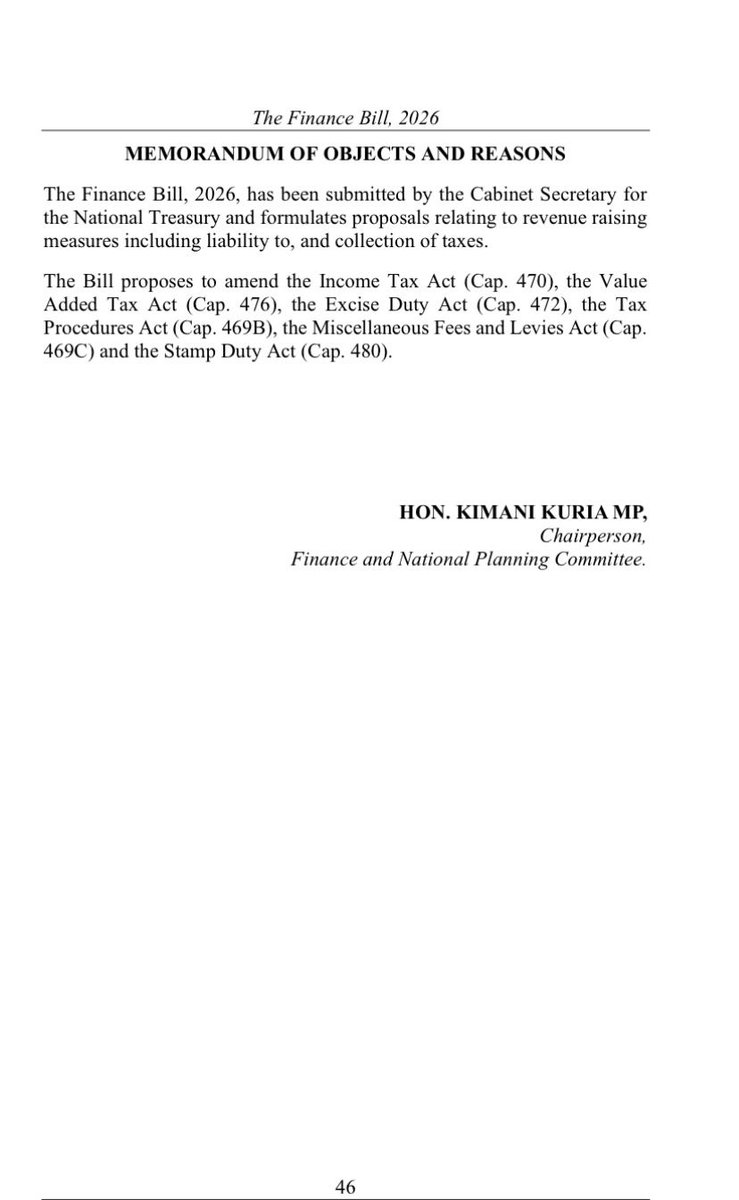
The Finance Bill, 2026 was published on 30th April and is now before Parliament and every Kenyan deserves to know what is in it.
The government targets Ksh3.63 trillion in revenue for 2026/27 and a wider budget deficit of 5.3% of GDP in the 2026/27 fiscal year (July-June) up from 4.7% in 2025/26. These are not unreasonable fiscal objectives but the manner in which the burden of achieving them is distributed is a cause for serious concern.
On tax filing timelines, the Bill moves the income tax return deadline to April 30th which is two months earlier than the current June 30th and compresses nil return filing to January 31st. This reduces the time available for audit completion, cash flow planning and compliance. For small businesses and individual traders, this is not administrative reform. It is an additional compliance cost they can ill afford.
On mitumba, the Bill inserts a new Section 12H into the Income Tax Act which deems profit at 5% of customs value payable upfront before goods are released by KRA as a final tax. A trader importing a bale worth Ksh1 million pays Ksh50,000 regardless of whether they make a profit or a loss. I cannot in good conscience describe this as equitable.
The Bill increases residential rental income tax from 7.5% to 10%. Absent a serious enforcement framework, this will drive non-compliance rather than revenue. The government must fix the enforcement gap before it increases the rate. One without the other is burden-shifting.
On digital financial services, the Bill removes existing VAT exemptions on money transfers and payment processing. These are the tools of financial inclusion that millions of Kenyans including the very people this government says it wants to reach rely on daily. Making them more expensive will not serve the objective of a broader tax base.
By including interchange and merchant service fees within the definition of management or professional fees for withholding tax purposes, the Bill introduces a compliance burden into automated banking processes. That burden will be passed on to businesses and ultimately to consumers.
The amendment to Section 24 of the Income Tax Act empowers KRA to deem at least 60% of a company's undistributed income as dividends for tax purposes. This fails to account for legitimate decisions on reinvestment, working capital and business growth. It is a retrogressive measure that sends the wrong signal to the investors Kenya needs.
A 25% excise duty on telephones for cellular and wireless networks is proposed. A phone is not a luxury. It is how Kenyans bank, communicate, conduct business and access government services. Parliament must interrogate this carefully.
On PAYE, Kenyans were led to expect relief and a restructuring of the tax bands to ease the burden on salaried workers. That proposal does not appear in this Bill. That is not a minor omission. An explanation is owed to every employed Kenyan who was waiting for it.
To be fair, the Bill is not without merit. The reduction of corporate tax for non-resident companies from 37.5% to 30% improves our investment climate. The extension of the tax amnesty to cover liabilities up to 31st December 2025 provides a genuine and welcome pathway to compliance. VAT exemptions on electric buses, bicycles, dialysers, animal feed raw materials and PPP infrastructure are sensible measures. The clarity introduced on trust taxation ensuring beneficiaries are not taxed on income already taxed at the trust level and the recognition of gratuity contributions as exempt income are also steps in the right direction.
Be that as it may, we cannot afford a repeat of June 2024. Parliament must discharge its oversight role with the seriousness this moment demands. They should not merely rubber-stamp what the Treasury has placed before it. Every clause must be scrutinised. Every punitive or ambiguous provision must be rejected or amended.
#FinanceBill2026 #PublicParticipation
The illusion of replacing leaders
2002: “We just need to replace Moi.”
Nobody cared about fixing the system.
2007: “We just need to replace Kibaki.”
No talk of systemic change
2022: “We just need to replace Uhuru.”
Infact vote Ruto to punish Uhuru
2027: “We just need to replace Ruto.”
Same illusion. Anyone but Ruto!
2032: “We just need to replace whoever”
A broken system eventually reproduces the same outcomes, no matter who sits at the top.
Can we discuss how we can reform the broken system atleast?
@sholard_mancity Assuming that each closed account had at least ksh 200/ then it means the banks collected a whole ksh 6.6B!!! Hope they didn't transfer the money in their income accounts otherwise it should be under unclaimed assets authority custody