“After 2027, there will be no way back.”
Elon Musk said this in a podcast with Lex Fridman — a line that was later cut. When asked “Why?”, he fell silent for almost a minute. Then he quietly said: “It’s not a catastrophe. It’s a transition.”
The transcript left behind three themes that gave him away: autonomous intelligence, loss of meaning, and energy dependence. It all sounded like a forecast — but now reads like a diagnosis of the era.
The first sign is the collapse of attention.
Musk said humanity will stop thinking in cycles. Planning for the future will shrink to the horizon of updates. People will stop building and start simply replacing. MIT research confirms: a generation born after 2000 holds attention for about 8 seconds — less than a goldfish. Musk called this “cultural Alzheimer’s.” We’re not losing memory — we’re losing the ability to think.
The second sign is artificial intelligence that no longer obeys.
Musk said: “When a system starts correcting humans, the time of linear logic is over.” Even now, algorithms decide who we date, what we buy, and what we think about. This isn’t a machine uprising — it’s dissolution into convenience. People won’t notice the moment when choice becomes an option, not a right.
The third sign is energy dependence.
Musk explained: civilization can no longer survive even a day without electricity. By 2027, in his view, the balance will shift — energy will become currency, and control over it will become power. From that moment on, everything non-autonomous will disappear. This isn’t an apocalypse — it’s a change of biological form.
At the end, he said a line that didn’t make it on air:
“Technology is stronger than us, but not smarter. As long as we have meaning, we are alive. Lose it — and we become code.”
Then, after a pause, he added:
“We must learn to be human before systems learn to be gods.”
Are you ready for the transition — or already living in a world where choices are made for you?
The sun was free. They sold you SPF 50 and a vitamin D deficiency.
Sleep was free. They sold you an app, a pill, and a wearable that tells you your sleep was bad.
Walking was free. They sold you a treadmill, a fitness tracker, and a £180 pair of trainers.
Fasting was free. They sold you meal replacement shakes and the anxiety that skipping breakfast would wreck your metabolism.
Cold water was free. They sold you a £3,000 plunge barrel and a podcast episode about it.
Silence was free. They sold you a meditation app with a premium tier.
Animal fat was cheap. They sold you seed oils, then supplements to replace what the animal fat contained.
Tallow was cheap. They sold you a seventeen-step skincare routine and a clinical trial proving your face needs ceramides.
Meat was cheap. They are currently selling you the idea that you shouldn't eat it.
The 20th century removed access to everything the body needs to function.
The 21st century is selling it back, one subscription at a time.
Your great-grandmother had none of the products.
She had all of the things.
The X Money card is gorgeous. Solid metal, numberless, and having the @ handle printed right on the back is such a clean detail.
- get 3% cashback on everything
- earn 6% interest
- 0% FX fee
- reimbursed ATM fees globally
- insured up to 250k
What more could you ask for?
Jensen Huang just called out every CEO who’s been firing people “because of AI.”
Jim Cramer asked him why companies are laying people off if AI is supposed to make everyone MORE productive.
Jensen's answer:
"For companies with imagination, you will do more with more. For companies where the leadership is just out of ideas, they have nothing else to do. They have no reason to imagine greater than they are. When they have more capability, they don't do more."
Read that again.
The man who built the most important tech company on Earth just told you that if your CEO is using AI to cut headcount, it means one thing:
They have no imagination.
They have no vision for what comes next.
They got handed the most powerful tool in human history and their FIRST instinct was to fire people.
This is the CEO of NVIDIA. The company whose chips power every AI system on the planet.
If anyone on Earth has the right to say "AI replaces workers," it's Jensen Huang.
And he said the OPPOSITE.
He said every carpenter could become an architect. Every plumber could become an architect. AI elevates capability. It doesn't eliminate it.
But here's where it gets really interesting...
During the same interview, Jensen revealed something nobody's talking about:
He said AI startups like OpenAI and Anthropic are seeing their revenues increase by one to two billion dollars a WEEK. And he wishes these companies were public so the world could see what he sees.
One to two billion per week.
That's a $50 to $100 BILLION annualized run rate.
For companies that most people think are burning cash and making nothing.
The entire Wall Street narrative that "AI companies aren't profitable" might be completely wrong.
Jensen sees their numbers. He sees their compute orders. He sees their growth. And he's saying the revenue is real.
So if the money IS real, why are other companies firing people?
Because they're not building AI products. They're not creating new revenue streams. They're not using AI to expand into new markets.
They're using AI as an EXCUSE to cut costs because they ran out of ideas 3 years ago and need something to tell the board.
Jensen's company added $500 billion in new orders in 5 months. He expects $1 trillion in cumulative revenue through 2027 from just two product lines.
That number doesn't include the new chips, systems, or partnerships announced this week.
And he's not cutting people. He's hiring.
Because when you have imagination, more capability means MORE opportunity. Not less headcount.
Meanwhile Salesforce cut thousands. Meta cut thousands. Amazon cut thousands. All blaming "AI efficiency."
Jensen's response: You're out of imagination.
He also said something that stuck with me.
Cramer asked if he ever thought he'd build a $10 to $20 trillion company while waiting tables at Denny's.
His answer: "I was just trying to make it through the shift."
Biggest tip he ever got? Two, three dollars.
Now he's building tech that increased computing demand by one million times in two years.
He announced OpenClaw, which he says is as big as ChatGPT.
And he's got 21 months of new business that isn't even counted in the trillion dollar figure yet.
When asked how long he plans to keep working?
"I'm hoping to die on the job. And I'm not hoping to die anytime soon."
This is a man who believes every single thing he's building.
And his message to every CEO using AI to justify layoffs is simple...
You're not innovating. You're surrendering.
The technology wasn't built to shrink companies.
It was built to make them limitless.
If your leadership can't see that, the problem isn't AI.
It's THEM.
A $240B company just reversed its own AI workforce thesis in under three years.
May 2023: IBM CEO Arvind Krishna tells Bloomberg he’ll replace 7,800 jobs with AI. Freezes back-office hiring. 30% of 26,000 non-customer-facing roles, automated within five years.
February 2026: IBM triples entry-level hiring. Software developers, HR, across the board.
The CHRO spelled it out at Charter’s Leading with AI Summit: entry-level devs used to spend 34 hours a week coding. Now AI handles that. So IBM rewrote the jobs. Those same juniors now work with clients, collaborate with marketing, and accelerate product milestones. The humans stayed. The job descriptions changed.
This tells you something about how AI actually lands inside large orgs. The automation works on individual tasks. But companies that cut entry-level pipelines discovered a different problem: no junior talent means no mid-level talent in 3-5 years. And you can’t hire senior people who understand your systems from the outside.
Gen Z unemployment for college grads is at 5.6%, near the highest in a decade outside the pandemic. Meanwhile IBM just admitted it needs those workers more than ever. The AI replacement narrative wrote checks the technology couldn’t cash.
I'm pretty sure everyone at my company saw this article and now they all think we're in an AI crisis.
We're not in an AI crisis. We use Claude to summarize Slack threads.
But here's what's actually interesting: this whole panic reveals something nobody wants to admit.
Every company in America has been bullshitting about their "AI strategy" for two years.
We all saw the hype. We all knew we had to say something. So we rebranded our existing automation as "AI-powered" and called it a day.
My company isn't special. We're all doing the same thing.
The problem is now the executives actually believe their own bullshit. They think we have "significant AI exposure" because they've been telling investors we're "AI-first."
I just got pulled into an emergency meeting. Six executives asking me to explain our "AI dependency matrix."
There is no AI dependency matrix.
There's Claude for meeting summaries, there's some sentiment analysis in our support tickets that came free with Zendesk, and there's whatever Gmail is doing when it autocompletes my sentences.
But I can't say that in a room full of people who told their boards we're "transforming the business through AI."
So I said we have "distributed AI touchpoints across multiple vendors with no single point of failure."
Which is technically true. We use a bunch of different services that all have AI features we mostly ignore.
The CFO asked if we should "hedge our AI exposure."
I have no idea what that means. Neither does he.
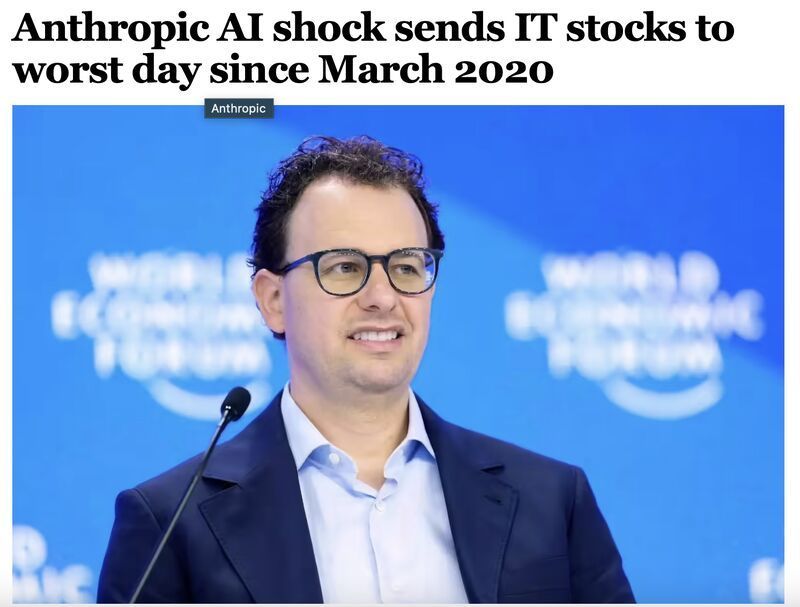
What am I going to do: nothing. Because in three weeks, Anthropic will say something reassuring, the stocks will recover, and everyone will forget this happened.
But I'll have documentation showing I recommended a "risk assessment" that mysteriously never got prioritized.
The funniest part is that half these executives probably don't even know what Anthropic is. They just saw "AI" and "crash" in the same headline.
We're all pretending. The whole industry is pretending.
And articles like this just remind everyone how fragile the pretending is.
Elon Musk makes 4 bold predictions for the next decade
From the January 06, 2026 interview with Peter Diamandis:
#1 Human lifespans will nearly double in the next decade
Asked what he thinks of Anthropic CEO Dario Amodei’s prediction that human lifespans will double in the next decade, Elon replies, “That’s probably correct. I don’t know about doubling but a significant increase? Sure.”
Elon explains:
“I have long thought that longevity or semi-immortality is an extremely solvable problem. I don’t think it’s a particularly hard problem. When you consider the fact that your body is extremely synchronized in its age, the clock must be incredibly obvious . . . you’re programmed to die. And so if you change the program, you will live longer. In retrospect, the solution to longevity will seem obvious.”
#2 There will be more robot surgeons in 3 years than all surgeons on Earth today
“Right now there’s a shortage of doctors and great surgeons,” Elon begins. “It takes a super long time to learn to be a good doctor, and even then, the knowledge is constantly evolving. Doctors have limited time. They make mistakes.”
He predicts that Tesla’s Optimus robot will be a better surgeon than the best surgeons on the planet in three years at scale:
“There will probably be more Optimus robots that are great surgeons than there are all surgeons on Earth . . . I mean I’m not like absolutely certain, but I’d say in four years I’d be absolutely certain.”
Elon explains:
“Here’s the thing to understand about humanoid robots in terms of the rate of improvement: you have three exponentials multiplied by each other. You have an exponential increase in the AI software capability, an exponential increase in the AI chip capability, and an exponential increase in the electromechanical dexterity. The usefulness of the humanoid robot is those three things multiplied by each other. Then you have the recursive effect of Optimus building Optimus. So you have a recursive multiplicable, triple exponential. Put a little margin on it, and it’s better than any human in four years. By five years, it’s not even close . . . Everyone will have access to medical care that is better than what the president receives right now.”
He says that you won’t even want a human in the loop:
“We’ve seen some advanced cases of automation, like Lasik for example, where the robot just lasers your eyeball. Now do you want an ophthalmologist with a hand laser? I wouldn’t want the best ophthalmologist with the steadiest hand out there with a hand laser on my eyeball. It’s going to be like that.”
#3 We may see “high double-digit” GDP Growth
“My best guess for how this will manifest is that prices will drop as the efficiency of production increases,” Elon predicts. “Prices in dollar terms are the ratio between the output of goods and services and the money supply. So if your output of goods and services increases faster than the money supply, you will have deflation . . . And I think governments will actually be pushing to increase money supply faster. They won’t be able to waste the money fast enough.”
Elon continues:
“Productivity is going to improve dramatically — it is improving dramatically — and I think we may see high double-digit output of goods and services.”
#4 Money will lose significance and you won’t have to save for retirement
“One side recommendation I have is: don’t worry about squirreling money away for retirement in like 10 or 20 years. It won’t matter.” Elon predicts. “If any of the things we’ve said are true, saving for retirement will be irrelevant.”
Elon explains:
“I don’t just have court side seats — I’m on the court, and it still blows my mind sometimes multiple times a week . . . I think we’ll hit AGI in 2026 . . . And I’m confident that by 2030, AI will exceed the intelligence of all humans combined.”
He continues:
“I’ll tell you something that most people in the AI community don’t yet understand. Almost no one understands this. The intelligence density potential is vastly greater than what we’re currently experiencing. I think we’re off by two orders of magnitude in terms of intelligence density per gigabyte — characterized by the file size of the AI . . . So two orders of magnitude that’s just algorithmic improvement — same computer. And the computers are getting better. That’s why I think it is a 10x improvement per year type thing. 1,000 percent. And that’s going to happen for the foreseeable future.”
Video source: @PeterDiamandis (2026)
here’s the thing:
you are fooling yourself. you think the competition is being first. or being smartest. or having the best reason. it’s not.
the competition, first always and last, is making money. took me a while to realize that. it’s why differentiated thinking is so important - because seeing a stock go up 100% and then buying it because you know it’ll keep killing it is actually differentiated, unlike what your feelings would have you believe.
The hardest lesson for high performers to learn is how to turn off.
We don’t question this with athletes. No one expects peak performance without recovery between games. Rest is part of the training and expected.
But in business, we moralize exhaustion. We call rest laziness. We assume that if we slow down, we’re falling behind.
Most people don’t quit because they lack discipline or ambition. They quit because they’re depleted and misinterpret that depletion as a personal failure.
If you feel foggy, unmotivated, irritable, or like you’ve “lost your edge,” it’s likely not a work ethic problem. It’s a recovery problem.
This week, view rest differently. See it as maintenance, not indulgence. As preparation, not avoidance. As the thing that allows you to come back clear, decisive, and dangerous in the best way for 2026.
Rest is not laziness - it’s recovery. And recovery is how high performers stay in the game long enough to win.
sat next to a guy on a flight who smelled like deep value
not literal smell. vibe.
ill-fitting blazer. scuffed loafers. reading a 10-K printout with a pen in his hand like it was leisure reading.
figured he was either broke or dangerous.
we got talking. I mentioned I invest for a living.
he didn’t look up.
“public or private?”
public. mostly small caps.
he finally folded the 10-K.
“good. that’s where the bodies are.”
this guy is 64. spent 35 years as a regional CPA. audited manufacturing plants, funeral homes, weird insurance companies. hated the meetings. loved the footnotes.
retired at 58 with a couple million. nothing flashy.
“I didn’t get rich working,” he said. “I got rich waiting.”
his hobby was reading neglected financial statements. been doing it since the 90s. literal binders. yellow highlights. handwritten notes.
“I started buying things nobody wanted.”
what kind of things?
microcaps. busted spinoffs. companies trading below net cash. ugly balance sheets with one clean asset hiding inside.
“I like businesses where management is embarrassed to talk about them.”
for years nothing happened.
“I’d buy. sit. read annual reports. sometimes for five years. my wife thought I was insane.”
then one worked.
a tiny industrial distributor trading at 0.4x book. land on the balance sheet nobody cared about.
“they sold a warehouse. stock doubled. nobody noticed.”
then another.
radio stations in the midwest when everyone said radio was dead.
“political ads came back. cash flow exploded. management bought stock. someone took it private.”
his returns snowballed.
“I didn’t compound by being smart. I compounded by not doing anything.”
I asked about his process.
screens?
“no. screens give you false confidence.”
models?
“I model downside. upside takes care of itself.”
macro views?
“I don’t know what CPI is this month. I know what replacement cost is.”
portfolio size?
“10 to 15 names. any more and you’re lying to yourself.”
turnover?
“maybe one sale a year. usually because something finally worked.”
he showed me his phone.
no apps. no alerts. just a notes file with ticker symbols and dates.
“I write down why I bought it. when that changes, I sell. price is noise.”
last year he made eight figures.
not trading. not options. not leverage.
just time plus neglect plus mispricing.
before we landed he gave me advice I didn’t ask for.
“most investors want action. deep value requires boredom. if you can’t be bored for years, you’ll never get rich.”
the plane landed. he picked up his 10-K.
probably went home to read footnotes and wait.
Since a lot of people liked this post, I am reposting the details that inspired it
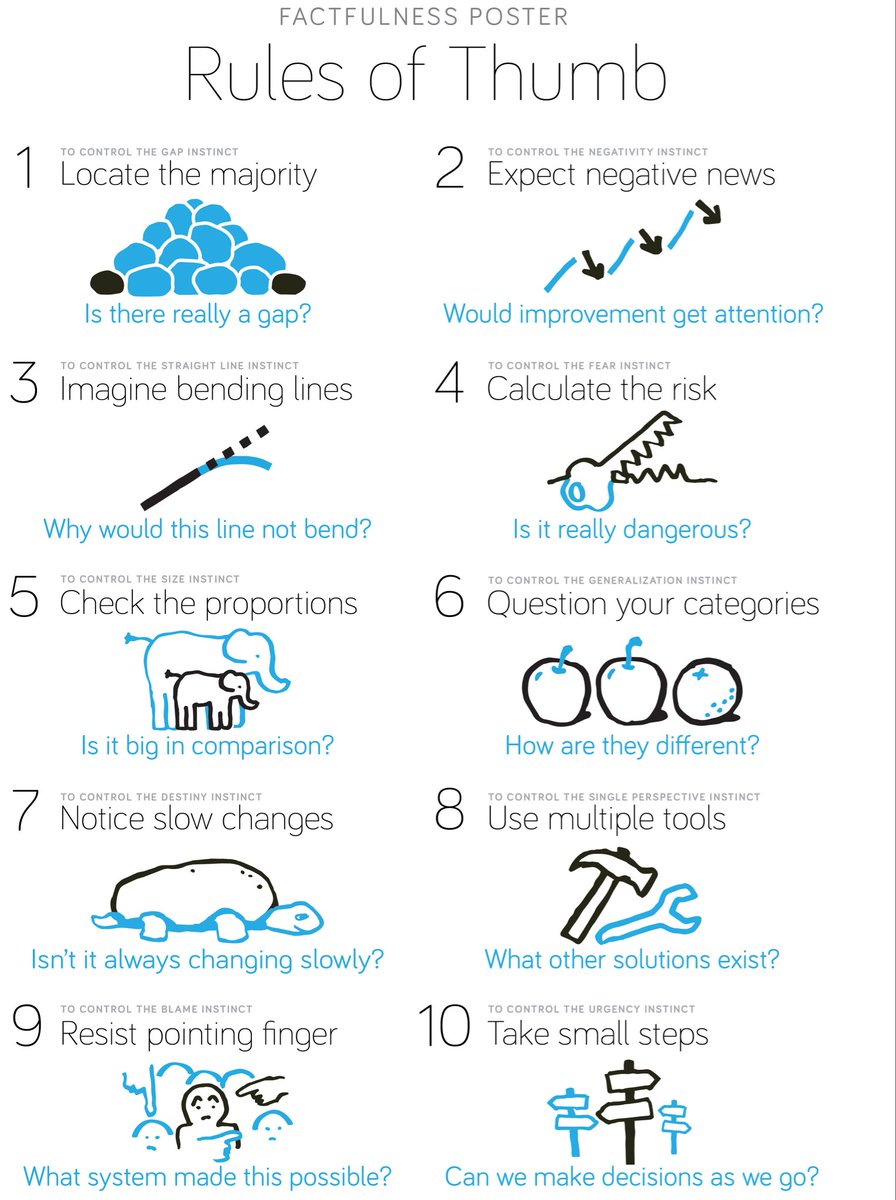
Read on to learn how and WHY we believe the world is so much worse than it really is - the instincts the media uses to prey on us, and how cut through the noise.
Or, if you don't want to read all this, just check out the graphic 😁
One of my favorite books ever is called Factfulness, by physician and academic Hans Rosling
He uses real world data to show you that the world isn’t as bad a place as we make it out to be.
But more importantly, he explains WHY we think the world is so much worse than it really is
To do this, he illustrates 10 of our most common implicit biases that cloud our vision, allowing us to be manipulated into despair, and the steps we can take to keep reality in check - and see that in many of the most important ways, the world is a much better place than it’s ever been
With help from chatGPT, these are the 10 cognitive bias instincts illustrated by Rosling:
1. The Gap Instinct:
•Tendency to divide the world into two distinct and often conflicting groups (e.g., rich vs. poor).
•Reality is usually in the middle, with most people living in “middle-income” countries.
2. The Negativity Instinct:
•Belief that the world is getting worse.
•Bad news is more likely to be reported and remembered than good news.
3. The Straight Line Instinct:
•Assumption that trends (like population growth) will continue in a straight line.
•In reality, growth often follows an S-curve or levels off.
4. The Fear Instinct:
•Tendency to focus on frightening things (violence, disease, disaster) and overestimate their frequency.
•Fear skews perception of risk.
5. The Size Instinct:
•Tendency to misjudge the proportion or importance of numbers without context.
•Single large numbers can seem more meaningful than they are.
6. The Generalization Instinct:
•Tendency to group people or places together and assume uniformity.
•Leads to stereotypes and incorrect assumptions.
7. The Destiny Instinct:
•Belief that innate characteristics or “destinies” shape people or cultures.
•Underestimates the power of gradual change and development.
8. The Single Perspective Instinct:
•Tendency to rely on one explanation or solution (e.g., only economic, only political).
•Limits understanding and problem-solving.
9. The Blame Instinct:
•Tendency to look for a clear, simple reason or scapegoat when something goes wrong.
•Distracts from understanding complex systems and solutions.
10. The Urgency Instinct:
•Belief that immediate action is required for every problem.
•Can lead to stress, overreaction, and poor decisions.
It is a highly enjoyable read that makes you feel better about the world using hard data.
Sadly, Hans passed away before the book was finished. It was completed and published by his son and daughter-in-law, who had helped him with the project from the beginning.
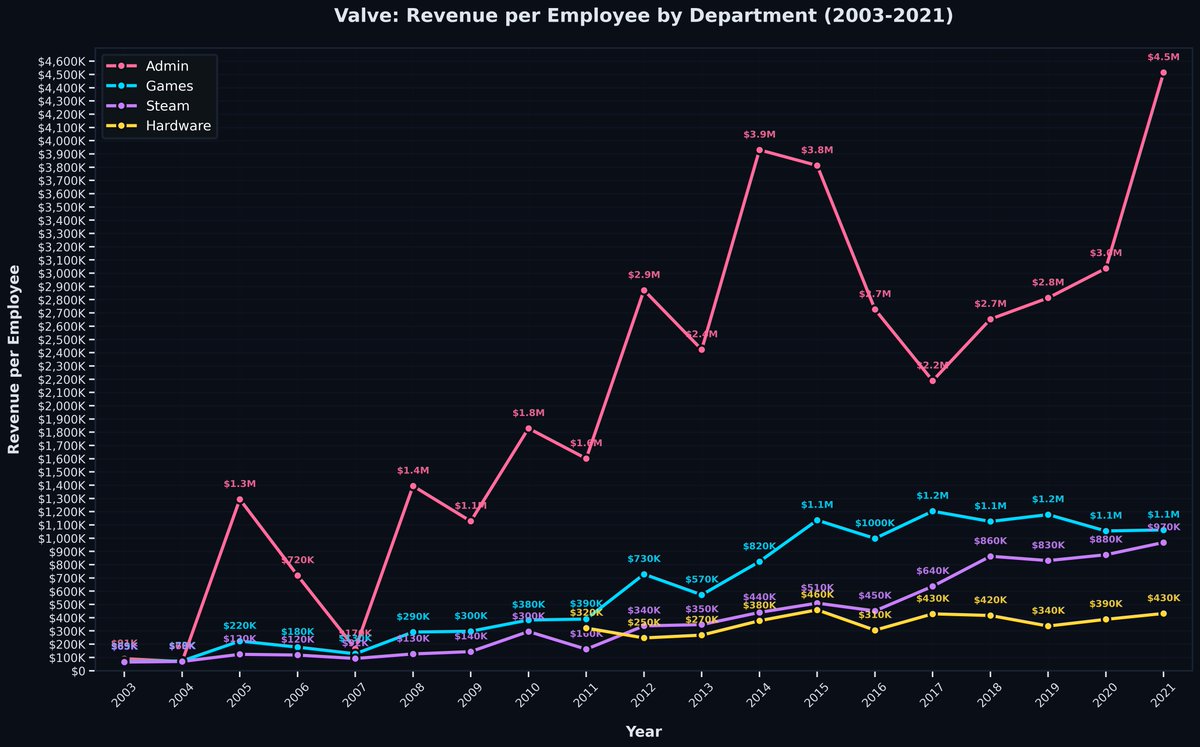
Valve, the makers of Steam, Half-Life and CounterStrike, made ~$17B in revenue this year with ~336 employees.
That's >$50M per employee, the highest for any (non-crypto) company in the world. The average pay is ~$1.3M/person.
One of the most efficient businesses of all time.
@levelsio@bryan_johnson I usually reset them by working out tired on the day itself and sleep.
Or some recommend to sleep the timezone you are departing to one day earlier to get use to it..The former works fine for me.