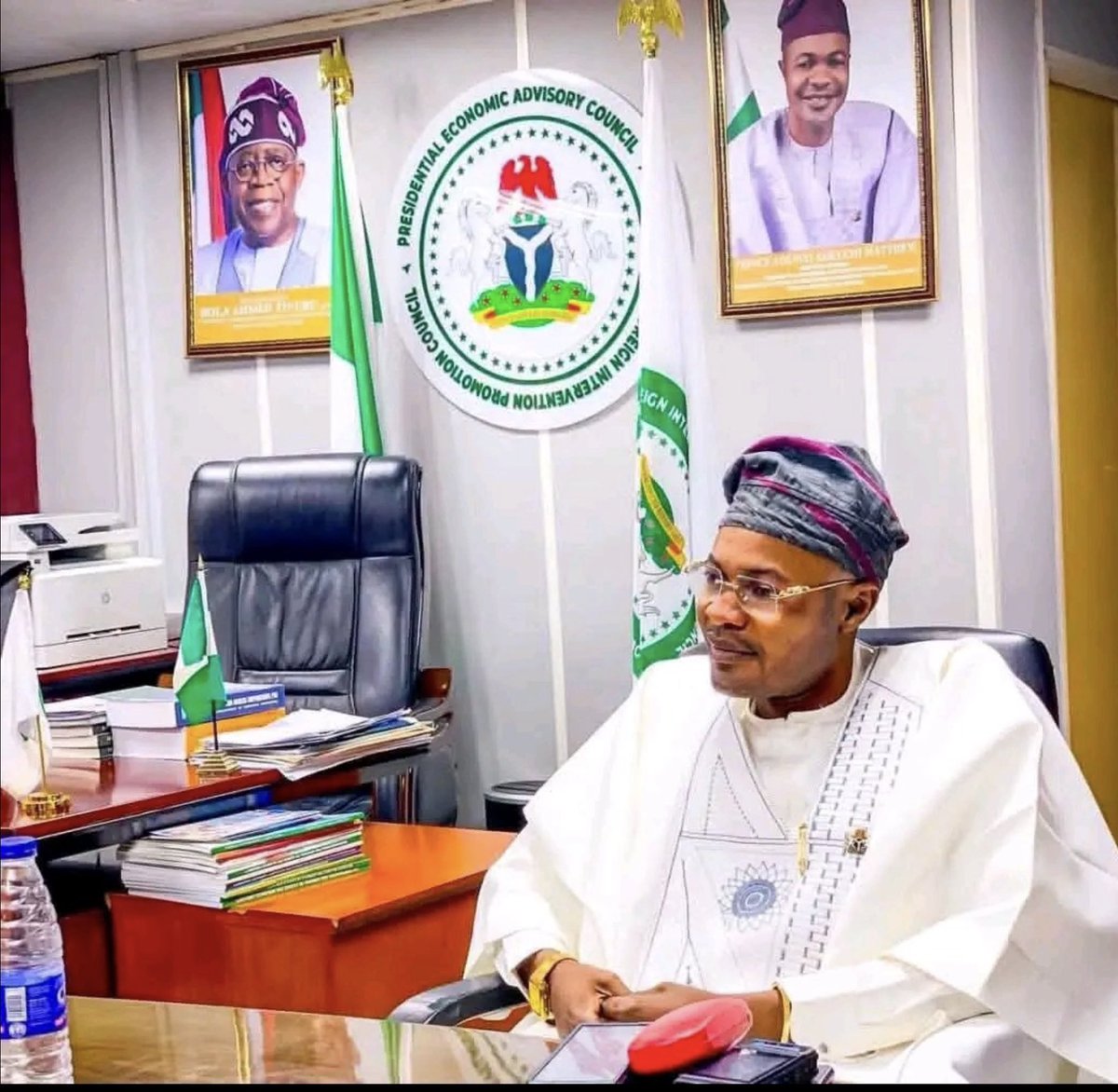
📌📌📌📌📌📌
‼️‼️🚨🚨‼️‼️
Record Breaking Development In The History Of Nigeria💥💥💥💥💥
All T-Pain Regime Banga Boys & Girls Should Gather Here
You were all wetting your pants that under President Buhari his signature was forged at CBN
Make una come collect
Now a whole fake federal agency known as “Presidential Foreign Intervention Promotion Council” was created under the the T-Pain regime
🔥with a fake DG
🔥allegedly with budgetary allocation
🔥with government branding
🔥headquartered at the Federal Secretariat
🔥calling meetings of foreign diplomats
🔥with @cenbank accounts
🔥visiting high profile heads of agencies like @officialEFCC
You see una life?
One of Nigeria’s biggest problems is the lack of accountability. Too often, people commit crimes and walk free without consequences. When there is no accountability, insecurity thrives and citizens lose confidence in the system.
Now is the time for our leaders, scholars, emirs, and elder statesmen especially from Arewa to come together and set our priorities straight. Security must be the number one agenda. With elections around the corner, every aspirant seeking our votes should clearly tell us how they intend to tackle insecurity and restore peace across the country.
As citizens, we must stand our ground and demand concrete plans before voting for anyone. And if those elected abandon the mission of securing Nigeria and serving the people, we must hold them accountable at the ballot box and vote them out. Nigeria deserves leaders who put the safety and welfare of its people first.
Imagine 1 million people sitting at home saying “my vote won’t count”.
That is 1 million vote lost.
And then we end up with the wrong person and the same people will say “the govt is bad”.
Participation is doing something about it 🫶🏾
One vote counts, it adds up.
Banditry is not surviving in Northern Nigeria merely because of government failure. It is surviving because the North, over time, has built an ecosystem that allows it to thrive.
Behind the man with the gun, there is often a village that fears him or protects him. There is a relative who knows where he sleeps. There is an informant who watches the road. There is a supplier who sells him fuel, food, motorcycles, or ammunition. There is a negotiator who profits from ransom. There is a praise singer who turns him into a legend. There is a politician who makes statements after every tragedy and returns to silence. And there is an educated northern public that can trend gossip or sex scandals for days but treat mass abduction like bad weather.
That is the part we do not like to say.
The forest did not create banditry. It simply gave it room to grow.
Banditry in Northern Nigeria did not begin today. Long before today’s headlines, northern trade routes and rural frontiers had a history of armed raids, cattle theft, attacks on traders, and criminal gangs operating in places where authority was weak.
That is one of the ironies of our history. Many people today, especially in Southern Nigeria, look at banditry and conclude that Nigeria should break apart. Yet insecurity along northern routes was one of the problems colonial rule claimed it was trying to solve when Nigeria was amalgamated in 1914.
Colonial authorities quickly discovered that the frontier was far less obedient than the maps they drew. Trade routes were disrupted by raids and ambushes. Traders and herders faced harassment. Rural authority was weak. Roads were unsafe. Violence had already become part of the region’s political economy. Even Lugard himself had some skimishes with armed bandits.
So the problem is old.
What changed was the scale, the weapons, the money involved, the collapse of local restraints, and the weakness of the modern state.
The modern form of banditry did not begin with mass kidnappings or attacks on schools Either. It started in ways that seemed smaller and easier to ignore.
In many rural parts of Zamfara, Katsina, Sokoto, Kebbi, and neighbouring areas, the first signs were cattle theft, highway robbery, and revenge attacks between communities. One man’s cattle would be stolen. Another group would retaliate. Villages accused one another of helping criminals. Violence gradually escalated.
This was the environment that produced men like Kundu and Buharin Daji.
Today, they are remembered as notorious bandit leaders. But before they became feared names, they emerged from communities already struggling with insecurity, poverty, and weak government presence.
In those communities, cattle were not just livestock. They were savings, school fees, food, and family wealth.
Losing fifty cows could mean losing everything.
At the same time, many people felt abandoned by the state. Some villages rarely saw police officers. Others believed security agencies only arrived after attacks had already happened. Many felt the courts were too slow or too corrupt to provide justice.
Then communities formed vigilante groups to defend themselves.
In many places, people welcomed them because they were desperate for protection. Nobody should mock people for trying to survive when the state has failed them. But over time, some vigilantes were accused of targeting entire Fulani communities instead of focusing on criminals. Others were accused of killing suspects without trial or punishing innocent people for crimes they did not commit.
Whether every accusation was true or not, the stories spread.
Young men heard that relatives had been beaten, arrested, or killed. They heard that Yan Sakai groups treated every Fulani man as a suspect. They heard that nobody would protect them. They believed nobody would listen to them.
Every abuse became evidence.
Every dead relative became a story.
Every injustice became a recruitment tool.
That does not excuse banditry. But It explains how it grows.
Some men entered the bush claiming self-defence. But to survive in the forest, they needed guns. Guns cost money. So they stole cattle. The stolen cattle were sold to buy more weapons. The more weapons they bought, the stronger they became. The stronger they became, the more young men joined them.
What may have started as a claim of self-defence slowly turned into organised crime.
But that was one doorway into banditry.
Another doorway was greed.
Not everyone entered the bush with a grievance. Some people simply saw that violence had become profitable. A man with a gun could steal cattle, collect levies, block roads, command fear, settle scores, and become more powerful than the honest farmer or herder trying to survive.
Once crime begins to pay more than work, society has already started advertising criminal life to desperate young men.
Then the cycle began feeding itself.
A man buys weapons for “self-defence.” Then he needs boys to carry those weapons. The boys need food. The food needs money. The money comes from cattle rustling. The rustling brings retaliation. The retaliation brings more weapons. More weapons bring more recruits. More recruits bring more mouths. More mouths bring more raids.
At some point, the original excuse dies, but the business continues.
That is how a grievance becomes an economy.
From there, the violence became more organised. Cattle rustlers became armed commanders. Armed commanders became negotiators. Negotiators became local power brokers. Eventually, some became men that governments found themselves bargaining with.
This is where figures like Dogo Gide and Awwalun Daudawa enter the story. They represent the stage where banditry moved beyond cattle rustling and rural raids and became a full ransom economy.
Roads became dangerous. Villages became sources of taxation. Farmers paid levies before harvesting crops. Travellers became targets. Schools became opportunities.
Daudawa’s role in the Kankara school abduction changed the trajectory of modern banditry. It showed that abducting schoolchildren could generate far more attention, pressure, and profit than traditional kidnappings.
Kankara opened the floodgates.
Bandit leaders across the region watched the panic, the headlines, the negotiations, and the pressure on government. What once seemed extraordinary quickly became a template. Schools became targets. Children became bargaining tools in a criminal economy.
But there is a question that should bother anyone who thinks seriously about this problem.
How do hundreds of schoolchildren get moved across difficult terrain by men on motorcycles and disappear into forests for days or weeks? How do armed men move, feed themselves, communicate, negotiate, and avoid capture across vast territories?
The answer is simple.
Bandits do not operate alone.
They rely on informants. They rely on people who know the terrain. They rely on suppliers. They rely on people who help them sell stolen cattle and buy weapons. They rely on negotiators who contact families and governments during ransom discussions. They rely on relatives, sympathisers, and terrified communities where silence has become a survival strategy.
As the Minister of Defence put it, the people around them are the oxygen of the business.
That is the ecosystem.
The men carrying the guns are only one part of it.
In many cases, people around them know who they are, where they operate, who supplies them, and who benefits from their activities. Some stay silent because they are afraid. Others stay silent because they are related to them. Some profit from the system. Others simply do not want trouble.
That is one reason banditry is so difficult to defeat.
But this ecosystem is not only about food, fuel, weapons, and informants. It also has a cultural side.
For generations, northern societies have had traditions of celebrating powerful and feared men. Figures like Kasu Zurmi and Gambo belonged to an older culture in which outlaws could become larger than life through stories, songs, and folklore.
Modern banditry inherited that tradition and adapted it.
Today, singers such as Late Suraju, Adamu Ayuba, Hamadu Makaho, Malam Jaka, Megari, and others help circulate the names of contemporary bandit leaders. The medium has changed, but the function remains the same. The criminal is transformed into a figure of prestige.
That matters because prestige attracts followers.
A young man is more likely to join a movement when its leaders are treated as powerful men rather than ordinary criminals. The praise song becomes part of recruitment. It becomes part of intimidation. It becomes part of the mythology that keeps the ecosystem alive.
Social media has only expanded the reach of that mythology.
The videos of bandits displaying weapons, cash, motorcycles, and armed escorts are not random acts of vanity. They advertise power. They project invincibility. They reinforce the status of particular commanders within the hierarchy of banditry.
But this is where the argument must leave the forest and enter the city.
Yes, communities around bandits have questions to answer. Some people are terrified. Some are trapped. Some are benefiting. Some know who supplies information. Some know who suddenly became wealthy. Some know which houses receive suspicious visitors. Some know which young men disappeared into the bush and later returned with money, motorcycles, women, and guns.
But the problem is not limited to rural communities.
The educated North also bears responsibility because too many of us have become accustomed to northern suffering.
A leaked chat can dominate discussion for days. A celebrity scandal can dominate discussion for days. Social media drama can dominate discussion for days. Yet villages are attacked, students are kidnapped, farmers are taxed by criminals, highways become unsafe, and entire communities are displaced, only for public outrage to disappear almost immediately.
We have attention.
We simply waste it.
That is why I struggle when people say the North lacks media power. The problem is often not the absence of a voice. The problem is how that voice is used.
We can spend endless hours discussing gossip, politicians, celebrities, tribal disputes, religious arguments, and social media controversies. But when farmers are paying taxes to criminals before harvesting their crops, many people suddenly lose interest.
That silence matters because banditry benefits when society quickly moves on. It benefits when attacks become routine news. It benefits when politicians know public anger will fade within days.
Compare this with Southern Nigeria. The South is far from perfect. It has its own problems, hypocrisies, and distractions. But when insecurity affects some southern communities, the public reaction is often different. People organise. Unions speak out. Community leaders are pressured to respond. The media keeps the issue alive.
In the North, we have become used to horror.
That is not resilience.
It is decay.
There is nothing admirable about becoming comfortable with the abnormal. The more we normalise it, the easier it becomes for leaders to ignore it. The easier leaders ignore it, the stronger the criminals become.
The farmer who cannot farm affects food prices in the city. The trader who cannot travel affects markets. The child who cannot attend school affects the future. A village paying levies to bandits is not buying peace. It is financing future violence.
Banditry does not stay in the forest.
The first thing we must do is strip away the romance.
The bandit is not a hero. He is not a defender. He is not a freedom fighter. He is not protecting any community by taxing poor villagers, kidnapping travellers, destroying farms, and turning schoolchildren into bargaining chips. Whatever grievance may have existed at the beginning has long been overwhelmed by criminality.
The second thing is to confront the ecosystem around him.
Praise singers are not harmless entertainers. Informants are not minor actors. Negotiation rackets must be exposed. Communities that knowingly protect criminals must face consequences, while innocent communities must be protected from vigilante abuse.
Security operations must be firm without becoming ethnic revenge. Traditional leaders must be held accountable. Rural economies must be rebuilt so that young men do not see the bush as their only path to power.
And the educated North must stop acting like spectators.
If we can make gossip trend, we can make the names of attacked villages trend. If we can spend days arguing about celebrities, we can spend days demanding action from governors. If we can organise political rallies, weddings, naming ceremonies, and religious gatherings, we can organise sustained pressure around insecurity.
This is not about blaming victims. Many northern communities are trapped between bandits, vigilantes, poverty, and a failing state.
But a society that wants to survive must tell itself the truth.
These men do not come from nowhere.
They come from communities. They rely on relationships. They depend on information, supplies, money, prestige, fear, and silence.
Until the North confronts the entire ecosystem, we will keep chasing the man with the gun while ignoring everything that allows him to keep fighting.
Qatar Energy LNG is seeking to hire talented Nigerians to support the company’s operations in Qatar.
Read the requirements below 👇 carefully and try your luck.
2010. South Africa. They said theft will be at an all-time high. Unsafe for world cup. Didn't happen.
2014. Brazil. Complained about some of the remote places the venues were. Unsafe for players. Didn't happen.
2018. Russia. "It's not a democracy". There would be marginalization. People would not even be free or allowed entry. Didn't happen.
2022. Qatar. " Slave built stadiums ". A morally bankrupt nation. " It cannot be fun". The tournament is horrible. No alcohols. Religious intolerance. Didn't happen.
2026. US. All the above happening.
We see.
One of the reasons the earliest attempts at Islamic banking in Nigeria, such as the dedicated Islamic banking windows in the old Bank PHB or Habib Nigeria Bank, faced so much scrutiny was because people kept asking this exact question you've just asked. They couldn’t understand how a financial institution could survive without the crutch of interest.
As time went by, scholars and financial experts needed to find a way out of this recurring problem. They had to prove that Islamic banks could cover their significant operating costs, infrastructure, and personnel without taking or giving a single naira of Riba (interest).
To do this, they developed authentic, asset-backed, money-making mechanisms that are foundational to Islamic banking today.
Please note that these are not just "interest with a different name," they are different entirely from the conventional interest-based banking.
Here is exactly why they are completely different from conventional banking:
1. Murabahah (Cost-Plus Financing): In a conventional bank, if you want a car, they give you a cash loan with interest, and you pay back cash for cash with an added percentage. That is Riba.
In an Islamic bank using Murabahah, the bank actually buys the car from the dealer themselves, owns it, and then sells that physical car to you at a disclosed profit margin, allowing you to pay in installments. The profit comes from a real trade transaction, not from renting out money.
2. Mudarabah and Musharakah (Partnership Models): Instead of just pooling deposits from savers and giving them a fixed, guaranteed interest rate, an Islamic bank acts as a partner.
In Mudarabah, the bank manages your funds in halal ventures, and the profit is shared based on a pre-agreed ratio, while the customer bears the financial risk.
In Musharakah, both parties pool capital for a business, sharing both the profits and the losses. The bank puts skin in the game. They earn by working and taking risk, not by exploiting a debtor.
3. Ijarah (Leasing): Instead of lending money to buy equipment, the bank buys the equipment and leases it to the customer for an agreed rental fee. The bank retains ownership and bears the risk of the asset, making the rental income entirely halal.
Having said this, now, let us talk about the reality of navigating a conventional financial ecosystem.
Because Islamic banks have to operate under the Central Bank of Nigeria (CBN), they are sometimes forced by regulatory compliance to participate in clearing systems or transactions that inadvertently generate Non-Permissible Income (NPI), such as penalty fees or unavoidable interest-bearing statutory reserves.
Islamic banks do not use this money to cover their infrastructure or staff salaries. Instead, they have a strict purification process. This NPI is completely segregated and channeled directly to charitable causes, such as funding public health clinics, building schools, or helping the poor. The bank derives zero corporate benefit from it.
One thing Islam prioritizes is striving toward the best, and not absolute perfection. We live in a highly imperfect, conventional financial world. These institutions are doing their best to be upon the truth, creating a halal alternative for millions of Muslims, and leaving the remaining gaps for the Almighty to pardon.
But to throw your hands up, capitulate completely, and allow Shaitan to trick you into thinking Riba is unavoidable just because banking has costs? What will then be the difference between us and them?
Allah knows best.
𝟕𝟔 𝐘𝐞𝐚𝐫𝐬 𝐀𝐟𝐭𝐞𝐫 𝐌𝐚𝐥𝐚𝐦 𝐒𝐚’𝐚𝐝 𝐙𝐮𝐧𝐠𝐮𝐫: 𝐀𝐫𝐞 𝐖𝐞 𝐀𝐧𝐲 𝐃𝐢𝐟𝐟𝐞𝐫𝐞𝐧𝐭?
In 1950, Malam Sa’ad Zungur asked a piercing question, which also happened to be the title of his epic poem: 𝑨𝒓𝒆𝒘𝒂 𝑱𝒂𝒎𝒉𝒖𝒓𝒊𝒚𝒂 𝒌𝒐 𝑴𝒖𝒍𝒖𝒌𝒊𝒚𝒂—Northern Nigeria, a republic or a monarchy?
His poem did not mince words, exposing greed, corruption, and social neglect.
He wrote:
“Matukar a arewa da karuwai,
‘Yan daudu da su da Magajiya.
Da samari masu ruwan kudi,
Ga mashaya can a gidan giya.
Matukar ’ya’yan mu suna bara,
Titi da Loko-lokon Nijeriya.
Hanyar birni da na kauyuka,
Allah baku mu samu abin miya.
Sun yafu da fatar bunsuru,
Babu mai taryonsu da dukiya.
Babu shakka’ yan kudu za su hau, Dokin mulkin Nijeriya.
In ko ‘yan kudu sunka hau,
Babu sauran dadi, dada kowa zai sha wuya.”
Here, Zungur critiques the ruling elite and urban youth: wealth hoarded by a few, public spaces filled with vice, and streets where poverty dominates. He warns that such imbalance will let outsiders dominate political power, leaving the common people to suffer.
He continued:
“Wagga al’ umma mai za ta yo,
A cikin zarafofin duniya.
Kai Bahaushe ba shi da zuciya,
Za ya sha kunya nan duniya.
Mu dai hakkin mu gaya muku,
Ko ku karba ko ku yi dariya.
Dariyar ku ta zam kuka gaba,
da nadamar mai kin gaskiya.
Gaskiya ba ta neman ado,
Ko na zakin muryar zabiya.
Karya ce mai launi bakwai,
Ga fari da baki ga rawaya.
Ga kore ga kuma algashi,
toka-toka da ja sun garwaya.”
These lines reflect moral decay, hypocrisy, and the normalization of lies. Zungur laments a society where truth is ignored, & deception colors every facet of life; from leadership to social interactions.
Finally, he paints a stark picture of communal and educational decay:
“𝑨 𝑨𝒓𝒆𝒘𝒂 𝒛𝒖𝒎𝒖𝒏𝒕𝒂 𝒕𝒂 𝒎𝒖𝒕𝒖, 𝑩𝒂 𝒛𝒂𝒍𝒂𝒌𝒂 𝒔𝒂𝒊 𝒔𝒉𝒂𝒓𝒉𝒐𝒍𝒊𝒚𝒂.
𝑪𝒂𝒎𝒇𝒆-𝒄𝒂𝒎𝒇𝒆 𝒅𝒂 𝒕𝒔𝒊𝒃𝒃𝒂𝒄𝒆 𝒕𝒔𝒊𝒃𝒃𝒂𝒄𝒆𝒏, 𝑺𝒂𝒊 𝒉𝒖𝒍𝒂 𝒎𝒂𝒊 𝒂𝒏𝒏𝒂𝒌𝒊𝒚𝒂.
Malaman karya ‘yan damfara.
Sai karya sai kwambon tsiya,
Sai hula mai annakiya.
Ga gorin asali da na dukiya,
Sai kace dan annabi fariya.
Jahilci ya ci lakar mu duk,
Ya sa mana Sarka har wuya.
Ya sa mana ankwa hannuwa,
Ya daure kafarmu da tsarkiya.
Bakunan mu ya sa takunkumi,
Ba zalaka sai sharholiya.”
He criticizes the collapse of social cohesion, the prevalence of fraudulent teaching, and the oppression caused by ignorance. Leadership, he says, is intertwined with exploitation rather than service.
𝐓𝐡𝐞𝐧 𝐯𝐬 𝐍𝐨𝐰:
Zungur’s 1950 challenges; corruption, nepotism, moral decay, inequitable wealth, lack of education, and social fragmentation; remain remarkably familiar. Today, Northern Nigeria still faces weak governance, underfunded schools, high youth unemployment, 𝐭𝐡𝐞 𝐲𝐨𝐮𝐭𝐡𝐬 𝐰𝐢𝐭𝐡 𝐥𝐢𝐭𝐭𝐥𝐞 𝐨𝐩𝐩𝐨𝐫𝐭𝐮𝐧𝐢𝐭𝐢𝐞𝐬 𝐮𝐬𝐞 𝐢𝐭 𝐭𝐨 𝐞𝐱𝐩𝐥𝐨𝐢𝐭 𝐨𝐭𝐡𝐞𝐫𝐬, limited industrialization, fragile internal security, communities struggling to maintain trust and cohesion and so on. Skill acquisition programs, social safety nets, and community empowerment initiatives exist only in fragmented form. While the vices were identified decades ago, systemic solutions to address them have largely been absent or inconsistently applied.
Zungur’s poem is more than historical critique; it is a warning for the present. As we navigate 2026 and head into 2027, the question remains: have we learned, or do the same vices continue to define our society? Action, accountability, and structural reforms remain the only path to a Northern Nigeria that truly reflects a republic, not a monarchy.
~𝐃𝐫. 𝐇𝐢𝐝𝐢𝐦𝐚💡✏️