🧠 ⚠️ Delirium signifying acute brain injury = a massive risk factor for future dementia, *especially* in people with low baseline long-term conditions/frailty.
This is not just an interesting epidemiological finding.
⭐ It is a major opportunity for dementia care - if acute brain injury during acute illness causes dementia we can work to understand how and then to design interventions.
👀 Dementia world - WAKE UP to delirium!
#delirium #dementia
Paper led by @rosespenfold - link in comments.
NB: A patient can be fully orientated and still delirious.
The core feature of delirium is inattention. Test it: months of the year backwards. Do not rely on orientation questions alone.
Attention/arousal = a vital sign of the brain. #delirium
Thank you Colin. I’m very sorry to hear about your mother.
More broadly, I agree that people outside healthcare need clearer information about dementia and delirium.
In fact, the situation with delirium is dire because many professionals don't really understand it, and many don't use the correct terminology. So we are in a situation where a lot of delirium, maybe even more than half in the UK, is never diagnosed. Therefore, it is never explained to families and people who have experienced it. That is a lot of episodes, given that there is probably around two million episodes of delirium per year in the UK alone.
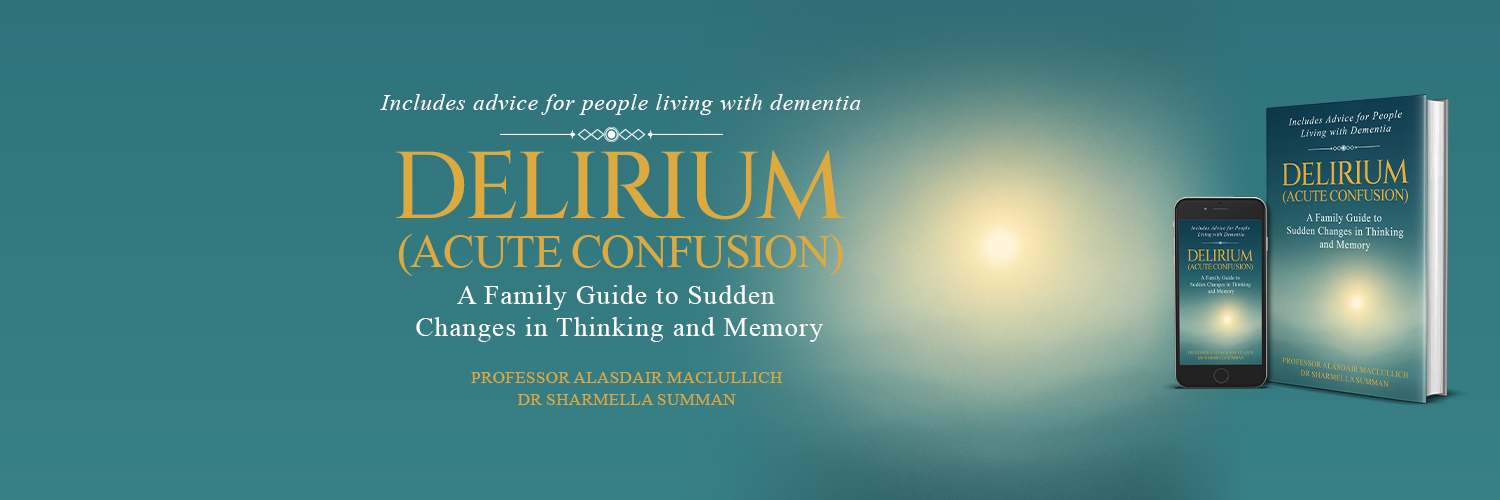
There are downloadable leaflets and public-facing websites on delirium, but they're all pretty short. Recently I started putting together a longer, more detailed one aimed specifically at families and carers on delirium - https://t.co/20pMraPcTP.
Early days - just over a month old - will continue to evolve.
The patient pushed the meal away.
The person beside the bed noticed and asked, “What looked wrong?” That was when the patient explained that the rice was moving, with small black and red things in it.
People with delirium often do not volunteer what they are seeing. They may not understand that it is a hallucination; to them, it is real, or if they aren't sure that it is real they worry that they are going mad.
They may also be frightened or ashamed to say anything.
When you see that a patient with delirium is looking perplexed, worried or even frightened, ask about what they are concerned about, and also directly if they are seeing anything strange or unexpected.
More information for families and carers: https://t.co/pEUOPBFUpW
(AI-generated visual reconstruction based on a real patient’s words.)
#delirium #PatientExperience
@A_MacLullich Delirium hallucinations are real to the patient dismissing them doubles the terror. The most powerful clinical tool here costs nothing: "Are you seeing anything unusual?" One question opens the door they were too afraid or ashamed to knock on.
You can test attention with nothing but your voice: months backwards, days backwards, serial sevens, spell WORLD backwards, digits reversed.
Under a minute, no kit. Alongside subjective assessment of attention, writing cognitive test results down can help to track change/recovery.
#delirium
Mr G, 80, using a fentanyl patch for chronic back pain, developed a fever from a chest infection and, over the same day, became drowsy, pinpoint-pupilled and confused, with a slowing respiratory rate.
The infection was real, but the delirium was opioid toxicity. Fever and warm skin had increased the absorption from his patch, and a dose that had been stable for months was suddenly delivering far more. The heat had turned a steady drug into an overdose.
We removed the patch, but the point the team almost missed is that removal alone is not enough. The drug already absorbed sits in a depot under the skin and keeps releasing for many hours, so he needed close monitoring for a full day, with naloxone to hand and given in small titrated doses if his breathing worsened.
Transdermal opioids deliver more when the patient is hot, whether from fever, a heatwave or a hot pack. In any febrile patient on a fentanyl patch who becomes drowsy and confused, think opioid toxicity, remove the patch, and keep watching well beyond it. #delirium
Very good questions. Removing the patch does not make the analgesic effect vanish immediately: fentanyl already in the skin continues to enter the bloodstream for many hours.
While Mr G remains drowsy or is breathing too slowly, safety comes first, so I would not simply replace the patch. His pain needs repeated assessment and non-opioid analgesia where suitable. Once the toxicity is clearly resolving, the team can cautiously introduce a short-acting opioid or another revised regimen, starting low because residual fentanyl may overlap with it.
Yes after months on fentanyl he is likely to be physically dependent. That is not the same as addiction. Withdrawal may emerge as the fentanyl level falls, often later because of the skin depot. It usually looks almost the reverse of toxicity: restlessness, sweating, yawning, dilated pupils, aches, abdominal cramps, vomiting or diarrhoea, and faster breathing, rather than drowsiness, pinpoint pupils, and slow breathing. Pain may also rebound.
This is also why naloxone is titrated to restore adequate breathing, rather than simply to make the patient fully awake. Too much can abruptly remove the analgesia and precipitate severe withdrawal. I've seen that happen and it is awful.
Refs:
Blundell M, Gill R, Thanacoody R, Humphries C, Wood DM, Dargan PI. Joint RCEM and NPIS best practice guideline: assessment and management of acute opioid toxicity in adults in the emergency department. Emergency Medicine Journal. 2024;41(7):440–445. https://t.co/mZn1xTQrU7
Manhapra A, MacLean RR, Rosenheck R, Becker WC. Are opioids effective analgesics and is physiological opioid dependence benign? Revising current assumptions to effectively manage long-term opioid therapy and its deprescribing. British Journal of Clinical Pharmacology. 2024;90(12):2962–2976. https://t.co/zaMVp220mQ
I am not sure - it seems that heat effects vary by drug and patch design. For menopausal estradiol patches, direct evidence is sparse; on a quick search - contraceptive patch studies did not show the fentanyl pattern. Perhaps check the leaflet for that exact HRT patch?
This review explains why effects differ between patches: https://t.co/CqylEsRBtL
The patient pushed the meal away.
The person beside the bed noticed and asked, “What looked wrong?” That was when the patient explained that the rice was moving, with small black and red things in it.
People with delirium often do not volunteer what they are seeing. They may not understand that it is a hallucination; to them, it is real, or if they aren't sure that it is real they worry that they are going mad.
They may also be frightened or ashamed to say anything.
When you see that a patient with delirium is looking perplexed, worried or even frightened, ask about what they are concerned about, and also directly if they are seeing anything strange or unexpected.
More information for families and carers: https://t.co/pEUOPBFUpW
(AI-generated visual reconstruction based on a real patient’s words.)
#delirium #PatientExperience
Age & Ageing editorial: make the 4AT routine at the front door for patients 65+, alongside NEWS and frailty scoring. One admission, three assessments. #delirium#4AT https://t.co/LVZ6WgJ6UG
Publishing delirium research should not require a four-figure fee.
Delirium is open access: €20 to submit and a €280 APC on acceptance. Peer review is estimated to take 4–6 weeks under normal circumstances.
https://t.co/um7I4twKBn
#Delirium
Two of the commonest causes of delirium are found with a hand and a bladder scanner, not the scanner suite. A loaded rectum and a full bladder cause agitation and resolve within hours. Examine the abdomen before the CT head. #delirium
He knew the date, so we "cleared" him. Orientation isn't attention. A patient can name the year and still fail the months-backwards test. Test attention. That's where delirium hides. #delirium
"I should have realised sooner." Carers can carry that for years.
Delirium is missed daily by trained professionals.
A relative who noticed something was wrong at all has often outperformed the system.
https://t.co/eMHjKBINFk = a website for families on #delirium