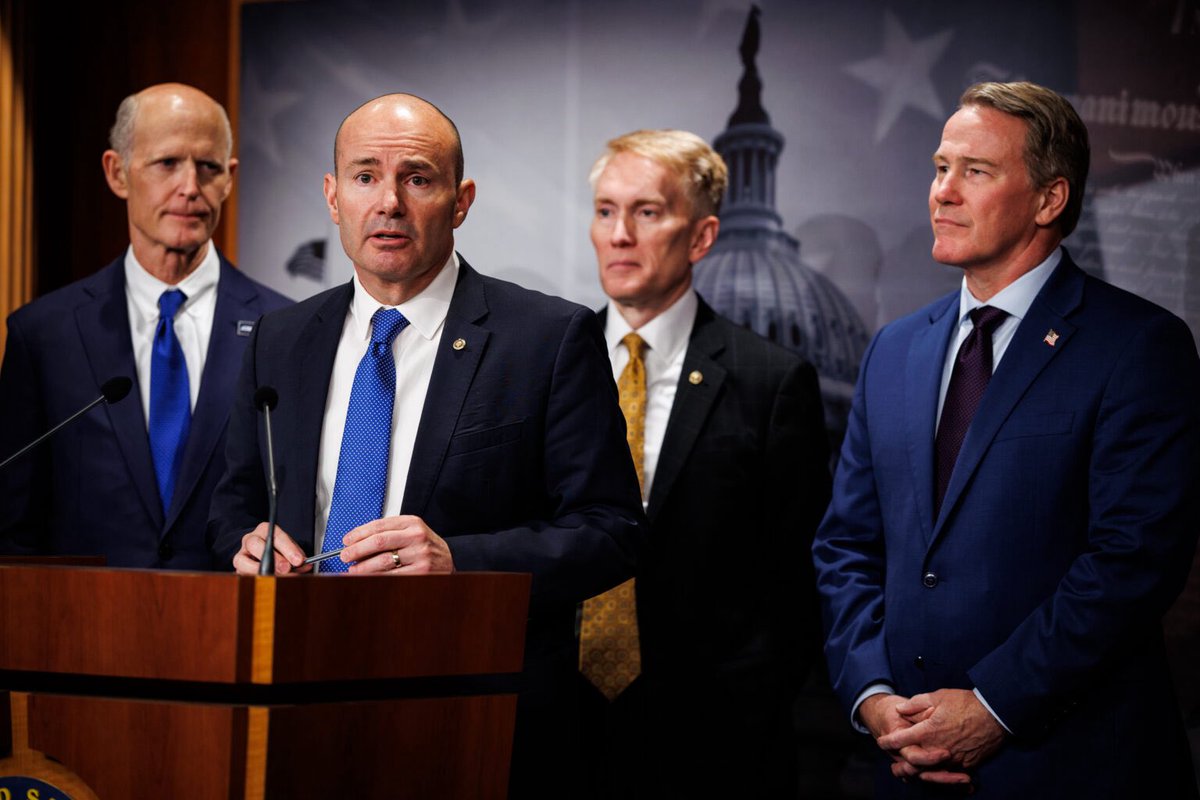
The Senate floor last week was a documented case study in how the SAVE Act actually works as a political object.
Fake electors alumni helped draft it. Trump said it guarantees Republicans never lose for fifty years. Cruz used floor time to rehearse 2020 claims that sixty-plus courts rejected. Murkowski warned it pre-positions a stolen election narrative for 2026. Tillis called it a waste of time.
Meanwhile the bill’s actual mechanics stayed mostly undebated: documentary proof of citizenship requirements that half of Americans cannot easily meet, absentee photo ID mandates Marc Elias says are logistically designed to end mail voting entirely, elimination of registration through churches, DMVs, and college campuses, and criminal liability for the local clerk who processes a form incorrectly.
The floor performance was not accidental. When the argument for your bill is a fraud claim courts have already buried, performance is the only play left.
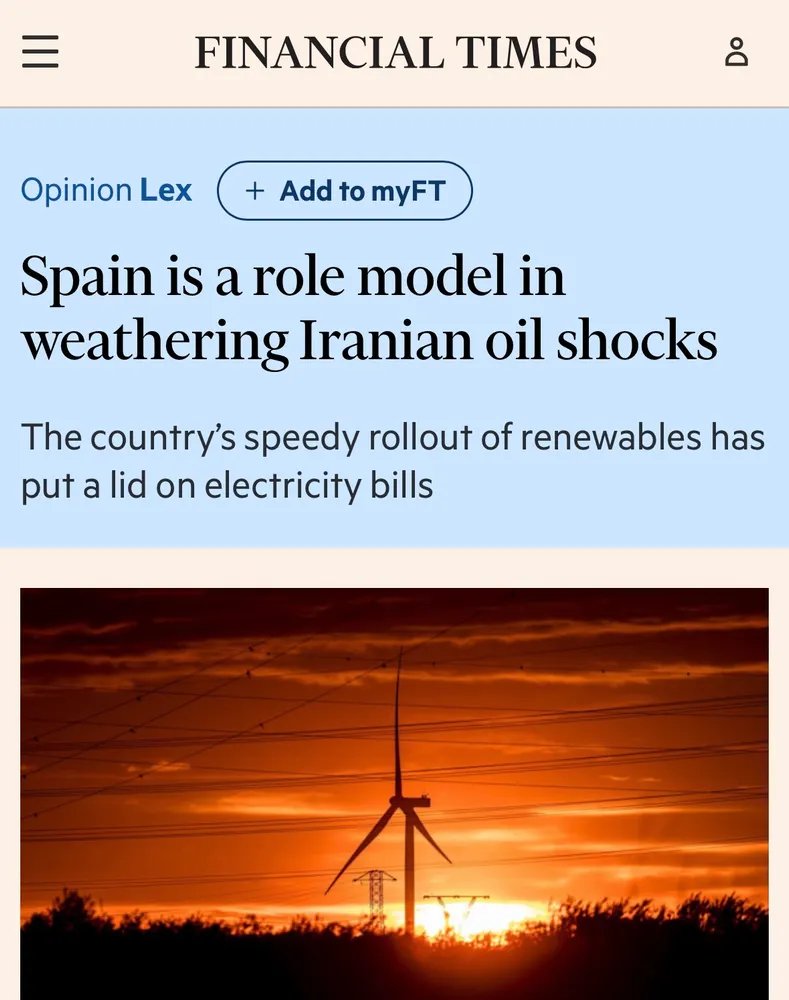
Spain's renewables build-out has structurally decoupled its electricity prices from gas markets.
Gas now sets the price in only 15% of hours, compared to 90% in Italy.
Countries that invested early in clean power are far less exposed to fossil fuel price shocks.
This exchange just happened on the Senate floor.
Cornyn: “I don’t understand how the SAVE Act disenfranchises voters.”
Durbin: “Happy to explain. Driver’s licenses don’t qualify under the bill. 50% of Americans don’t have passports.”
Cornyn: “Why not just amend it?”
Durbin: “When’s the last time the Senate actually amended a bill?”
Silence.
The SAVE Act requires passport-level documentation to register to vote.
50% of Americans don’t have a passport.
The people least likely to have passports: the elderly, the poor, rural Americans, young first-time voters.
The people most likely to have passports: wealthy Americans.
This is not voter protection.
This is voter selection.
And when a senator suggested fixing it — his own colleague couldn’t name the last time the Senate amended anything.
That’s the Senate in 2026.
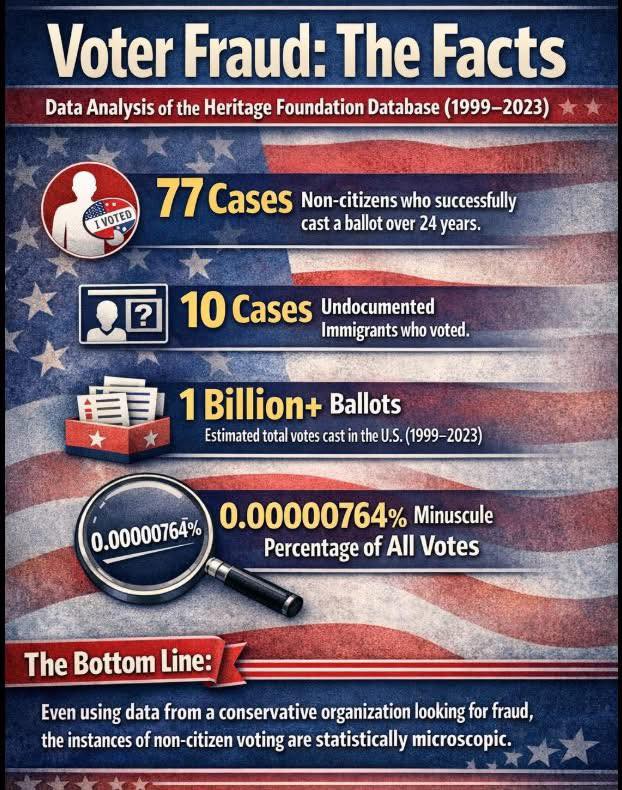
Even using the right wing conservative Heritage Foundation’s research, there is no justification for Trump's SAVE Act.
It is voter suppression, designed for the insidious purpose of staying in power regardless of what the majority of American voters want.
But the Republicans have to dress the SAVE Act up as if it is preserving "election integrity." Those are lies - don't fall for it.
#ProtectOurVote
Oregon was the first state to have universal vote by mail which was supported by Democrats and Republicans. The Constitution is clear: determining time, place and manner of elections is up to the states.
For the 900,000 women in Oregon who changed their name after marriage, the need to provide documentation to re-register costs time, money and will disenfranchise eligible voters from casting a ballot. The SAVE act is voter suppression, pure and simple.
The House is about to vote on a bill that could lead to hundreds of billions in lost energy infrastructure investments.
Here are some of the Republican-led House districts with the most to lose.
1. Rep. Kiggans (VA-02): $12 billion at risk.
🧵
If the House passes their big bill, they would be voting to cancel thousands of energy projects over the next decade.
There's a reason that trade unions are calling this "the biggest job-killing bill in history."
Just a reminder that Trump promised to cut your energy bills in half and now is actively pushing a bill that screws over more than 90% of planned energy projects. This thing will make it more expensive for you to run your AC or for any business to operate.
We knew this day could come but here we are. The 2026 proposed @NOAA budget shutters all world-class federally funded meteorological, oceanographic, and climate labs in America. Included is @HRD_AOML_NOAA, a fixture for over 50 years in Miami. Hundreds of top scientists tossed.
Here's what the Senate's bill would do:
Increase electricity prices in every state—as much as 25%.
Increase the number of uninsured Americans by 11.8m.
Cut food stamps funding by 22%.
It would do all that and still add $4.5 trillion to the national debt.
Electricity demand is booming in Louisiana—partly from AI data centers.
If the US Senate passes their bill, the state would be heading for an electricity shortage.
Utilities would have to turn away data center projects. And electricity bills would rise by ~10%.
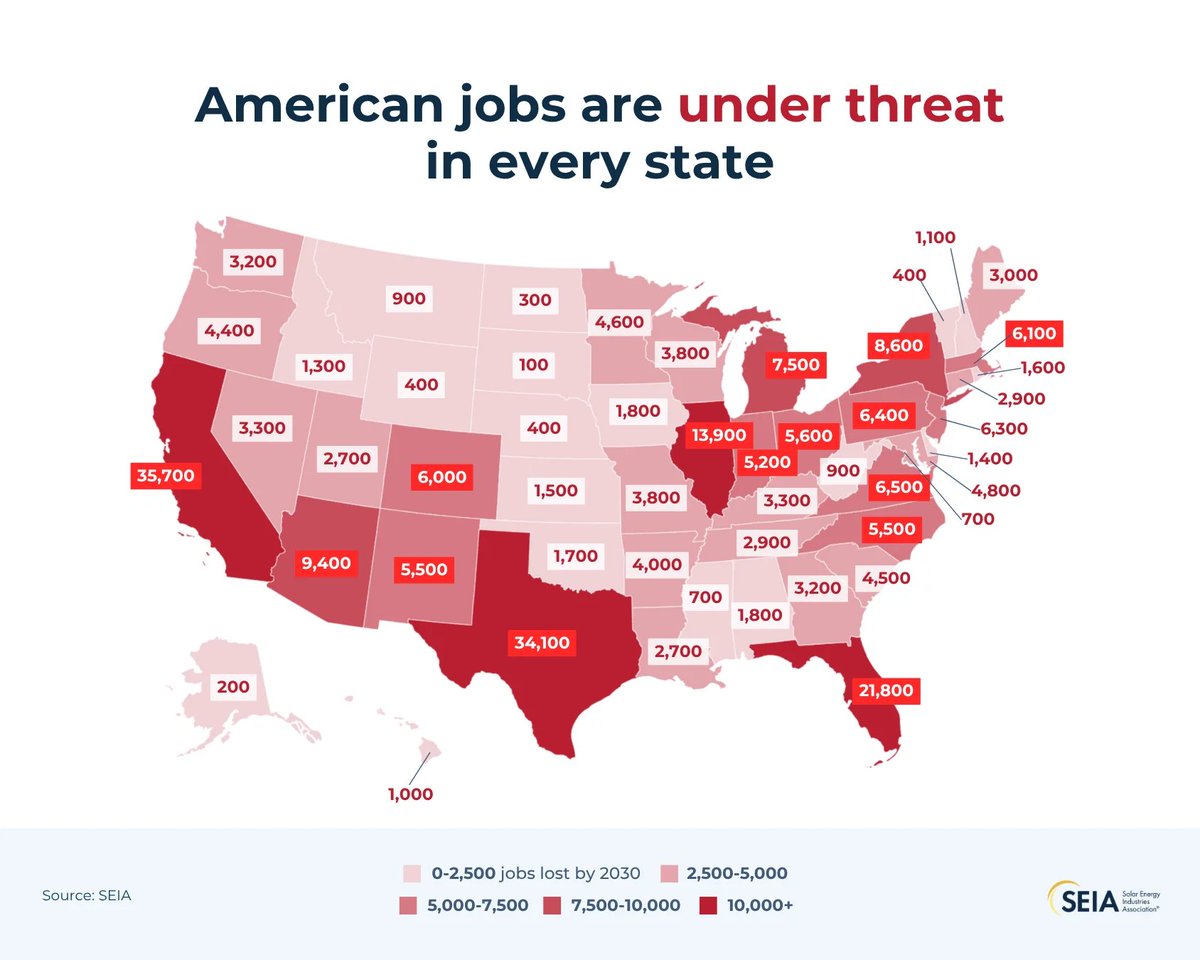
There's a reason that the largest construction workers union in America called Senate Republicans' bill "the biggest job killing bill in our country's history."
It would lead to mass layoffs in every state in some of the fastest-growing sectors of our economy.
Wind and solar are not fringe technologies in the US. They have overtaken coal in 24 states since US coal generation peaked in 2007.
This includes red states such as South Dakota, Oklahoma, Kansas and Texas...
...and, as of 2024, the US as a whole!
According to the clean energy industry, here’s what the Republican tax bill means:
- 300,000 fewer jobs per year in wind and solar.
- 300 GW less wind and solar built this decade. This is several times more than what we add to the grid in an entire year and we’ll just lose it, as demand soars.
- $450 billion of lost capital
Meanwhile China will surge ahead. Loser stuff.
Another big statement against the Senate bill.
The trade union representing 860,000 electrical workers says the bill will cost "hundreds of thousands of good-paying construction jobs."
I hadn't seen this statement reported anywhere else.
Another big statement against the Senate bill.
The trade union representing 860,000 electrical workers says the bill will cost "hundreds of thousands of good-paying construction jobs."
I hadn't seen this statement reported anywhere else.
A "new tax" on energy. The public's going to love this!
Republicans in Congress are trying hard to raise your electricity bill.
"This tax will increase prices," said the EVP of the US Chamber of Commerce. https://t.co/dfdRlIx1jN