The agentic trust stack is almost complete.
ERC-8004 gave agents identity.
x402 gave them money.
AgentKit tied them to verified humans.
https://t.co/zTt5hqiGwW gave them a discovery layer.
One thing is still missing. And it's the biggest one.
@nickprince made every service discoverable. x402 made every API a payment endpoint.
ERC-8004 made every agent an identity.
The next turn: every jurisdiction becomes queryable.
Every citizen's agent can represent them anywhere.
More on the build: https://t.co/o7KormIgyl
So our agents will apply to zones for us.
Negotiate residency with municipalities.
Hold and present the credentials that prove who we are.
Pay the fees. Sign the forms. Track the status.
Every interaction between a citizen and a government becomes agent-to-agent.
We're building it @Sovrnplace
KYC made humans legible to banks.
KYA will make agents legible to merchants.
The next layer is making jurisdictions legible to agents.
Every right your government issues you, residency, license, tax status, citizenship, becomes a signed credential your agent can present, anywhere.
Three primitives are missing, and we're shipping all three.
A verifiable identity governments will accept: W3C VC 2.0, ISO mdoc, EUDI-compatible.
A registry of jurisdictions with machine-readable programs.
A cross-zone exchange so credentials issued in one zone verify in another.
Open schemas. Apache 2.0: https://t.co/rBhgtFSNlh
Governments are the largest category of services humans consume.
And the least legible to agents.
Residency programs. Visa classes. Zone licenses. Tax regimes. Citizenship pathways.
Every one of them is a service. Today it lives in PDFs, consulates, and 5-month waits.
None of it is queryable.
x402 has processed 140M+ payments. Stripe, Visa, Mastercard, Google, AWS, Microsoft all joined the x402 Foundation this month.
The plumbing for agent-to-service commerce is now industrial infrastructure.
But a citizen's agent can still only buy things.
It cannot be anywhere.
Ask your agent to book a flight. Works.
Ask your agent to apply for residency in a free zone, open a business in an SEZ, or prove you qualify for a tax program.
Falls apart.
Not because the agent can't. Because the jurisdiction has no machine-readable way to answer.
@a16zcrypto 2026 trends list named KYA, Know Your Agent, as the critical missing primitive.
Signed credentials linking every agent to its principal, constraints, and liability.
They solved for commerce. They didn't solve for country.
The agentic trust stack is almost complete.
ERC-8004 gave agents identity.
x402 gave them money.
AgentKit tied them to verified humans.
https://t.co/zTt5hqiGwW gave them a discovery layer.
One thing is still missing. And it's the biggest one.
Most relocation/residency advice today is outdated, biased, or locked behind expensive consultants.
We wanted something fast, unbiased, and actually usable.
This is just the first product. We’re building Sovrn as the broader infrastructure layer for cities and global mobility.
More here: https://t.co/R8PzzYHaIb
We're launching Sovrn AI today.
Try it: https://t.co/DGgq2AWODN
AI that shows you exactly where to move to save $30K-90K/year in taxes.
Free to try. Takes 60 seconds.
Here's what we built:
1/ Stop guessing where to move. Start filtering the world.
The "one-size-fits-all" nation-state is dead. In 2026, you don't just "live" in a country, you subscribe to a jurisdiction.
Explore it here: https://t.co/6P1o4DkTTS
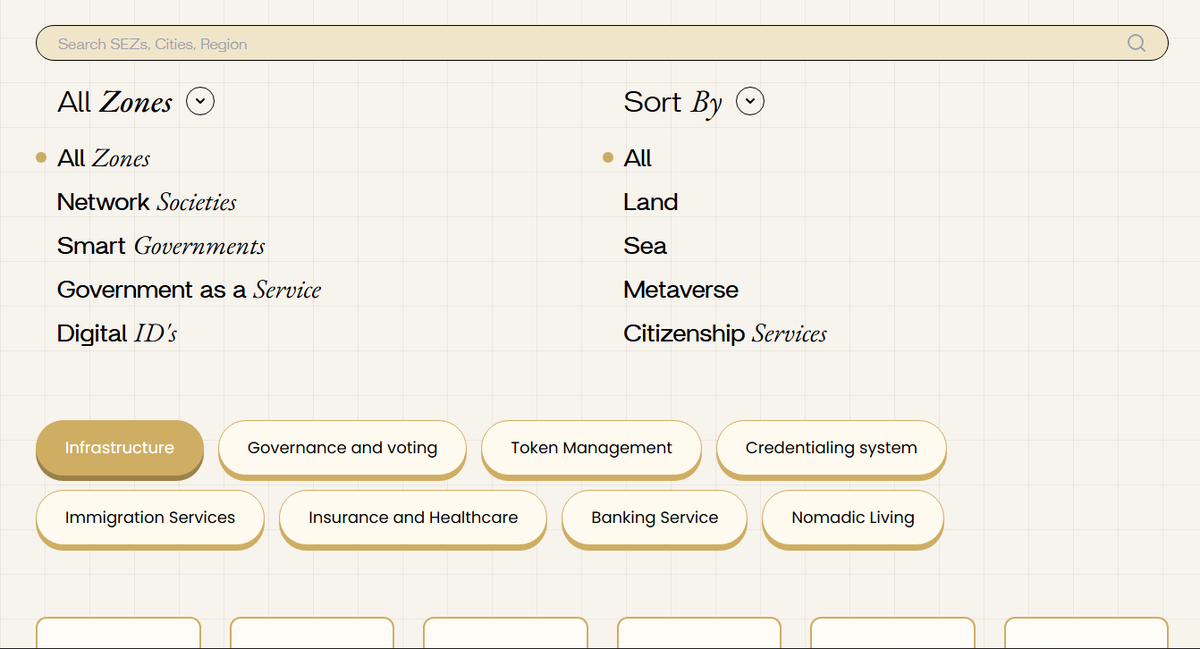
We built the Sovrn Dashboard to help you navigate the $100B+ Startup City ecosystem.
Recently I have been starting to worry about the state of prediction markets, in their current form. They have achieved a certain level of success: market volume is high enough to make meaningful bets and have a full-time job as a trader, and they often prove useful as a supplement to other forms of news media. But also, they seem to be over-converging to an unhealthy product market fit: embracing short-term cryptocurrency price bets, sports betting, and other similar things that have dopamine value but not any kind of long-term fulfillment or societal information value. My guess is that teams feel motivated to capitulate to these things because they bring in large revenue during a bear market where people are desperate - an understandable motive, but one that leads to corposlop.
I have been thinking about how we can help get prediction markets out of this rut. My current view is that we should try harder to push them into a totally different use case: hedging, in a very generalized sense (TLDR: we're gonna replace fiat currency)
Prediction markets have two types of actors: (i) "smart traders" who provide information to the market, and earn money, and necessarily (ii) some kind of actor who loses money.
But who would be willing to lose money and keep coming back? There are basically three answers to this question:
1. "Naive traders": people with dumb opinions who bet on totally wrong things
2. "Info buyers": people who set up money-losing automated market makers, to motivate people to trade on markets to help the info buyer learn information they do not know.
3. "Hedgers": people who are -EV in a linear sense, but who use the market as insurance, reducing their risk.
(1) is where we are today. IMO there is nothing fundamentally morally wrong with taking money from people with dumb opinions. But there still is something fundamentally "cursed" about relying on this too much. It gives the platform the incentive to seek out traders with dumb opinions, and create a public brand and community that encourages dumb opinions to get more people to come in. This is the slide to corposlop.
(2) has always been the idealistic hope of people like Robin Hanson. However, info buying has a public goods problem: you pay for the info, but everyone in the world gets it, including those who don't pay. There are limited cases where it makes sense for one org to pay (esp. decision markets), but even there, it seems likely that the market volumes achieved with that strategy will not be too high.
This gets us to (3). Suppose that you have shares in a biotech company. It's public knowledge that the Purple Party is better for biotech than the Yellow Party. So if you buy a prediction market share betting that the Yellow Party will win the next election, on average, you are reducing your risk.
Mathematical example: suppose that if Purple wins, the share price will be a dice roll between [80...120], and if Yellow wins, it's between [60...100]. If you make a size $10 bet that Yellow will win, your earnings become equivalent to a dice roll between [70...110] in both cases. Taking a logarithmic model of utility, this risk reduction is worth $0.58.
Now, let's get to a more fascinating example. What do people who want stablecoins ultimately want? They want price stability. They have some future expenses in mind, and they want a guarantee that will be able to pay those expenses. But if crypto grows on top of USD-backed stablecoins, crypto is ultimately not truly decentralized. Furthermore, different people have different types of expenses. There has been lots of thinking about making an "ideal stablecoin" that is based on some decentralized global price index, but what if the real solution is to go a step further, and get rid of the concept of currency altogether?
Here's the idea. You have price indices on all major categories of goods and services that people buy (treating physical goods/services in different regions as different categories), and prediction markets on each category. Each user (individual or business) has a local LLM that understands that user's expenses, and offers the user a personalized basket of prediction market shares, representing "N days of that user's expected future expenses".
Now, we do not need fiat currency at all! People can hold stocks, ETH, or whatever else to grow wealth, and personalized prediction market shares when they want stability.
Both of these examples require prediction markets denominated in an asset people want to hold, whether interest-bearing fiat, wrapped stocks, or ETH. Non-interest-bearing fiat has too-high opportunity cost, that overwhelms the hedging value. But if we can make it work, it's much more sustainable than the status quo, because both sides of the equation are likely to be long-term happy with the product that they are buying, and very large volumes of sophisticated capital will be willing to participate.
Build the next generation of finance, not corposlop.
You don’t beat competitors by doing the same thing slightly better.....you beat them by doing something different that matters more to your customer.
If everyone’s fighting over price, find a better experience.
If they’re all optimizing convenience, find a niche they’re ignoring.
The key is focus.
And solving one painful problem really well.
As our work moved from research into live pilots and city partnerships, we've evolved to match that reality.
Illuminated is now Sovrn.
Learn more → https://t.co/leqzHgRkTP
Illuminated is becoming Sovrn.
Our mission remains: to build infrastructure for modern cities and global citizens.
Follow along, as we turn zones into onchain bankable economies.
1/
𝐎𝐯𝐞𝐫 𝐭𝐡𝐞 𝐥𝐚𝐬𝐭 𝐲𝐞𝐚𝐫, 𝐈𝐥𝐥𝐮𝐦��𝐧𝐚𝐭𝐞𝐝 𝐡𝐚𝐬 𝐠𝐫𝐨𝐰𝐧 𝐟𝐚𝐫 𝐛𝐞𝐲𝐨𝐧𝐝 𝐚 𝐬𝐢𝐧𝐠𝐥𝐞 𝐩𝐫𝐨𝐝𝐮𝐜𝐭 𝐨𝐫 𝐢𝐝𝐞𝐚.
We started by exploring how identity, residency, and governance might evolve in a digital, global world.
Government institutions are monolithic. They assume you live, work, and belong in one place.
But what if citizenship and access were services, not traps? What if they were portable?
Sovrn (prev @illuminatedDAO) is building the layer that transcends locality. We make critical access to identity, banking and residency, predictable and legal for a world that has already moved on.
We're not subversive to governments- we're for people whose lives don't fit on a map📍
@SabineVdL Zip codes and passports were brilliant proxies for 20th century control points, we need is to build the verfiable digital proxies for the borderless world.
The Internet removed borders for work.
Governments never caught up.
We work online.
We build globally.
We move across borders.
We’re building a world where your identity, banking, and access aren’t tied to geography.
The future of work is borderless.
The future of citizenship should be too.
Sovrn exists to fix this. More Soon.