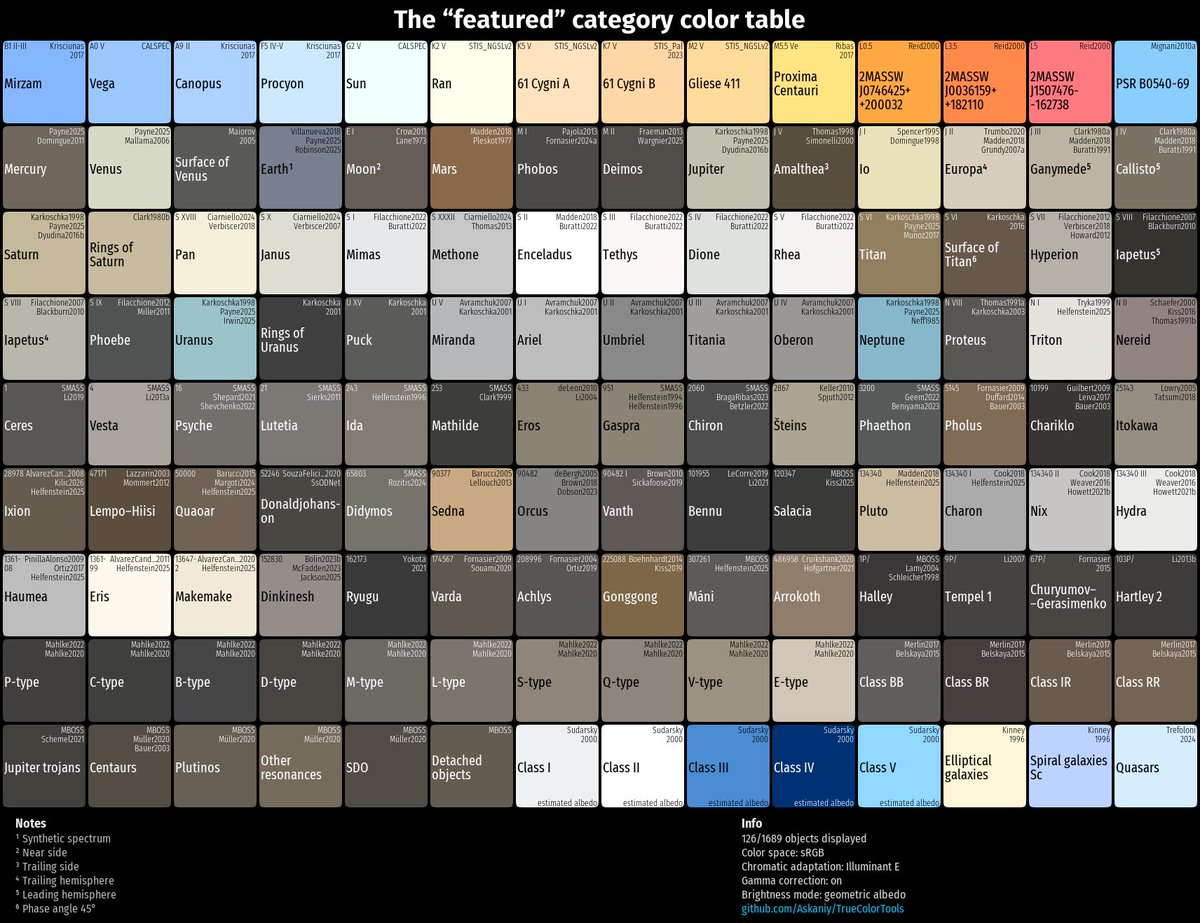
Current color table for some featured data (including Torifune and Kamoʻoalewa this time).
More options can be found here (https://t.co/N2pcsUHcjM) or generated for different categories.
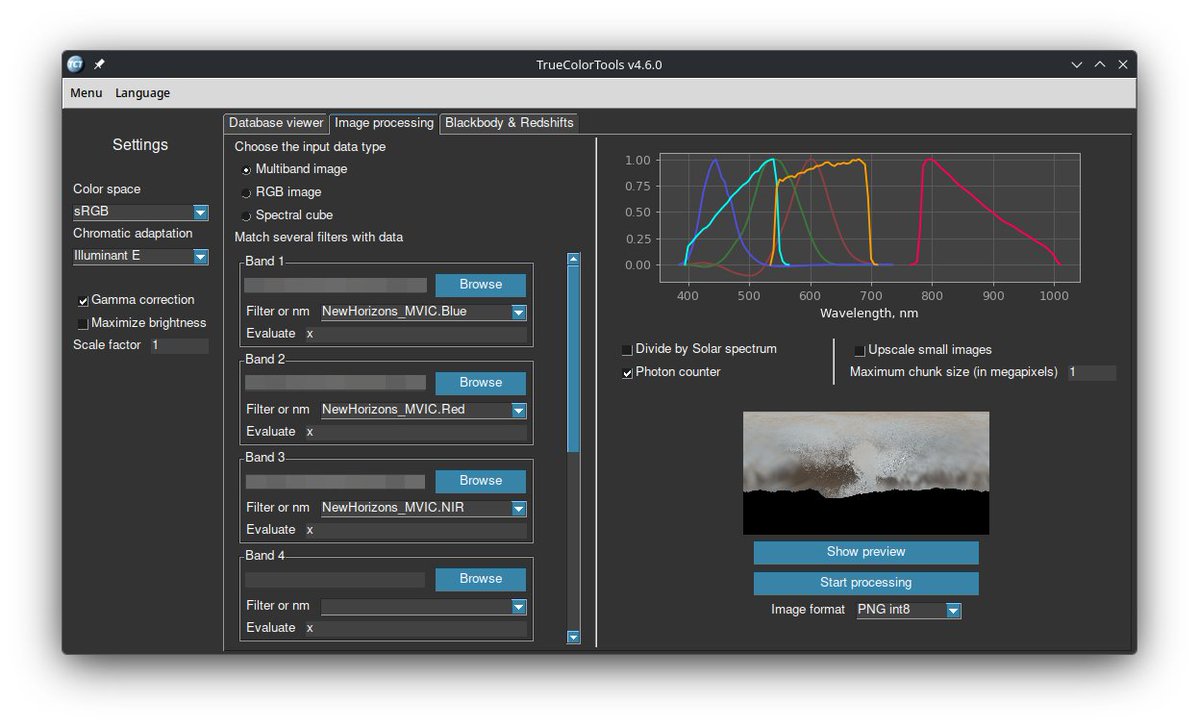
TrueColorTools v4.6 is out!
The changelog is dominated by new and updated spectral data. Thanks to LunaTheSilly, Pedro J. Garcia, Geobica, and SevenSpheres for their contributions!
https://t.co/2Z1NoCZgXZ
Designed and rendered in Blender updated wordmark for @CelestiaProj
After some modifications, it will be used for the new splash screen that the community is currently working on
Limb darkening in Celestia was primarily implemented by Hleb Valoshka, AstroChara calibrated the star textures, while Pedro J. Garcia and I helped in fixing. The animation also shows seamless transition to the resolved star rendering mode, which was developed by Levin Li and me
The radio sources were rendered using CelestiaStarRenderer I developed and redesigned last month: https://t.co/qDE5rWIsOX
You can download the map and see more details on Flickr and DeviantArt:
https://t.co/miUyMpYEfX
https://t.co/LJsYR948JI
What would the night sky look like if we could see it in radio waves? This synthetic false color map, which was created as a byproduct of my work with radio data, illustrates this hypothetical scenario.
Simple cylindrical projection, center right ascension 0°.
I used GSM2016 model available in PyGDSM library to map diffuse radiation (with some patched parts) and SPECFIND V3.0 to map radio sources.
Sources:
https://t.co/bsr7Bv37vR
https://t.co/F9AfD8YsrT
https://t.co/si7MCVFlYB
https://t.co/8BSVfDgrSt
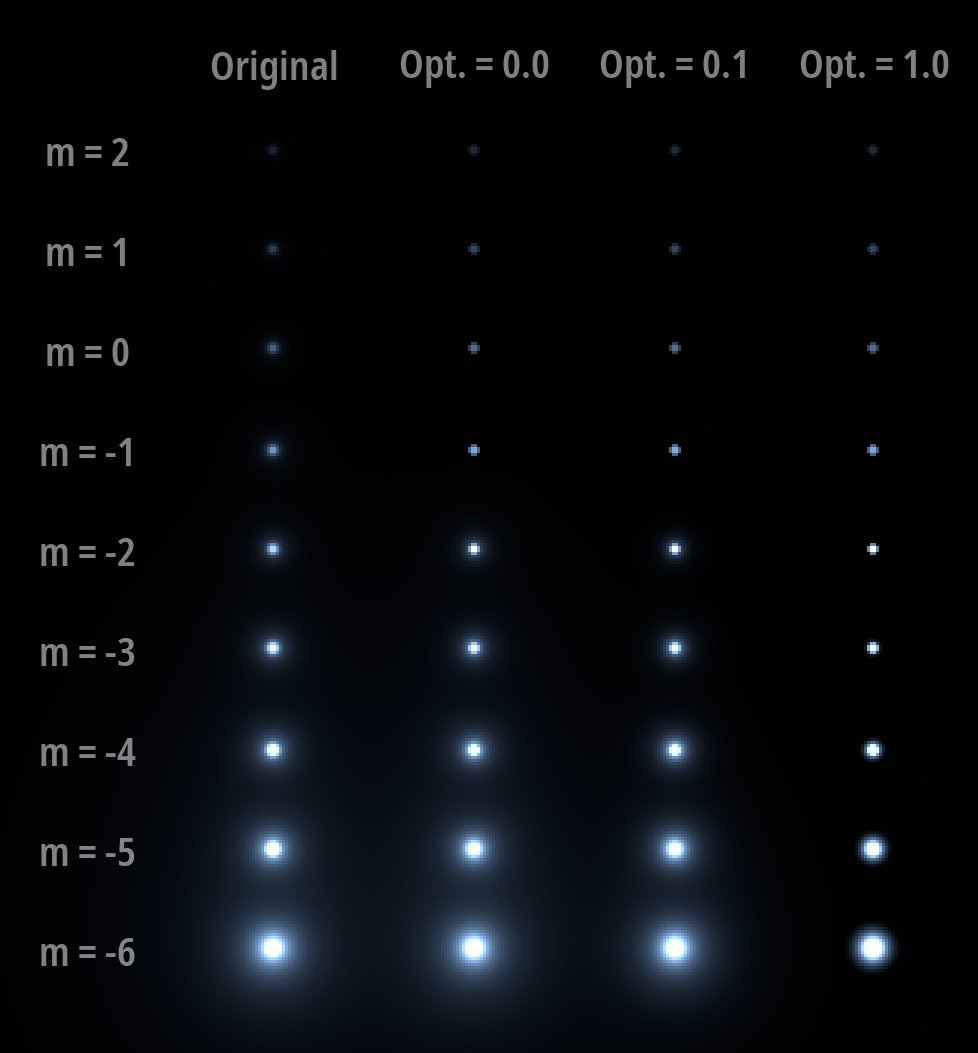
I present a method of PSF star rendering that bypasses convolution to improve performance
Details and Python examples are available here: https://t.co/qDE5rWIsOX
Thanks to Levin Li for implementing it in Celestia! (Work in progress)
@ToughSf Mars might be even blander... See https://t.co/GP8AiyiiXE
I recently reprocessed it one more time after adding better support for chromatic adaptation to TrueColorTools:
Map of Mars in true colors: images from Mars Express were projected by Michael et al. (2024) and post-processed with TrueColorTools. TCT used the Tikhonov regularization method to reconstruct a spectral cube from four HRSC channels and simulated human perception of it.
[1/3]
@mightbejell0 It's not only Neptune! At least it's good that it made the news
I developed a program to calculate other colors of space objects: https://t.co/txQy5Y7naO
(In fact, it was created before Neptune's color was revealed)
The texture map is intended for visualization purposes.
Also, I made a true color version (16-bit color depth).
Details:
- Simple cylindrical projection, planetocentric coordinate system, center longitude 0°.
- sRGB color space with chromatic adaptation for illuminant E.
Last week, I processed a contrast-enhanced false color map of asteroid Ryugu by painting a mask to fill regions of unknown or corrupted data. The RGB values correspond to Hayabusa2's x, v, b filters.
Source: https://t.co/2O3OOfP1mm
Yokota et al. (2021): https://t.co/soBB12leHn
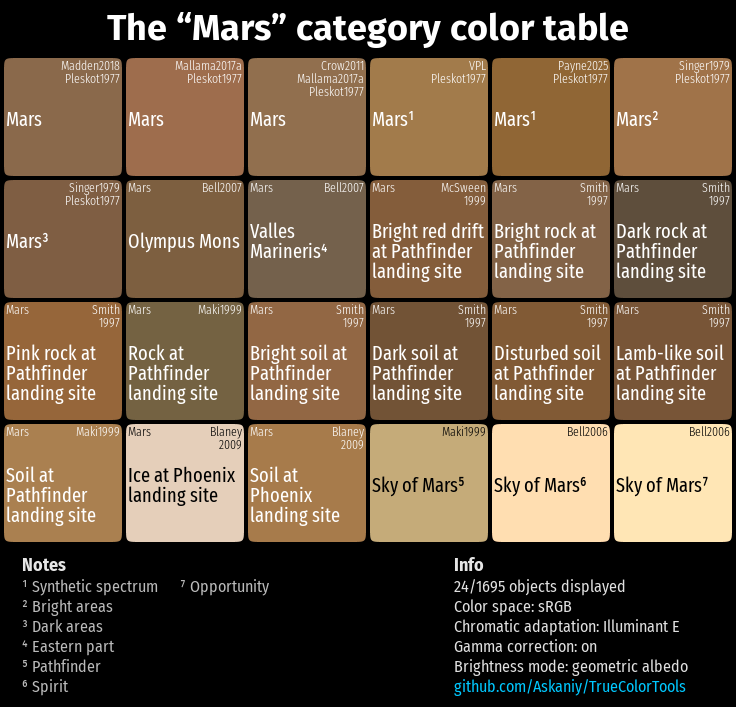
@DonaldPMitchell Here is my collection of colors from the spectra of Mars. There are also differences between sources, but they are smaller.
The color table was generated here: https://t.co/txQy5Y7naO
@AJamesMcCarthy@yuntao_lu I apologize if I came on too strong, agree that it's difficult to explain something briefly and have everyone understand it correctly. Thank you for your work on astrophotography (and Gregory updates)!
@AJamesMcCarthy@yuntao_lu The problem is actually much more computationally complex than just “color balancing”... 😅
Discrepancies between filters and color matching functions significantly alter colors.
And practically everyone forgets about gamma correction...
@AJamesMcCarthy@yuntao_lu I developed a program that reconstructs a spectral cube consistent with measurements so that it can then be “reshot” in RGB. Suggest taking a look:
https://t.co/txQy5Y7naO
Simple cylindrical projection, center longitude 0°.
Gamma corrected, albedo scaled.
Color space: sRGB, while point: Illuminant E.
Links for the full resolution (11K, 2 km/pix):
https://t.co/x913dIy47k
https://t.co/7s2UR2RRQX
[3/3]
Map of Mars in true colors: images from Mars Express were projected by Michael et al. (2024) and post-processed with TrueColorTools. TCT used the Tikhonov regularization method to reconstruct a spectral cube from four HRSC channels and simulated human perception of it.
[1/3]
The original paper by Michael et al. (2024): https://t.co/lFchVz7gO6
The data archive used: https://t.co/7KiLiIurL6
TrueColorTools: https://t.co/txQy5Y7naO
A related article: https://t.co/NCZuIU2Hu6
[2/3]




![aAskaniy's tweet photo. Map of Mars in true colors: images from Mars Express were projected by Michael et al. (2024) and post-processed with TrueColorTools. TCT used the Tikhonov regularization method to reconstruct a spectral cube from four HRSC channels and simulated human perception of it.
[1/3] https://t.co/pt5FmJMir6](https://pbs.twimg.com/media/G_a7NEBWAAAPW2d.jpg)