AI is changing global hiring.
Companies can now automate tasks that once required entire teams, and the bar for technical roles is rising.
For DevOps engineers, 2027 won’t be about knowing more tools.
It will be about being able to:
- Design reliable infrastructure
- Reduce cloud costs
- Automate with AI
- Build internal platforms
- Secure systems
- Troubleshoot complex failures
- Understand business impact
- Make better technical decisions
Don’t compete with AI on tasks AI can automate.
Learn to solve the problems AI still needs humans to understand.
Combining infrastructure, software engineering, AI, and business thinking will give DevOps engineers a significant advantage in 2027.
Felix realized about ₦15 million from the money raised for him by the streets of X yesterday.
Now that he is a graduate, he should forget about NYSC and focus on building a future for himself.
He has two options:
1. Write GRE and pursue a fully funded scholarship to universities in the US.
If he is a STEM graduate, he stands a very good chance of getting offers from several schools, with 3M he might find himself in the US.
While pursuing this, he should gather all his academic credentials, with his transcript being the most integral requirement. He should also get his documents properly verified and authenticated by the MOE and MOFA in Abuja.
2. Apply to two universities in Lithuania.
There is a good chance he would secure admission from at least one. He can then proceed to pay tuition, which could range from ₦4 million to ₦5 million, depending on the institution.
After receiving the necessary admission documents, he can proceed with the visa application and pay the required visa fees about ₦300K.
With ₦7 million on the dot, he would land himself into Lithuania.
Warning: ₦15 million is a meagre amount of money and shouldn't risk into investing in any business in Nigeria where Govt policies could sweep all inside the ocean tomorrow, and eventually return to his default financial position.
The goal should be to use the money it as a ladder to permanently change his financial trajectory and create and secured a good future for his kids in Europe.
Since my post about getting daily job alerts from ChatGPT blew up, let me show you exactly how I do it.
You can set up ChatGPT to search for fresh jobs in your niche and send you a daily list instead of spending hours scrolling through job boards.
Here’s the prompt I use:
“Every day, search the web for newly posted remote [JOB TITLE] roles that match my experience.
Prioritize jobs posted within the last 24 hours and only include roles that are actively hiring.
Search company career pages, reputable startup job boards, LinkedIn Jobs, Wellfound, and other reliable sources.
For every job, provide:
• Company name
• Job title
• Location/eligibility
• Posting date
• Salary, if available
• Direct application link
• 5 relevant keywords
• 5 technical skills required
Exclude expired jobs, duplicate listings, recruitment scams, and roles that explicitly restrict applicants to the US.
Send me the strongest opportunities every day at [TIME].”
Then replace [JOB TITLE] with the type of role you’re looking for.
For example:
Remote Operations Manager
Remote Executive Assistant
Remote Customer Success Manager
Remote Social Media Manager
Remote Project Manager
The trick isn't just asking ChatGPT to “find me jobs.”
Be specific about:
Your role + location eligibility + freshness + where to search + what information you want back.
That’s how you turn ChatGPT from something you ask questions to into a proper job-search assistant.
Save this post. You’ll need the prompt later.
I saw someone say they have ideas and the skills to build them, but they’re too broke to start.
So I put together a stack for developers with talent but basically zero budget:
1 Vercel
Deploy frontend and full-stack web apps.
↳ https://t.co/89HdVlDxpU
2 Cloudflare Workers
Run serverless APIs and backend logic.
↳ https://t.co/CVPiZ22R5h
3 Neon
Serverless PostgreSQL database.
↳ https://t.co/neaFXKGqUd
4 Supabase
Postgres database, auth, storage and realtime APIs.
↳ https://t.co/3VAysNJmVd
5 Clerk
Authentication, OAuth and user management.
↳ https://t.co/0gFALU7UCO
6 Cloudinary
Store, optimize and serve images/videos.
↳ https://t.co/HdzhSfNp2S
7 Cloudflare R2
Object storage for files and other assets.
↳ https://t.co/nSLX7JhcHD
8 Resend
Send verification emails, password resets and notifications.
↳ https://t.co/wBdsdmHIsK
9 Upstash
Serverless Redis for caching, rate limiting, queues and AI agent memory.
↳ https://t.co/EeYZBaibfT
10 Google Gemini API
Add AI chat, reasoning, vision and other AI features.
↳ https://t.co/dfxOqNhWUt
11 Groq
Fast LLM inference for AI apps and agents.
↳ https://t.co/Ik21RVLdPb
12 OpenRouter
Access multiple AI models through one API.
↳ https://t.co/NQKAbC3eCI
13 Hugging Face
Use and experiment with thousands of open models.
↳ https://t.co/bKc0Hl3vBh
14 Qdrant Cloud
Vector database for RAG, semantic search and AI memory.
↳ https://t.co/jOQOA3Iev2
15 GitHub
Host your code, collaborate and run basic CI/CD workflows.
↳ https://t.co/hqNGUextmt
16 PostHog
Product analytics, events, funnels and feature flags.
↳ https://t.co/CPMqMDDmlJ
17 Sentry
Monitor crashes, exceptions and application errors.
↳ https://t.co/rtlV5vfBW7
18 UptimeRobot
Monitor your app/API and know when it goes down.
↳ https://t.co/eVL9MU9TQs
19 Public APIs
Hundreds of APIs you can use for side projects and prototypes.
↳ https://t.co/7btoeXkRtQ
20 GitHub Student Developer Pack
If you’re a student, check this before paying for developer tools.
↳ https://t.co/fU6vyPj860
You obviously won’t need all 20 for one project.
Pick what your idea needs, build the first version, validate it and start paying for infrastructure when you actually have a reason to scale.
Being broke can limit how far you scale.
It doesn’t have to stop you from building version one.
If you’re learning DevOps , don’t just focus on learning how to use advanced tools.
Focus on understanding how the tools actually work.
Knowing the commands, memorizing YAML, or following tutorials isn’t enough.
Understand what happens underneath.
How does Kubernetes schedule a pod?
How does Docker isolate processes?
How does DNS resolve a request?
How does a load balancer route traffic?
How does Terraform create and manage infrastructure?
How does a CI/CD pipeline move code from commit to production?
The deeper your understanding of the fundamentals, the easier it becomes to troubleshoot problems, make better architectural decisions, and learn new technologies.
Don’t just learn the tool. Understand the technology behind the tool.
Tools change. Fundamentals compound.
Key GitHub Terms You Need to Know
To navigate GitHub without getting lost:
Repository (or "Repo"): This is simply the project folder. It contains all the code files, documentation, images, and folders for a single specific project.
Commit: This is a saved checkpoint. When a developer changes the code and saves it to GitHub, they create a "commit" along with a short text message explaining what they fixed or added.
Branch: This is a parallel sandbox. If you want to test a crazy new feature without breaking the live website, you create a ‘branch’ (a copy of the code). You experiment safely there, away from the main project.
Pull Request (PR): This is a request to merge changes. Once you finish testing your code on your separate branch, you submit a Pull Request asking the project owner to review your work and slide it into the main, live codebase.
If you don't have money to buy connects on Upwork, you should be sending at least 10-20 warm emails per day until you land your first job.
When you make enough money, buy 1000 connects and bully other people on Upwork.
But for now, head to Google and type...
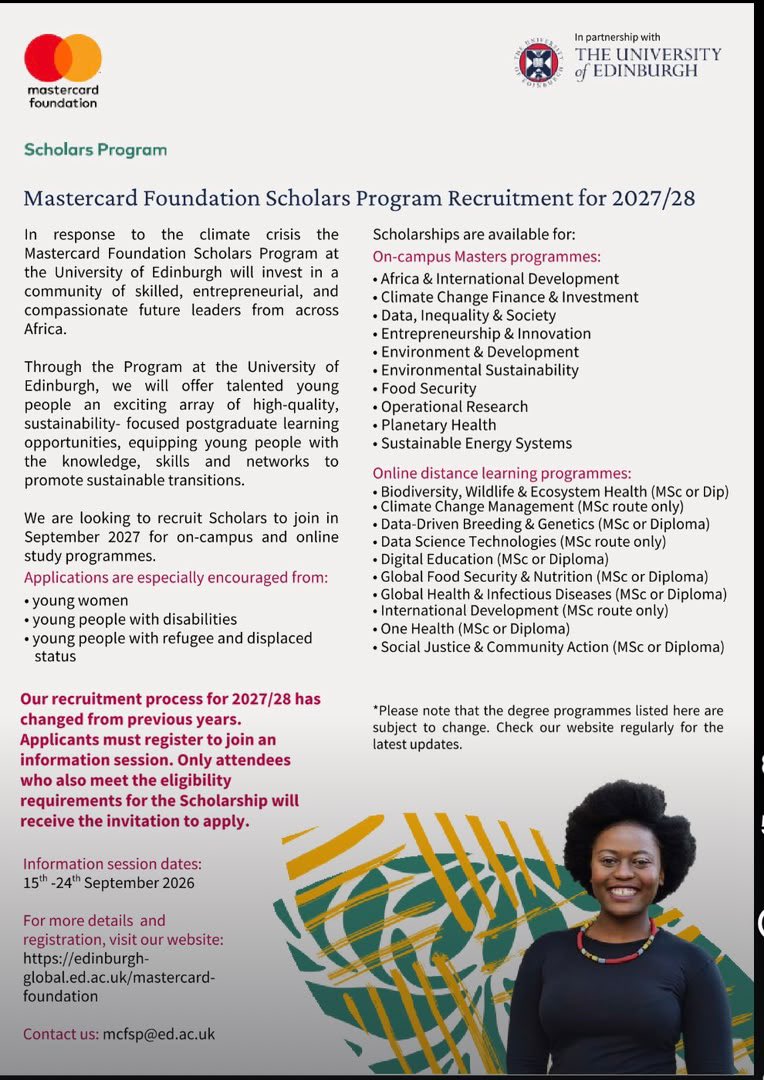
Fully Funded Mastercard Foundation Scholarship at The University of Edinburgh
You will need to have achieved the equivalent of a UK Second Class (Upper) Bachelor’s (Hons) degree or higher.
To be eligible to apply, you need to attend one of the virtual information sessions between 15 and 24 September 2026. Ensure you register here and check for more information here:
https://t.co/ATAi2BFN3B
For those looking to become professionals in Microsoft sql server
https://t.co/JuUqSuLFvV
This is a free training course that will take you from zero to hero!
After months of planning...
I'm excited to introduce EduFly 🎉 beta version.
A learning platform focused on:
- DevOps
- Cloud
- Open Source
- Career Roadmaps
- Hands-on Projects
Learn faster.
Build more.
Grow together.
Any feedback is appreciated..!!
https://t.co/SpMUGKsYiQ
Visa sponsorship + Remote jobs + Freshly funded startups!
European Tech Visa Sponsorship
https://t.co/0cG1NsgTzh
US Tech Visa Sponsorship
https://t.co/4GobLk06zi
Japan Tech Visa Sponsorship
https://t.co/QZvaDwuNAA
150 Remote Companies Hiring
https://t.co/Nyr3R9x3AG
100% Remote Hiring Companies
https://t.co/oxlA04UU5w
400+ San Francisco Bay Area companies
https://t.co/LzP3zns3K7
1500+ Recent Funding Startups
https://t.co/yNRpm5oueq
Indian Startups Freshers DS/ML/AI Hiring 2026
https://t.co/IEaPKmJIe3
Indian Robotics Startups Database
https://t.co/7MV7NQdszm
1300+ Hidden Companies Hiring List
https://t.co/clu9NJAzAN
Bookmark it!
System design is not just for software architects.
As a DevOps engineer, you need to understand how systems are designed, how components communicate, where bottlenecks occur, and what happens when things fail.
You should be able to look at an architecture and ask:
→ Where is the single point of failure?
→ How does this scale?
→ What happens when traffic spikes?
→ How are services communicating?
→ Where should caching happen?
→ How is data replicated and backed up?
→ What happens when a region goes down?
→ How do we monitor and recover the system?
Knowing Terraform, Kubernetes, Docker and CI/CD is valuable.
But knowing why the infrastructure is designed the way it is makes you a much stronger DevOps engineer.
Don’t just learn how to deploy systems.
Learn how systems work.
If I wanted to make $300K+ in cloud in 2026, I wouldn’t chase another certification.
I’d build a strategy around skills, leverage, visibility, and global opportunities.
Here’s exactly how I’d approach it:
Master cloud fundamentals
AWS/Azure/GCP are tools. I’d make sure I deeply understand networking, IAM, compute, storage, databases, DNS, security, and architecture.
Go beyond “Cloud Engineer”
I’d build expertise in:
- Kubernetes
- Terraform
- CI/CD
- Cloud security
- Observability
- Platform engineering
- FinOps
- Distributed systems
The goal: solve expensive infrastructure problems, not just deploy servers.
Learn to design, not just implement
I’d practice designing production-grade systems:
- High availability.
- Multi-region architectures.
- Disaster recovery.
- Scalability.
- Security.
- Cost optimization.
Senior-level compensation comes from owning architecture and outcomes.
Become exceptional at automation
If I can turn a 3-day manual process into a 10-minute automated workflow, I’m creating measurable business value.
I’d become dangerous with Terraform, Python/Go, Kubernetes, GitOps, and CI/CD.
Use AI as leverage
I’d use AI to accelerate:
- Infrastructure code
- Troubleshooting
- Documentation
- Automation
- Research
- Testing
- Incident analysis
But I’d never outsource understanding to AI.
AI makes skilled engineers faster. It doesn’t replace engineering judgment.
Build proof of work
I’d stop saying “I know AWS.”
Instead, I’d show:
- Architecture diagrams
- Open-source contributions
- Production case studies
- Infrastructure projects
- Cost optimization examples
- Technical articles
- GitHub repositories
Your portfolio should make your CV almost unnecessary.
Position for the global market
I wouldn’t limit myself to opportunities in my local market.
I’d target:
- US companies
- European companies
- Remote-first companies
- International consulting
- Cloud consulting
- Contracting
The internet has made the talent market global.
Build an audience
I’d consistently share what I’m learning.
Not motivational fluff.
Actual technical content:
“Here’s how I solved this Kubernetes problem.”
“Here’s how I reduced AWS costs.”
“Here’s how I designed this architecture.”
“Here’s what broke and how I fixed it.”
Visibility creates opportunities.
Develop consulting skills
At $300K+, I wouldn’t rely entirely on salary.
I’d build the ability to consult, architect, mentor, train, and solve infrastructure problems for companies.
Technical expertise + communication + business understanding = leverage.
Stop pricing myself by years of experience
The market doesn’t pay you because you’ve been around for 10 years.
It pays for the problems you can solve and the value you can create.
So if I wanted $300K+ in cloud in 2026, my goal wouldn’t be:
“Learn more cloud.”
It would be:
Become the engineer companies trust with their most expensive infrastructure problems.
That’s where the money is.
Mercor Guide
Step 1: Create your account
Visit:
[Mercor Login](https://t.co/bvzzXOpiRX)
Create your account using:
Email verification, or
Google account.
Step 2: Complete your profile
Fill in:
Professional headline
Resume
Education
Work history
Languages
Skills
Certifications
A complete profile helps Mercor match you with suitable AI opportunities.
Step 3: Browse available roles
Go to:
[Mercor Explore Jobs](https://t.co/CpnLRq1WBP)
Search for:
AI Trainer
AI Generalist
Prompt Writer
Data Annotator
Coding Evaluator
English Reviewer
Content Reviewer
Step 4: Apply
Each application may require:
Resume upload
Short questionnaire
AI interview
Skills assessment
Some completed assessments can be reused for future applications.
Step 5: AI Interview
Use:
A laptop or desktop
Google Chrome
A quiet room
Stable internet
Clear English
Questions usually cover:
Your background
Work experience
Problem-solving
Communication
Step 6: Wait for offers
Unlike Handshake, Mercor lets you apply directly to open listings, but selection depends on project demand and your qualifications. Continue applying to new roles if you're not selected initially.
Tips to get more offers
Use an ATS-friendly resume.
List all AI-related freelance work.
Complete every assessment carefully.
Keep applying—many contributors receive offers only after multiple applications.
TO WHOM IT MAY CONCERN,
All AUTHENTICATION at the Ministry of education has been digitalised.
You don't have to travel to abuja anymore, just read through and follow the process as required .
Best of luck to those of you seeking to authenticate your credentials at MOE.
5 free websites that exist but most people don’t know
1. https://t.co/LwtKDxKlhr — Offers free lifetime domain names and website hosting at no cost.
2. https://t.co/j3orcnBLbI — A global payment and sales platform designed to accept payments and sell products globally (similar to Stripe).
3. https://t.co/eXtr02hOa5 — An AI tool designed to generate startup ideas and business structures.
4. https://t.co/jqhHXrStcu — An AI-powered website builder that helps you generate, customize, and publish a website in 3 minutes.
5. https://t.co/jtbP3UTVJc — Helps you discover viral content ideas and analyze/predict if your content will perform well or flop before posting, along with suggestions to improve it.