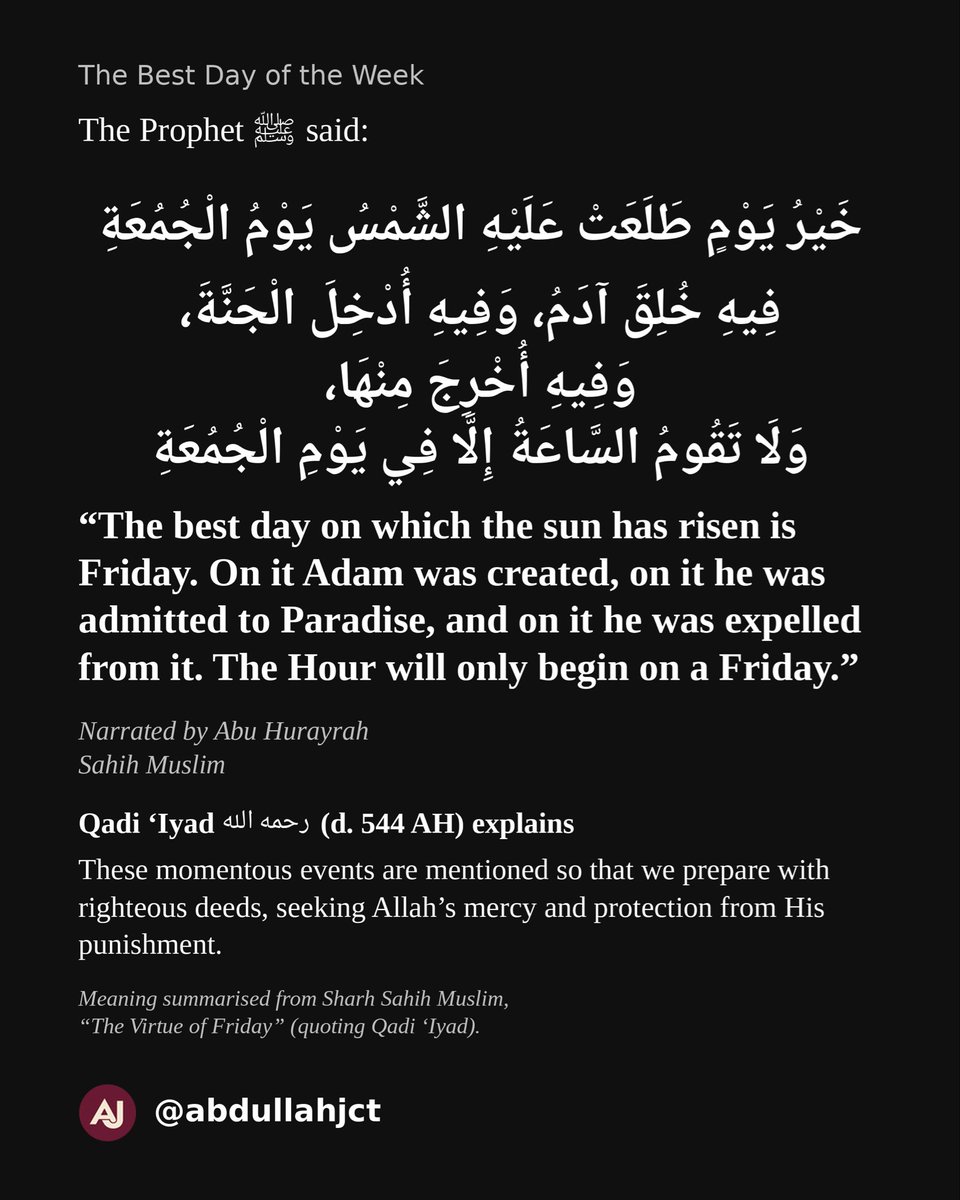
I’ll share benefits from the Qur’an and authentic Sunnah, plus insights from scholars throughout Islamic history, for my benefit and insha’Allah yours.
I’ll also share reflections and join conversations on character, responsibility, and everyday life.
May Allah allow us to benefit from what we learn and share, help us put it into practice, and forgive our shortcomings.
Shaykh as-Sa‘di رحمه الله (d. 1376 AH) explains that whoever dares to kill an innocent person has crossed a boundary that protects everyone.
Whoever spares a life out of fear of Allah honours that same boundary.
(Tafsir as-Sa‘di, al-Ma’idah 5:32.)
SubhanAllah, one life matters so greatly that Allah mentions it alongside all of humanity.
We should never become so accustomed to hearing of deaths that we forget the worth of each person.
May Allah protect innocent lives, restrain the oppressors and bring relief to those living in fear.
Shaykh as-Sa‘di رحمه الله (d. 1376 AH) explains that this verse reveals Allah’s knowledge of every detail.
Every falling leaf, every hidden seed, even the sand and pebbles in the wilderness are known to Him.
(Tafsir as-Sa‘di, al-An‘am 6:59, meaning summarised.)
SubhanAllah, a leaf falls where no person sees it, yet Allah knows.
How comforting to remember that your quiet tears, your hidden struggles and the good you do unnoticed are also known to Him.
May Allah grant us hearts that find peace in remembering Him.
Al-Khandaq means “the trench” and one of its most moving details is that the Prophet ﷺ shared in the digging himself.
Ibn Kathir رحمه الله (d. 774 AH), in Al-Bidayah wa al-Nihayah, mentions that The Prophet ﷺ carried earth until dust covered his abdomen.
(Bukhari)
SubhanAllah, the Messenger of Allah ﷺ was there alongside his Companions, sharing their hardship.
A beautiful lesson in leadership. Serving others means being willing to carry the burden with them.
Shaykh Rabee’ on Brotherhood & Rectification.
“Be diligent in preserving the bonds of brotherhood. And if some estrangement arises between you, then put the past behind you and begin afresh, turning over anew, with clean pages from this very moment.”
Shaykh Rabīʿ ibn Hādī al Madkhalī, Al Majmūʿ, vol. 1, p. 481
D. Laylat al-Qadr.
“The Night of Decree is better than a thousand months.” (Surah al-Qadr, 97:3)
A thousand months is 83 years and four months. Yet Allah says this one night is better than that.
A single night worth more than a lifetime. What immense mercy from our Lord.
May Allah allow us to reach Ramadan and Laylat al-Qadr, and grant us sincere worship and His forgiveness. Ameen.
We take care over how we appear before people. This verse reminds us to take care over what Allah knows of our hearts.
Shaykh as-Sa‘di رحمه الله (d. 1376 AH) explains that Allah knows our hidden thoughts and secrets, and urges us to fill our hearts with knowledge of Him, love for Him and sincere goodwill towards His servants. (Tafsir as-Sa‘di, 5:7.)
May Allah purify our hearts and make us fear Him in public and in secret. Ameen.
A. Twelve.
And from the best of months within the Islamic year is Ramadan. Shaykh Ibn Baz رحمه الله (d. 1420 AH) described it as the best month of the year.
Allah عز وجل says:
“The month of Ramadan in which the Qur’an was revealed, a guidance for mankind.” (Al-Baqarah, 2:185)
May Allah allow us to reach the next Ramadan, grant us sincere fasting and prayer, and draw our hearts closer to His Book. Ameen.
Allah عز وجل says:
“And Allah does not love corruption.” (Al-Baqarah, 2:205)
Shaykh as-Sa‘di رحمه الله (d. 1376 AH) explains that fine words cannot establish righteousness, deeds must confirm them. (Tafsir as-Sa‘di.)
Terrorising civilians and destroying their livelihoods is corruption, whatever slogans accompany it.
May Allah protect Saudi Arabia, its people and residents, restrain the aggressors and preserve security throughout the Muslim lands. Ameen.
Subhan Allāh! How we see this Prevalent Today!
Abu Hāzim said:
"In the past, when a scholar met someone more knowledgeable than himself, that day was a day of gain for him. When he met his equal, he would discuss knowledge with him. When he met someone below him, he would not behave arrogantly towards him. Then this age came, and a man began finding fault with someone more knowledgeable than himself, seeking to make people turn away from that scholar so that they would think he had no need of him. He would not discuss knowledge with his equal, and would behave arrogantly towards anyone below him. Thus the people were ruined."
2128 | Jāmi’ Bayan Al-‘Ilm Wa Fadlihī
A reminder to examine ourselves before recognising it in everyone else.
Can we learn from someone without feeling diminished? Accept correction without defending our pride? Help someone who knows less without making them feel small?
These are questions to carry into every lesson, conversation and reply we write.
May Allah protect us from envy and arrogance, make us humble before the truth, and reward you for sharing this, @aitchmk__. Ameen.
This is deep and peak at the same time.
Some of us went to meet a potential spouse and didn’t realise we should’ve been taking notes at the family dinner.
Sometimes the food is so good we forget why we’re there. We came to learn about the family and left asking for the recipe.
There’s a practical example in Fatimah bint Qays رضي الله عنها
She consulted the Prophet ﷺ about her suitors, and he advised her about their circumstances before recommending Usamah ibn Zayd رضي الله عنه.
(Sahih Muslim.)
A valuable lesson, alongside meeting the family, ask trustworthy people who actually know the person.
Good hospitality makes an impression, informed advice helps us make a decision.
May Allah grant us righteous spouses and sound judgement. Ameen.
This brings to mind ‘Umar رضي الله عنه and his land at Khaybar.
The Prophet ﷺ advised him to preserve the land as an endowment and give its produce in charity.
The asset remained, while its yield continued benefiting others.
(Bukhari)
That is the wisdom of a waqf, giving that keeps generating benefit.
For a school, an income-producing endowment could help fund teachers, repairs and places for families who cannot afford fees.
SubhanAllah it’s important for people to remember that free education still needs a lasting source of funding.
The ummah will always need sincere scholars and students of knowledge, alongside honest businesspeople, skilled tradespeople, entrepreneurs and generous donors.
The Companions served Islam through different strengths. We should nurture that same sense of shared responsibility.
May Allah bless and reward you, @SalahIranee, for opening this important and much-needed conversation.
Ameen
Even a journey with friends has guidance in the Sunnah.
Imam al-Khattabi رحمه الله (d. 388 AH) explains that this keeps their affairs united and prevents divided opinions from leading to disputes.
(‘Awn al-Ma‘bud, quoting al-Khattabi.)
Such wisdom, a simple arrangement can protect friendships and keep a journey peaceful.
May Allah grant us humility, cooperation and good companionship. Ameen.
Just before these words, Allah says: “So pardon them and overlook.”
(Al-Ma’idah, 5:13)
Shaykh as-Sa‘di رحمه الله (d. 1376 AH) explains that pardoning others is part of the goodness Allah loves.
This goodness includes benefiting people in their religion and worldly lives.
(Tafsir as-Sa‘di.)
Sometimes, the good we offer is quietly forgiving a hurt we could have repaid.
May Allah soften our hearts and make us among those He loves. Ameen.
A home library can give our children something precious: a place to grow familiar with the words of the scholars.
Ibn al-Mubarak رحمه الله (d. 181 AH) was asked about spending time alone. He replied:
“I sit with the Companions and the Tabi‘in (by), looking through their books and narrations.”
(Reported in Siyar A‘lam al-Nubala.)
Even a small shelf can be a beautiful beginning, especially when we open those books together.
May Allah fill our homes with beneficial knowledge and help us live by what we learn. Ameen.
An embrace and a du‘a. What a beautiful way to nurture a young heart.
Ibn Hajar رحمه الله (d. 852 AH) explains that this prayer includes both memorising the Qur’an and understanding it.
(Fath al-Bari, commentary on this hadith.)
Ibn ‘Abbas رضي الله عنهما went on to become one of the greatest interpreters of the Qur’an.
Alongside teaching our children, let us keep asking Allah to open their hearts to His Book.
May Allah grant us and our children understanding of the Qur’an and lives guided by it. Ameen.
The Prophet ﷺ said to Ibn ‘Abbas رضي الله عنهما:
“Know that if the whole nation gathered to benefit you, they could only benefit you with what Allah had already written for you.
And if they gathered to harm you, they could only harm you with what Allah had already written against you.
The pens have been lifted and the pages have dried.”
(At-Tirmidhi; graded hasan sahih by Imam at-Tirmidhi.)
There is peace in remembering that nothing in our lives escapes Allah’s decree.
May Allah settle our hearts upon trust in Him. Ameen.
@Al__Quraan Allah عز وجل said of His Prophet ﷺ:
“And indeed, you are of a great moral character.”
(Surah al-Qalam, 68:4)
Even in how we greet one another, he ﷺ taught us humility and respect.
May Allah beautify our character and help us follow his example. Ameen.