Prof de lettres, conférencier, ex-chargé de TD à Lille. Auteur d'articles universitaires. Romancier, dramaturge. Membre du Bureau Académique du SNALC Lille.
Les résultats du mouvement intra-académique seront publiés, normalement, à partir de 12h aujourd'hui. En cas de questions ou si vous voulez être accompagné lors d’un recours, n’hésitez pas à contacter le SNALC Lille ! https://t.co/vJsI8TUKpi
Hors classe et classe exceptionnelle : contingents de promotions 2026 https://t.co/tkdEpB9RSP Les contingents et les taux de promotion montrent que les changements de grade sont loin d’être automatiques #educnat
Pour faire face à la hausse des coûts du #carburant , le Gouvernement a mis en place une aide de 100 € pour les travailleurs modestes dits “grands rouleurs” https://t.co/oc3eGvNNeO
Le #SMIC est revalorisé de 2,41 % au 1er juin https://t.co/sjFX3pgQml En revanche, ce n’est pas le cas de la valeur du point d’indice qui détermine le niveau des traitements dans la fonction publique
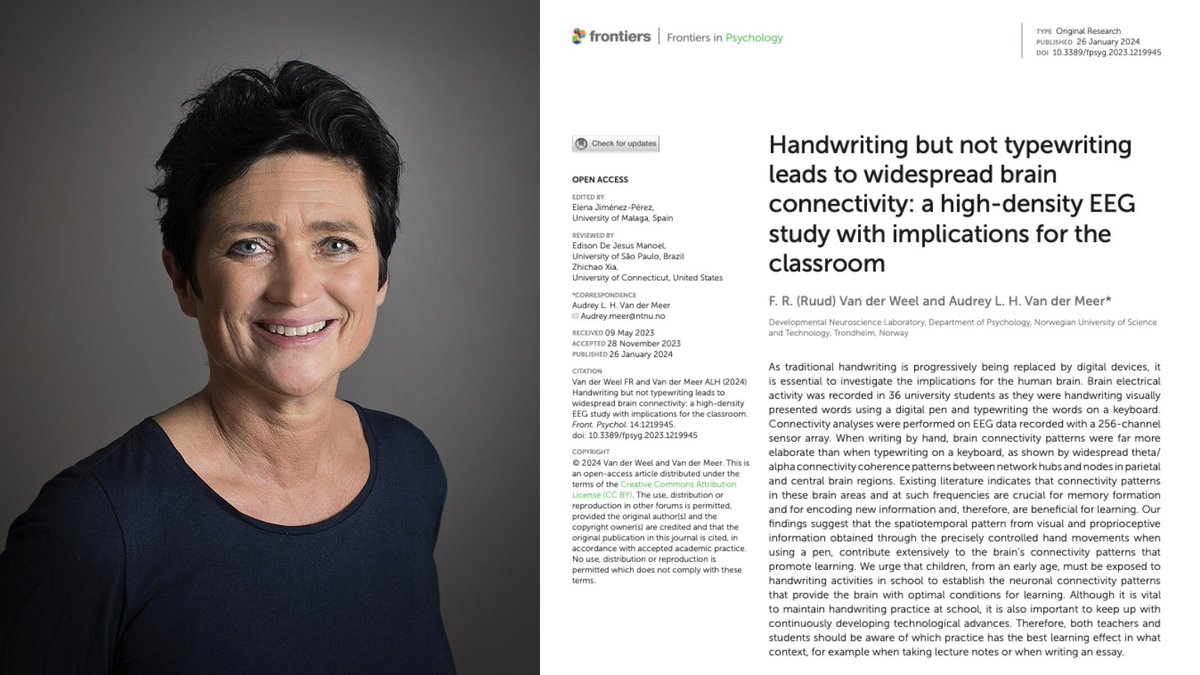
A Norwegian neuroscientist spent 20 years proving that the act of writing by hand changes the human brain in ways typing physically cannot, and almost nobody outside her field has read the paper.
Her name is Audrey van der Meer.
She runs a brain research lab in Trondheim, and the paper that closed the argument was published in 2024 in a journal called Frontiers in Psychology. The finding is brutal enough that it should have changed every classroom on Earth.
The experiment was simple. She recruited 36 university students and put each one in a cap with 256 sensors pressed against their scalp to record brain activity. Words flashed on a screen one at a time.
Sometimes the students wrote the word by hand on a touchscreen using a digital pen, and sometimes they typed the same word on a keyboard. Every neural response was recorded for the full five seconds the word stayed on screen.
Then her team looked at the part of the data most researchers had ignored for years, which is how different parts of the brain were communicating with each other during the task.
When the students wrote by hand, the brain lit up everywhere at once.
The regions responsible for memory, sensory integration, and the encoding of new information were all firing together in a coordinated pattern that spread across the entire cortex. The whole network was awake and connected.
When the same students typed the same word, that pattern collapsed almost completely.
Most of the brain went quiet, and the connections between regions that had been alive seconds earlier were nowhere to be found on the EEG.
Same word, same brain, same person, and two completely different neurological events.
The reason turned out to be something nobody had really paid attention to before her work. Writing by hand is not one motion but a sequence of thousands of tiny micro-movements coordinated with your eyes in real time, where each letter is a different shape that requires the brain to solve a slightly different spatial problem.
Your fingers, wrist, vision, and the parts of your brain that track position in space are all working together to produce one letter, then the next, then the next.
Typing throws all of that away. Every key on a keyboard requires the exact same finger motion regardless of which letter you are pressing, which means the brain has almost nothing to integrate and almost no problem to solve.
Van der Meer said it plainly in her interviews.
Pressing the same key with the same finger over and over does not stimulate the brain in any meaningful way, and she pointed out something that should scare every parent who handed their kid an iPad.
Children who learn to read and write on tablets often cannot tell letters like b and d apart, because they have never physically felt with their bodies what it takes to actually produce those letters on a page.
A decade before her, two researchers at Princeton ran the same fight using a completely different method and ended up at the same answer. Pam Mueller and Daniel Oppenheimer tested 327 students across three experiments, where half took notes on laptops with the internet disabled and half took notes by hand, before testing everyone on what they actually understood from the lectures they had watched.
The handwriting group won by a wide margin on every question that required real understanding rather than surface recall.
The reason was hiding in the transcripts of what the two groups had actually written down.
The laptop students typed almost word for word, capturing more total content but processing almost none of it as they went, while the handwriting students physically could not write fast enough to transcribe a lecture in real time, which forced them to listen carefully, decide what actually mattered, and put it in their own words on the page.
That single act of choosing what to keep was the learning itself, and the keyboard had quietly skipped the choosing and skipped the learning along with it.
Two studies. Two countries. Same answer.
Handwriting makes the brain work. Typing lets it coast.
Every note you have ever typed instead of written went into your brain through a thinner pipe. Every meeting, every book highlight, every idea you captured on your phone instead of on paper was processed at half depth.
You did not forget those things because your memory is bad. You forgot them because typing never woke the part of the brain that would have made them stick.
The fix is the thing your grandmother already knew.
Pick up a pen. Write the thing down. The slower road is the faster one.
Déclaration d’ #impôts : le SNALC vous guide https://t.co/ghv8so2NXa Chaque année, la période de déclaration de revenus soulève de nombreuses questions pour les personnels de l’ #ÉducationNationale
#DéclarationImpôts : Entre abattement forfaitaire et frais réels, nouveautés, démarches à suivre et précautions à prendre, le SNALC vous guide pour optimiser votre déclaration en toute sérénité #educnat https://t.co/ghv8so3lMI
#Collèges en progrès : la #LibertéPédagogique menacée ? https://t.co/oXnINVOjAl Après la réforme de 2016 et la démarche « Notre école faisons-là ensemble », le Ministère a dégainé son nouveau plan pour lutter contre l’échec scolaire : « les collèges en progrès »
Le SNALC exige que la liberté pédagogique des #enseignants soit pleinement respectée et que toute modification de l’organisation #pédagogique fasse l’objet d’une véritable consultation des personnels, sans injonctions venues d’en haut https://t.co/oXnINVOjAl
Il est inconcevable que les conclusions d’une consultation impliquant 133 citoyens tirés au sort donc forcément non-spécialistes de l’enseignement scolaire, puissent prévaloir sur l’expérience, l’expertise et le vécu de + de 300 000 professeurs des écoles https://t.co/g7Ia57AqbP
Comment un professeur peut-il se faire respecter ?
Par le savoir. On le lui interdit.
Des examens. Ils sont factices.
Par le salaire. On l’appauvrit.
Par les sanctions. Elles s’effacent devant la culture de l’excuse.
Par le soutien de la hiérarchie. Il n’est jamais acquis.